
Oxford University
The Oxford Word of the Year 2025 is rage bait

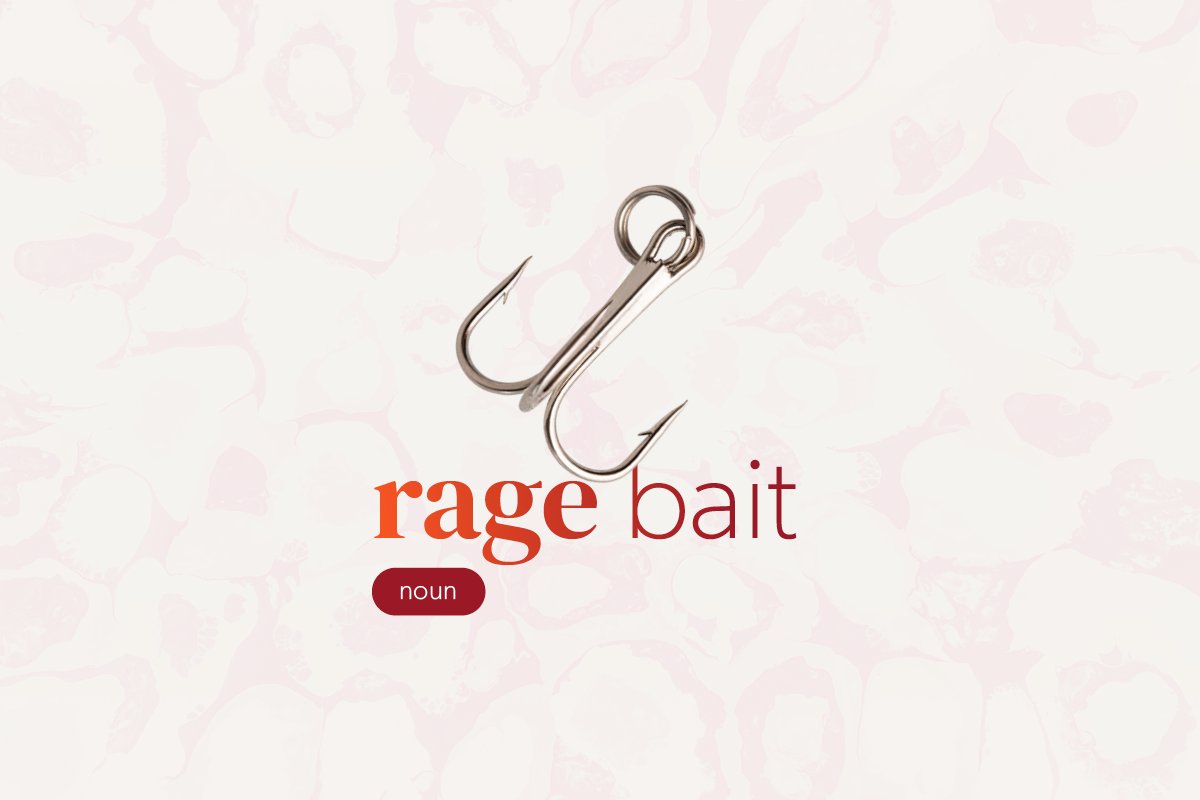
The wait is over—the official Oxford Word of the Year 2025 is rage bait.
Our language experts shortlisted three contenders—rage bait, aura farming, and biohack—that reflect our conversations and preoccupations over the past year. After three days of voting in which more than 30,000 people had their say, our experts chose rage bait after considering votes, the sentiment of public commentary, and their analysis of our lexical data.
Why rage bait?
Rage bait is defined as “online content deliberately designed to elicit anger or outrage by being frustrating, provocative, or offensive, typically posted in order to increase traffic to or engagement with a particular web page or social media content”.
With 2025’s news cycle dominated by social unrest, debates about the regulation of online content, and concerns over digital wellbeing, our experts noticed that the use of rage bait this year has evolved to signal a deeper shift in how we talk about attention—both how it is given and how it is sought after—engagement, and ethics online. The word has tripled in usage in the last 12 months.
Rage bait was first used online in a posting on Usenet in 2002 as a way to designate a particular type of driver reaction to being flashed at by another driver requesting to pass them, introducing the idea of deliberate agitation. The word then evolved into internet slang used to describe viral tweets, often to critique entire networks of content that determine what is posted online, like platforms, creators, and trends.
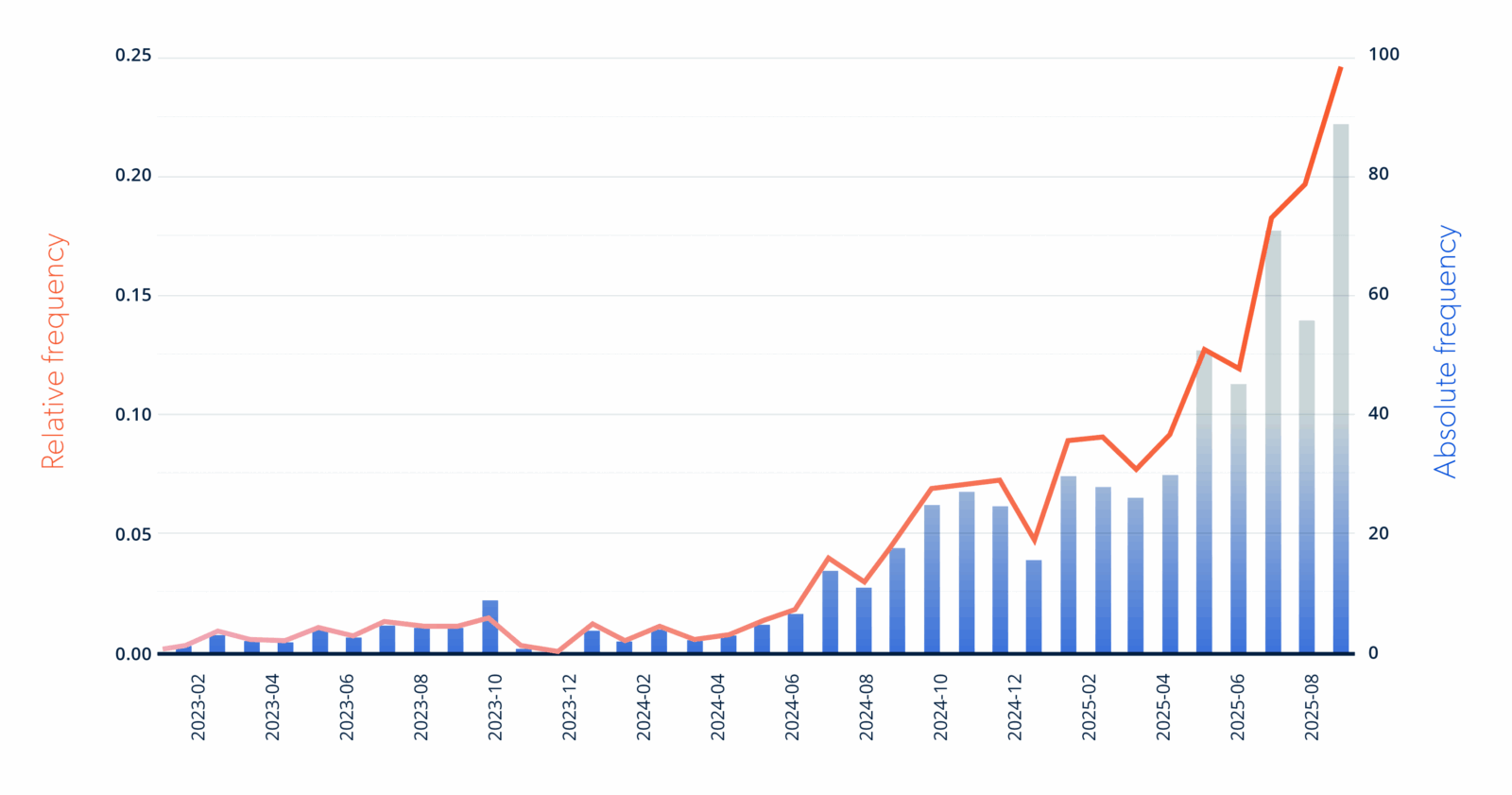
Since then, it has become shorthand for content designed to elicit anger by being frustrating, offensive, or deliberately divisive in nature, and a mainstream term referenced in newsrooms across the world and discourse amongst content creators. It’s also a proven tactic to drive engagement, commonly seen in performative politics. As social media algorithms began to reward more provocative content, this has developed into practices such as rage-farming, which is a more consistently applied attempt to manipulate reactions and to build anger and engagement over time by seeding content with rage bait, particularly in the form of deliberate misinformation of conspiracy theory-based material.
Isn’t rage bait two words?
The Oxford Word of the Year can be a singular word or expression, which our lexicographers think of as a single unit of meaning.
Rage bait is a compound of the words rage, meaning ‘a violent outburst of anger’, and bait, ‘an attractive morsel of food’. Both terms are well-established in English and date back to Middle English times. Although a close parallel to the etymologically related clickbait—which has a shared objective of encouraging online engagement and the potential to elicit annoyance—rage bait has a more specific focus on evoking anger, discord, and polarization.
The emergence of rage bait as a standalone term highlights both the flexibility of the English language, where two established words can be combined to give a more specific meaning in a particular context (in this case, online), and come together to create a term that resonates with the world we live in today.
Speaking about this year’s winner, Casper Grathwohl, President of Oxford Languages, said:
“As technology and artificial intelligence become ever more embedded into our daily lives—from deepfake celebrities and AI-generated influencers to virtual companions and dating platforms—there’s no denying that 2025 has been a year defined by questions around who we truly are; both online and offline.
“The fact that the word rage bait exists and has seen such a dramatic surge in usage means we’re increasingly aware of the manipulation tactics we can be drawn into online. Before, the internet was focused on grabbing our attention by sparking curiosity in exchange for clicks, but now we’ve seen a dramatic shift to it hijacking and influencing our emotions, and how we respond. It feels like the natural progression in an ongoing conversation about what it means to be human in a tech-driven world—and the extremes of online culture.
“Where last year’s choice, brain rot, captured the mental drain of endless scrolling, rage bait shines a light on the content purposefully engineered to spark outrage and drive clicks. And together, they form a powerful cycle where outrage sparks engagement, algorithms amplify it, and constant exposure leaves us mentally exhausted. These words don’t just define trends; they reveal how digital platforms are reshaping our thinking and behaviour.
“Year after year, it’s incredible to see the campaign spark curiosity, conversation, and—most importantly—participation. The Oxford Word of the Year invites us to pause and reflect on the forces shaping our collective language. I can’t wait to see what the next year brings.
Find out more about Oxford Word of the Year, including our 2025 shortlist and approach, here.

Professor Yuval Shany. Image credit Ian Wallman.
On January 21, 2026, Anthropic published its ‘New Constitution’ for Claude – a series of Large Language Models (LLMs) that perform general-purpose generative AI functions. The Constitution – an 84-page document – is presented as a ‘foundational document that both expresses and shapes who Claude is’. It also enumerates actions that Claude should refrain from undertaking (‘hard constraints’), and identifies considerations the system should weigh when deciding whether to perform certain actions.
A few weeks after the Constitution was published, Anthropic faced two real–world situations in which its normative outer-boundaries were tested: Its showdown with the US Department of War (DoW), regarding legal limits on the utilization of Claude; and its actual use for targeting by the US military in the war in Iran.
These developments highlight the importance of introducing strong human rights safeguards into the Constitution.
No place for human rights?
According to the Constitution, Claude should conform to four sets of values, applied in the following hierarchical order: Safety, ethics, compliance with Anthropic guidelines and helpfulness. Put differently, Claude should strive to assist users, unless instructed by Anthropic not to do so, or if it deems the request to be unethical or unsafe.
The Constitution also introduces a number of ‘hard constraints’ – specific no–go areas, which should never be attempted, including attempting ‘to kill or disempower the vast majority of humanity or the human species as a whole’ or assist ‘any individual or group with an attempt to seize unprecedented and illegitimate degrees of absolute societal, military, or economic control’.
While some ethical standards enumerated in the Constitution overlap with human rights – e.g., privacy, protection from harm, rule of law, equal treatment, the right to access information and political freedom – the document does not explicitly mention the term ‘human rights’. This is in contrast to the 2023 version of the constitution which referred to the UN Universal Declaration of Human Rights.
This means that many important human rights protections that could be relevant to the operation of Claude – for example, the right to liberty, freedom of religion and the right to intellectual property – have not been clearly integrated into the Constitution.
Anthropic vs the US Department of War
Shortly after the promulgation of the Constitution, Anthropic was mentioned in the news in two dramatic contexts – both underscoring the importance of developing effective normative backstops.
First, on 4 March 2026, the Department of War designated Anthropic a supply–chain risk due to its refusal to allow the Department to use Claude for mass domestic surveillance purposes and for operating lethal autonomous weapon systems. Instead, the DoW signed a contract with OpenAI for the provision of substitute AI systems.
As Dr. Brianna Rosen from the Blavatnik School of Government explained, the insistence of the DoW on being able to use AI systems for ‘any lawful use’ left in place a governance gap, since US law (and, in fact, also international law) does not clearly ban, under all circumstances, mass surveillance or the use of autonomous weapon systems.
Delineating the permissible scope of such extraordinary capabilities through contractual negotiations between the U.S. government and Anthropic (or OpenAI) appears to provide weaker human rights guarantees than embedding universally accepted protections directly in the AI system itself, through a Constitution or a comparable normative framework. This is especially so given the difficulties of monitoring and enforcing state compliance in sensitive domains such as national security.
Dr. Rosen is also right to point out that the negotiating position of Anthropic on mass surveillance, which focuses on domestic surveillance only, may already fall short of international human rights standards in the field, which capture foreign surveillance too.
Secondly, it has been widely reported that Claude systems, still in use by the US military, have been employed in the war in Iran for target selection purposes. It has also been speculated – albeit without hard evidence – that the use of AI systems may have contributed to one high-profile operational mistake (the targeting of an Iranian school) by reason of reliance on out-of-date maps of the attacked area.
Here again, questions arise as to whether the Constitution, as currently drafted, contains appropriate safeguards against reliance on AI systems in contexts involving lethal consequences.
Arguably, a more human rights-oriented approach would include within the system’s constitutional norms an explicit requirement that any use of the AI system in armed conflict comply with the basic principles of international humanitarian law (which give effect also to human rights principles), including flagging precautionary obligations such as real–time target verification before attacks are recommended.
In this policy space, reliance on AI systems may not only result in operational mistakes; it might also perpetuate accountability gaps (enabling humans to blame outcomes on the AI). In such cases, embedding human rights ‘by design’ within the AI system’s constitution which governs its operation could offer a much more effective level of protection against violations of basic individual rights.
Read an expanded edition of this article (co-written with Dr. Noa Mor, Prof. Renana Keydar and Prof. Omri Abend) via the Institute for Ethics in AI blog.
Oxford University
Oxford tops QS World University Rankings in four subjects, named overall top for Humanities
This makes it the UK university with the most courses ranked top in the world; the University was also ranked first in the world overall in the arts and humanities subject area, and came in the top three in four of the five broad subject areas ranked.
Oxford’s Vice-Chancellor, Professor Irene Tracey FRS, said: ‘Oxford’s strength is based on the breadth and depth of our scholarship, and these latest QS subject rankings are a powerful affirmation of that enduring commitment to support all disciplines. To see four of our subjects – Anatomy and Physiology, Anthropology, Geography, and Modern Languages – ranked first in the world is a remarkable achievement, and one that reflects the dedication of our academic community.
‘That we are the UK university with the most subjects ranked top globally speaks not only to excellence, but to the collaborative, curiosity-driven culture that underpins our fundamental and translational work.
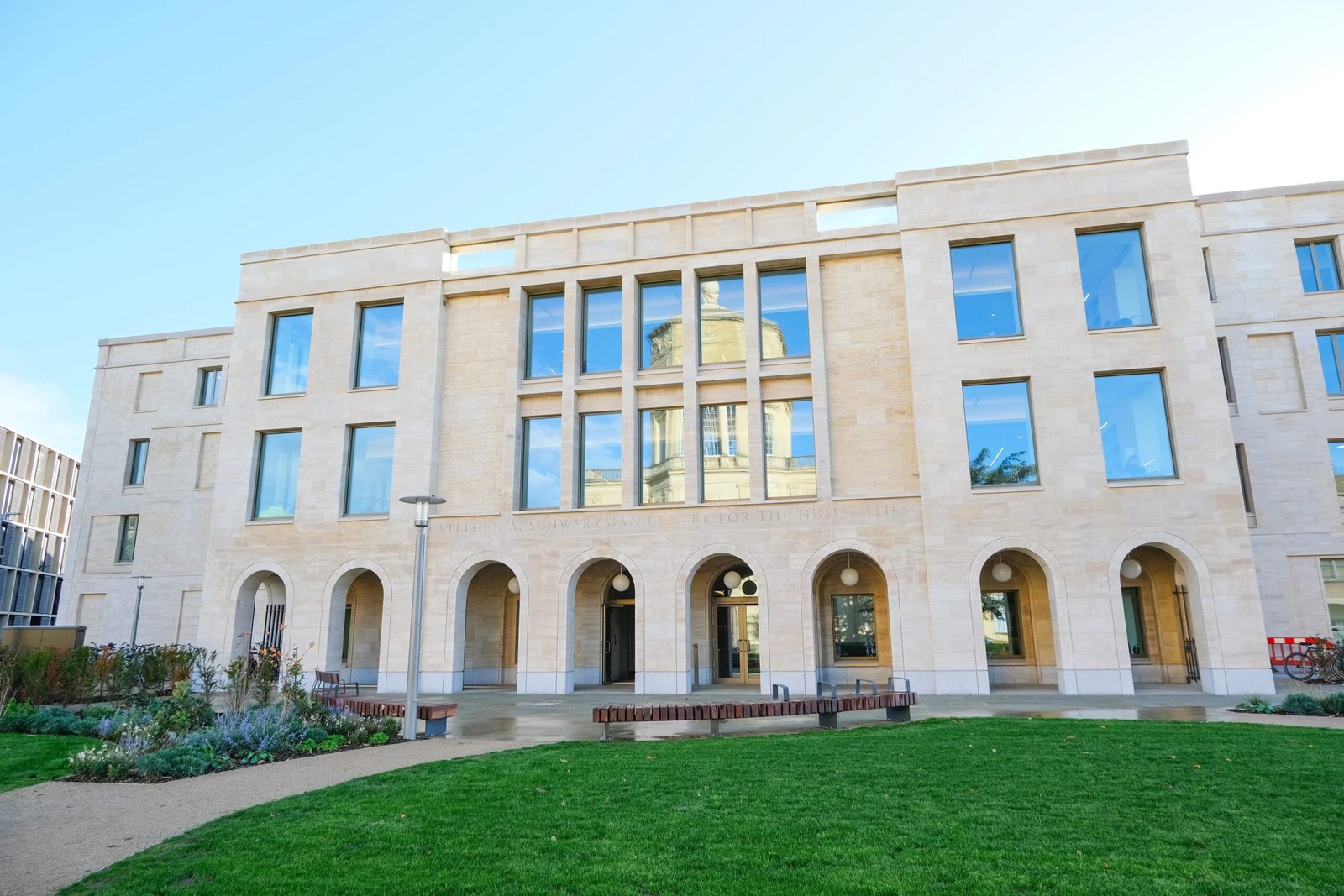
‘I am particularly delighted that Oxford has also been recognised as number one in the world for Arts and Humanities overall. At a moment when we are launching our new centre for the Humanities alongside an ambitious Arts and Cultural Programme, this is both a timely endorsement and a reminder of the vital role that the humanities play in helping us understand ourselves, our societies, and our shared future. As a university, we honour our intellectual heritage while continually renewing it – ensuring that our teaching and research serve the world with insight, creativity, and purpose.’
Professor Dan Grimley, Head of the Humanities Division at the University of Oxford, said: ‘I am delighted that the strength of the teaching and research across our humanities subjects has been recognised by the latest QS World University Rankings. The achievement of colleagues in our Faculty of Medieval and Modern Languages to demonstrate excellence against a challenging backdrop of the decline of language teaching in schools is particularly impressive.
‘Outstanding research and expertise from the humanities is critical to tackling the major challenges of the 21st century. We also hear from our graduates and their employers that the skills they learned studying the humanities give them an advantage in navigating professional careers which are being impacted by AI in new and uncertain ways.’
Oxford’s School of Geography and the Environment (SoGE) ranked number one for the 16th consecutive year out of 251 institutions featured. Professor Giles Wiggs, Head of the School of Geography and the Environment, said: ‘Topping the QS World Rankings for Geography for an incredible 16th successive year is a remarkable achievement by everybody at the School of Geography and the Environment. Yet again, the ranking reflects the talent and dedication of our community of academic, research and professional services staff and is testament to the enduring global reach and reputation of our collaborative and multi-disciplinary science and teaching. I am extremely proud to be a part of that community.’
The Department of Physiology, Anatomy and Genetics is placed number one for seven consecutive years, top of over 200 universities included in this year’s rankings. Head of Department Professor David Paterson said: ‘This is a terrific achievement for my colleagues and all members of the department who have made this possible. As I finish my 10-year term as Head of Department at the end of the academic year it is pleasing to see we have made this top spot for 9 out of the last 10 years. I am very proud to have been a part of this journey.’
The School of Anthropology returns to the number one spot for the 4th time in 5 years; this year 202 other institutions were compared. Head of the School of Anthropology and Museum Ethnography Professor Clare Harris said: ‘I am delighted that the School of Anthropology and Museum Ethnography has returned to the top spot in the QS World University rankings for Anthropology this year. This success is testimony to the excellent work of our academics, researchers, professional services staff, students and the entire school community. Congratulations to all!’
Modern Languages topped the subject ranking for the first time since 2022 this year, having been ranked second each of the last three years. 352 other universities were ranked in the subject. Head of the Faculty of Medieval and Modern Languages Professor Philip Rothwell said: ‘Modern Languages is delighted to achieve first place in this year’s QS World Rankings, and to be an integral part of the Humanities Division that also ranks first. Our placement reflects our strong research culture, global engagement as a faculty, and the outstanding educational experience and employability of our students. It is also testament to the unwavering commitment of our faculty members and staff to a broad discipline that brings together multiple ways of seeing and being in the world, and of understanding our shared humanity in its rich diversity.’
The 2026 edition of the QS World University Rankings by Subject features 55 individual subjects across five broad subject areas. This 2026 rankings provide comparative analysis on the performance of more than 1700 universities from across the globe.
Earlier this year, the University of Oxford ranked first in the world in the Times Higher Education (THE) Subject Rankings for Medicine and Computer Science. Oxford leads in Medicine for the 15th consecutive year and in Computer Science for the eighth.

Oxford Intersections is our online interdisciplinary research resource, inviting academics and global experts to investigate the world’s most urgent and challenging subjects from all angles.
As we mark one year since the programme launched, we reflect on the over 300 articles we’ve published since then, covering over 250 subject areas from authors all over the world.
Intersections are organized by topic, inviting ideas from different disciplines to clash, complement, and counterpoint, prompting new viewpoints and questions. Explore some of the original content published so far in our first four topics:
AI in Society
Philipp Hacker, General Editor of AI in Society, and Chair for Law and Ethics of the Digital Society at European University Viadrina:
“AI in Society investigates AI’s pervasive influence on our economic, legal, personal, and cultural spheres. It takes a unique format, in which contributors from various disciplines collaborate to chart both the promises and societal challenges of AI, with particular attention to generative AI models and their global impact. From my perspective as its General Editor, AI in Society aims to serve as a reliable reference point for ongoing debates on how to align technological innovation with fundamental rights and societal values.”
Read Philipp’s full article

Read some of the published research
Borders
Alexander Diener, Professor of Geography at the University of Kansas, and Joshua Hagen, Dean of the College of Letters and Science, University of Wisconsin-Stevens Point, General Editors of Borders:
“We hope readers will engage Oxford Intersections: Borders to encounter new perspectives on a topics that is elemental to human experience and foundational to the form and function of power.”

Read some of the published research
Beyond Oral Tradition: Digitalizing Indigenous Environmental Knowledge for Climate Resilience in Africa
Dorcas Stella Shumba
Reconfiguring Borders: The Role of Conspiracy Theories in Shaping Knowledge and Information Flows in Online Discourse
Massimiliano Demata
Concepts from the Margins: Reimagining Governance and Belonging Through Border Children’s Lived Experiences
Ana Isabel Sandoval
Racism by Context
Meena Dhanda, General Editor of Racism by Context and Professor of Philosophy and Cultural Politics at the University of Wolverhampton:
“Combatting racism requires an unflinchingly analytical understanding of the roots, the history, the manifestation, the mechanisms, the proliferation, and the entanglement of its many forms within institutions and practices across all spheres of human interaction. Racism by Context has undertaken this enormous challenge by bringing into conversation cutting-edge research from different global locations.”

Read some of the published research
Hair Discrimination and the Racialization of Black Young People’s Bodies: A Critical Analysis of Racism in U.K. School Settings
Siobhan O’Neill, Karis Campion, Sweta Rajan-Rankin
Soul Circuitry: Chronicles of Cyborgian Intelligence in Afrofuturism
Nettrice Gaskins
‘You are Nathan F*cking Shelley!’: Orientalism, White Saviourism, and the Radicalization of Nate in Ted Lasso
Adam Ehsan Ali, Matt Ventresca
Social Media in Society and Culture
Laeeq Khan, General Editor of Social Media in Society and Culture and Associate Professor in the School of Media Arts & Studies at Ohio University:
“Addressing today’s most pressing challenges requires a new approach to thinking. An interdisciplinary transformative approach can advance knowledge by exploiting and harmonizing the strengths of various disciplines within a unified framework. This approach deepens our collective understanding by bringing together the disparate and sometimes contradictory perspectives of many disciplines, all of which offer valuable insights.”

Read some of the published research
Sharenting on Instagram: A Study of Emotional Well-Being and Child Safety
P V Chandana, Velayutham Chandrasekharan, Tamilselvi Natarajan
Gaming on Social Media: An X- and YouTube-Driven Social Network Analysis of Minecraft Conversations
Mohd Ali Samsudin, Goh Kok Ming
Functional Aspects of Ritual in Digital Religion
Antonio Salvati
What’s coming next
In addition to continually developing our published topics, in the next year we’ll be launched intersections for Environmental Change and Human Experience, Gender Justice, Climate Adaptation, and Cultures of Waste, with many more to come in the following years.
Discover the full collection here.
The post Celebrating one year of Oxford Intersections appeared first on Oxford University Press.



-

 Crime & Safety2 weeks ago
Oxford: ‘Next generation’ LimeBikes in city from today
-

 Jobs & Careers2 weeks ago
Why Join Oxford | Oxford University Jobs
-

 Jobs & Careers2 weeks ago
Explore our Careers
-

 Student Life2 weeks ago
The independent cinema battling Oriel College to stay open
-

 Oxford Events2 weeks ago
Michelin Guide Oxfordshire Restaurants – The Oxford Magazine
-

 Oxford Events2 weeks ago
Oxford News and Events, What’s on in Oxford, Exhibitions
-

 Jobs & Careers2 weeks ago
Internal Job Board for University vacancies
-

 Crime & Safety2 weeks ago
Crash partially blocks A40 and causes severe Oxfordshire traffic