
Student Life
The independent cinema battling Oriel College to stay open


On a freezing January evening, an eager crowd piled into a small, independent cinema just off the Cowley Road, the Ultimate Picture Palace (UPP). The event, a private screening of Chloé Zhao’s Hamnet, was hosted by the cinema in collaboration with Dame Pippa Harris, the film’s Golden Globe winning producer. Packed into the UPP’s single-screen 108 seat auditorium, the invitees were an eclectic mix of notables from the University of Oxford, including the Vice Chancellor Irene Tracey, film students from the Ruskin, and passionate local cinephiles.
At first glance, the evening appeared to be the perfect blend of ‘town and gown’, with both halves of Oxford coming together as a cohesive community to share their love of cinema. But this sense of unity belies a growing tension, as relations between the UPP and the University become increasingly strained. With the looming threat of an unrenewed lease from Oriel College, the current landlord of the premises, the independent picturehouse is appealing to the community at large for support in the struggle against the ever-clarifying spectre of closure.
A cultural hub in East Oxford
The Grade-II listed building which hosted the evening screening has functioned on and off as a cinema for more than a century. Founded by a local actor in 1911, what was then known as the East Oxford Picture Palace showcased the early offerings of the emerging medium of film, until its owner was conscripted in 1917. The cinema stood unused for 50 years, before being reopened by a pair of Oxford alumni in 1976. Under the new name of the Penultimate Picture Palace (PPP), the cinema became a staple of Oxford’s small but enthusiastic film community, cherished for its late night screenings and its adventurous, often controversial, programming choices.
After the PPP’s closure in the 1990s, responsibility for the cinema passed through several hands in quick succession. It was run variously by a former employee, local film enthusiasts, and even, in the summer of 1994, a group of squatters who renamed it the Section 6 Cinema and hosted free screenings for families. Eventually it found its way to Becky Hallsmith, a local who, in 2011, bought it in what she called an “impulse purchase”, and set about renovating the premises. After Hallsmith’s passing in 2018, a group of friends and family assumed responsibility for the venue; their aim was to transform it into a community-owned cinema, and, in 2022, they succeeded.
Despite its numerous names and many managers, the UPP has remained consistent in two respects at least: its independence as a business and its role as cultural hub in East Oxford. For this reason, it’s as much the star of the show at the Hamnet screening as the Oscar-nominated film and its celebrated producer. In a post-screening discussion, Dame Harris fondly recalled how going to the PPP as a teenager with Sir Sam Mendes, the director who would later become her co-producer, fuelled their life-long obsession with film. Nor is Harris the only one who clearly cares about the cinema. Many of the audience members were among those who donated to the UPP when the COVID-19 pandemic threatened to close it in 2020, raising £87,000 in a little over a week.
A challenge of ‘long term security’
The event was motivated by this palpable love of the UPP, as well as the sense of community pride in Oxford’s born-and-raised producer and her success with Hamnet. Yet aside from this, the primary purpose of the evening’s entertainment was to raise awareness of the latest existential threat facing the storied venue.
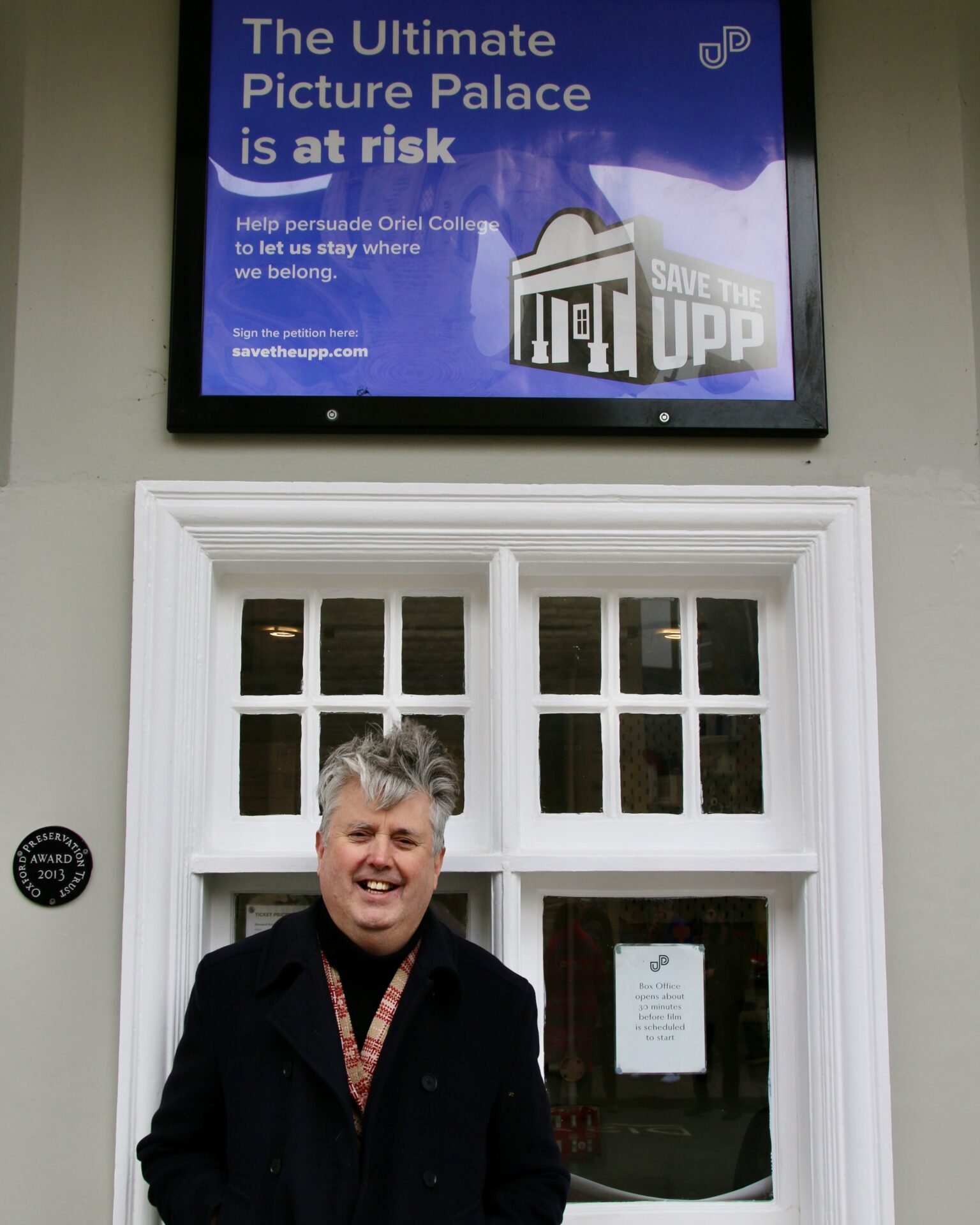
As Micaela Tuckwell, the Executive Director of the UPP, explained to the audience, Oriel College bought the freehold to the UPP building in 2021, with plans to redevelop it as part of a ‘fifth quad’ once the cinema’s lease expires in 2037. With this in mind, the College is refusing to grant the UPP’s request for an extension of their current lease.
“The challenge we now face is one of long-term security”, Tuckwell said when we sat down for an interview after the Hamnet screening. “As things stand, we have just eleven years left on our lease. That might sound like plenty of time, but in reality it makes it extremely difficult to invest responsibly, carry out essential renovation works, remain commercially viable, or plan properly for future generations.”
The most pressing issue, Tuckwell explained, is the imminent need for renovations. Unsurprisingly, given its age, the UPP is not fit for modern purposes. There is no flat access to the building, and the loos, positioned somewhat amusingly at the bottom of stairs directly below the screen, are not wheelchair accessible. The building’s energy efficiency likewise demands attention; renovations are required to keep a lid on heating costs and ensure that the cinema is financially solvent. Without these improvements, the picturehouse may have to close before the end of its lease.
Tuckwell said that the investors required to fund the renovations are already lined up, but that they are unwilling to commit unless the UPP secures a lease of at least 20 to 25 years. This predicament has, furthermore, prevented the picturehouse from procuring essential funding that enables the day to day operation of the cinema. Last year, the UPP was denied a major National Lottery grant because it did not meet the lease conditions. As a result of Oriel’s reluctance to commit to the cinema’s long term residence in the building, Tuckwell emphasised that the UPP “can’t modernise the cinema… to be competitive” with other venues in Oxford.
This critical juncture in the history of the UPP is inevitably coloured by the broader instability in the independent cinema sector. Seismic changes in the screen landscape at large, driven by the rise of streaming and accelerated by the market challenges that formed the corollaries to the COVID-19 pandemic, have posed significant difficulties for picturehouse owners across the country. A survey conducted by the Independent Cinema Office last year found that, without significant capital investment, almost a third of independent cinemas in the UK will close within the next three to five years. While it is not the only local business threatened by the increasing encroachment of the University of Oxford into the surrounding town, the loss of the UPP, one of only two independent cinemas in Oxford, would be particularly devastating for many of the city’s movie-goers. The fragility of the independent cinema industry, once a cornerstone of the global cultural milieu, renders the UPP’s current campaign even more crucial.

A cinema ‘for the entire city’
For Alastair Phillips, Chair of the Management Committee of the UPP, the closure of cinema would be a devastating blow for the arts in Oxford. “The UPP is an amazing cultural resource for the entire city”, he stated. “It covers all kinds of diverse programming.” It is certainly true that the UPP is willing to showcase films that others are not. This is clearly exemplified by their screening of The Voice of Hind Rajab, the ‘docufiction’ about the murder of a five year-old Palestinian girl by the Israel Defense Forces. While the film has struggled to find distribution elsewhere, despite having been showered in awards, the UPP ran it for more than two months between 2025 and 2026.
Tuckwell and Phillips see the UPP as an asset which can benefit both the local population and the University community. They emphasise that they are willing to work constructively with Oriel College and are keen to avoid playing into the ‘town versus gown’ narrative. “I feel that we all belong together in this city, and we can cooperate together”, Phillips said. “We’re here as a learning resource for the College and for the University, and there’s different ways we can kind of develop that relationship as we go forward.”
“What we’d really like to do is to be able to have a creative partnership”, Tuckwell explained. “It could be them using this as a lecture space in the day and us continuing to be able to have a public theatre cinema at night. We’ve put that on the table to them, but unfortunately, the latest thing they said to us was ‘no, we definitely can’t give you a longer lease’.
“There’s lots of examples around the country of higher education institutions working with independent cinemas or independent theatres. We were asking the College to support that vision.”
Phillips points to the example set by the University of Warwick, where he is a Professor of Film and Television Studies. He says the film department there regularly works with the local Arts Centre, which has a three-screen cinema. “We do all kinds of collaborative activities with the Warwick Art Centre cinema. We work on student events, we work on programming… we’re always involved in speaking opportunities.
“We’re very interested in developing a really close relationship with Oriel that can benefit both the cinema, but also Oriel students. Students want to be film makers, they want to interact with screen culture, maybe while they’re at university, but maybe some of them will go on into the industry. We want to give them a leg up.”
Oriel College told Cherwell: “We are proud of our heritage cinema, the Ultimate Picture Palace, and are in dialogue with the new managers about how to ensure it remains open to the wider public. We have no plans to extend the lease at this early stage in the tenancy.”
The campaign to ‘save the UPP’
In spite of all this reconciliatory rhetoric, it’s clear that the UPP are willing to take decisive action to fight for the future of the venue. On Thursday 12th March, the cinema initiated its campaign to “save the UPP”, launching a petition which already has 12,000 signatures. This was followed with a call for regulars to gather outside the cinema, with the aim of recreating a historic photograph taken of its patrons in front of the building.
The local community responded in droves, with well over two hundred people turning up – so many that they did not all fit inside the small premises. Standing amongst this crowd, the depth of feeling for this small business is unmistakable. When Tuckwell addressed the patrons and mentioned Oriel College, they loudly booed and hissed, which she rather diplomatically tried to discourage.
Regulars were forthcoming with fond memories of the UPP and their previous interactions with it. “You know what student life is like, you leave all your work to the middle of the night”, one former Oxford University student in his sixties said. “They used to screen films at midnight and the last thing you really wanted to do is to work continuously all the way through. A two hour break to go out and watch some crazy film in the middle of the night at the PPP just got you through, it really did.”
His fear for the future is palpable. “We’re facing a sycamore gap moment here”, he said, referencing the devastation felt when the iconic tree at Hadrian’s wall was felled illegally. “This beautiful thing could be taken from us, and we have one chance to talk the people who are planning to do that out of taking that from us.”
Another Oxford alumnus explained the key role the picturehouse has played in his life: “The PPP is where I took my girlfriend for our first date. She’s now my wife, the mother of my children. For me, like generations of other students, I would imagine, the PPP is not just a vital part of Oxford’s cultural life specifically, but of life in all its senses.”
One of the patrons who showed up to lend her support was Anneliese Dodds, the Labour MP for Oxford East. Speaking with us, she made a direct plea to Oxford students to support the UPP’s campaign: “Come to the cinema, enjoy it. It’s yours as well… But once you’ve come and enjoyed it, please do raise your voice. Make clear that this cinema really needs to stay right in the heart of the community”.

Nor is support for the campaign limited to local residents. It is evident that many current Oxford students, who might be supposed to be the beneficiaries of such ‘studentification’ efforts as Oriel has planned, are also concerned about the future of the picturehouse. One Oxford student described the UPP as “a bastion of what cinemas could be”, stressing that “it would be a resounding loss were it to be yet another institution gobbled up by the University.”
Despite its grounding in the local community, and relatively peripheral location to the nucleus of student life in Oxford, the UPP nevertheless continues to make a compelling contribution to the cultural lives of those at the University. One Oxford student said: “It’s my favourite cinema in Oxford, and I’ve thoroughly enjoyed every time I’ve been; the proximity to many a Cowley pub for a post-film debrief with friends is a recipe for the perfect evening. I’d be gutted to see it go, and I hope the community voice speaking up for it is enough to challenge Oriel’s over-extended reach.”
Another student emphasised the “sense of being in a communal experience that UPP gives you that just doesn’t carry over in a shopping-centre multiplex.” Without the UPP, cinema-goers in central Oxford would be furnished only by Oxford Cinema & Café on Magdalen Street, Phoenix Picturehouse in Jericho, and Curzon in Westgate, which would make the city “immeasurably poorer”.
An emblematic struggle
Above all, the campaign to “save the UPP” concretises the idea that preserving culture, in all its forms, starts at home. The art deco venue, and its variegated programme of mainstream, independent, and classic films, ensures the unique appeal of the UPP, and its endurance at the core of Oxford’s artistic milieu. The enthusiasm of cinema-goers, past and present, is a potent testament to the vibrant contribution of such independent picturehouses to the cultural lives of local communities. The UPP embodies the perilous status of these cultural cornerstones up and down the country: beloved by their communities, they are nevertheless living with the constant threat of closure. In Oxford, the issue is further aggravated by the constant development projects of colleges, forcing independent businesses into conflict with the University itself. Yet, seeing how passionate the Oxford community is about this cinema, one can’t help but feel, and hope, that the Ultimate Picture Palace will live on for another century.
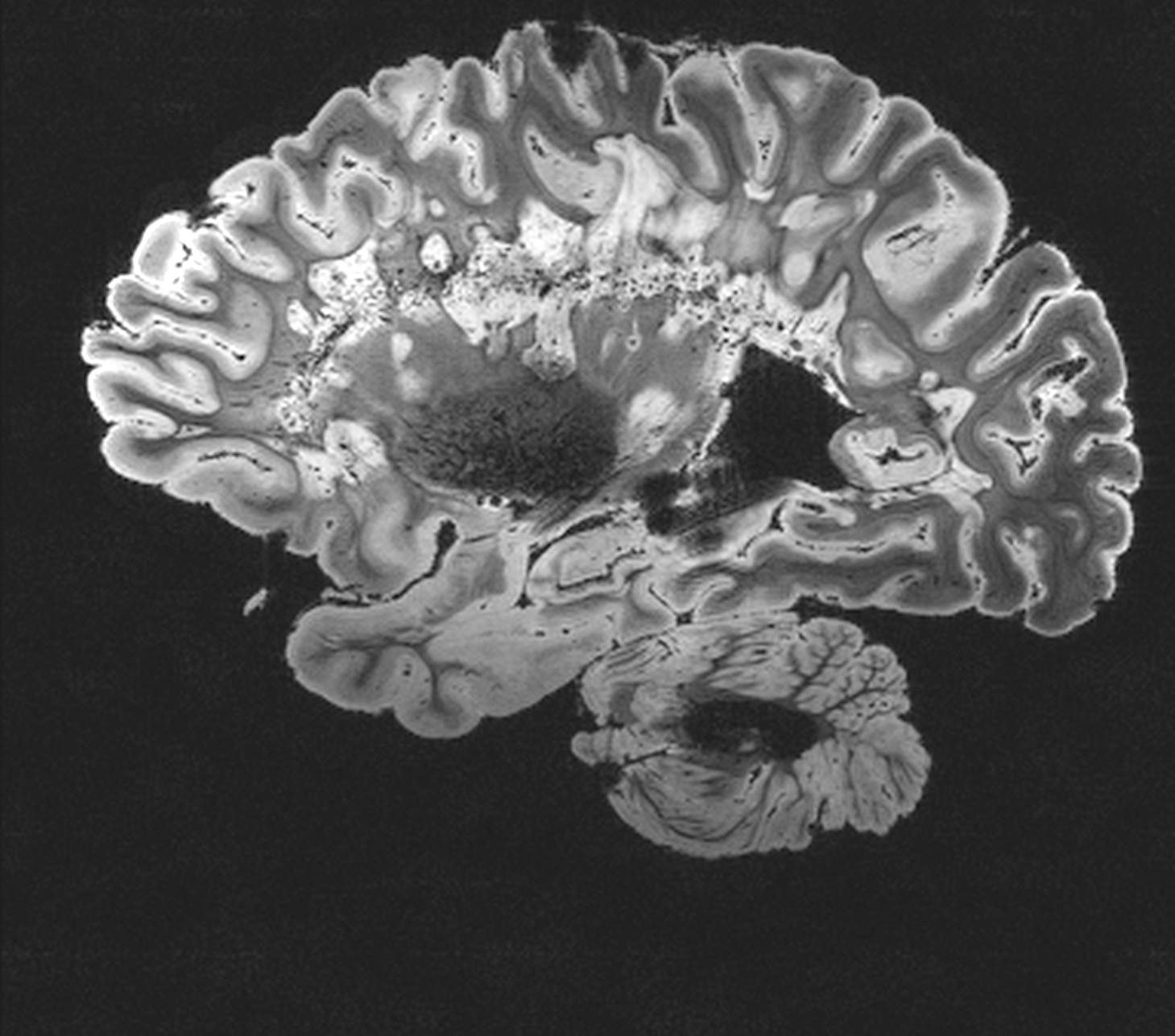
A new predictive tool has been developed by a team of researchers to help clinicians identify which stroke patients are most likely to experience long-term cognitive difficulties. The ‘Cognition Calculator’, introduced in a study published in The Lancet: Healthy Longevity, uses information routinely recorded during hospital care to estimate the likelihood of problems with thinking, memory and communication six months after a stroke.
The study, conducted by researchers at the University of Oxford and the University of Birmingham, developed and tested a statistical model using clinical data collected from stroke patients during the early stages of hospital care. The model draws on data, including results from cognitive screening tests alongside information such as age and stroke severity. Researchers found that early cognitive performance was one of the strongest indicators of longer-term outcomes.
Cognitive impairment is common following a stroke, but can be difficult to anticipate. Whilst post-stroke care has traditionally focused on physical recovery and preventing future strokes, researchers say thinking and communication difficulties are a major factor in patients’ long-term quality of life.
Professor Nele Demeyere, who led the research team, told Cherwell: “Many colleagues recognise the challenge of discussing cognitive outcomes with patients when there is so much uncertainty, so there is interest in tools that could help structure those conversations more clearly.”
Demeyere emphasised to Cherwell that the calculator is not yet intended to be used as a finished clinical product. Instead, she described the research as providing “rigorous groundwork” for future research to refine and test the model in wider clinical settings.
The research comes as the NHS is increasingly using digital tools and artificial intelligence to improve stroke care, including software now deployed across stroke centres in England to help clinicians analyse brain scans and make faster treatment decisions. Updated national stroke guidelines have also placed greater emphasis on early cognitive screening and long-term rehabilitation.
Dr Andrea Kusec, another Oxford researcher involved in the project, told Cherwell: “The response has been very positive, with many recognising the value of developing tools that can support conversations about what ‘life after stroke’ will be like.”
She added: “Clinicians often are key in providing messages of hope and allay some of this uncertainty – this tool can become a way to support those tough conversations.”
The study also highlights the wide range of cognitive recovery after stroke. According to Kusec, one of the most surprising findings was how differently prediction models performed depending on the type of cognitive impairment involved, such as language, memory, or executive function. “This really speaks to the individual nature of post-stroke cognitive outcomes”, she said.
Researchers hope the model will now be tested in larger patient groups and across different healthcare settings. If validated further, it could help clinicians identify patients who may benefit from closer monitoring, targeted rehabilitation, or additional support.
Demeyere told Cherwell that the broader aim is to ensure cognitive health is recognised as a central part of stroke recovery. “Post-stroke care has historically focused, understandably, on survival and preventing recurrent strokes. Increasingly, we recognise that cognitive and communication difficulties are central to long-term quality of life… This study represents one step in that direction. It reflects a broader shift towards viewing cognitive health as a core component of stroke care.”

Councillor Chewe Munkonge has been announced as Oxford’s next Lord Mayor, becoming the first Black person to hold the city’s highest civic office. The nomination was confirmed at a meeting of Oxford City Council on 23rd March by council leader Sudan Brown. Mukonge is expected to take up the largely ceremonial role for the 2026/2027 civic year, subject to his re-election in May.
Munkonge, who represents Quarry and Risinghurst ward, was first elected to the council in 2014 and currently serves as Cabinet Member for a Healthy, Fairer Oxford, as well as the council’s Small Business Champion. He also serves as the Central Administration Officer of the Oxford Trust, where he supports “all the operations of The Oxford Trust and Science Oxford’s events and education activities”. Outside politics, Munkonge works as a Central Admin Officer for a local charity and previously served as a governor at The Swan School between 2019 and 2025.
The Lord Mayor of Oxford typically undertakes over 300 engagements annually, including leading the city’s Remembrance Sunday service and attending royal visits, and supporting organisations. During his term, Munkonge has chosen Sobell House and St Theresa as his official charities. Sobell House Hospice is a local charity that provides specialist support for people with life-limiting illnesses and their families.
The Lord Mayor role is a politically neutral position appointed annually by Oxford City Council, typically at its Annual Meeting in May. By convention, it is offered to the longest-serving councillor who has not previously held the office.
Alongside Munkonge’s appointment, Councillor Louise Upton, the outgoing Lord Mayor, has been named Deputy Lord Mayor, while Councillor Linda Smith will serve as Sheriff of Oxford.
In a press release statement, Munkonge said: “I am deeply humbled and truly honoured to be chosen as the next Lord Mayor of Oxford… As the first Black Lord Mayor of our city, I stand on the shoulders of those who paved the way, and I hope to be a source of inspiration for future generations.”

Sperm tagged with green fluorescent protein in the sperm storage organ of a female Drosophila fruit fly. Credit: Krish Sanghvi.
The findings are based on a major, cross-species analysis which revealed a shared pattern across many animals, from insects to mammals. Sperm that is stored (whether in males or females) deteriorates rapidly – resulting in reduced sperm performance, fertilisation success, and embryo quality. Crucially, the new study also offers insights into why this happens.
The researchers carried out a meta-analysis of 115 human studies (involving 54,889 men) and 56 studies across 30 non-human species. This confirmed that mature sperm in storage generally deteriorates in quality independently of the age of the male – a process called post-meiotic sperm senescence.
In humans, longer periods of sexual abstinence were associated with increased sperm DNA damage and oxidative stress, along with reduced sperm motility and viability.
Co-lead author Dr Rebecca Dean (Department of Biology, University of Oxford) said: ‘Because sperm are highly mobile and have minimal cytoplasm, they quickly exhaust their stored energy reserves and have limited capacity for repair. This makes storage particularly damaging compared to other types of cells. Our study highlights how regular ejaculation can provide a small but meaningful boost to male fertility.’
Differences between males and females
Sperm quickly exhaust their stored energy reserves and have limited capacity for repair. Our study highlights how regular ejaculation can provide a small but meaningful boost to male fertility.
Co-lead author Dr Rebecca Dean (Department of Biology)
Both male and female animals can store sperm as a reproductive strategy (in humans, sperm can last for several days in females but the effects of such storage are unknown). In males this ensures enough sperm are present for mating, and in females this can enable reproduction even when males are scarce. However, the study found a striking difference in the rate of sperm deterioration in males versus females. In the species studied, females are generally better than males at preserving sperm quality long-term.
‘This likely reflects the evolution of female-specific adaptations, such as specialised storage organs that provide antioxidants to extend sperm viability’, explained senior author Dr Irem Sepil (Department of Biology, University of Oxford). ‘These organs often secrete reproductive fluids to nourish sperm and could provide unexplored avenues for biomimicking technology to improve artificial sperm storage in the future.’
Lead author Dr Krish Sanghvi (Department of Biology, University of Oxford) added: ‘Ejaculates should be viewed as populations of individual sperm which undergo birth, death, ageing and selective mortality. The rates of these demographic processes can differ in males and females, mediating the “demographic” structure of sperm populations and sex-specific differences in sperm storage effects.’
Implications for human fertility
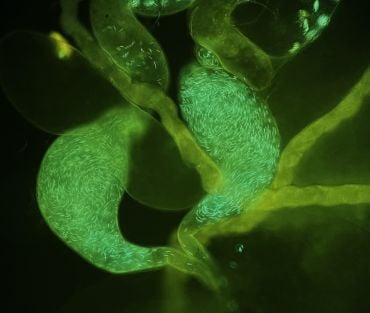 Sperm in the testes and sperm storage organs of a male Drosophila fruit fly. Credit: Krish Sanghvi.
That sperm can age in both sexes independently of the organism’s age has been largely ignored in reproductive medicine. The findings therefore have immediate implications for clinical practice. For instance, the results suggest that the upper limit of seven days in the WHO guidelines may be too long. This aligns with recent evidence suggesting that ejaculating within 48 hours of providing a sample can significantly improve IVF outcomes.
By breaking down the barriers between biomedical and zoological research, this study provides a new lens for understanding reproduction. Besides influencing protocols in fertility clinics and assisted reproduction, the findings could also benefit captive breeding programmes for endangered species – as well as deepening our understanding of how species evolved mechanisms to reduce sperm damage during storage.
The study ‘Sperm storage causes sperm senescence in human and non-human animals’ has been published in Proceedings of the Royal Society B.
For more information about this story or republishing this content, please contact [email protected]



-

 Crime & Safety2 weeks ago
Oxford: ‘Next generation’ LimeBikes in city from today
-
 Jobs & Careers2 weeks ago
Why Join Oxford | Oxford University Jobs
-
 Jobs & Careers2 weeks ago
Explore our Careers
-

 Oxford Events2 weeks ago
Oxford News and Events, What’s on in Oxford, Exhibitions
-

 Crime & Safety2 weeks ago
Crash partially blocks A40 and causes severe Oxfordshire traffic
-

 Oxford Events2 weeks ago
Michelin Guide Oxfordshire Restaurants – The Oxford Magazine
-

 Jobs & Careers2 weeks ago
Internal Job Board for University vacancies
-

 Oxford News2 weeks ago
British children are growing taller but not for the right reasons