
Oxford University
New research from Oxford University Press shows how children take life lessons from books


The findings of a new report from Oxford University Press, More than words: the real-life impact of reading, reveal how the majority of children believe that reading shapes how they treat others and helps them to navigate real-life situations.
The new research shows that three in five children (59%) believe what they have read in a book has helped them in a certain situation—such as being bullied, losing a family member, overcoming social anxiety, or starting a new school—highlighting that the benefits of reading go further than just understanding and comprehension. Other findings include:
- Seven in ten children (70%) said that reading helps them understand why people act the way they do
- More than two-thirds (68%) said it helps them think about how they treat other people
- While more than half (57%) of 12-14-year-olds continue to see the value of reading, both enjoyment and frequency of reading declines; 27% of 12-14-year-olds question its value in day-to-day life, with 17% undecided.
The report is based on a survey of 3,000 children aged 7-14 years old and 200 teachers across the UK, and with insights from the Oxford Children’s Corpus—the largest living database of children’s reading and writing in English in the world, containing over 500 million words.
Reading has an impact in real-life situations
82% of children agreed that stories remind them of things that happen in real life, showing the strong connection children make between what they read and their own experiences.
Our research also highlights the important role reading plays in helping children to understand and talk about their emotions. More than four in five children (84%) said reading helps them learn new words for feelings.
Teachers are seeing these benefits first-hand. Almost all teachers surveyed (95%) agreed that reading helps children develop their vocabulary, while three in five said they had witnessed a pupil gain a better understanding of an emotion through reading. More than nine in ten teachers (91%) identified empathy and perspective-taking as key benefits of reading.
Emotional themes are not confined to particular genres
Our research suggests that children do not necessarily seek out books about emotions directly but instead gravitate towards more entertaining books which can present real-life issues and emotions in accessible ways through humour or action.
When asked what genres they prefer to read, children said they were most drawn to funny stories (49%), adventure stories (40%), and fantasy stories (30%). However, many of the books cited alongside these genres—for example, Diary of a Wimpy Kid, Lottie Brooks, and Harry Potter—explored serious topics like conflict with friends, bullying, or bereavement.
A challenge with older readers
While children of all ages can gain emotional insights from a wide range of books and genres, the findings suggest that, as they get older, many need help maintaining their connection with reading.
Nearly three-quarters (72%) of children aged 7-10 said they liked reading, however, this fell to 59% among 11-14-year-olds. Reading frequency also dropped, with 79% of 7-10yr olds who said they read at least once a week, compared with just 61% of those aged 11-14.
One possible reason for this decline is that some older children do not see books as relevant to their daily lives. While 57% of 12-14-year-olds recognize the value of reading, one in four (27% of 12-year-olds; 25% of 13-year-olds; and 29% of 14-year-olds) disagreed that books had helped them navigate situations they have faced. A further 17% are neutral on the topic.
This presents an opportunity to provide more support to help older readers discover books that reflect their experiences and interests so that they feel reading is more meaningful and engaging.
Elizabeth Munn, Managing Director of OUP’s Education division, said: “This research shows how deeply children are engaging with the books they read and using them to make sense of the world around them. It’s incredible to see how children are actively applying what they read on a page to real life—whether that’s understanding the perspective of somebody else, navigating a situation in their own life, or reflecting on their own behaviour towards others.
“Children are growing up in an increasingly complex world. Our research reaffirms that reading remains one of the most powerful ways to help them develop empathy, confidence, and emotional understanding—skills that are just as important as academic success in equipping them for the future.”
The report also includes contributions from leading literacy and education organizations, including Book Aid International, EmpathyLab, and the National Literacy Trust.
Read the full report here.

OUP Education and English Language Teaching teams were proud to participate in, and host, the attendees of the AIEOU (AI in Education at Oxford University) Summer School, in July.
The conference marked one year since the founding of this growing global community of researchers, academics, educators, industry leaders, and policymakers – united by the goal of tackling some of the biggest questions facing education today.
Dr Sara Ratner, of the University of Oxford’s Department of Education, designed a week-long programme in collaboration with colleagues at the University’s Social Sciences Division as well as a team at the UK’s Department for Education, bringing together diverse perspectives from over a hundred representatives of academia, schools, government, industry, and civil society.
Over the week, attendees discussed not only the advances in AI technology, but also what meaningful impact looks like in education.
Discussions throughout the week brought together diverse perspectives, asking difficult questions about what AI should do in education and demanding evidence of its impact on learner outcomes.
Sarah Ultsch, Director of Global Product at OUP, shared her impressions of the event: “The debates and workshops of this summer school have been tremendously important, because the decisions we make now will shape the experience of learners for years to come.”
She also highlighted her team’s recent launch of L2-Bench, the world’s first benchmark for evaluating AI in second language learning, culminating in the release of an open-source dataset for the benefit of the wider education and technology community.
During the week, summer school attendees were welcomed to OUP’s Oxford offices for an informal gathering and tour of the OUP Museum, which showcases key milestones and stories from our 500-year history. Liz Tyler, Managing Director of UK Education, welcomed participants and applauded the aims of the event that align with OUP Education’s commitments:

Liz Tyler
Managing Director, UK Education
“At OUP, we develop services to support teachers and schools that are based on evidence and research, and we are deeply committed to working with the sector and with experts to establish an evidence base that will help us understand how AI might improve teaching and learning.”
She also pointed towards recent research conducted by teams at OUP into student attitudes to the use of AI: the Teaching the AI Native Generation and Navigating AI in Education reports. These have shown how much students as well as their teachers need more data and evidence to guide the use of AI in developing cognitive skills and improving learning.
As the AIEOU community enters its second year, the conversations and partnerships sparked during the summer school will continue to shape the understanding of AI’s role in education. Through ongoing research and collaboration with the University of Oxford, OUP remains committed to helping the sector navigate the opportunities and challenges of AI and focus on improved learner outcomes.
Oxford University
Celebrating highlights in literacy, digital learning and assessment, and research publishing

Our Annual Report for 2025/26 is now available
The report shares a number of publishing highlights in research and education, as well as our continued commitment to our global communities and to operating sustainably.

Professor Irene Tracey
“I am so incredibly proud of what OUP contributes to Oxford and the world. The dedication of the leadership and staff, board members, and academic delegates is evident in their service to the Press.
“As we collectively balance the human need to create, tell, and share stories as the world around us changes at pace, I am confident that my colleagues at OUP will continue to uphold our long-held traditions while shaping the new.”

Nigel Portwood
“This has been a year of investment, innovation, and growth for OUP. Against a changing backdrop in some of our markets, we remained focused on fulfilling our mission by expanding our publishing portfolio, embracing new technologies, and developing tools and services to support learning and research across the world.”

Highlights from 2025/26
We acquired
Karger Publishers, a highly regarded medicine and health sciences publisher based in Switzerland.

1.3 million people
visited the Oxford English Hub, the home of our digital content for teaching and learning English.

We launched
Green Sparks, a strand of the Oxford Reading Tree which comprises 42 books that provide age-appropriate environmental education linked to the UN Sustainable Development Goals.

We met
our target of 100% certified sustainable paper for our print publications.

We donated
more than 154,000 books to readers worldwide.

The post Celebrating highlights in literacy, digital learning and assessment, and research publishing appeared first on Oxford University Press.
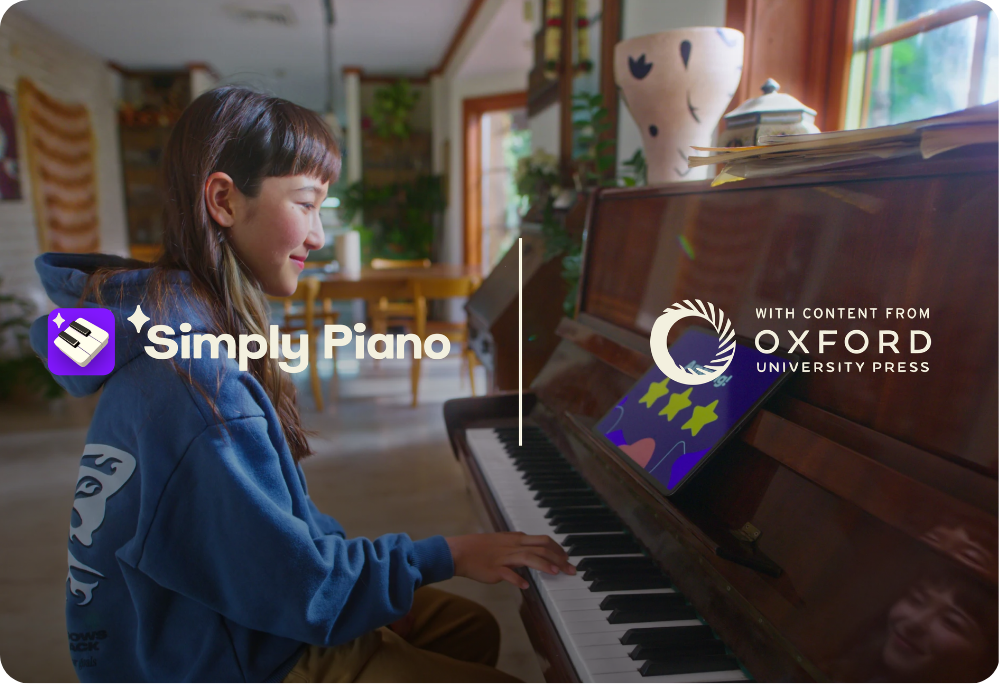
We’ve signed an agreement with Simply, the leading digital platform for creative hobbies, bringing select content from our acclaimed piano method to millions of Simply Piano learners worldwide.
What OUP content is available in Simply Piano?
Simply Piano users now have access to an expanded library of high-quality, curated sheet music spanning our works including Piano Time and Tunes for Ten Fingers, all within the app’s interactive learning environment.
Piano Time is one of our well-established beginner piano methods, widely appreciated for its natural progression and musical, engaging pieces. It helps students build reading, rhythm, coordination, and technique in a way that feels enjoyable rather than mechanical—which is why it has remained a trusted teaching resource for years.
Tunes for Ten Fingers is an introductory book for absolute beginners, encouraging security at every step and making learning fun.
These titles form part of our wider music publishing programme. We have long been a leader in classical music publishing, with a catalogue spanning centuries of repertoire and serving musicians from beginners to professionals. Through this collaboration, our music will now reach millions of Simply Piano hobbyists and lifelong learners worldwide.
OUP bringing sheet music content to Simply
Robin Barry, Director of Music at OUP, shared: “We are delighted to bring content from OUP’s piano method—trusted by teachers for generations—to the Simply Piano community, a platform that shares our commitment to quality and progression for aspiring musicians around the world.”
“Access to songs people love is one of the strongest drivers of learning,” said Yuval Kaminka, CEO and co-founder of Simply. “Working with OUP allows us to bring our learners and casual players sheet music of the highest editorial standard. It’s an important step in building a platform that supports learners at every stage and a proud moment for Simply.”
“What stands out in OUP’s early piano materials is the pedagogical clarity of the arrangements and pieces,” added Danny Fine, Simply Piano’s Music Pedagogy Lead. “They introduce new skills in a very structured and approachable way, which makes them especially effective for helping learners build confidence and gradually master core musical skills.”
As interest in creative hobbies grows globally, the addition of OUP’s portfolio strengthens Simply Piano’s library, giving users access to music they can both learn and enjoy.
Find out more about OUP’s sheet music here.


Mark Harris amongst Oxford United goals in League One revival

Jamie Cumming injury update issued after Oxford United thrash Foxes

Air traffic control issue causes flight delays and disruption across UK | Airline industry
-

 Oxford News4 weeks ago
Train cancellation alert amid ‘fault’ near London Paddington
-

 Oxford News4 weeks ago
Museum evacuated and Oxford University closed amid incident
-

 Business & Technology4 weeks ago
Currys rolls out NiCE software to unify customer service
-

 Business & Technology3 weeks ago
Apprentices say AI is reshaping tech skills demand
-

 Oxford Events4 weeks ago
Wilderness Festival 2026: four days of music, food, art and wild escapism
-

 Business & Technology4 weeks ago
Love Island unknowns outshine influencers in growth
-

 Oxford News2 weeks ago
Richard Hammond takes control of classic car company
-

 Oxford News4 weeks ago
Oxford’s iconic shark in roof celebrates 40th anniversary