
Student Life
What are you looking at? A reflection on the Ashmolean’s Aphrodite exhibition

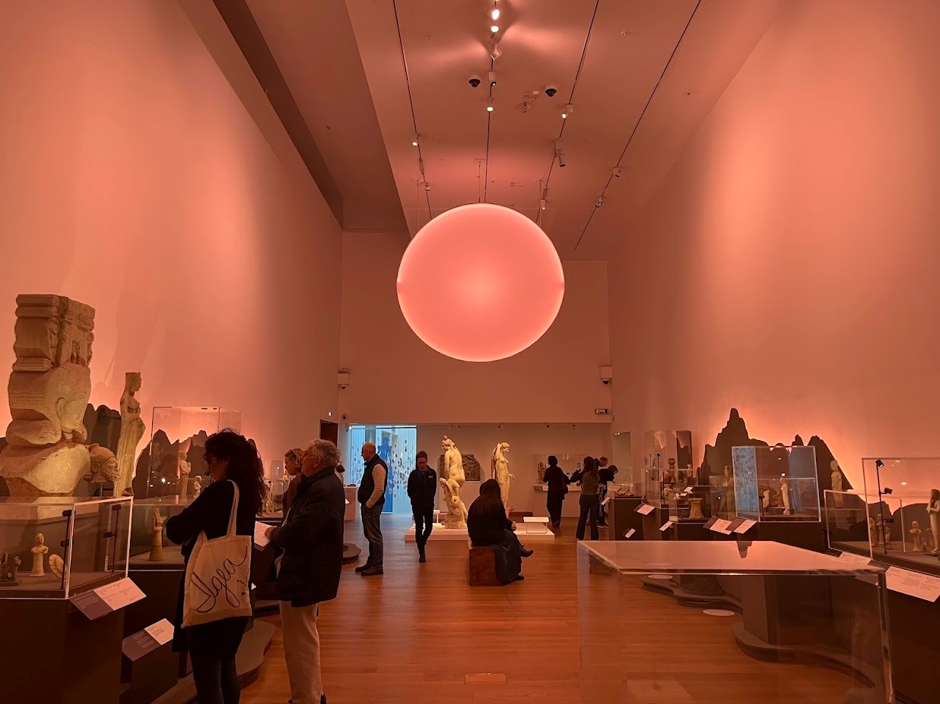
The woman crouches, nude. A gauzy blue curtain hangs where she hides her chest; behind it I can just see the other artefacts. She isn’t looking at me. Over one white shoulder, she stares into the distance. This is Aphrodite, or perhaps the later Venus – not Mesopotamian Inanna, or Assyrian Ishtar. I know she couldn’t be the Cypriot Aphrodite either.
The plaque calls her Crouching Aphrodite; she’s the first of many images in this room that depict the goddess bathing. Some Romans sculpted her in the second century, but she is really only a copy; there was a Greek original. In many ways, the image of her is a succinct summary of the Ashmolean’s exhibition. The voyeuristic pose, the elaborate up-do, her naked back; these are the marks of beauty and desire. She implies sex, perhaps looks towards love. When I sit down later to write about her, however, I realise I didn’t truly notice much at all about her date, her body or her history. All I know is that she looked right past me.
The first room of the exhibition, Aphrodite: The Making of a Goddess at the Ashmolean, is painted a dark blue. Statues and friezes glow, though they were originally brightly-coloured, and the vases shine above their small lights. We have begun in media res, if you like to think of the goddess’ journey through time as one long story – which I, and presumably the curators, would. The next room takes us from the second century to around 3000 BC. We are now with Ishtar, Inanna, the goddess of love, as she began in the Middle East and, later, as she was in Cyprus; the goddess when she wasn’t a goddess of love at all.
It makes sense to begin there, though, with the classical: we know her image the best. When I walk into the second room, I see that familiarity cast against the strange. Small fertility statues line the left wall. Etched into their features are some of the same rough lines I made in clay at school, using wooden pottery tools. A huge pink circle illuminates the space from the opposite end; everything is bright and quite literally rose-tinted. The sense of time is enormous, only matched by the weight of the goddess’ gaze; here, she looks right at me.
Where the classical goddess looked away, her Middle Eastern ancestor was almost always facing straight ahead. Of course, there are logical explanations. Classical sculptors had very consistent ideas about which poses best displayed the body, and thus statues rarely looked straight ahead. Similarly, the function of these older statues fits a straight, forward-facing structure far better. Many were made for small shrines, for personal luck.
But I do not believe that the sole purpose of an exhibition like this should be education. There is something valuable in how we respond to it, which parts stand out and why. I know it is probably a coincidence that the more powerful the goddess is in her culture, the more ancient and remote from my own imagination, the more direct her eyes are. It still feels a little like we have lost something there, and I cannot quite put my finger on it.
The final room reinforces my vague sense of loss. A replica of the Venus de Medici stands there, nude and shy as Crouching Aphrodite. On the opposite wall hang drawings that detail her precise measurements. They believed, in the Renaissance, that the Venus de Medici portrayed the perfect feminine form. The drawings thus measure out every limb, every joint. Little numbers and dotted lines scatter her body; drawn from the front, drawn from the side. I know that these were made, at least ostensibly, for artistic education. And yet, I can only imagine that these men were getting ready to cut the goddess open and sell her body for parts, like a pig or a side of beef. And, if she can be cut open like this, as though Venus de Medici lay on the table of the butcher’s shop and not on a pedestal in The Uffizi, then Aphrodite must no longer be a goddess. Now, she is only another woman.
Hanging next door is A Girl Drawing by Peter der Werff, small and perhaps even unassuming. Of everything I have seen, though, I feel the closest to that little girl. She sits at a table, drawing the Venus de Medici. Between her and the statue, a boy holds the bust of another woman and tries to distract her. The girl’s gaze is unchanged and her mouth a little slack. I can’t see what’s on her page, but something tells me she isn’t trying to measure the goddess’ breast size. As always, Venus does not look back. Like the Crouching Aphrodite, the goddess looks over her shoulder and into the background. In this little painting, I feel maybe we have found something of what we lost from the statues of Inanna and Ishtar. Aphrodite might not be looking back at us just yet, but we at least are trying to catch her eye.
At least, that is the age-old adage. It is what many Oxford students, often cast as the ‘ambitious type’, will have heard time and time again. Whether it be early entry undergraduate applications or job interviews, we as a society are obsessed with being first at everything, and those who are first are, inevitably – so we are told – successful. However, while this may just be symptomatic of the world we live in, there is one race that I will never compete for first place in: that of waking up first.
Let me just clarify: I am, resoundingly, not a morning person. The precise moment at which my alarm clock begins to beep and my phone begins to buzz is, without fail, the worst of my day. Add a grey sky, cold room, and soft duvet to the mix, and I think few would dare suggest I am overexaggerating.
Then comes the slog: snooze, snooze, snooze, but eventually it has to be time to get out of bed and, in the murkiness of the delightful British autumn, start my day. It is a process certainly not unfamiliar to any student, but one made all the more pertinent today, when the proverbial ‘early bird’ has become an even greater icon of success than it has been before. More than ever, too, we have become obsessed with maximising our productivity in every aspect of our lives, streamlining our time to push our busyness to its capacity.
This busyness is certainly no stranger to an Oxford student, for whom ‘doing everything’ is not so much a choice as it is a doctrine. Inscribed in early sporting commitments, the morning essay deadline and 9am lecture are, inevitably, alarms variously beginning with a seven, six, or even five. This is often supplemented with copious amounts of coffee and usually makes for a begrudging start to the day.
For some, however, this is the ideal lifestyle: an early night, an early start, and an undeniable sense of achievement obtained before the sun has even peeled back its sheets, and ditched the pyjamas. It is a way of life sustained by the modern cult of productivity, in which the very act of doing is an invaluable social currency that feels impossible to escape. In our desperation for constant advancement, we capitalise on the doing of everything. We are told that two cooked breakfasts, a workout, meditation, a walk, coffee, and the completion of all our work is possible before the (I would argue still early) hour of 10am, and, honestly, I am sceptical.
Some call the discipline necessary to engage in this morning routine ‘self-improvement’, but it can hardly fail to be self-destructive in the immensity of its expectation. I don’t know about you, but I will not be making any seismic decisions before breakfast. In fact, it is unlikely I will have even decided what I’ll be wearing. Perhaps this is narrow-minded, for there is an undeniable (if egotistical) reward in being able to reel off the imposing list of tasks you completed all while your friends and family slept, letting the early bird start hunting.
However, I cannot help but doubt this 5am alarm and the gloating that accompanies it. Under constant pressure that this is the right, the healthy, the committed, and the successful way of life, it is impossible for guilt not to shadow those who hesitate to admit that no, they have not ‘done’ anything yet, even though it is 11am. There is a certain shame in accepting you haven’t ‘achieved’ anything yet with your day, and one that is only exacerbated by the cacophony of blaring opinions on social media and ‘productivity guidelines’, in which we are baited with success, and teased with the ever superior successes of others.
Perhaps this comes only as some form of self-vindication for the many days that I, red-faced, have admitted to having wasted my morning, those precious hours in which time is endless and potential is limitless. And yet, I do not seem to be alone in this feeling, and we are not scientifically unjustified in it, either. It is an uncontested fact that circadian rhythm changes with age, and is set to a later schedule in the years of twenties and teenagedom, meaning it is only natural to sleep later, and to wake later in accordance. Studies have proven not only this, but also that students’ performance in cognitive activities (such as taking exams) is better at 1.30pm, than either 9am or 4.30pm.
Bolstered by such evidence, this unmatched productivity and glamour of the early morning is marred: while the choice of some, this obsession with the early hours is unfounded as a miracle solution to the perfect life, and its propaganda is not enough to tempt me. After all, while so often confounded by our academic environment, there is much more to our day than the achievements perceived as ‘productive’ in the traditional sense. Although a midnight essay crisis is a situation where I know I’m not alone, the evening often lies in wait with open arms for so much more. Social events, in particular, are usually hosted in the evening, stretching into the hours of the night. Evenings are not exempt, either, from those pursuits typically associated with the morning. It is only at the cost of these evening hours that the early bird can rise.
I imagine that I will always be a night owl, taking advantage of the dying light for everything that can be achieved before dawn, and more. While this avian foil is the most well-known image, the appended ending of the early bird proverb is an even greater favourite of mine: “The early bird gets the worm, but the second mouse gets the cheese.” Perhaps some of us will never be first to the mark, chased by the growing light, but we should all take our rewards when they come, without rising to an impossible standard of what is productive or admirable, for there is no shame in choosing to bide our time, and rising, if just a little later.
A week after returning from visiting my friend studying in Reims, a charming city in the Champagne region of France, I sent her a text: “I miss your friends.” I had known them for three days, an embarrassingly short time to claim such an attachment. And yet, there I was, staring at a reading list with an inexplicable nostalgia for people I barely knew. I missed a flat I’d visited a handful of times and the Thursday tradition at Saint Maurice bar I’d borrowed for one evening. Stranger still, I missed a person: a slightly louder, more spontaneous, French-phrase-attempting version of myself who stayed behind in France, and neglected to board the Eurostar home.
My friend was amused by my sentimentality for a city she had lately associated with mid-term preparation. Seeing Reims through my eyes, she told me, had reminded her to appreciate it. For three days, I inhabited the most romanticised version of her ordinary life. No deadlines, laundry, or the type of mundane grievances that inevitably accumulate, even in the loveliest of places. But I realised that, just as my visit had briefly changed her relationship with the city, it had changed mine with myself. I missed being me there as much as I missed being there.
I think William James would have understood my text. In Principles of Psychology, he argued that a person has “as many social selves as there are individuals who recognise him”. This, he suggested, is just how selfhood works: we step into a different version of ourselves with each group that knows us, each a partial expression of who we are. Susan M. Andersen and Serena Chen’s concept of the ‘relational self’ suggests we carry mental models of the people close to us that shift how we behave when they’re around. This isn’t necessarily dishonesty or performance. Some people make you funnier, others more thoughtful, others capable of talking to strangers in broken French. It might take leaving their company to notice how much of ourselves they brought out, for better or for worse.
University, it turns out, is an extraordinarily efficient machine for manufacturing these selves, and Oxford seems particularly fertile ground for it. There is the college self, who you become when you queue for the dining hall, do your laundry, and collect parcels from the porter’s lodge. There is the tutorial self, who says things like “encapsulates” with an ease that is rarely demonstrated outside oak-pannelled rooms lined with books. There is the rowing self, the library self, the Spoons self, and, in due course, the home self.
Each belongs to a slightly different world, sustained by the company in which it exists. People often talk about Oxford’s sense of identity as a single, unified, aesthetic experience: bookish students moving through spires and candlelit libraries. In reality, however, the selves we occupy come from the many intense, smaller components of our lives. We belong to so many different places and people that leaving any one of them behind can feel like leaving something of ourselves behind too.
I find this most apparent in Michaelmas. I’m sure I’m not alone in wanting it to promise a fresh beginning: a better work ethic, a more packed social calendar, a newfound commitment to attending lectures, and maybe, just maybe, a sustainable sleep schedule. Social media only adds to the feeling. As I scroll, the instructions to begin a ‘winter arc’ seep into my subconscious. Reinvention in October is a trend as old as TikTok, and it feels almost compulsory. New wardrobes, timetables, and fresh seasonal coffee options offer us every opportunity, and every pressure, to become a slightly improved version of ourselves.
This year, the transition felt even more abrupt. I had only just returned from France when noughth week demanded an entirely different version of me. Suddenly, I was no longer babbling rusty GCSE French over drinks, but a second-year student, expected to have acquired some wisdom, academic discipline, and general competence over summer. I was caught between affection for the self I’d left behind, and anticipation of the one I might become.
Yet, what might offer some comfort is how quickly this new self begins to feel ordinary. By fifth week, some novelty has worn off, and your routines may have settled. You know when Michaelmas-you wakes up, where they like to study, and which newly familiar faces they’ll encounter on the way there. We develop our own small geography each term, and soon enough it’ll become second nature for a short time.
This can make Michaelmas bittersweet. Autumn is conventionally associated with endings, retreating indoors, hibernating. Yet at university, it is the season in which so much begins. New friendships form under trees already shedding their golden leaves, and new routes back from the library will become familiar as the daylight disappears and tries to draw you home. We spend October becoming people that we get to know only in November, before December arrives to take them away.
Because then it all reverses. Eight weeks on, even more weeks off, and the communities we’ve assembled scatter across the country and the world.
So, somewhere between college Christmas dinner and packing a suitcase in a freezing room, the person you’ve spent Michaelmas becoming begins to slip into the past. Perhaps it’s only in January, scrolling through your carefully curated end-of-term Instagram dump, that you realise how attached you’d become to October-to-December-you.
We have plenty of language for missing people and places, but less for missing the person we were in their company.
The odd thing is that, come Hilary, I’ll probably return to many of the same people and places, and become a slightly different person all over again. For all my attempts to make a fresh start, I was equally determined to mourn my last self. Maybe that’s the real Michaelmas tradition: spending eight weeks reinventing ourselves, then the vacation looking back at who we became.
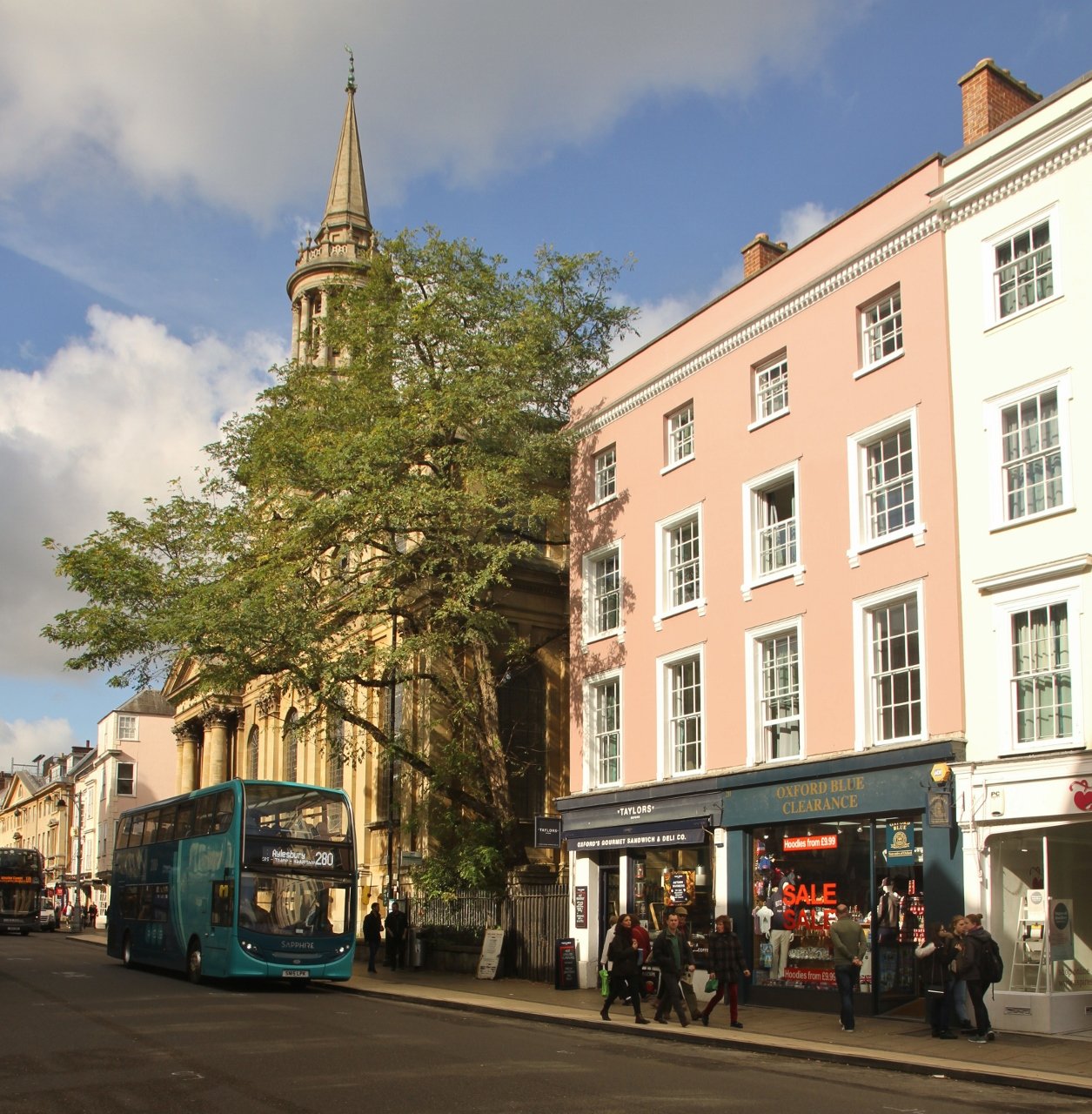
All Souls, Brasenose, Lincoln, and Oriel are working together to revitalise Oxford’s historic Market Quarter, with a particular focus on encouraging independent businesses.
The quarter makes up much of the city’s centre, including Turl Street, High Street, and King Edward Street. All four colleges own properties in the area, many of which are occupied by small businesses. Alongside restoring and redeveloping specific properties, the project is also designed to promote greater collaboration between businesses and the colleges. The colleges have launched a website to boost footfall, and also plan to hold events in the future. Lincoln is already paying for extra cleaning on Turl Street and working on improving lighting.
Many of the colleges have historic connections to businesses in the area. Lincoln, for example, has owned the Mitre Inn, now occupied by Gusto Italian, since 1475. Today, more than 40 cafés, shops, and restaurants sit on property owned by the four colleges. The colleges hope that their long-term approach to managing their properties will help give independent retailers the confidence to settle in the area.
In a joint statement to Cherwell, the colleges said that they plan to work with existing businesses to “build on what makes this part of Oxford distinctive”. They hope the investment will improve the experience of students, residents, and tourists who use the streets by encouraging “a strong mix of independent and specialist retailers, alongside interesting places to eat and drink”. The colleges have decided to work together on this project so they can “develop a particular feel to the area” and provide “a distinctive and attractive shopping and leisure experience”, compared with destinations like Westgate, which focuses on national brands.
Shepherd and Woodward on Turl Street agreed, telling Cherwell: “Whilst we recognise that there is a demand for T-shirts and memorabilia, Oxford would be a less attractive area if every shop sold tourist goods or Harry Potter goods.”
Students also stand to benefit from the income generated by this investment. The rent businesses pay helps subsidise student accommodation – often in the flats above – as well as tuition and financial support, which at Lincoln amounts to £1.8 million annually.
Cherwell spoke to several local businesses, many of whom expressed gratitude for the support offered by the colleges. This includes Vaults and Garden, a cafe now located on King Edward Street, which faced a prolonged legal battle over their previous location in Radcliffe Square. The cafe owner, William Pouget, told Cherwell that Oriel’s support has “really mattered” when the businesses faced “unprecedented difficulties”. “In my experience,” he added, “Oxford colleges are understanding, compassionate and responsible landlords who take their ethical obligations seriously”.
Missing Bean, a cafe on Turl Street, also emphasised the “good relationship” they have with Lincoln. Ori Halup, Co-Founder and Director of Missing Bean, told Cherwell: “The colleges can play a big part through their investment and the businesses they bring into their properties.” The business hopes the college’s investment will lead to expanded outdoor seating and a curation of “a thoughtful mix” of shops, restaurants, and cafés.
For some local businesses, this town-and-gown partnership is relatively recent. All Souls only purchased its High Street properties in 2020. The College plans to restore the historic shopfronts and create space above for seminar rooms and offices. A spokesperson for All Souls told Cherwell: “We believe that the project will be very much to the benefit of the Market and city centre generally, as well as to the academic mission of the College.”
According to plans displayed on their website, the project is also designed to help preserve the “historic features of the buildings… wherever possible, including early stonework, roof timbers and historic ceilings.”



-

 Student Life4 weeks ago
From Oxford to Cambridge: The 204-mile punt for Alzheimer’s
-

 Oxford united FC4 weeks ago
Oxford United win 2-1 at Notts County in League One return
-
 Student Life4 weeks ago
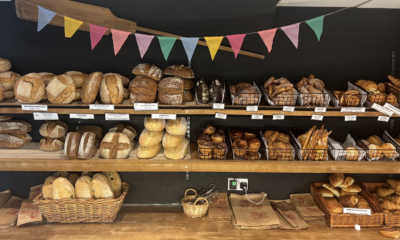
Hidden in plain sight: the bakery behind Oxford’s café counters
-

 Property & Housing4 weeks ago
Blenheim displays new Oxfordshire scheme with show home
-

 Property & Housing4 weeks ago
Plans developed for 12 affordable Blackbird Leys homes
-

 Traffic & Transport4 weeks ago
Uber begins self-driving robotaxi trial in Manchester | Uber
-

 Oxford united FC3 weeks ago
Oxford United beat Wigan Athletic 2-1 in League One victory
-

 Oxford united FC4 weeks ago
Karl Robinson in ‘best in EFL’ comment on Oxford United’s Aaron Ramsey