
Student Life
Anti-hunting group protests against alleged illegal hunt on St John’s College land

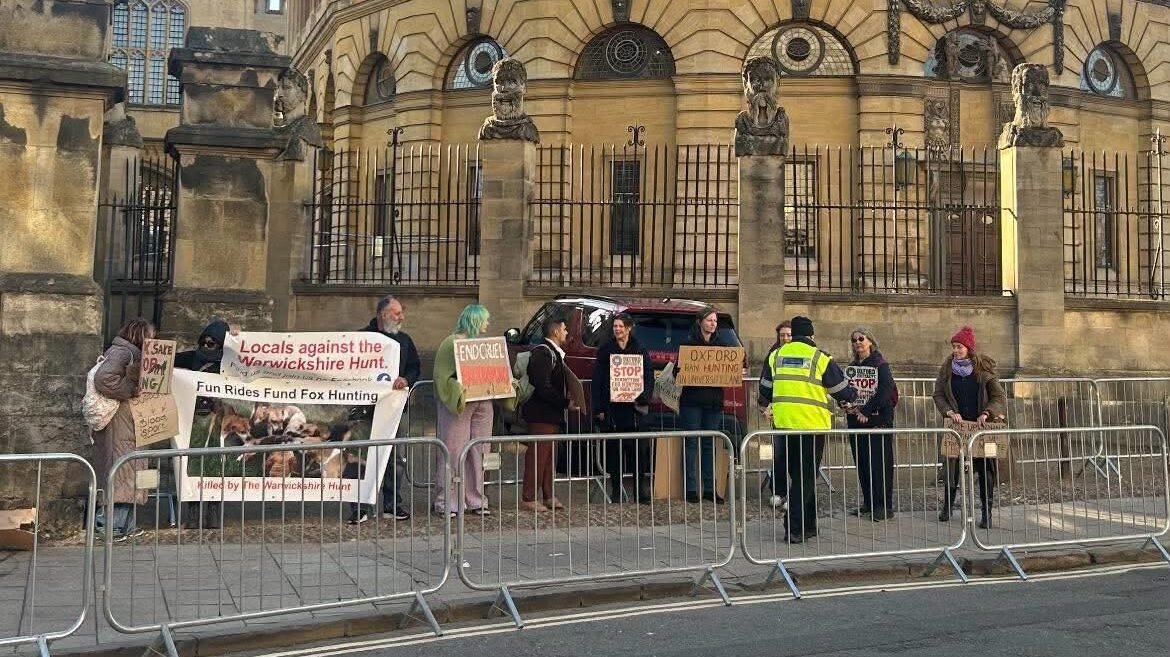
Anti-hunting protesters gathered outside the Sheldonian Theatre during matriculation on Saturday to protest against alleged illegal hunting activities on land owned by St John’s College.
Locals Against the Warwickshire Hunt allege that on 1st September an illegal hunt crossed onto land owned by St John’s at Heathcote Farm, near Stratford-upon-Avon. The organisation opposes and monitors the Warwickshire Hunt, a historic fox hunting pack dating back to the 18th century. The organisation told Cherwell that the Warwickshire hunts’ actions result in “cruel and barbaric torment of wildlife” and that they “blight local communities”.
Officially, hunting groups in England can only practise trail hunting, in which an artificial scent is laid for hounds to follow. Using hounds to kill or maim wild animals, or using trail hunting as a cover for hunting an animal, is illegal under the Hunting Act 2004. Locals Against Warwickshire Hunt allege the hunt breaks these laws to illegally hunt foxes.
St John’s issued a statement on 3rd September denying that illegal hunting took place on their land. They note that the hunt travelled across Heathcote Farm with “express consent” of the College’s tenants. The College also stated that it “would not knowingly permit unlawful activity to take place on its property” and that it had “found no evidence” that an offence was committed.
The College met with representatives from Locals Against the Warwickshire Hunt on 5th October to discuss their concerns; however, the group still decided to go ahead with their planned protest last Saturday 17th October.
Around 20 individuals gathered outside of the Sheldonian Theatre at 10am, some holding placards calling for the College to ban trail hunting on its lands. Oxfordshire Coalition of Animal Advocates and Oxfordshire Hunt Saboteurs also joined the group. As students came out of the Sheldonian for matriculation, the protesters told them to tell their colleges to “stop the hunt”.
At the protest, Brian, a spokesperson for Locals Against the Warwickshire Hunt, told Cherwell: “Local people have had enough… we have people that go out and get their roads blocked… they get hounds through their gardens… pets disappearing. It can’t go on.
“What we’d really like would be for St John’s College to say that’s it. We’re not allowing it on our land any more. And then we’re all friends again.”
Another member of Locals Against the Warwickshire Hunt told Cherwell: “It’s just not acceptable. They [Warwickshire Hunt] had an opportunity over 20 years ago to legitimise their actions. Trail hunting was brought in to allow them to do things, providing they called their dogs away. They use it as a smokescreen… They know that they have broken the law. They do it deliberately because they have a bloodlust for murdering animals.”
Following the meeting with Locals Against the Warwickshire Hunt, St John’s has stated it is considering the matter through its statutory governing processes, which will ensure a “potentially significant decision” is made about trail hunting on College land. In the meantime, the College has temporarily removed permission for Warwickshire Hunt to access its land until November 2026.
During the summer vacation, I decided to reach out to a friend I’ve known for more than seven years. We graduated from high school together, each moved to UK universities, and are both navigating the second-year experience of applying to internships, studying, and socialising. Yet, despite the parallels between our lives, I hadn’t seen my friend since last December. We didn’t text everyday or call very often. Our communication at university went no further than the occasional Instagram comment.
So naturally, when I asked them to meet up, a question nagged at my mind: “If we’re not sending each other constant updates, are things going to be awkward?”
Coming to university, I realised that the stable, effortless reliability of my friends from home was, all of a sudden, precarious and difficult to maintain. As if turning off a light, the brightness of a friendship can abruptly dim when both of you are dealing with the hurdles of Freshers’ Week, getting used to the workload, and settling into a new routine. Finding time to text can feel impossible, and, before you know it, you haven’t talked in a month. Or two. Anxious thoughts creep into your head. Without even realizing it, you’ve managed to convince yourself that someone who was once a dear friend is now a complete stranger.
Then I met my friend. Jokes galore, laughs about, memories resurfacing, and promises to call more often. Talking with my friend, I realised that time and distance do not have to strain a relationship. Leading separate lives does not negate what you had in the past, nor does it define your future. Not only did our conversation go well, we even spoke about reaching out to more old friends.
I explained how it felt weird to call up a friend at a random time, in those moments where you’re alone in your room and have nothing to do. Aren’t I intruding into their personal lives? What if they’re busy? Aren’t I annoying them with my pestering? My friend’s response to these worries changed my perception completely about reaching out: “When you get a call from an old friend, don’t you get a warm fuzzy feeling inside?”
I am here to tell you to reject the thoughts of doubt. When you flip the situation, you realise receiving a text from someone you’ve known for such a long time is not just a welcome surprise; it’s also one of those things that makes you wonder why you hadn’t thought of it yourself. Speaking with my friend helped me realise how the barrier to reaching out is really just a mental one. Especially in our digital age, where sending a message is instantaneous, emotional distance to someone is only created in your own imagination. Making the first move then becomes a matter of experience. The more you do it, the easier it becomes to keep in touch.
Now don’t get me wrong, it doesn’t always work out. Sometimes you’re left on delivered, or even worse, read. A change in mindset is what I propose: being left on read by a friend could be their own mistake! Assuming malice or ignorance is merely jumping to conclusions with little evidence, which, as Oxford students, we should understand is not always rational. If not, however, we’ve arrived at our worst-case scenario. Congrats! Rock bottom, as it turns out, is not so bad. Unfortunately, growing apart is a part of growing up. Not everyone you reach out to is going to rekindle a flame of friendship.
Rejection from one, however, does not equal rejection from all. To let one sad experience colour your view of how every instance of reaching out will go is a mistake. This leads me to my next point, which is: double texting is not the end of the world! In stressful times like the beginning, or even the middle, of university, it’s not unusual for texts and calls to get lost. The art of reaching out includes being alright with the ‘embarrassment’ of saying “hi” multiple times, and to multiple people.
But when all seems lost, when a person insists on staying a brick wall to your texts, perhaps it becomes time to move on. This is alright too. Reaching out requires balance: being brave enough to poke a friend, but also recognising when your efforts should lie elsewhere. After all, you’re at Oxford now! Seeking out new friends should also be a part of your goals. The interesting point about reaching out is that it also helps build your skills in finding friends. Just like meeting new people, breaking the silence requires confidence, acceptance that rejection is possible, and the chance to train a muscle everyone should build.
To end on a happier note, I am glad to say reaching out to my friend led her to visiting me in Oxford. My two worlds collided, and I couldn’t be more excited about the way a balance could be created between my old life and my new one. This is a call to all Oxford students: reach out to your old companions, you might never know what could come of it.

As this article goes to print, Oxford University is missing two of its offer-holders. In a haunting echo of the trials faced by approximately 78 Palestinian students last academic year, several of whom held places at Oxford, two Sudanese doctors are unable to begin master’s courses at the University this October. This comes after the High Court dismissed their legal challenge to Home Secretary Shabana Mahmood’s ‘emergency brake’ visa policy, which also affects applicants from Afghanistan, Cameroon, and Myanmar.
As the Oxford Sudanese Society stated in its recent announcement, the decision is a “collective penalty” against students who have faced extraordinary barriers in accessing higher education. Based on rhetoric accusing students from the four nations of “abusing” the visa system to claim asylum in the UK, it is symptomatic of an en vogue desire to pander to anti-immigration sentiments. This flies in the face of the educational meritocracy successive governments have said they wanted to achieve.
If the UK holds itself to be a centre of educational excellence, it cannot deny deserving students access to universities on political grounds. The Home Office’s own figures, moreover, do not scream “abuse of the system”. In 2025, the four affected nations made up only 0.7% of study visas granted; 380 of the 1,480 Sudanese students given visas between 2021 and 2025 went on to claim asylum.
The rhetoric used to prevent talented individuals from taking up deserved places at Oxford and elsewhere, therefore, appears to be no more than a string of buzzwords. Effectively, the government is punishing students for falling foul of the current political landscape’s value systems. It did the same to the aforementioned Palestinian students, who could not be granted visas without registering biometric information that has been impossible to acquire in Gaza since 2023.
After a summer of uncertainty, at least six of these scholars reached Oxford last academic year, benefiting from the University’s Palestine Crisis Sponsorship Scheme, which allowed them to carry out the biometrics process in Jordan. Yet many students without sponsorship remain unable to acquire the necessary documents. Some, who cannot meet the requirement of having to leave dependent families in a warzone, have had to make what one St Hilda’s College offer-holder described as the “heartbreaking choice” to remain. Many are therefore as shut off from British education as their Sudanese counterparts.
There is hypocrisy to this at every level. It is, of course, obvious that falsely claiming that students are “exploiting British generosity” contravenes both universities’ efforts to attract diverse intellectual talent and the basic human right to education. But on a deeper level, we must examine British complicity, both contemporary and historical, in the current state of the countries the government has denied visa access to.
There are no visa offices in the Gaza Strip partly because it is being bombarded by a state the UK continues to have a defence relationship with. There are, arguably, conflicts in Sudan, Afghanistan, and Myanmar partly because of British actions dating from the peak of the British Empire to the present day – and it is largely because of these conflicts that student visa-holders would choose to seek asylum.
And if they were to seek asylum in such great numbers, why would it be a problem? Are we not facing a shortage of skilled, specialised minds, for example in the medical profession? Would the NHS not benefit from the government allowing students to study International Health, Genomic Medicine, or Health Service Improvement (a selection of the MSc courses that Sudanese and Palestinian offer-holders held places for), rather than blocking them from entering the country?
Most saddeningly, this decision disadvantages students aiming to use higher education to better ameliorate the problems facing their home nations. One of the Sudanese students barred from entering the country saw an education at Oxford as her way to “help rebuild health systems in a country devastated by war”. It is paradoxical to take the current situation in Sudan as justification for preventing its students from accessing an education that could help lessen its severity.
Every student with an offer from Oxford deserves to take up their place, regardless of nationality. By denying a whole generation of students their future on trumped-up charges of asylum ‘abuse’, the government is dealing direct harm to both Britain and the wider world.
“Everyone has the right to education… higher education shall be equally accessible to all on the basis of merit.” (Universal Declaration of Human Rights, Article 26(1))
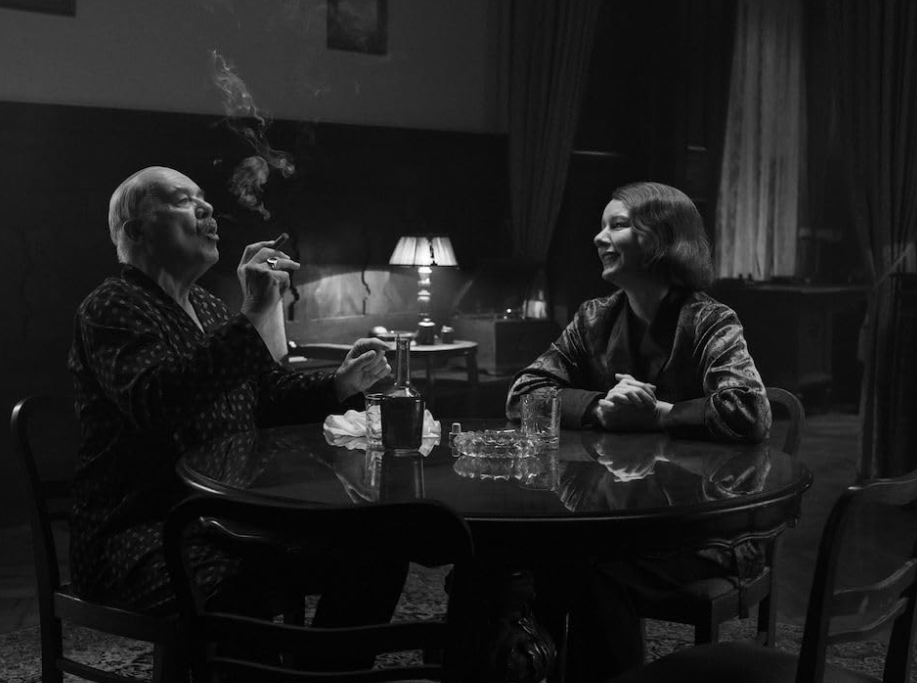
Fatherland, which recounts celebrated Modernist author Thomas Mann’s return to a Germany in wreck and rubble, deals with great personal malaise against a backdrop of great political unease. The year is 1949 and Mann is giving a reading tour through East and West Germany, at least ostensibly hoping to edify and uplift his war-traumatised audience. It is clear, though, that Mann’s grandiloquence will not conjure a better order into being. Some of the brightest shots illuminate gaping expanses of rubble between the town halls and churches where Mann holds forth to packed crowds, and after these addresses, drunken candour and old wartime songs abound. All of this is observed by Mann’s daughter Erika, played by Sandra Hüller, who does a good job of balancing critical winces and bitter-sympathetic smiles as she is dragged between events, silent except in her capacity as an interpreter for Mann’s’ interviews to a cloying international press. She also acts as the family’s moral conscience. Her brother Klaus, played by August Diehl, is profoundly depressed and not in touch with his haughty ‘magician’ father, and when, after a devastating incident Erika also loses contact, the daughter-father drama intensifies until emotional release is forced in the film’s last moments.
I watched Fatherland shortly before the tense mid-September Berlin elections where the far-right Alternativ für Deutschland (AfD) and far-left Die Linke party both gained significant ground, so at least the atmosphere, if not the specifics of the political turbulence depicted in the film, was of a piece with my surroundings. The Kino International venue, huddled near the centre of the dreadful, looming Communist concrete of Alexanderplatz also put me in mind of the East-West tensions strikingly portrayed in the film by the story’s progress eastwards, across checkpoints and into sparser rural space; my interest was primed for a scintillating political piece.
Instead, though, I found the personal drama far more compelling than the film’s political commentary, which often felt simplistic and lacking in the former’s emotional intelligence. The first scene, a study of Klaus in strikingly focused despair over a literary and personal crisis of meaning, shows the 30-something’s lithe, sinewy torso in exposing, crisp black-and-white. There’s a shadowy, blurred one-night-stand in the background above the bed (Klaus was gay but, intriguingly, the long-haired lover is genuinely androgynous), and as they move passively, perhaps indifferently, Klaus writhes about in angst and indecision while on the phone to Erika. It is one of the longest scenes of the film, and the camera’s static, steady character study reminded me of some of Bergman’s best psychological work in Scenes from a Marriage. Klaus’ initiating scene casts an ironising shadow over the ensuing bourgeois soirees on his father’s speaking tour, and his brief screen presence conveys as much character as Zischler manages to in his role as the main Mann.
I always admire when cinema makes political events moving; films as diverse as The Battle of Algiers, Paths of Glory and Steven Spielberg’s Munich have all brought me to tears with visually eloquent set pieces set in war or its aftermath. Fatherland is not so articulate. Pawlikowski relies on easter egg quasi-gags to poke fun at history’s villains, including Gustaf Gründgens, a Nazi-era thespian (though no Leni Riefenstahl; the remarkable Gründgens is a prime case study for the ‘art versus artist’ dilemma) and friend of the Manns who is portrayed as a charmless, bigoted representative of the postwar German intelligentsia in a brief, brusque interaction with Erika. I refer readers to Uncle Max in The Sound of Music for a complex, queasily likeable Nazi sympathiser, and to Mephisto for a nuanced confrontation with Gründgens himself.
Other objects of political criticism are crass, materialist American propagandists in the West and, more interestingly, a slimy, Mephistopheles-quoting Soviet general and his East German underling from the culture ministry. This last official follows the party line with Mann, but his sometimes faltering, conflicted manner concisely betrays all the sorrow, uncertainty and daunting weight of his countrymen’s past and future. Occasionally, the cinematography achieves the same political poignance: in a devastated West German town, the camera lingers on a bleach-white empty church hall, suggesting false innocence and secular angst.
Indeed, black-and-white is deployed to great effect. Many mornings on the road are shot through with searing sunlight turned eerily silver and cold by cinematographer Lukasz Zal, and the sombre aesthetic somehow enhances a closing burst of Bach from the organ of an almost-abandoned East German church, the site of Mann’s much belated emotional unloading – a scene which, albeit, has by my reckoning somehow more bathos than pathos.
I would almost venture to say that Fatherland much more resembles a certain kind of cosy, historical dramedy than a serious political piece. Mann appears too hapless and bumbling to offer us a protagonist apt to deal with the ongoing turmoil within his family and fatherland. Well-paced and clocking in under 90 minutes, it goes down enjoyably, though maybe too comfortably, but its occasional flashes of emotional incisiveness are to be commended.
The post A jarring Mann: ‘Fatherland’ (2026) in review appeared first on Cherwell.



-

 Oxford University4 weeks ago
New to the Oxford English Dictionary this September
-

 Oxford united FC4 weeks ago
Chris Gunter steps away Wales role to focus on Oxford United
-

 Oxford united FC2 weeks ago
LIVE: Exeter City vs Oxford United – Jersey Mike's Trophy group stage
-

 Traffic & Transport3 weeks ago
Why should I have to pay more for buses if I don’t use a smartphone? | Bus fares
-
 Traffic & Transport3 weeks ago
How poor public transport policy is putting the brake on cities | Road transport
-

 Oxford united FC2 weeks ago
Oxford United lose to Exeter City on penalties in Jersey Mike’s Trophy
-

 Student Life3 weeks ago
Oxford partnership allows OpenAI to use rare Bodleian texts to train ChatGPT
-

 Student Life2 weeks ago
Rhodes scholarships cut amid financial difficulties