
Student Life
Antisemitism at UK universities 79% higher than before October 7th attacks


CW: Antisemitism
The University of Oxford was among ten universities to record five or more antisemitic incidents from 2024-2026, a new report on antisemitism at UK universities shows.
The Community Security Trust (CST), a UK charity which monitors antisemitism in Britain, has published a report tracking recorded antisemitic incidents affecting Jewish students, academics, university staff, and campus organisations between 2024 and 2026. Its executive summary warns that “the 7 October attacks ha[ve] resulted in a baseline level of antisemitism that is significantly higher than before”.
Last year saw 95 reported incidents across UK universities, a 14% increase on previous years. This figure remains below the “unprecedented” 272 incidents recorded during the single academic year of 2023/24 but is 79% higher than the last academic year before the Hamas attacks on 7th October.
CST’s report shows that the city of Oxford had the joint seventh most incidents of University antisemitism in the UK. Of the five incidents reported in Oxford, the majority occurred online. The report also references an incident in October 2024 where a swastika was drawn on a sign for the David Slager Jewish Students society on George Street.
A significant proportion of antisemitic incidents concerned Israel, Gaza, Hamas, the October 7 attacks, and the ongoing conflicts in the Middle East. A reported 62% of incidents “contained such references alongside anti-Jewish language, motivation or targeting” while 55% of incidents “demonstrated explicitly anti-Zionist motivation alongside antisemitism”. References to Hitler, the Nazis, or the Holocaust appeared in 26% of incidents.
The CST findings follow the Union of Jewish Students’ (UJS) ‘Time for Change’ report, published in March 2026, which found that “antisemitism on campus is normalised”.It urges universities to “make clear the difference between anti Israel speech or activity, and antisemitism – and enforce this difference through disciplinary action when students, staff or societies cross the line”. The charity also suggested that educational institutions “make reporting of incidents accessible and worthwhile” in order to “build trust in university processes”.
In response to the report, a spokesperson for the Oxford Jewish Society told Cherwell that they “value the continued engagement of the University with the Jewish community to resolve issues of antisemitism”. However, they said that “the collegiate structure of the university and the unaffiliated nature of key institutions means that there is a deficit of accountability across the University”.
“Jewish students should not have to become less visibly Jewish, less openly Zionist or less willing to speak in order to feel comfortable at university”, the society added. “Antisemitism does not cease to be antisemitism because it is expressed in the language of anti-Zionism. Hostility towards Jewish students because of their real or assumed connection with Israel is not legitimate.”
A spokesperson for the University of Oxford told Cherwell: “Oxford is unequivocal: there is no place for antisemitism, harassment, or discrimination within our community.
“The University condemns, in the strongest possible terms, any form of racial hatred, including any actions or language urging violence against groups of people.”
When asked about measures taken to counter antisemitism at Oxford, the University spokesperson highlighted efforts to promote racial and religious inclusion. These include an annual Student Racial and Religious Inclusion Forum, first held in March 2026, which brought students together to share their experiences. The University also said its Equality and Diversity Unit has facilitated antisemitism training from the Union of Jewish Students for student-facing staff.

Along Cowley Road, a taste of South India sits within a rather inviting building, complete with burnt red accents and the occasional fairy light: Dosa Darlings. After many of my friends had moved to the area into their second-year houses, it only seemed right to try out a restaurant located somewhere beyond a five minute radius of Turl Street. For one night, I left the joys of Najar’s and the Covered Market in search of a new place to add to the ‘treat’ rotation.
Walking inside, the atmosphere was immediately welcoming, complete with dim lighting, though not too dark given the sparkle of lights decorating the restaurant, and the candle perched in the middle of our table. It was looking to be a lovely evening, which was only further confirmed by the rather beautiful-looking jug of water (still, not sparkling) on the table. This was nothing like the typical uninspiring water containers I had become accustomed to receiving during my summer in the US.
We ordered a selection of food for the table – I have learnt that ordering as a couple is far superior to having individual meals – since there was so much on the menu that looked appetising. There were the famous dosas and other classic curry dishes, as well as vegetarian options, and ‘little plates’. After some difficult deliberation, we started with two vegetable samosas (£6.50 total), accompanied by a tamarind chutney, as well as a plate of beef chukka (£9.50). Whilst I did not try the latter, I was assured on good authority that it was quite delicious – and I can confirm that the samosas were delightful. They were fresh, piping hot from the kitchen, and generously sized too, leaving us with some leftovers (though not for lack of enjoyment).
The first dishes were speedy, but we then waited another 50 minutes until our main courses came out. Ordinarily, this would have been fine, but here everything was ordered to come together. The wait took a little away from the experience, mainly because, after looking around, it was quite clear that most tables were emptying – even those who had arrived after us. We did finally receive the selection of poppadoms (£4) we had ordered some time earlier to nibble on. This was genuinely quite exciting; there were several types which were all different, not just in shape but also in flavour, texture, and, best of all, colour. So, I suppose, had we not been waiting for so long, we would not have had time to enjoy the novelty of this selection.
This period of delay gave us our most memorable experience of the evening by far. My boyfriend returned from the bathroom, sat down, and exclaimed: “You won’t believe what they’re playing in there.” He was correct; I did not believe him until I went to test the claim myself. Playing very loudly in an otherwise quite chic bathroom was the booming voice of Stephen Fry narrating to me the journey of the ‘Golden Trio’ in Harry Potter and the Deathly Hallows – not quite what I was expecting, given the relatively inoffensive and quiet music playing in the background of the rest of the building. Either way, I did enjoy my short time hearing about Harry’s journey within the Ministry of Magic before returning. Eventually, the main event was here: a prawn moilee curry (£16) and a walnut cinnamon and honey dosa (£9.50).
The curry wasn’t particularly memorable and was quite light on prawn, but the flavour was enjoyable and paired with what was left of the poppadoms. For those who have not enjoyed a dosa before, they are quite spectacular in their own way. Dosas are cone-shaped savoury crepes, and mine was so big it didn’t quite fit on the plate. It was, however, utterly delicious, and drowned in honey. I think our combination of flavours may have negated the savoury component slightly, but nonetheless it made the wait worth it. It had a Goldilocks quality, in the sense that it was filling, but not overly so in the way some breads and dipping snacks tend to be.
Just before the restaurant had completely emptied, we decided to ask for the bill, and it was here that our waiter made up for the earlier inconvenience. He brought over two desserts for both of us to try. I wasn’t quite sure what it was at the time, but after a few Google searches, I believe it was ras malai, since it had a spongy disc in the middle soaked in a bath of milk flavoured with a range of spices. The spongy part was not quite to my taste, but the milk component had a unique (but enjoyable) taste to it which, I suppose, is all I can ask for in a complimentary dish.
Despite the longer-than-anticipated wait time, the evening was memorable and, at the very least, was a great environment to spend a couple of hours in. I would recommend trying a dosa to anyone; they have so many options that finding a flavour to suit you shouldn’t be an issue. It’s not the place to go for a cheap evening out, but it is by no means overpriced. So if you’re looking for a place to go for a special occasion, or a reason to venture past Magdalen Bridge, then Dosa Darlings is just right.
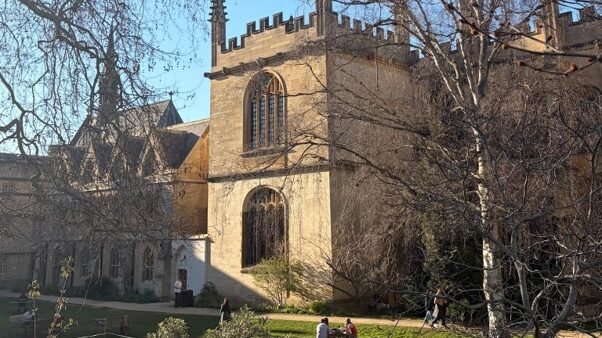
Cherwell District Council will decide next month whether to grant permission for a controversial £900 million data centre development funded by Exeter College.
The development, named EXOq, is located next to Oxford Parkway station in Kidlington and aims to be a “home for global research innovation and education”, with a particular focus on AI and quantum computing. The plans include a large data centre to provide computing infrastructure, alongside an innovation hub aiming to bring together researchers, government institutes, and investors.
The plans also include a conference centre, 180-room hotel, and a further education college that focuses on “equipping the young people today with the skills to be the workforce of tomorrow, working in and supporting newly emerging technologies linked to EXOq”. Construction would begin in 2028 with an expected completion in 2040.
Exeter College finance and estates bursar, Nicholas Badman, told Cherwell: “EXOq is a once-in-a-generation opportunity for Oxford and the region. Exeter College is uniquely placed to deliver the sovereign High-Performance Compute infrastructure the country, and the Oxford ecosystem, needs to compete in quantum computing and AI.”
The University of Oxford’s Vice Chancellor, Irene Tracey, said that “fundamentally, EXOq fits very well with the university’s needs and it has my full backing”.
Exeter’s plans come alongside a government drive to grow the UK’s compute infrastructure. The government’s 2025 UK Compute Roadmap forecasts that the UK will need three times as much data centre capacity by 2030 to keep pace with AI developments.
The plans also tie in with the government’s ambitions for the Oxford-Cambridge growth corridor, which it has dubbed “Europe’s Silicon Valley”. An economic impact assessment produced in support of the application suggests that the gross value added could reach £1.4 billion and create 7,000 jobs total, of which at least 4,600 would be in the local area.
Local residents have criticised the planned development. Kidlington Councillor and Leader of the Green Party on Cherwell District Council, Ian Middleton, has publicly objected to the proposal, while more than 35 local residents submitted statements opposing the plans during public consultation. One resident urged the council to “be courageous and stop letting the colleges dominate the whole area” while another labelled the development “huge, unwanted, and unnecessary”.
Local campaign groups, such as the Oxfordshire branch of the Campaign to Protect Rural England, have raised environmental concerns including the development’s impact on the green belt separating Oxford from Kidlington and a nearby ancient woodland. One objecting group, Wolvercote Neighbourhood Forum, explicitly references noise problems caused by data centres in the US in a letter opposing the site.
In response to queries about the project’s environmental impact, Badman told Cherwell: “The College understands local concerns and is committed to making EXOq an exemplar of sustainable data centre design.” Badman noted that the plans include on-site solar power and would reuse waste heat from the data centre through a low-carbon heat network serving both EXOq and the surrounding area. He added that the College is exploring off-site renewable energy and working with electricity generators and is “committed to ensuring EXOq’s demands will not conflict with local energy needs”.
The most significant local challenge to the project surrounds the provision of golf courses. In 2025, the 118-year-old North Oxford Golf Course, owned by Merton College, Exeter College, and the University of Oxford, closed to make way for a housing project. Greenway, a group set up by former members of the club, told Cherwell that “the college gave assurances that Frieze Farm [the land upon which EXOq would be built] could be used if necessary as a replacement for the golf course”. Such a use is suggested in the Cherwell District Council Local Plan 2031.
Regarding the potential golf course, EXOq states that “evidence submitted to the Local Plan highlighted that the popularity of golf is declining nationally, and there is insufficient demand locally to justify the EXOq site as a replacement course”. In a statement to Cherwell, Greenway have labelled these statements inaccurate.
A decision is expected at the start of next month after the council’s independent golf need report is complete. The report will be the third golf need survey attached to the application, after Exeter and Greenway submitted their own competing surveys.
CW: rape.
This week, Cornell University has made headlines as prosecutors reopened an investigation into the alleged rape of a student at the Ivy League in 2024. The case is characterised by extreme violence and the university’s apathy towards the anonymous Jane Doe. When victims are ignored, and perpetrators’ punishment is to write an essay, what can we learn from those who use art as protest on campus?
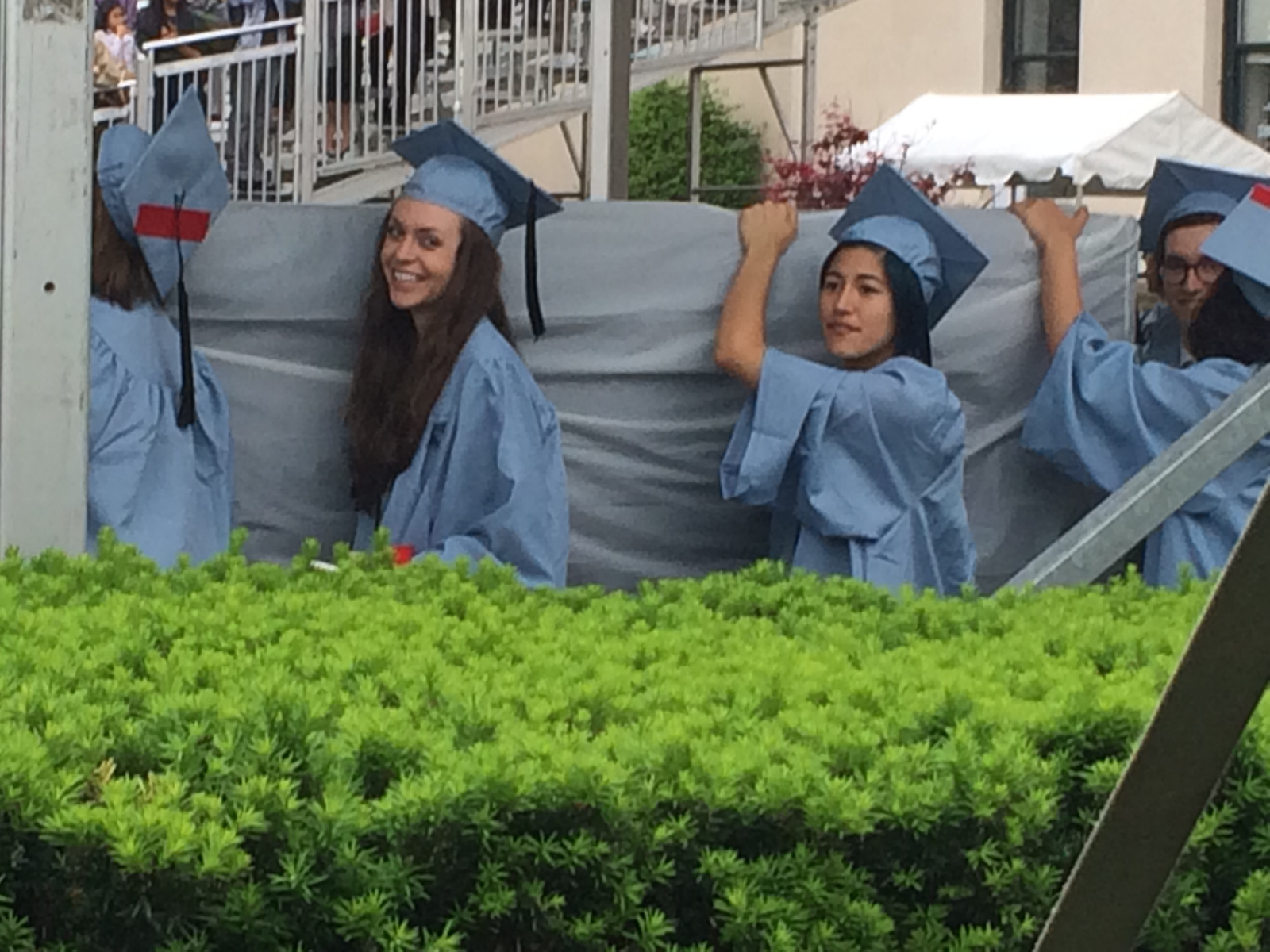
In 2015, Columbia University student Emma Sulkowicz carried her dorm room mattress across her graduation stage. She had been carrying it for months: every day the university failed to expel the man she accused of anally raping her. Having reported the assault to the university in April of 2013, Columbia found her attacker, Paul Nungesser, “not responsible” for his alleged crimes. She filed a report with the New York City Police Department to no avail.
In response, the visual arts student embarked on a performance art piece entitled Mattress Performance (Carry That Weight), as her senior thesis. Starting in September 2014, Sulkowicz carried a 23kg, dark blue, extra-long twin mattress, identical to the one on which she was raped, with her constantly while on campus. Dubbed by Sulkowicz to Columbia Spectator as an “endurance art piece”, she described the mattress as “the perfect size for me to just be able to carry it enough that I can continue with my day, but also heavy enough so that I have to continually struggle with it”.
Her performance was intended to travel by “word of mouth”. Having written the rules of engagement for lugging the heavy mattress around the walls of her studio space, she left the rest of her performance unexplained: a student walking around campus with a blue rectangle of springs and plastic.
On the steps of university buildings, at coffee shops, covered in a sheet matching the shade of Sulkowicz’s graduation gown, the mattress is always there. The mattress’ out-of-placeness is off-putting, interrupting a space of efficiency, learning, and practicality. It is cumbersome, attention-grabbing, and unsettling. It’s a weight not only to those who carry it, but a disruption to the lives of those around it. Its presence speaks to an absence of accountability and justice in the space it inhabits. Notably, under Sulkowicz’s regulations, the mattress was not allowed to be removed from the university campus, even when she was elsewhere. The burden of truth and violence was made big, blue, and bold. It’s difficult to move and impossible to ignore. In a piece written for TIME, Sulkowicz accused Columbia of being “more concerned about their public image than keeping people safe”. When the words of victims have limited consequence and perpetrators fail to be held accountable, art speaks in a tongue that cannot be twisted.
Protest is often remembered through its material objects. We picture the hourglass of Extinction Rebellion, the peace sign of the anti-Vietnam War movement, the crouching panther of the Black Panther Party. The visual memorabilia and graphic art of protest leave a lasting cultural and personal impression. In an interview with Tate, artist Jeremy Deller recalls the impact the protest art of the 2017 Women’s March had on him: “It was kind of the first time you saw… those body parts being drawn or in public being displayed, those sort of reproductive organs.” Really, women’s reproductive systems have been displayed on museum walls with varying accuracy for centuries. Think only of Gustave Courbet’s 1866 L’Origine du monde: it’s all the ‘taboo’ bits and nothing else. Possibly, it is the presence of these taboo bits paraded so pointedly, with overt political sentiment behind them, as well as the real-life person holding the placard, that makes protest art, at least to Deller, so remarkable. It discards any question of whether art should be political and forces it to be so. It gives the aesthetic political purpose; it upsets how we understand, use, and display art. In Sulkowicz’s case, it makes the mundane, purpose-driven object an aesthetic anomaly that first surprises, and then frightens.
Sulkowicz’s performance art protest draws on the visual interruption caused by something being in the wrong place, detaching the signifier from the sign. The spatial anachronism of mattress-in-library, or mattress-in-cafeteria, creates an unsettling instance of a stubborn, physically cumbersome dedication to truth-telling. The mattress is impossible to ignore; so is the silent system of gender-based violence that permeates university culture. Sulkowicz makes the location of violence mobile, unavoidable, and universal. While the weight of assault can be carried by anyone anywhere, the mattress is a reminder that the perpetrators of such violence are just as present.
The tool of oppression deployed by universities like Cornell and Columbia is language in the form of excuses and essays. Language is fortified to protect the guilty and complicit from the consequences of their actions. Art, at this moment, confuses the schemes of language. It evades clear distinction, forces itself to be acknowledged, and upsets the campus’ playhouse of power and punishment.


Antisemitism at UK universities 79% higher than before October 7th attacks

New direct train services from London to Wrexham and Rochdale rejected | Rail industry

Oxford United youngster opens up on ‘surreal’ Aaron Ramsey influence
-

 Oxford united FC2 weeks ago
Chris Gunter steps away Wales role to focus on Oxford United
-

 Oxford united FC4 weeks ago
Former Oxford United boss Matt Bloomfield drops Wycombe manager hint
-

 Oxford united FC3 weeks ago
Oxford United transfer chief explains EFL embargo and contract dilemma
-
 Student Life3 weeks ago
Oxford falls to lowest ever spot in The Times UK University Guide 2027
-

 Oxford University2 weeks ago
New to the Oxford English Dictionary this September
-

 Oxford united FC3 weeks ago
Aaron Ramsey gives Luka Lynch update after Oxford United absence
-

 Student Life3 weeks ago
Protest held outside Town Hall over sale of Council-owned building to St Peter’s
-

 Oxford Events3 weeks ago
Stage Watch: Pinocchio, Peppa Pig, Affluenza, Dirty Dancing, & Ballet Shoes