
Student Life
Protest held outside Town Hall over sale of Council-owned building to St Peter’s

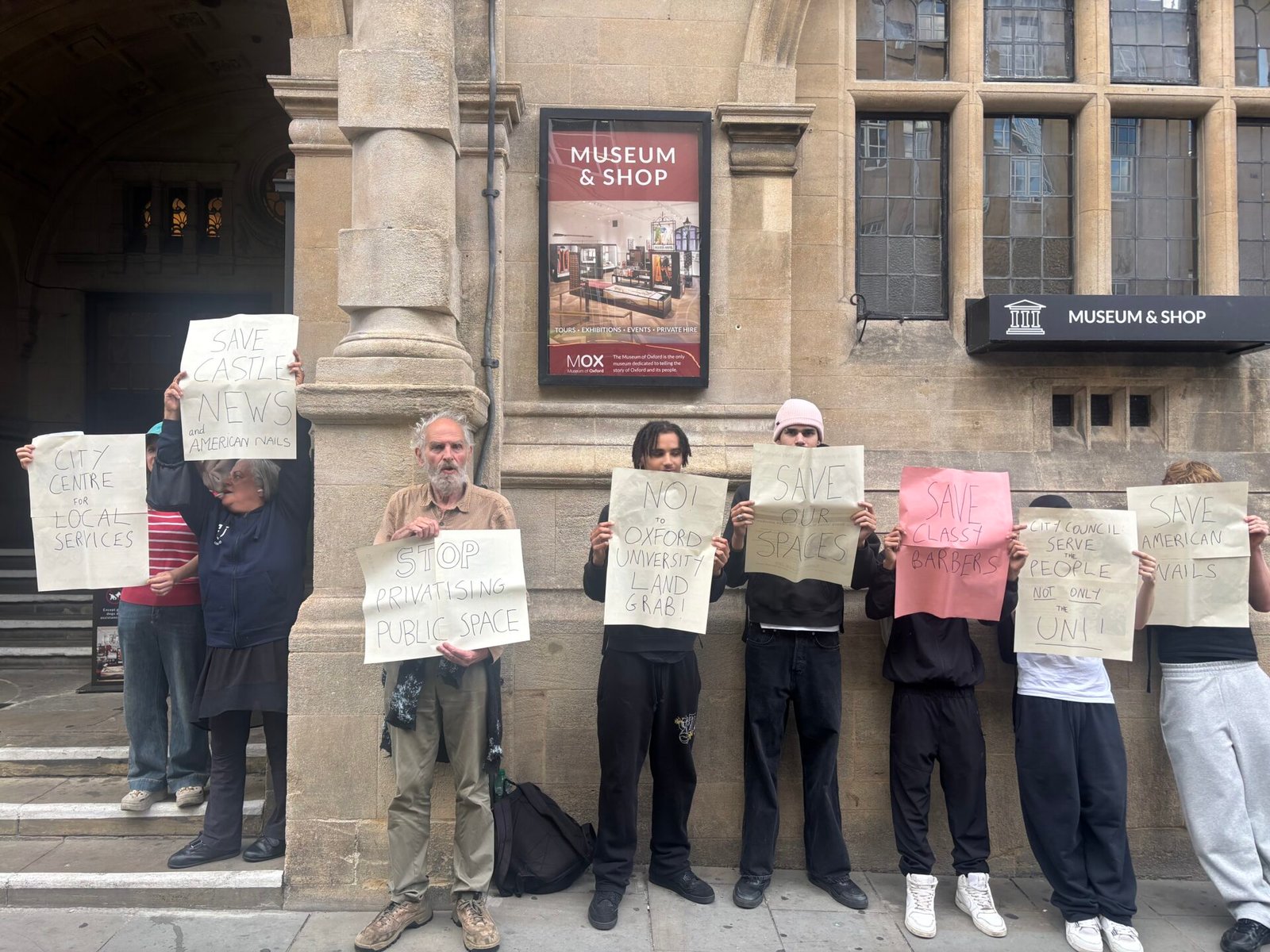
A protest took place today outside Oxford Town Hall against Oxford City Council’s plan to sell 11 New Road to St Peter’s College, which would convert most of the building into student housing. The protest, organised by the campaign group Save Our Spaces, was held at 5.30pm, ahead of the Council’s Cabinet vote on the sale of the building.
The Council-owned building, a mixed-use property on the edge of St Peter’s estate, houses a six-bedroom flat leased to the College and three other businesses: Castle News, Classy Barbers, and American Nails. Under the College’s plan, it would convert all but the ground floor into 24 student rooms and add an extra floor. The proposal is subject to planning permission.
A petition opposing the sale of the building, launched on 11th September by the campaign group Save Our Spaces, has gathered over 400 signatures by the time of publication. A spokesperson for Save Our Spaces told Cherwell: “Once again, the City Council is selling off community space to serve the University’s land grab. These three businesses serve thousands of local people and are much loved by the local community. But they have been treated with total contempt by the Council and St Peter’s College, who have been drawing up plans behind their backs to kick them out.”
The spokesperson added that selling a publicly owned building that brings in “well over £100,000 per year in rent” is “an incredibly short-sighted strategy”.
The Council told Cherwell: “St Peter’s College… approached the Council with a proposal to acquire the property, and terms have subsequently been negotiated. The decision to dispose of the freehold title will generate a capital receipt that can be used to support the provision of investment in and services for communities in Oxford which otherwise would not be affordable.”
They added that the sale would “remove future liabilities associated with the property”, as a “significant future expenditure would be required” if it kept the property.
In their statement to Cherwell, the Council disputed “misinformation” and claims that have “circulated online about the loss of community space as a result of the sale”, as the building is part of its commercial portfolio and has only commercial tenants.
The proposal would also see two of the three businesses continuing to operate, as St Peter’s is “proposing modifications to the upper floors and basement, not the retail on the ground floor”, according to the Council. St Peter’s similarly told Cherwell that it “plans to retain the business tenants, Castle News and Classy Barbers, occupying the ground floor of the building”. However, the floor occupied by the third tenant, American Nails, would be converted into student accommodation.
St Peter’s added that “this project is in line with the College’s strategic commitment to increase the amount of College accommodation available to students who would otherwise be out on Oxford’s private rental market”. The intended purchase follows St Peter’s recent expansion on New Road, including Castle Bailey Quad, a 54 en-suite room Passivhaus development, which the College opened in 2024.
The College’s plan is the latest in a series of disputes over college and University developments in Oxford. In February, residents objected to Oxford University Development’s plans for redeveloping 25 Wellington Square, which houses several independent businesses. In April, the Council rejected Regent Park’s plans to convert the Oxfam Bookshop on St Giles’ Street into its Middle Common Room.
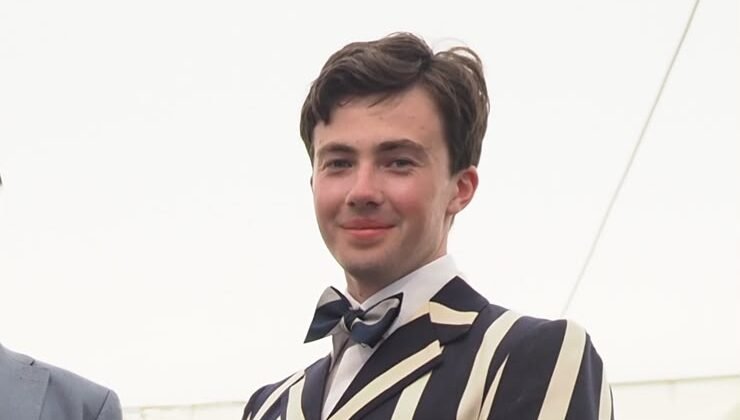
When I sit down to interview second-year Ancient and Modern History student Robin Munday, he happens to be wearing his Swiss Glacier Pistol Club fleece. The Oxford University Pistol Club (OUPC) captain is right to sport his discipline with pride. In his first year at the club, the team beat Cambridge twice: in an official varsity match in Hilary, and an unofficial competition in Switzerland during the long vacation. A few further victories against other university teams in the summer also contributed to OUPC’s “moderate success” last year, he tells me.
This year does not look set to disappoint either. Competition has not started yet, but since an appearance at Freshers’ Fair, the club’s weekly training sessions at Iffley Road Sports Centre are fully booked, and its group chat has over 200 members. “There are some very talented freshers,” Munday tells me. “By and large most have never touched a gun before, but some of them have and are very promising shots.” Munday mentions how some of the new members are getting to grips with trickier techniques, like aiming at targets that collapse when the bullet hits.
The incoming pistol shooters could not be in safer hands. “I’d always grown up around shooting,” Munday says. “The first time I was on a shooting range I was a few weeks old, and I started shooting aged five, with an air pistol I got for Christmas. When I was six, I was on centre-fire, more powerful revolvers.” Munday started competitive shooting at the 2015 Swiss Federal Shooting Festival aged ten, the youngest of around 35,000 competitors. He went on to win the under-21 division of the Swiss Feldstich contest in 2024, and a year later placed third.
His affiliation with OUPC, though, started well before its recent successes. Munday’s parents met at OUPC as undergraduates. His father served as “one of the early captains” after the club broke off from the Rifle Club in 1976, and his mother became captain a few “generations” later. He still owns and occasionally wears a size XS OUPC polo shirt which the club gave his parents as a gift for him.
“For a very long time, I’ve wanted to become captain of the OUPC – I’m proud partly because I’m following in my parents’ footsteps,” Munday tells me. The club’s events lined up for this year will certainly make his tenure an exciting one. “In a couple of weeks there’s the Oxfordshire Rifle Association Gallery Rifle Championships, and, like every year, there’s the Faded Blues.” In part of the latter event, Munday tells me, OUPC alumni compete against current members, who, he adds, “are almost always defeated”. Whatever the case, there cannot be anyone better placed than Munday, with his unique overview of OUPC’s history, to take part.
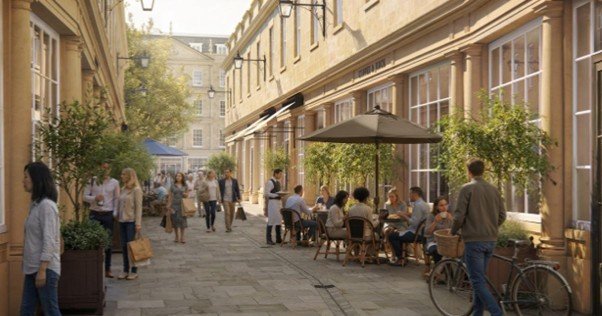
Oxford City Council has approved plans to transform Oxford’s Clarendon Centre into a new public square, with trees, seating, and a water feature.
The redevelopment, proposed by the site’s owner Goldmoney Properties, will involve removing the shopping centre’s roof to create an open-air square measuring approximately 41 by 42 metres. The pedestrianised space is intended to host events including Christmas markets, ice skating, and outdoor concerts.
Council planning officers concluded that “the proposal would make best and most efficient use of the existing site” and that “economic benefits would be derived from the provision of high-quality retail, food and beverage and office uses”.
Plans for Clarendon Square were first submitted earlier this year. On 24th February, Goldmoney Properties Ltd submitted an application for planning permission, proposing the demolition of over 8,000 square metres of existing floorspace and the removal of the centre’s roof to create a large public square open to the sky.
The 3.5-acre site, located on the corner of Cornmarket Street and Queen Street, was conceived by Roy Sebag and designed by Quinlan Terry CBE. Terry’s design features classical stone facades along both streets.
Goldmoney Properties acquired the site in a £30 million deal after its previous owner, Lothbury Property Trust, entered liquidation. Sebag, the investor behind the redevelopment, outbid a joint venture involving the Crown Estate, Pioneer Group and Oxford Science Enterprises.
The Council accepted a previous application, submitted in July 2024. It also aimed to remove the roof of the Clarendon Centre and create a new public space, but included plans for student accommodation that are not in the current proposal.
The approval marks a significant step toward the redevelopment of one of Oxford’s central shopping sites. Sebag told Cherwell: “I am delighted that Clarendon has received planning approval and grateful to everyone who has helped us reach this point. My intention is to create a beautiful public square in the heart of Oxford: somewhere people can meet, sit and enjoy the city.”
A spokesperson for Goldmoney Properties Clarendon Square Ltd told Cherwell: “At Clarendon, we have made a deliberate and quite radical choice: to reduce the amount of built space and open the estate to the sky, creating a substantial outdoor square and open-air streets.”
They added: “We believe the relative scarcity of this kind of setting in central Oxford, together with the quality of the architecture and the interest we are seeing from prospective occupiers, gives the scheme a strong commercial foundation.”
Councillor Susanna Pressel, who previously welcomed the plans, told Cherwell: “I’m glad this planning application got permission – with some sensible conditions. I think the new Clarendon Centre will be a great asset to the city.
“Students are lucky to have access to dozens of college quads, but most townspeople would never think of going through those private-looking doors, so a new green space will be very welcome.”
Pressel added: “The developers have promised to seek out lots of independent stores and cafes, and not charge ridiculously high rents, so let’s hope for some interesting new places to go to.”
The redeveloped Clarendon Centre is set to open in 2028.

Pro-Palestine protesters marched from Cowley to the Weston Library on Saturday 31st October, demanding Oxford University’s divestment from Israel.
Around 120 people attended the protest, including groups such as Oxford Students for Palestine (formerly Oxford Schools for Palestine), Oxford Action for Palestine, Oxford City Green Party and Health Workers & Allies for Palestine.
The protest started with a speech about Oxford-educated administrators’ role in the creation of Israel, notably through the Balfour Declaration.
Green councillor Ahalya Bala also commented on the current situation in Palestine: “This is not a war. This is annihilation… The atrocities are still happening. It is just the pace that changes.”
“In the West Bank, forced displacement, seizures, neighbourhoods levelled to the ground, military raids, arbitrary detentions, torture, rape, executions, and land theft for Israeli expansionism and the cruel racial segregation and domination of Palestinians.”
A large banner at the centre of the gathering read: “Israel bombed 36 hospitals in Gaza and murdered more than 1700 healthcare workers. Targeting healthcare is a war crime. Arms embargo & Sanctions now!”
As protesters moved through Oxford, they chanted “blood money on your hands, show us your divestment plans”, “arms embargo right now”, and “Oxford University pick a side, justice or genocide”.
Two march attendees, Lisa and John, have been protesting for Palestine daily outside Carfax Tower. They spoke to Cherwell about the current state of the student movement for Palestine. Lisa, a current graduate student said that: “For students the consciousness is there and the willingness is there but people are afraid.” John added that Oxford’s prestige meant “there is a lot of power and opportunities to speak up concentrated here”.
Outside the Weston Library, protesters heard speeches from Nick Maynard, an Oxford alumnus and surgeon who has worked extensively in Gaza, and Haya Adams, an activist from the SOAS-liberated zone. Maynard, who went to Exeter College, said in his speech: “There are moments in history when silence becomes a form of complicity… More than 22,000 children have been killed in Gaza in the last three years.” He told the audience about individual patients he had seen in hospitals in Gaza, explaining that, on one occasion, his colleagues were stripped of critical supplies of baby formula by the Israeli military upon entering the strip.
Regarding the international treatment of Palestine, Maynard later told Cherwell: “We know it’s been failed by our governments, we know it’s been failed by our media, but it’s also being failed by our academic institutions… They have not given students a sufficient platform to talk about the genocide. Students have been fantastic. The university needs to give a much bigger platform to its students.”
Oxford Students for Palestine, one of the groups organising the protest, told Cherwell: “We wish to remind the University and others that Oxford city is extremely pro-Palestine, that we call for the end of the genocide and apartheid, and we call for every Palestinian to be liberated and have the right to return. We are twinned with Ramallah for a reason.”
The group added that “we’re calling on Oxford University and its colleges to disclose and fully divest from any Israeli investments, products, or banks like Barclays”. They also criticised the Oxford University Endowment Fund (OUEM) as “fundamentally resistant to disclosure and divestment”.
Adams, from the SOAS-liberated zone, told Cherwell: “The most basic and bare minimum thing that Oxford University can do is cut ties with genocide through their investments, through their partnerships. There really are ethical alternatives… Oxford University can also protect the right to free speech by allowing students to speak up for Palestine with no disciplinary action. They need to be held accountable for the arrests that happened during the time of the encampments.”
In response to a right of reply, Oxford University said: “Oxford is steadfast in its commitment to freedom of expression and to the right to peaceful protest within the law. At the same time, we have a legal and moral duty to uphold the rights, dignity and safety of every member of our community. When behaviour, including protest, causes serious disruption, harassment or safeguarding concerns, we will act in accordance with the law and our own established procedures.”
OUEM did not respond to our request for comment.
As the march ended, Oxford Students for Palestine reflected on how it fit with the global student movement. They told Cherwell: “The last thing we will say is that the students united will never be defeated, as we’ve seen across the world.”
Additional reporting by Stanley Arlidge and Freya Robson.



-

 Student Life4 weeks ago
From Oxford to Cambridge: The 204-mile punt for Alzheimer’s
-

 Oxford united FC4 weeks ago
Oxford United youngster opens up on ‘surreal’ Aaron Ramsey influence
-

 Oxford united FC4 weeks ago
Oxford United win 2-1 at Notts County in League One return
-

 Student Life4 weeks ago
Exeter College to fund data centre in Oxford
-
 Student Life3 weeks ago
Hidden in plain sight: the bakery behind Oxford’s café counters
-
 Property & Housing4 weeks ago
Plans developed for 12 affordable Blackbird Leys homes
-

 Property & Housing4 weeks ago
Blenheim displays new Oxfordshire scheme with show home
-

 Traffic & Transport3 weeks ago
Uber begins self-driving robotaxi trial in Manchester | Uber