
Student Life
Visual politics in Oxford’s streets

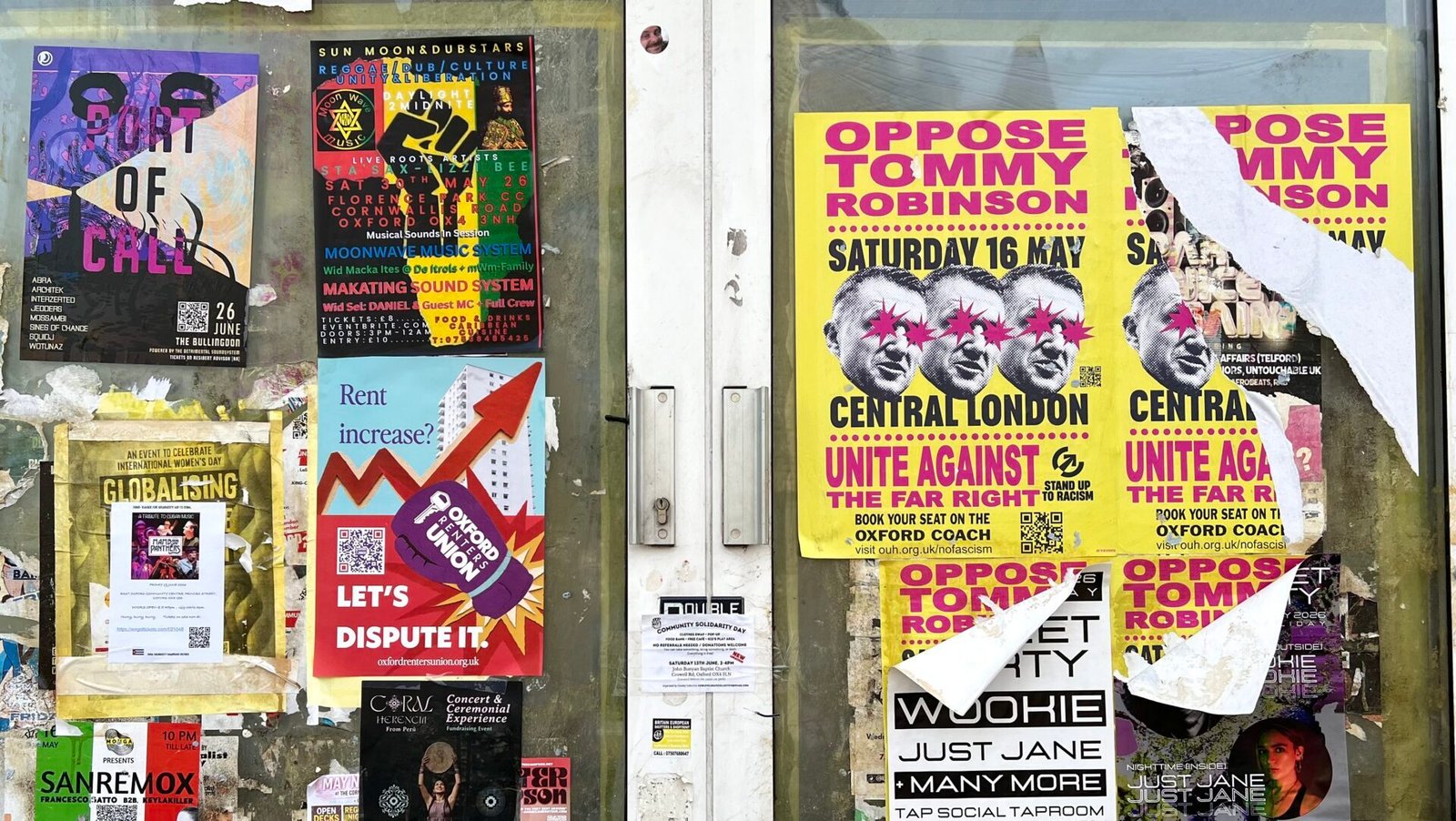
One of the most enduring images of grassroots politics is the pamphlet and the pamphleteer: the putting up of flyers, the taking over of public surfaces, the giddy circulation of agitational print, the vexation of the powers that be. “Is not all the controversy, whose slaves the poor shall be?” demanded a Leveller pamphlet in 1648, during the English Civil War. If, in the past, such material emerged from societies of lettered men and small printers, today Oxford residents walking down Cowley Road or George Street will easily find entire ecosystems of posters covering abandoned shops, construction hoardings, and disused telephone booths. They call out to passersby to campaign for affordable rent, attend an internationalist feminist protest, organise against animal abuse, or, provocatively, to smash the Epstein class. The peeling leaflets reveal older ones underneath. Lampposts and bus stops throughout town have an impressive past (and present) life in stickers. The distribution of print as a means of political communication remains as strategic and ungovernable as it has historically been.
It is just as well that street posters appear and crumble away through storied cycles of their own; yet much of mass organising today has migrated online, and finds its widest reach and most calculable impact there. It leaves the impression that physical media is somehow marginal, or touchingly quaint. Who takes notice of these posters? How do they speak to us, or fail to? In practice, different causes and their aesthetics find themselves fighting for space, literally, on Oxford’s streets. Paper is ephemeral; flyering is decentralised; anyone can as freely put one poster up as tear down another. This quiet, tactile, relentless agency shapes what our streets look like all the time. Street posters form a living, changing map of the communities and persuasions that inhabit a town.
You might begin to plot that map at the closed Debenhams in Oxford city centre. It is a hotspot for flyering of all kinds, due to the significant foot traffic the intersection receives. In May, the shop’s exterior displayed Stand Up to Racism’s “Oppose Tommy Robinson” posters – one of them already half-ripped – under which lay Together Alliance’s older, anti-far-right protest posters from March. Later that month, these remnants were also pasted over by the Oxford Renters Union’s newest campaign leaflets, to be found on various deserted shop windows and scaffolding sites elsewhere in town as well. The Union tells Cherwell that these leaflets are a crucial link between the Union and anyone struggling in a housing system that, year by year, increasingly disadvantages the socioeconomically vulnerable.
Those current leaflets all concern the Union’s resisting rent increases campaign, part of a broader national campaign demanding an end to unaffordable housing. They all display a QR code that takes you directly to the Union’s home page. In it, one finds the pledge to challenge the next rent increase at the First-tier Tribunal, as well as information on renters’ rights, legal recourse for when a landlord hikes up the rent, and exactly how much money one could save by making an appeal at a rent tribunal, even if the appeal fails. A mass campaign at a tribunal could delay verdicts, thereby extending the rent freeze period, and possibly help lower the fair market rate for everyone. For many, the public flyer provides an entry point to all of this.
Union spokesperson Maisie Wilson told Cherwell: “Leaflets and posters help us reach people who don’t have easy access to social media – which will be more and more people if we don’t fight the housing crisis.
“When we’ve leafleted about events, many people, especially older people, have said how glad they are that we leafleted: they wouldn’t have known about it otherwise as they don’t have an online presence. Our Union is for everyone who rents, not just those who are tech savvy!”
Oxford City Council reported in March 2026 that the number of Oxford households requiring temporary accommodation had more than doubled over the past several years. Homeless Oxfordshire drew attention to the fact that, in 2024-25, the number of Oxford households owed a prevention duty (meaning they faced imminent eviction) had risen by 111%. The rising threat of homelessness comes from the nationwide cost-of-living crisis, rapidly increasing local private rents, and the shortage of affordable social and private housing in Oxford and its environs. Excluding London, Oxford consistently yields the highest average rent in the UK. The average monthly private rent in Oxford increased by 6.6% in the twelve months leading up to May this year, and had, in August 2025, reached a staggering 11.7%.
Those struggling to keep a roof over their head, or to accommodate a family, hardly have the luxury of spending hours on the internet untangling policy documents to figure out what rights they are entitled to and how to uphold them, or seeking resources for collective advocacy for affordable rent. The visibility and simplicity of Union flyers lining a city’s main streets make such resources patently more accessible, and offer up the plain fact that a struggling renter is not alone. Wilson also states that the Union would like to further increase their accessibility by producing leaflets and posters in other languages. Immigrant households are, after all, more likely to be in the private rent sector due to lower home-ownership, and were the head of 22% of households assessed to be homeless or at risk of homelessness in the 2023-24 financial year.
“Grassroots activism is still vital in political organising, and it is very important that this is seen to be taking place within people’s own communities rather than exclusively online”, the non-profit animal rights organisation Animal Aid told Cherwell, echoing the Union. “And physical media is vital for this.”
Indeed, there is an entire repertoire of visual strategies surrounding the work of being seen, and of being seen in community. With the survival of the Ultimate Picture Palace at risk due to Oriel College’s graduate accommodation plans, a notable number of shops in Cowley have put up “Save the UPP” flyers on their doors and shop windows. A bold icon of the deeply beloved local independent cinema is depicted against a simple green, pink or red background, and one only needs to take a walk in the area to feel the solidarity. Oxford Stand Up to Racism and Animal Aid both supply leaflets to groups and individuals to use as they choose, with the former stating that, aside from putting up posters in city streets for the general public to see, “flyering from campaign stalls and distributing posters for workplaces are also important to involve people in collective activity”.
Joseph Miller, the director of PauseAI UK, a volunteer-led movement dedicated to incentivising governments to regulate frontier AI development, similarly says that flyering is “a good activity in itself, for the community to work on, for people to get to know each other and contribute in a useful way”. These posters visualise the identity and stated goals of a cause as much as mutual recognition between its people.
Thought also goes into where the flyers go up, or, more precisely, where they are allowed to. The latter-day pamphleteer in this country deals less with persecution of free speech than with the fine tangles of public property. Flyposting on public property is not permitted and could lead to legal ramifications; Oxford City Council investigates resident reports, submitted via FixMyStreet, of unauthorised posters, stickers, and advertisements, then works to remove them from street furniture within seven working days. Flyposting on private property, such as empty shops, is the responsibility of the property owner. The reactive nature of anti-flyposting law enforcement means that pockets of the flyer landscape could get systemically rubbed out every once in a while, or, alternatively, preserved for an impressive duration if no one is offended enough by the sight to report it. Organisations tend to post on surfaces that are highly visible in high-footfall areas, and whose legal ownership isn’t quite so straightforward or sacrosanct in practice.
“We mostly just find those spots where you can put wheatpaste on a surface and then stick up the poster and not have it be in anybody’s way”, says Miller. “So these are places like electrical boxes…or building sites where there are lots of people passing by.”
Quantity, however, might matter more than the exact location: “Often just having it in lots of different places is more important than where it is, because people might not notice it the first time or the second time, but the third time they see it, they’ll actually look at it.”
After all, we, the passersby, are vital participants in this politics of looking and seeing. The posters, small or large, plain or strikingly designed, each in their own way call for our attention and reaction. Often they persuade the viewer to take practical steps: to sign a petition, attend an event, participate in a boycott, seek help, or make contact with an organisation. When asked how PauseAI links bottom-up involvement to its lobbying of national or even global institutions, Miller explains that their flyers and events encourage people to show up at protests, sign open letters, or email their local MPs for support on such issues as PauseAI’s ongoing AI liability campaign. The campaign pushes for the UK Parliament to introduce legislation holding AI companies accountable when their models enable critical harm, such as security breaches of national infrastructure and biosecurity threats.
Regarding the people that tend to respond to PauseAI’s projects, Miller observes that “our biggest demographic is people who work in AI themselves, people who are experts in technology in some way”. The tech industry in London has provided a large inflow into the movement, as has climate change activist circles, and academic populations in cities such as Leicester and Oxford itself. There may be a limit to how far posters can induce someone to reconsider an opinion or notice something they previously hadn’t, if they don’t go out of their way to look at them. What the posters are best at, perhaps, is inspiring action in towns already politically amenable to what the posters call for, and in people for whom AI, or rent, or Oxford Union platforming, or the far right, is already a pertinent issue.
Still, leaflets and posters might simply seek to educate. According to Miller, PauseAI is interested in raising awareness of AI’s risks, including deskilling workers, facilitating cyberattacks and other safety hazards, and enabling an “extreme concentration of power to a small number of tech companies”. This may be done through talks and discussion groups advertised by flyers, or information shared by the flyers themselves.
Likewise, Animal Aid told Cherwell that their leaflets “may simply exist to inform the public about an issue”. On their anti-horseracing leaflets that have appeared on High Street, most of the space is taken up by information on the British horseracing industry, whose profit-driven exploitation of racehorses is well documented. “Around 200 horses are killed each year on British racecourses”, the pamphlet reads. When their racing careers are over, large numbers of thoroughbreds “are sent to the slaughterhouse…either unwanted or broken down through injuries”. It also tells the story of the racehorse Underwriter, who, upon his retirement, was sent to a sale and to almost certain death, until the Hillside Animal Sanctuary in Norfolk rescued him by bidding directly against the slaughterhouse. “Many horses are not so lucky”, the text reminds us. The bottom of the sheet shows Animal Aid’s contacts, and the option to donate to a sanctuary.
There is a simple humility to these walls of paper-and-print, which speak of affairs vast and small to whoever might listen, emerging and dwindling wherever there is street activity. Among the hundreds of other things that constitute life in Oxford, the streets themselves tell us what manner of a place it is we inhabit, and how we move through and belong to it. They are a palimpsest of how people make their demands known, and where we finally pick up on what others have been saying, perhaps for a very long time.

St Edmund Hall has opened new, sustainability-focused accommodation in Norham Gardens, one of Oxford’s most affluent neighbourhoods.
The College describes the buildings, which took three years to construct, as an “exemplar” of sustainability. Designed by architects Wright & Wright LLP, they are certified with a Passivhaus standard, widely regarded as the industry benchmark for energy efficiency, and were built using “sustainably sourced and low-embodied carbon materials”. According to a press release on the Teddy Hall website, the buildings will use 70% less energy than the typical modern building.
It contains 127 en-suite study rooms, split across three new buildings: Willis House, Ashton House, and Elliott House, on the nearly 50-year-old Norham St Edmund site. The buildings, which back onto University Parks, are powered at least in part by solar panels and are heated by air-source heat pumps.
The rooms include heated towel racks, big double beds, and dimmable lights. Despite the luxury, the College kept the nightly rate in line with the rest of its Norham housing. The College told Cherwell that it “recognises the need to keep rents as low as possible” and that its accommodation costs are “below the median of all Oxford colleges”. By that standard, tenants are expected to pay around £30 a night.
Rooms on the site will be reserved for Teddy Hall returning undergraduates. They will not be available to postgraduates and, by extension, not be offered through the Oxford University Collegiate Accommodation System, now in its second year of opening college rooms to students from other colleges. The accommodation will allow Teddy Hall to accommodate all undergraduates for their whole degree.
The development’s outdoor spaces are boasted as climate-resilient and biodiverse, with landscaped gardens and lawns. For budding geographers and biologists, the most intriguing feature may be an ecology pond.
Chancellor William Hague said in a press release: “Norham St Edmund is a world-leading blueprint for future student accommodation projects and sustainable building design, both in Oxford and beyond. I look forward to seeing it serve a thriving college community for generations to come.
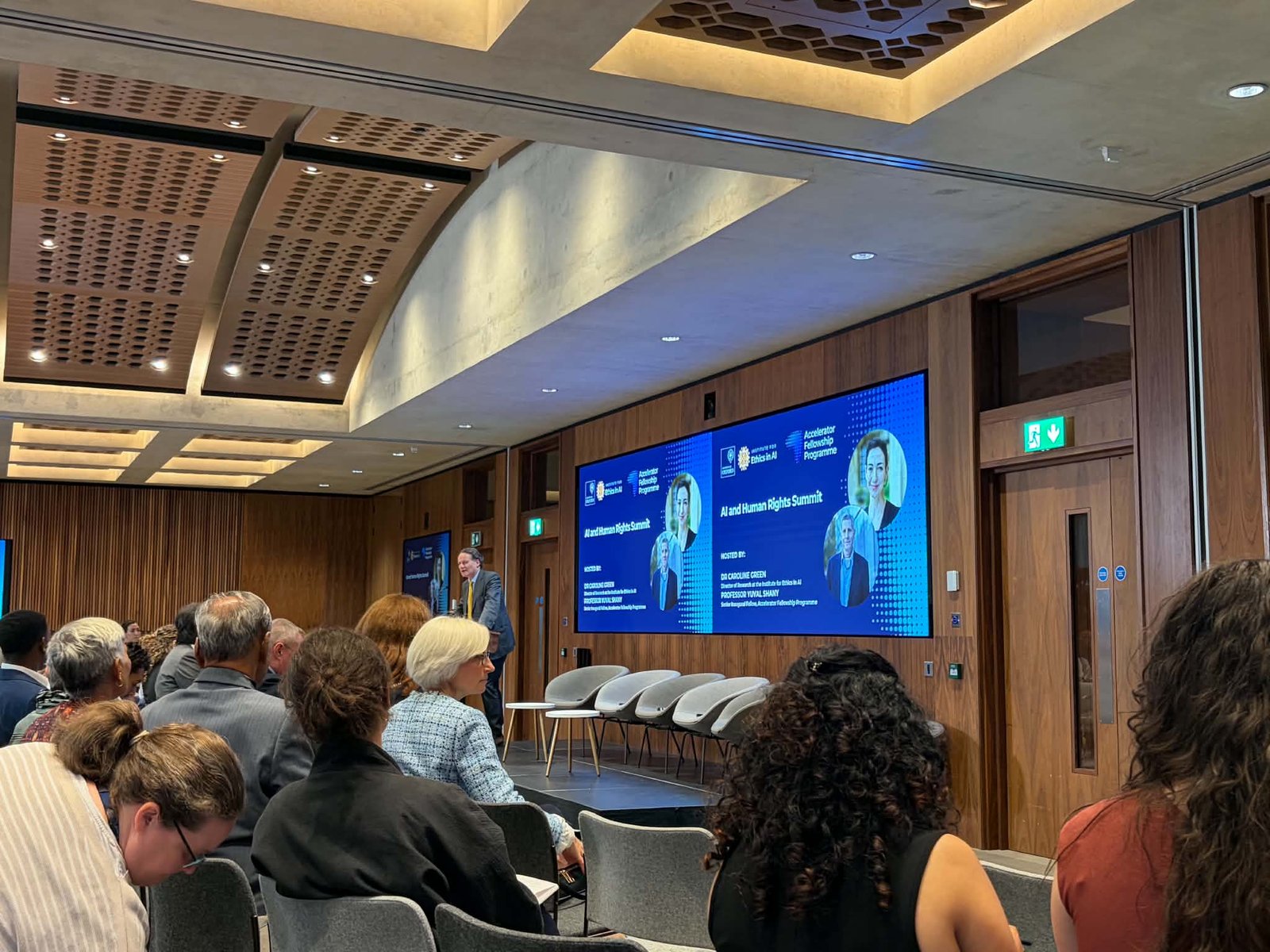
Human rights experts called for stronger legal protections against the risks posed by artificial intelligence (AI) at an Oxford AI and Human Rights Summit, with speakers arguing that human rights standards must be embedded into AI governance and technology.
The summit was hosted at the newly redeveloped Rhodes House in Oxford and organised by the Institute for Ethics in AI. It built upon Professor Yuval Shany’s consultation on a white paper, published in 2025, on the need for and feasibility of an international AI Bill of Human Rights, which proposes ways to adapt existing human rights standards so as to better address some of the unique challenges posed by AI systems and their uses.
An opening video address from the United Nations High Commissioner for Human Rights Volker Türk outlined how AI policy can keep pace with a fast-developing technology. He said that “great power demands responsibility on the same scale, and when the two don’t match, we have a problem”. Corporate control, he explained, means that AI policy stretches beyond existing national borders. He continued to praise this summit for bringing together leaders and representatives at the forefront of the discussion.
Speakers called on the UK government to establish legislation, recalling Labour’s manifesto commitment to an AI Bill of Human Rights. The panellists broadly agreed on the importance of human rights, but appeared less aligned on what enforcement should look like in practice.
In an exclusive interview, Michael O’Flaherty, the Council of Europe’s Commissioner for Human Rights, told Cherwell that political short-termism Continued on pg. 2 risks undermining efforts to address the long-term consequences of AI. “We are infected across our societies with shorttermist responses to the great issue of our societies and politics,” he said, adding that electoral cycles make it difficult for politicians “to think beyond the next election”.
O’Flaherty also noted that younger generations no longer take the international human rights system for granted. “There is no longer an assumption that the human rights system is safe, that it will survive,” he told Cherwell. He argued that political leaders increasingly treat human rights selectively, saying: “Increasingly, leaders are treating human rights, if they are respected at all, as an a la carte buffet. We take those rights because they serve our goal. We’ll ignore others because they get in the way.
The summit also heard concerns about the effects of AI-generated misinformation on communities that may have limited access to, or awareness of, the technology itself. An audience question asked human rights experts to consider the impacts of AI on populations, such as those in India, who might be unaware of its existence. The focus on the impact of AI on populations in developing countries more vulnerable to the power of big tech was a key theme of the summit.
Eileen Carter from the South African Human Rights Commission warned that underrepresentation of African languages in large language models could exacerbate existing inequalities. She also raised concerns about the effects of misinformation and deepfakes on elections, referring to more than 360 deaths associated with unrest and the amplification of narratives.
The third panel, which offered a civil society perspective on promoting human rights in AI systems, offered some hope. Across all speakers, the potential for AI to transform the beliefs that underpin human rights, including the rights to water, education, and an interpreter, was debated. When asked about AI’s potential to unravel and alter the definition of human rights, such as what is included in the ‘right to education’ O’Flaherty told Cherwell: “The damage that can be done by AI has hit more dramatically and more visibly than perhaps any other sector within education through the phenomenon of cognitive loss, of cognitive transfer. We’re only beginning to realise the extent to which we have allowed education to be fundamentally undermined for an entire generation.
“It’s time to seize that now and engage it. I’m not sure that the classic understanding of the human right to education is particularly well-framed for this extraordinary development.”
In a discussion on different countries’ regulatory approach to AI, Suresh Venkatasubramanian, professor at Brown University and former AI advisor to US President Joe Biden, argued that AI systems should not be treated as inevitable developments beyond human control. “We continue, I think, to talk about AI as a thing that emerged out of nowhere that we just have to deal with,” he said. “We forget that these aren’t coming from an alien planet and they were built by entities that choose to build them in a certain way.” He called for pressure on technology companies to make different choices about how AI systems are developed.
Questions of accountability also emerged during discussions about AI’s potential to improve access to justice. Research presented by Philippa Webb said that only 10% of people who have access to a lawyer can get one while there are thousands of bookings for an interpreter in a court covering 150 languages. However, this progress is not cemented as “general-purpose chatbots hallucinate 58% of the time on a legal task”. The use of AI in moderating legal proceedings raised fundamental questions about humanity and authority. Thompson Chengeta from Liverpool John Moores University said that “human rights is the last line of defence so when we say we want a human rights based governance… human rights is not an idea, it is an obligation. There is a gap that can only be recovered by a legally binding instrument”.
The event culminated in a panel offering an industry perspective. Co-host Dr Caroline Emmer De Albuquerque Green questioned representatives from Meta, Google, Microsoft, and OpenAI. Michael Karimian, who works in digital diplomacy at Microsoft, discussed the role of private sectors in engaging with AI, defining corporate responsibility as something which “provides transparency and identified risks”.
All companies supported having formal programmes to ensure that they have an AI policy in place. Within their own companies, they suggested protective measures such as specialised training to ensure that policies, such as whistleblowing, are understood. Alexandria Walden from Google described how consultations with stakeholders could be used to identify when the product breached users’ boundaries. These assessments, according to OpenAI’s spokesperson, “feedback into tangible technical input” and “benchmark it”.
Fundamentally, understanding the rationale behind human rights is imperative, though lacking. Alexandria Walden from Google said: “Whether or not they understand human rights, they care enough to infuse it in their company… we might not always get it right, but it is something we care about.”
Where former panels discussed controls to ensure human rights are considered in the development and implementation of AI products, this panel focused on mitigation. A spokesperson from Google pointed out that technology is inevitably going to move faster, so multiple tools are needed. Companies, OpenAI’s representative noted, still encounter issues such as discrimination and free speech. Consequently, they regard this as an additional policy which companies have a structured model to deal with, but newer companies, and newer industries, haven’t learnt it yet.
In her concluding remarks, Green called for policy makers to “make the abstract actionable” at both governmental and corporate levels. She argued that, by framing the issues posed by AI as human rights issues, we gain a “foundation” for recognising AI’s many societal impacts.
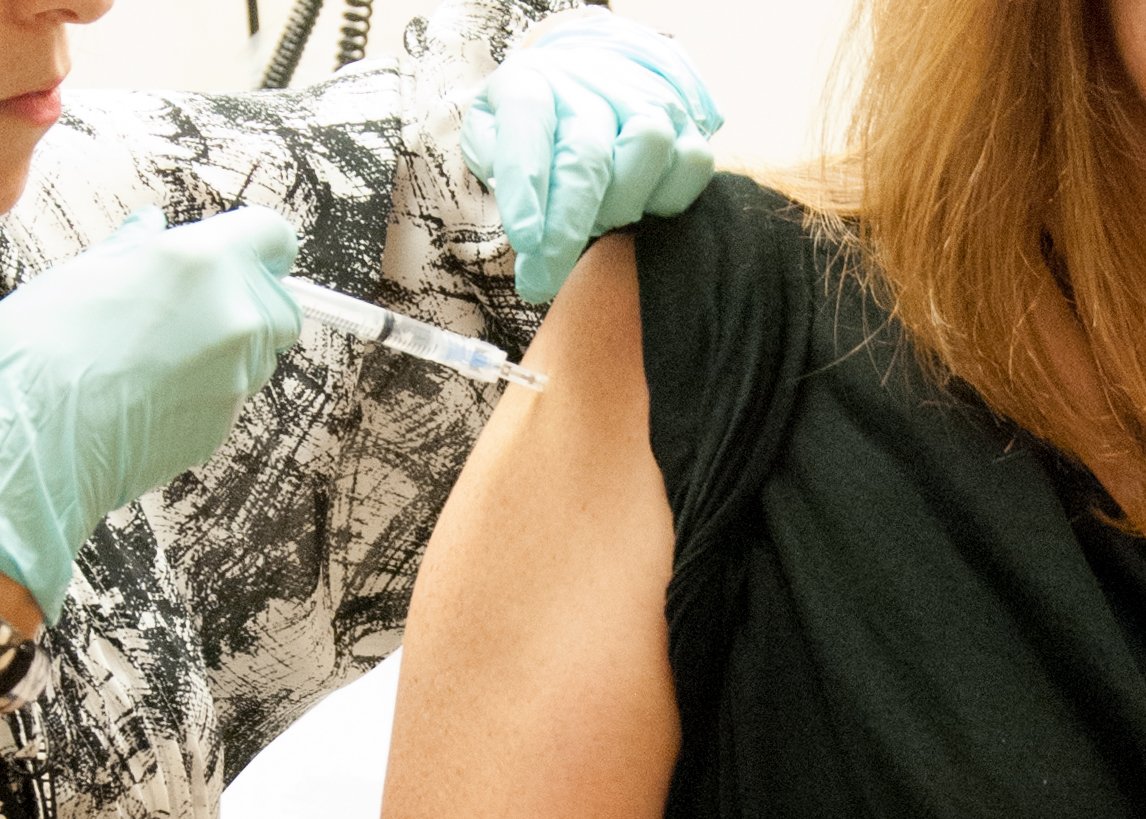
Ugandan participants in a clinical safety study received an Oxford developed Ebola vaccine this week.
Researchers vaccinated the first participants on 6th October in Masaka, Uganda. The phase follows the launch of a first-in-human Phase I trial in the UK evaluating the same vaccine candidate.
They received the vaccine as part of an evaluation of the safety and efficacy of a ChAdOx-based Bundibugyo Ebola vaccine candidate developed by the Oxford Vaccine Group (OVG) and the Pandemic Sciences Institute at the University of Oxford.
Development for this vaccine began in May this year in response to the ongoing Ebola outbreak in the Democratic Republic of the Congo (DRC). The research, led by OVG’s Professor Teresa Lambe and Professor Simon Drysdale, is funded by the Coalition for Epidemic Preparedness Innovations (CEPI). No licenced vaccine for the Bundibugyo strain of Ebola virus currently exists.
In a statement to Cherwell, OVG said its involvement includes collaborating with the Ugandan research team to support “the study’s scientific design, clinical trial coordination, safety oversight, and evaluation of vaccine safety and immunogenicity”. The Phase I clinical trial addresses a rare strain of Ebola virus affecting communities in the DRC since May. The phase is a collaboration between the Medical Research Council/ Uganda Virus Research Institute and the London School of Hygiene and Tropical Medicine (LSHTM).
Dr Nicole Lurie, CEPI’s Executive Director for Emergency Preparedness and Response, told Cherwell: “It [the Bundibugyo outbreak] remains the fastest-growing and second-largest Ebola outbreak ever recorded – and we currently remain without a licensed vaccine or treatment.” The Bundibugyo Ebola epidemic in the DRC has surpassed 8,600 cases, with almost half of infections proving fatal.
The outbreak was declared a Public Health Emergency of International Concern (PHEIC) by the World Health Organisation (WHO) in May.
OVG told Cherwell: “For more than a decade, the University of Oxford has performed many clinical trials of candidate viral-vectored vaccines. Some of the most promising vaccines used a modified chimpanzee adenovirus, a harmless version of a common cold virus. The Oxford-AstraZeneca (ChAdOx1) COVID-19 vaccine was approved for emergency use in the UK in December 2020 and was estimated to have saved six million lives during 2021 alone, and over 3 billion doses were used worldwide.” The adenovirus vector vaccine technology trialled in this study was successfully used worldwide as part of the Oxford-AstraZeneca COVID-19 vaccine.
More funding is necessary to ensure the development and approval of the Ebola vaccine. Lurie told Cherwell: “Without sufficient additional funding, we are at risk of not being able to develop these promising vaccine candidates… CEPI urgently needs US$128M now to keep our Bundibugyo emergency R&D response moving. Without it, we are putting the DRC, and the world, at tremendous risk.”



-

 Oxford united FC4 weeks ago
Chris Gunter steps away Wales role to focus on Oxford United
-

 Oxford University3 weeks ago
New to the Oxford English Dictionary this September
-

 Oxford united FC1 week ago
LIVE: Exeter City vs Oxford United – Jersey Mike's Trophy group stage
-

 Traffic & Transport2 weeks ago
How poor public transport policy is putting the brake on cities | Road transport
-

 Student Life3 weeks ago
Oxford partnership allows OpenAI to use rare Bodleian texts to train ChatGPT
-

 Traffic & Transport2 weeks ago
Why should I have to pay more for buses if I don’t use a smartphone? | Bus fares
-

 Oxford united FC2 weeks ago
Northern Ireland fans laud Oxford United defender Ciaron Brown
-

 Oxford Events4 weeks ago
Four days of equestrian spectacle at 2026 Blenheim Palace International Horse Trials