Student Life
Twelve Oxford colleges do not pay all staff the Oxford Living Wage
At least twelve Oxford colleges were not paying all staff the Oxford Living Wage (OLW) as of their most recent financial year, Cherwell can reveal.
Balliol, Brasenose, Harris Manchester, Oriel, Regent’s Park, St Anne’s, St Catherine’s, St Edmund Hall, St Hilda’s, St Peter’s, Trinity, and Wolfson all paid their lowest-earning employees less than £13.16 per hour, the OLW set for 2025-26. Reuben has not yet responded to Cherwell’s Freedom of Information request.
The OLW is a voluntary hourly rate, distinct from the government’s minimum, that, according to its website, reflects the “real cost of living and working in Oxford” – the UK’s secondmost expensive city. Introduced by Oxford City Council in 2018, the OLW is set at 95% of the London real Living Wage, a different hourly rate calculated by the Living Wage Foundation.
The OLW stood at £13.16 per hour in 2025-26, rising to £14.06 per hour in April 2026-27. Meanwhile, in 2025-26, the UK real Living Wage sat at £12.60 per hour and the London real Living Wage at £13.85, before respectively increasing to £13.45 and £14.80 per hour for 2026-27.
In 2020, the University of Oxford committed to paying all staff at least the OLW. However, as Oxford colleges are independent employers, the University’s pledge did not extend to them.
Among the twelve colleges that did not pay all staff the OLW, the share of staff receiving it varied. At St Peter’s and Wolfson, just 46% and 54% of staff were paid at least the OLW, while 98% of staff at St Catherine’s and Trinity were paid it.
Who gets left out
The headline figure, however, obscures variations in pay across staff groups. Across the twelve colleges, academic and administrative staff were mostly paid at or above the OLW threshold. Pay below the OLW threshold was concentrated predominantly among casual employees – non-permanent employees typically without guaranteed hours – and, among them, those who work in catering, facilities/maintenance, and security.
For instance, Wolfson paid casual security employees £12.21 per hour, but their full-time and part-time counterparts at least £15.55 per hour, with a ceiling of £21.68. At St Hilda’s, casual catering, facilities/maintenance, and security staff earned £12.60 per hour, even as equivalent permanent staff made at least the OLW of £13.16 – a difference of 56p per hour.
Staff in catering, facilities/maintenance, and security were among the lowest-paid groups in 13 of the 20 colleges that provided sufficient data. For the remaining seven colleges, some administrative employees earned the same as, but not less than, catering, facilities/maintenance, or security staff.
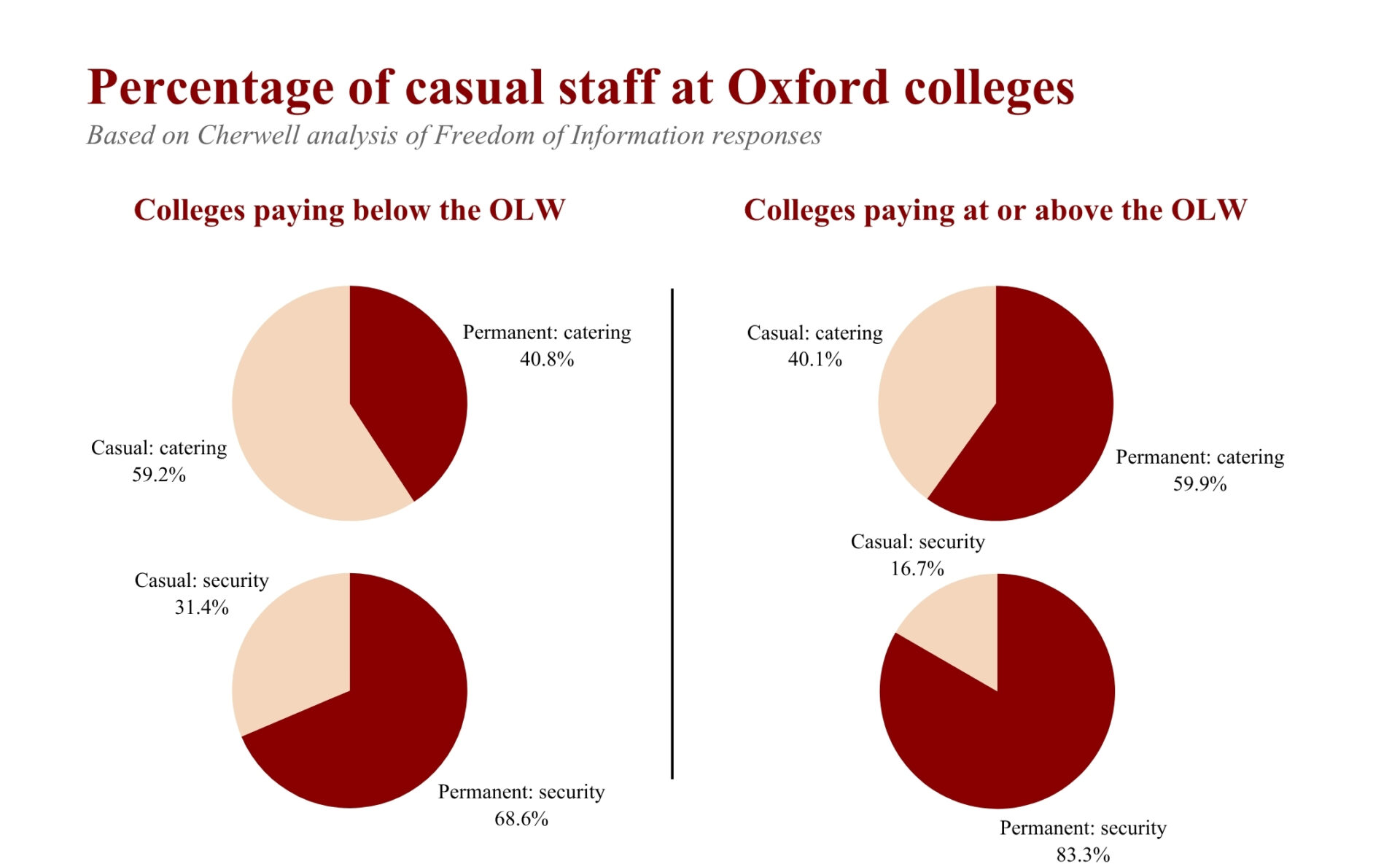
The colleges that did not pay all staff the OLW also tend to rely more on casual employees. For example, excluding St Catherine’s, which did not provide a full breakdown by contract type, the non-OLW colleges employ 321 of their 542 catering staff – 59% – on casual contracts. In comparison, among colleges that met OLW, 40% of catering staff are on casual contracts. The same colleges also employ 17% of their security on casual contracts, compared to 31% at colleges that do not pay the OLW.
The casual hourly rate, moreover, does not capture the full extent of the pay gap. Cherwell’s data found that casual workers across a number of colleges are excluded from benefits above the statutory minimum. At St Hilda’s, for example, all staff but casual staff have access to free eye tests, healthcare, dental care, a contribution towards glasses, and a cycle scheme.
Research by the Living Wage Foundation has found that casual and other insecure employees are as disproportionately likely to be younger, older, and from minority ethnic backgrounds. Accommodation and food services – the sector that most closely maps to college catering and facilities/maintenance work – also accounts for the second-highest percentage of insecure work in the UK. Cherwell does not hold data on the age or ethnic makeup of casual employees at Oxford colleges.

The bigger picture
Of Oxford’s 39 colleges and four permanent private halls (PPHs), 16 hold formal accreditation as OLW employers from Oxford City Council. Accreditation, which is overseen by the council, requires employers to pay all staff based in Oxford at least the OLW and implement the respective annual pay increases. Accredited employers are also listed publicly on the council’s website.
Beyond the 16 accredited employers, a further 15 colleges and PPHs pay all staff the OLW without formal accreditation. As a result, the number of collegiate OLW employers has grown more than fourfold since 2020, when Cherwell previously found just eight to be paying all staff the OLW, although that figure includes St Benet’s, a PPH which closed in 2022.
Several colleges also noted that, while they did not pay all staff the OLW, they met the threshold for all permanent employees. For instance, a spokesperson for Harris Manchester told Cherwell that the college has a “policy of paying the Oxford Living Wage for all full-time or part-time members of staff”. St Anne’s, St Catherine’s, and St Hilda’s referenced similar policies.
More colleges also said they meet at least the real Living Wage threshold for all staff. A spokesperson for Regent’s Park told Cherwell the real Living Wage “is the minimum we pay to all staff, irrespective of contract type or age”. St Anne’s, St Edmund Hall, St Hilda’s, and St Peter’s likewise confirmed to pay all staff at least the real Living Wage.
A spokesperson for Brasenose, meanwhile, told Cherwell that “the college is committed to ensuring that pay levels remain fair, competitive, and appropriate to the roles undertaken”, adding that it undertakes regular benchmarking and at least one salary review per year. “While not all roles may align precisely with the Oxford Living Wage”, the spokesperson told Cherwell, the college still provides “a range of additional benefits … that are highly valued by staff which go beyond basic pay”, including generous leave, pensions, and free lunches.
Likewise, a spokesperson for Regent’s Park told Cherwell the college “places the highest value on its staff and recognises the essential contribution they make”, and that the college is “committed to fair pay for everyone who works here”.
In response to Cherwell’s findings, Councillor Chewe Munkonge, Cabinet Member for a Healthy, Fairer Oxford, told Cherwell: “When employers commit to paying the Oxford Living Wage, they’re making a meaningful difference to the lives of thousands of local people and we want as many businesses as possible to sign up.
“Many Oxford colleges are already accredited and, as major employers in our city, this is fantastic for the thousands of people working there. I would encourage any colleges that are contemplating it to speak to those already doing it or reach out to our team to find out more. Together, we can make Oxford a fairer city for everyone.”
Balliol, Harris Manchester, Oriel, St Edmund Hall, Trinity, and Wolfson were contacted for comment.