
Student Life
Tommy Robinson’s invitation to Oxford Union met with protest: Live updates

Background
Stephen Yaxley-Lennon, who calls himself Tommy Robinson, is due to speak at the Oxford Union at 8:30pm this evening at a debate on the motion “This House believes the West is right to be suspicious of Islam”. The event has drawn condemnation from University societies, local politicians, and local faith leaders.
The debate comes days after Yaxley-Lennon was detained at Heathrow Airport on Saturday evening under the Counter-Terrorism and Border Security Act 2019, following his return to the UK from Russia. His phones were seized, but no further action has been announced by the Metropolitan Police.
Thames Valley Police (TVP) has confirmed a significant policing operation across Oxford city centre from 3:30pm today. St Michael’s Street, where the Oxford Union is located, has been closed to vehicles and pedestrians since 4pm, and will remain shut until 11pm. Despite earlier statements, it has been confirmed that no other roads will be closed.
Businesses in the city centre have also been closing early: The White Rabbit pub announced in advance it would shut from 3:30pm, citing safety concerns and solidarity with other independent businesses. The Handlebar Kitchen on St Michael’s Street closed at 3pm – their pavement licence was revoked for the day. Activate Learning, which runs further education colleges in the area, has also written to parents and carers advising students to avoid large gatherings and allow extra time for journeys through the city centre.
In a statement, Oxford City Council Leader Susan Brown has raised the question of the cost of the large-scale security operation. She wrote that the Oxford Union “must meet the full costs of staging their event, rather than leaving Oxford’s taxpayers to pick up the bill”. The Oxford Green Party has also issued a statement, demanding that the Oxford Union “cover the entire cost of the security operation it is requiring” and that “compensation be paid by the society to local businesses forced to board up their windows and close”. Cherwell has previously reported that the Oxford Union is just years away from insolvency.
The Oxford University Islamic Society issued a formal statement warning that the invitation posed a direct threat to Muslim students’ safety, arguing that “extending a platform to individuals whose reputations are built upon targeting minority communities is not without consequence”. A group of Oxfordshire Liberal Democrat politicians, including MP for Oxford West and Abingdon Layla Moran, have also called on the Union to reflect on whether proceeding “was consistent with “the values of respect, inclusion, and community cohesion that Oxfordshire strives to uphold”.
Individual colleges at the University of Oxford have announced that they will remain closed to the public this afternoon, and have reached out to remind their students to take the requisite precautions. Wadham College, for example, urged students to “please act responsibly, stay safe and vigilant and take the disruption into account when planning your afternoon and evening”.
The debate is due to feature Laurence Fox and Jonathon Sacerdoti (alongside Yaxley-Lennon) on the proposition, and Jacob Rees-Mogg, Abdullah Al-Andalusi, and Michael Doward on the opposition.
Defending her decision to invite Yaxley-Lennon in an article in The Telegraph, Elrayess wrote: “For more than 200 years, the Oxford Union has existed to host debates – not to platform views uncritically, but to subject them to the most rigorous scrutiny. You do not invite a speaker to endorse them: you invite them so that their ideas can be examined, and their claims tested.”
A spokesperson for the Oxford Union previously told Cherwell that the Union gives “members the opportunity to challenge…a broad range of speakers” and “only host[s] speakers who agree to be challenged”.
The University of Oxford has shared a reminder that “welfare services are available to support all students”.
Updates at 5:15pm:
A white van was seen entering the Union from New Inn Hall Road, prior to the arrival of any protesters.
Updates at 5:45pm:
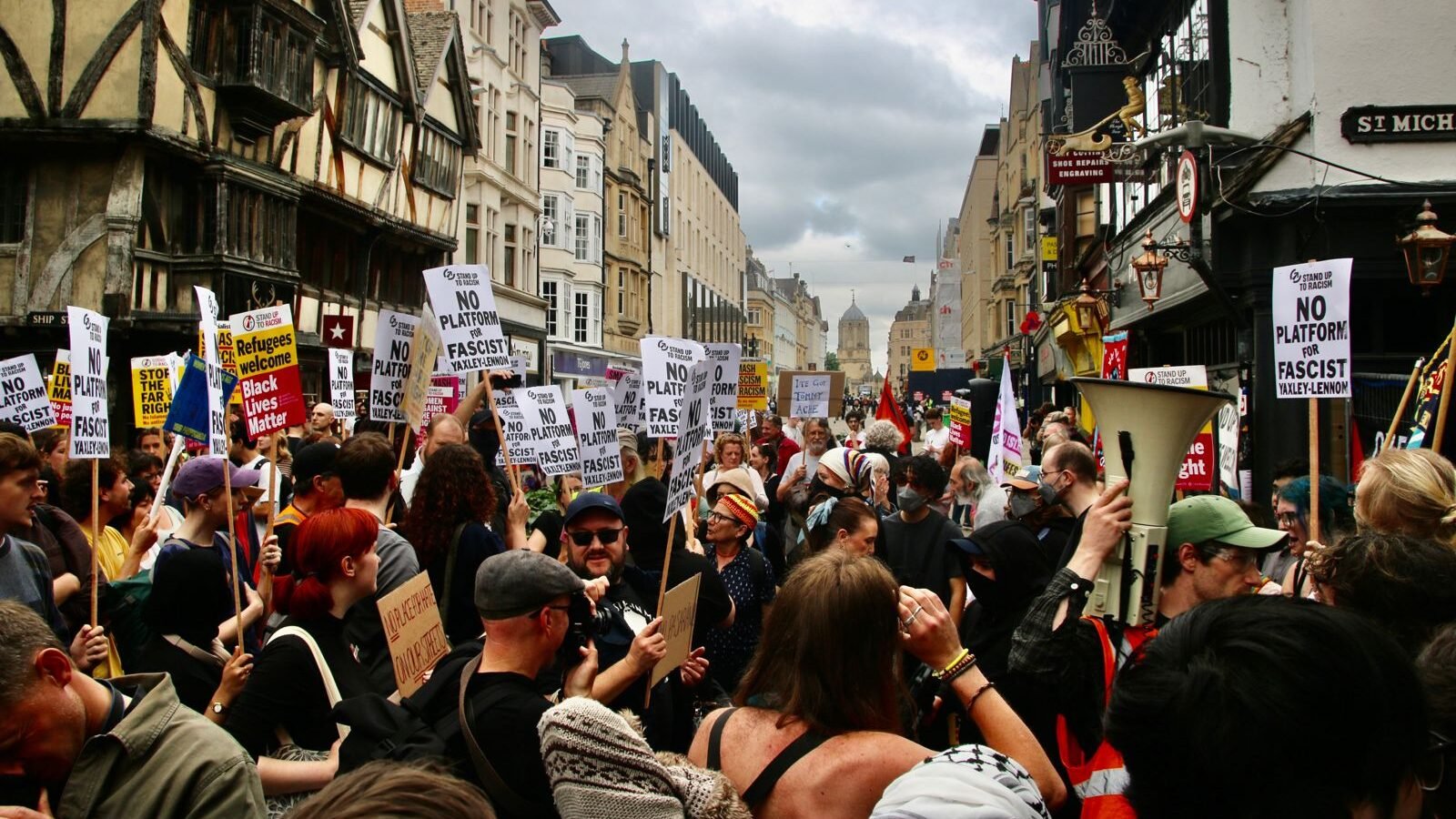
Despite intense police presence, around 60 people started to gather on St Michael’s Street, as growing crowds surrounded the entrance to the Oxford Union around Cornmarket Street. Organisers from Oxford Stand Up to Racism were seen handing out leaflets and signs to passersby.
A spokesperson for Oxford Stand Up to Racism told Cherwell: “I expect a lot of people to come out for this protest, and we’re going to take back the streets for unity and for the safety of all our people.
“Tommy Robinson is not here for political debate, and it’s wrong to legitimise his views that he’ll be espousing as political ideas. By the strength of our numbers, we can prevent this horrible debate, which is a televised pantomime to whip up racism.”
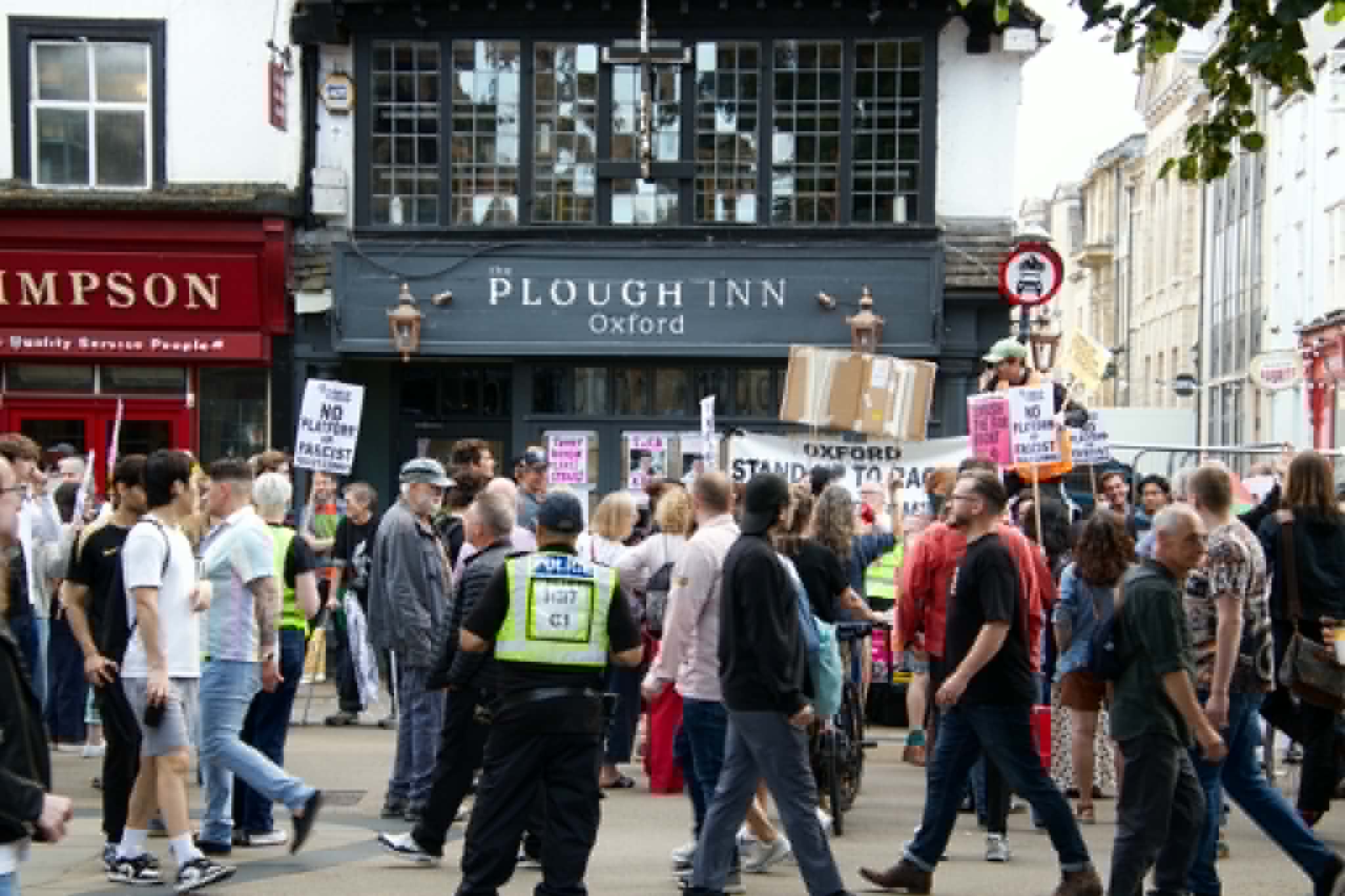
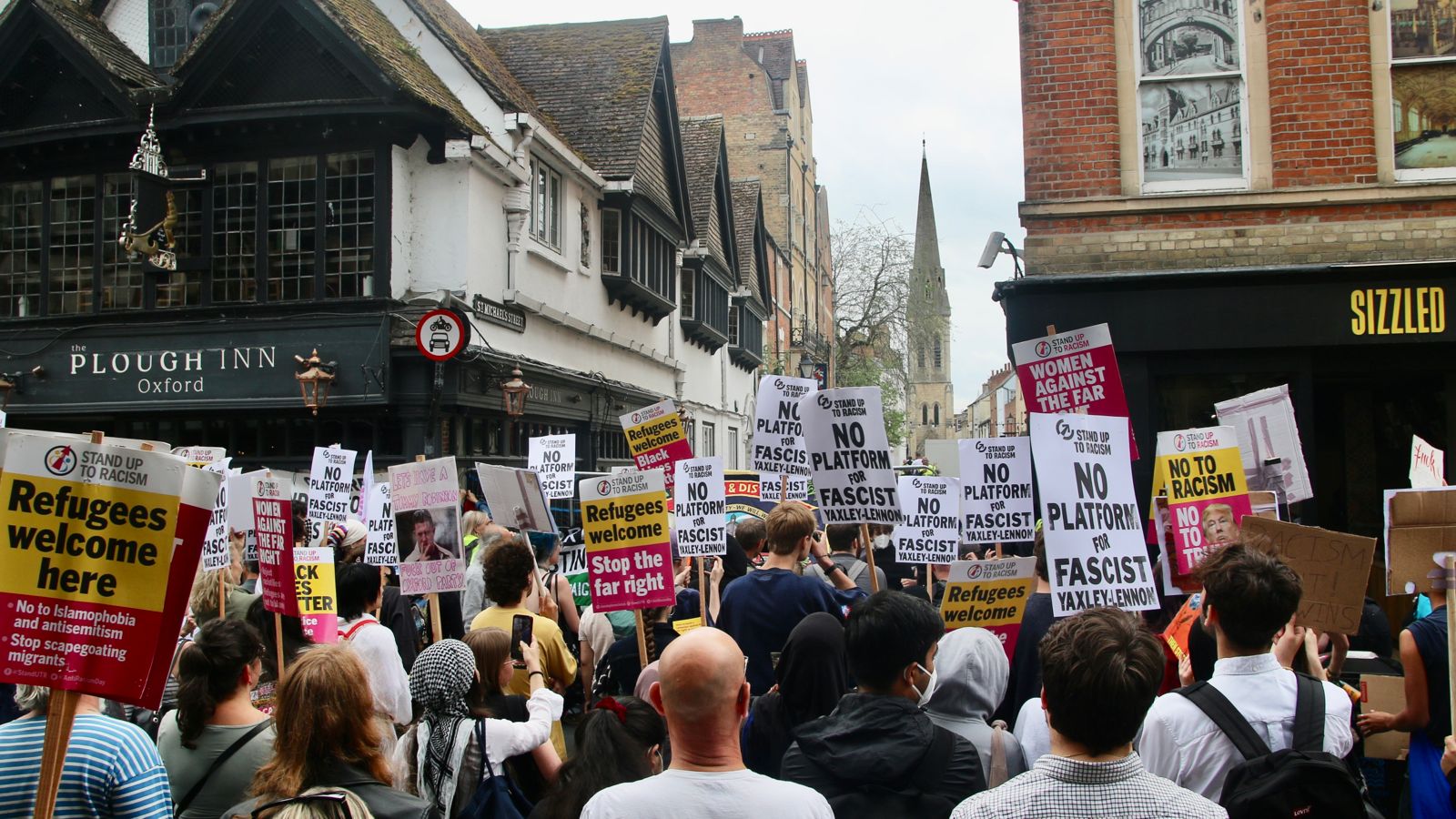
Protesters carrying placards continued to arrive, with chants amplified through megaphones including: “This isn’t debate, you’re spreading hate”, and “Nazi scum, off our streets!”. Thames Valley Police remained at the scene and prevented people from entering the area.
At the junction of New Inn Hall Road and St Michael’s Street, another group of anti-fascists assembled, in a demonstration organised by Oxford Resists in collaboration with societies including Oxford Action for Palestine, Oxford Students Palestine Solidarity, and Oxford DIY Pride. The majority of these protesters appeared to be students.
A first-year Oxford student, when asked about their reasons for attending the protest, told Cherwell: “One of my friends expressed concern for their safety, off the back of Tommy Robinson speaking at the Union, and all the demonstrations, particularly the far right demonstrations, I know she can’t even come today at all, and I’m in a position to be here safely.
“With exams going on and with such a busy time [in Oxford], the presence of Tommy Robinson and his supporters in Oxford has really scared some people.”
A member of Oxford Students Palestine Solidarity told Cherwell: “We’re here to fight against fascism, and we’re here to fight for our Muslim brothers and sisters. The entire idea of this debate is to oppress the Muslims in this city and everywhere… this is extremely dangerous for Muslims across Oxford and across the world.”
Updates at 6:15pm:
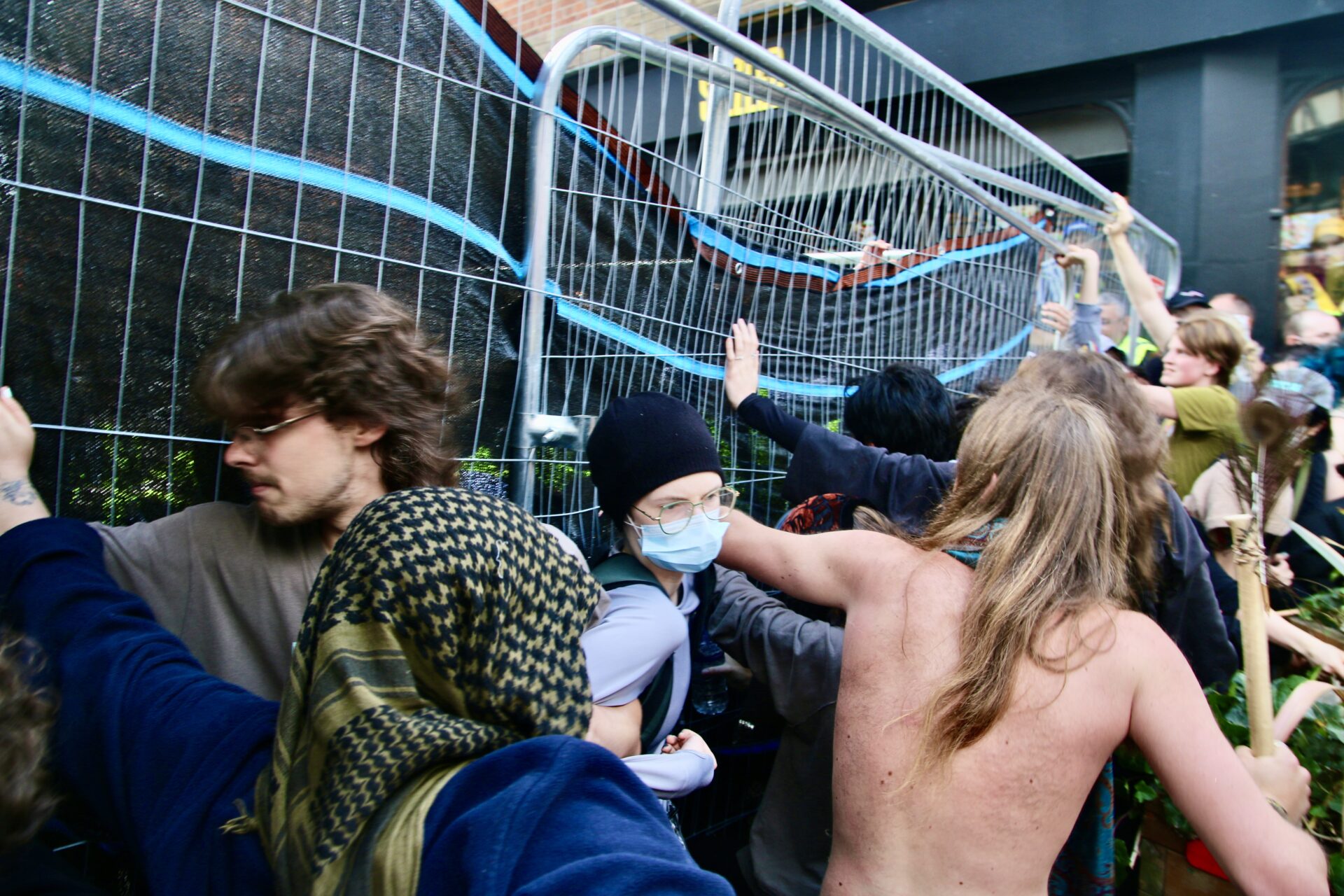
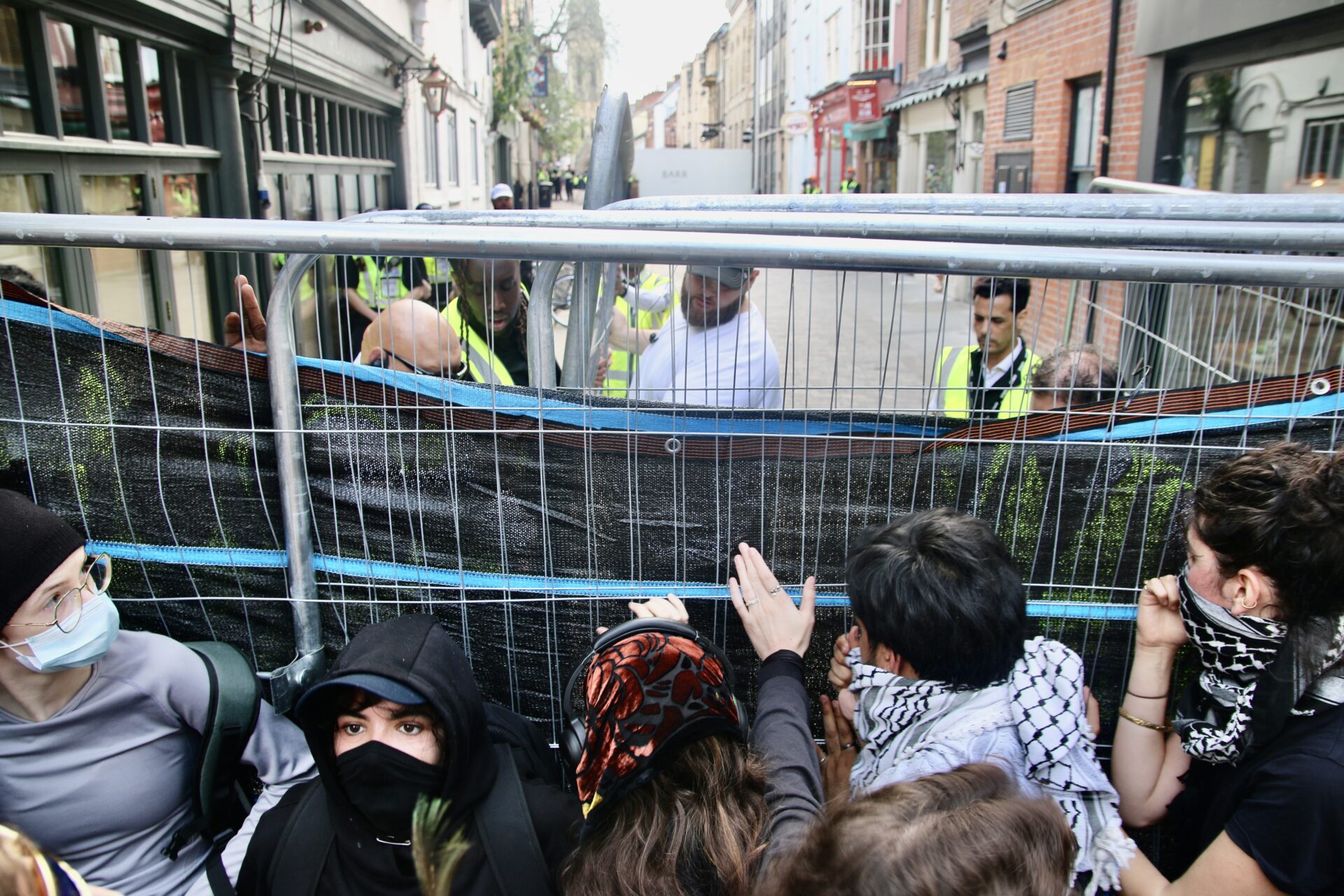
Numerous protesters attempted to push past the barricades blocking access to St Michael’s Street, and were met by security forces preventing entry. This altercation formed a focal point of the protest, and continued throughout the evening.
On nearby George Street, one man was seen by onlookers to have climbed the scaffolding of a building, in what appeared to be an attempt to get closer to the Union itself.
At this point, the number of anti-racist protesters seemed to outnumber pro-Robinson protesters around five to one, with repeated cries of “Oxford is anti-fascist” emerging from the crowds. Representatives from multiple different groups could be seen joining Stand Up to Racism, including Oxford Green Party, the National Education Union, and Oxfordshire NASUWT.
A second year student among the anti-fascist protesters told Cherwell: “I’m here at this protest, along with 700 other people, proud anti-racist, anti-fascists, to show the Oxford Union that they cannot divide our city, they cannot divide our university, they cannot divide our community by platform of hate. Free speech is different to hateful language.”
Meanwhile, a small group of Communist activists gathered with flags outside the Weston Library, slightly removed from the chaotic action on Cornmarket Street.
In Bonn Square, a group of counter-protesters began to assemble, including the Oxfordshire Patriots. Within a short time, they started to move towards both New Inn Hall Street and Cornmarket Street.
Speaking to Cherwell, Aiden Noble, head of the Oxfordshire Patriots, said his group had attended the protest to support the Oxford Union’s decision to host Tommy Robinson. Noble told Cherwell: “Just because Tommy’s got his views, we shouldn’t be silencing him, we should be allowing him to speak what he wants to speak, whether it’s right or wrong, or somewhere in the middle.
“Sometimes I listen to him and I think ‘You’re an idiot, mate’, do you know what I mean? But a lot of the things he’s been saying recently, people are seeing it.”
Updates at 6:45pm:
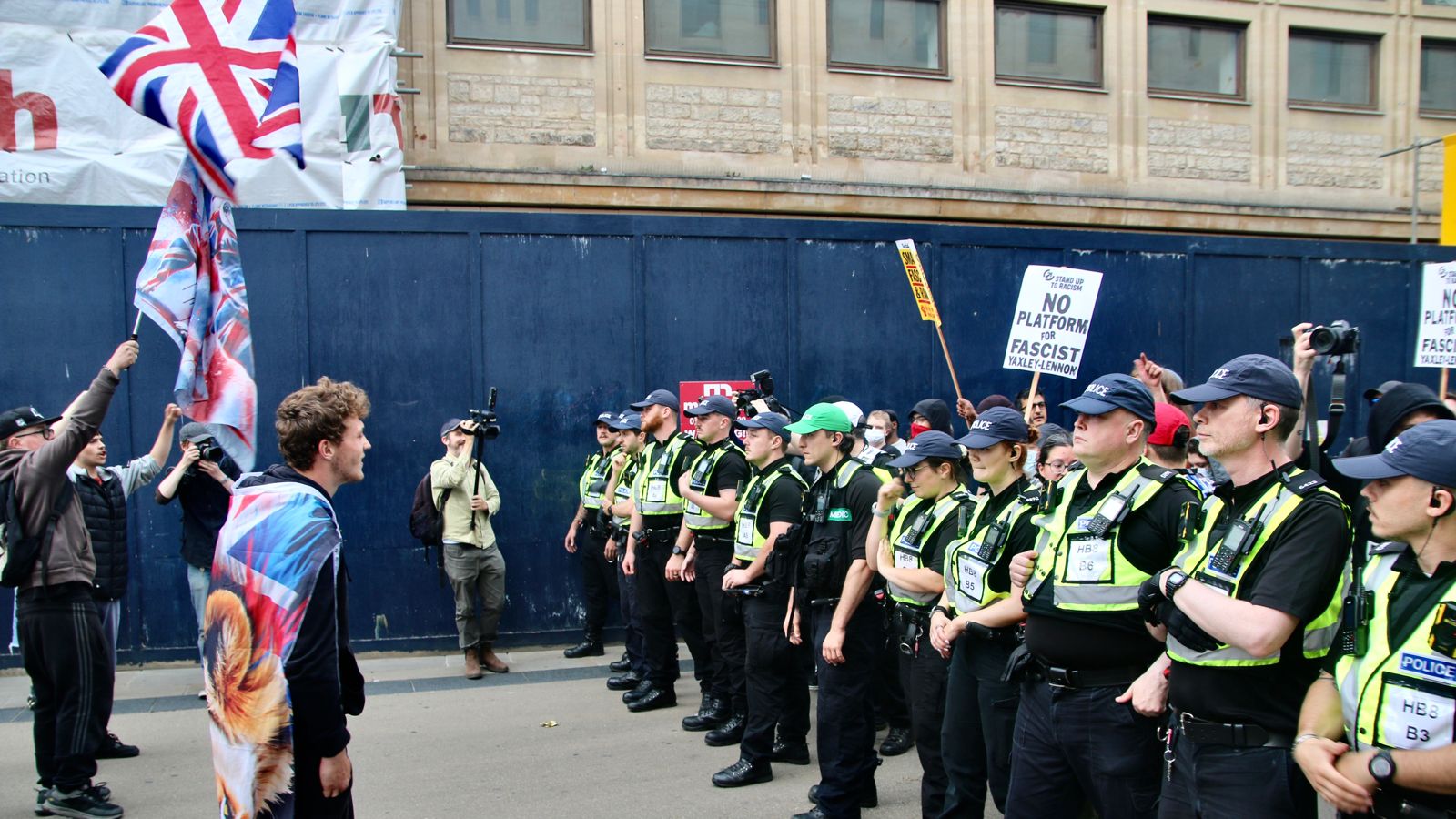
Increasing numbers of demonstrators bearing Union Jack flags continued to arrive on New Inn Hall Street. Police established a large cordon separating the protesting groups, with officers maintaining a visible presence as crowds grew on both sides.
Confrontations between protesters started to arise on New Inn Hall Street as police tried to stop demonstrators’ attempts to get closer to St Michael’s Street. As this took place, Aiden Noble was seen shouting for his fellow protestors to pull back.
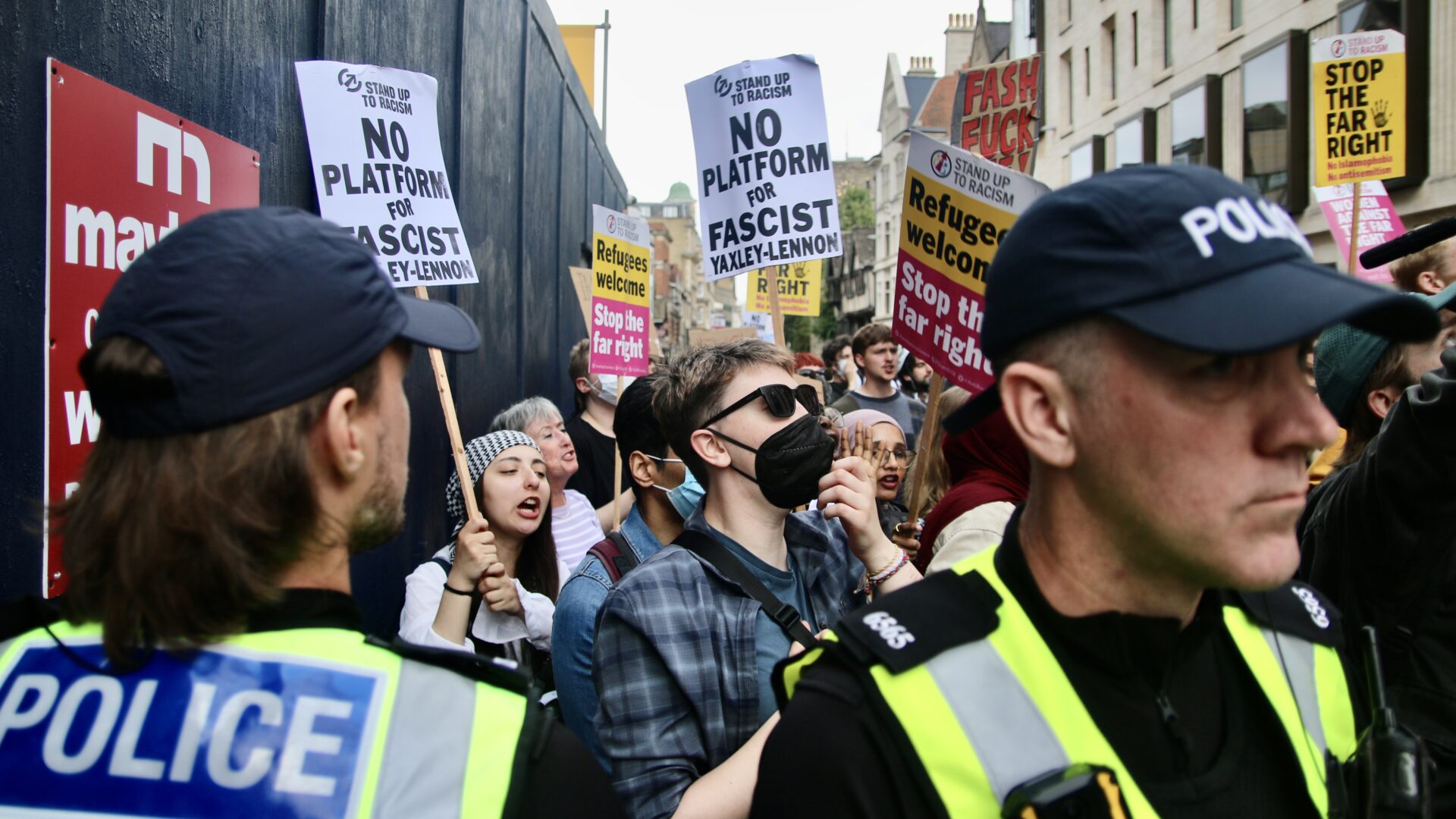
Shortly after this, balloted members of the Oxford Union also arrived on New Inn Hall Street, but were unable to get to the entrance of the event on account of the amount of overcrowding.
Soon after, a large police wall formed on Cornmarket Street in an attempt to separate the opposing protest groups. While this operation took place, police presence on the corner of Market Street continued to increase, as two more lines of police arrived to shut down rising confrontations between the opposing groups of protesters.
Updates at 7:45pm:
As the entrance on St Michael’s Street continued to be blocked, a human wall began to form around the entrance to Plush nightclub, as some attempted to enter the Union from this direction. More police subsequently arrived at the scene, as the police cordon on Cornmarket remained unbroken despite the mounting pressures from demonstrators.
By this point, anti-fascist numbers appeared to have increased to around 500, still significantly outnumbering their pro-Robinson counterparts.
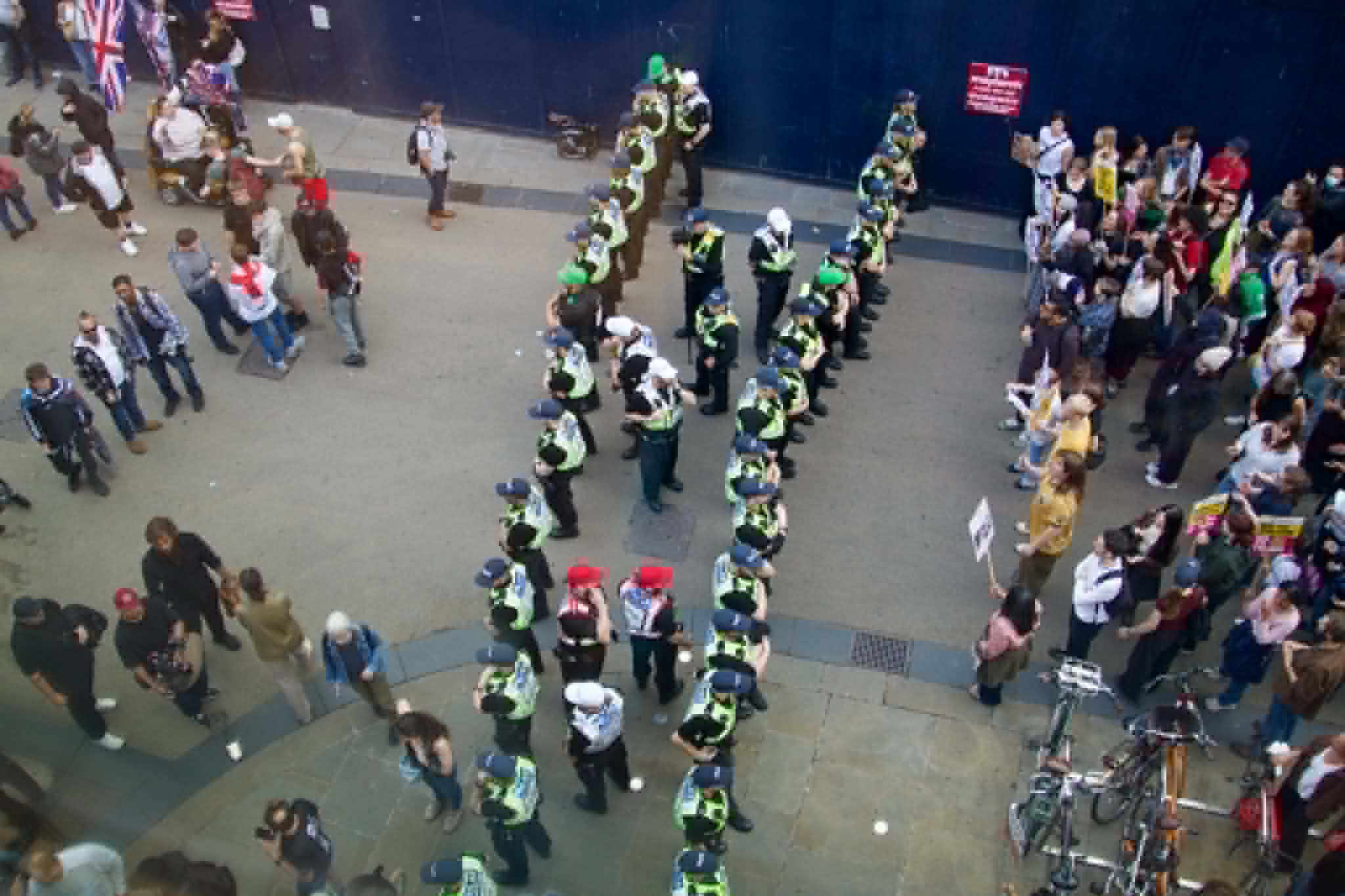
Tensions persisted at the barrier blocking the end of St Michael’s Street, where sporadic confrontations continued as still the police prevented the public from entering. At this point, it remained largely unclear how many people had made it inside the chamber for the debate itself, beginning at 8:30pm.
At approximately 8:32pm, an anonymous Union committee member confirmed to Cherwell that the debate was still going ahead as planned.
Very shortly afterwards, another anonymous committee member told Cherwell that there were “believed to be around 20–30 people in the building in total”, with only “single digits” having made it through the blockades. The source added that this included junior officers who were “being prevented from entering”.
A former Junior Officer in the Union, when talking to Cherwell, condemned the conduct of the Union Committee throughout the lead-up to the event: “The concerns of members have been completely ignored. The concerns of minority communities have been ignored. The safety of members has been ignored. Despite pleas from the council, the police, faith leaders, it was all ignored by a group of people who, I think pushed this debate for more ideological purposes… I say that not only is the event a disgrace, but the conduct of the current leadership of the Union is disgraceful.”
Shermar Pryce, formerly Chief Advisor to the President who resigned following the invitation to Yaxley-Lennon, spoke to Cherwell about his disappointment with Elrayess: “I think she should genuinely not only be embarrassed, but she should be apologetic to the students of Oxford, the local authorities, and the Oxford Union itself, and all of its members.”
Update at 9pm:
Footage from inside the Union seen by Cherwell revealed that the chamber was largely empty, as members waited for the debate to begin. Individuals who had successfully ballotted, including Union officers, continued to be unable to enter. The Union Treasurer, Milo Donovan, supposed to preside over the debate, was similarly unable to enter.
A former Union Committee member told Cherwell that the mishandling of the situation by the Union is “a very bad look, not just for the Union, but for the city itself, to think that this is the image that we’re putting out there for our city, for our university, for our community.”
In a reply on X to Jacob Rees-Mogg’s appeal to allow people into the Union, Thames Valley Police said: “The decision to suspend entry to the event was taken by the event organisers, not the police.”
Yaxley-Lennon posted a picture of protestors on X, with the caption: “When these lot want me to be quiet. I know I must keep speaking. Louder. Whatever the cost.”
Update at 9:50pm:
The debate finally started, although nearly an hour and a half later than the expected 8:30pm slot. The slightly quieter sound of protest could still be heard from the chamber.
In a recording heard by Cherwell, Yaxley-Lennon argued that Islam lacks “common ground” with other religions in his speech. He cited the death penalty for homosexuality in some countries as his primary example of this, claiming that “four of the five major schools of Islamic law think [homosexuality] should be punished by death.”
Updates at 11.10pm:
Cherwell understands that the final opposition speaker, Laila Nasher, a student, was unable to enter the Union building. Arwa Elrayess stepped in to speak in her place. An anonymous source in the Union told Cherwell that Elrayess pushed against Yaxley-Lennon, accusing him of redirecting anger towards Muslims and minorities.
Update at 1:10am:
The last guests were seen leaving the Union, as St Michael’s Street was reopened to the public and police dispersed.
The results of the debate, posted on the Oxford Union Instagram, show a victory for the opposition, with 33 votes, from members voting with membership cards and 30 votes for the proposition.
Reporting by Beatrix Arnold, Mercedes Haas, Ned Remington, and Hattie Simpson.
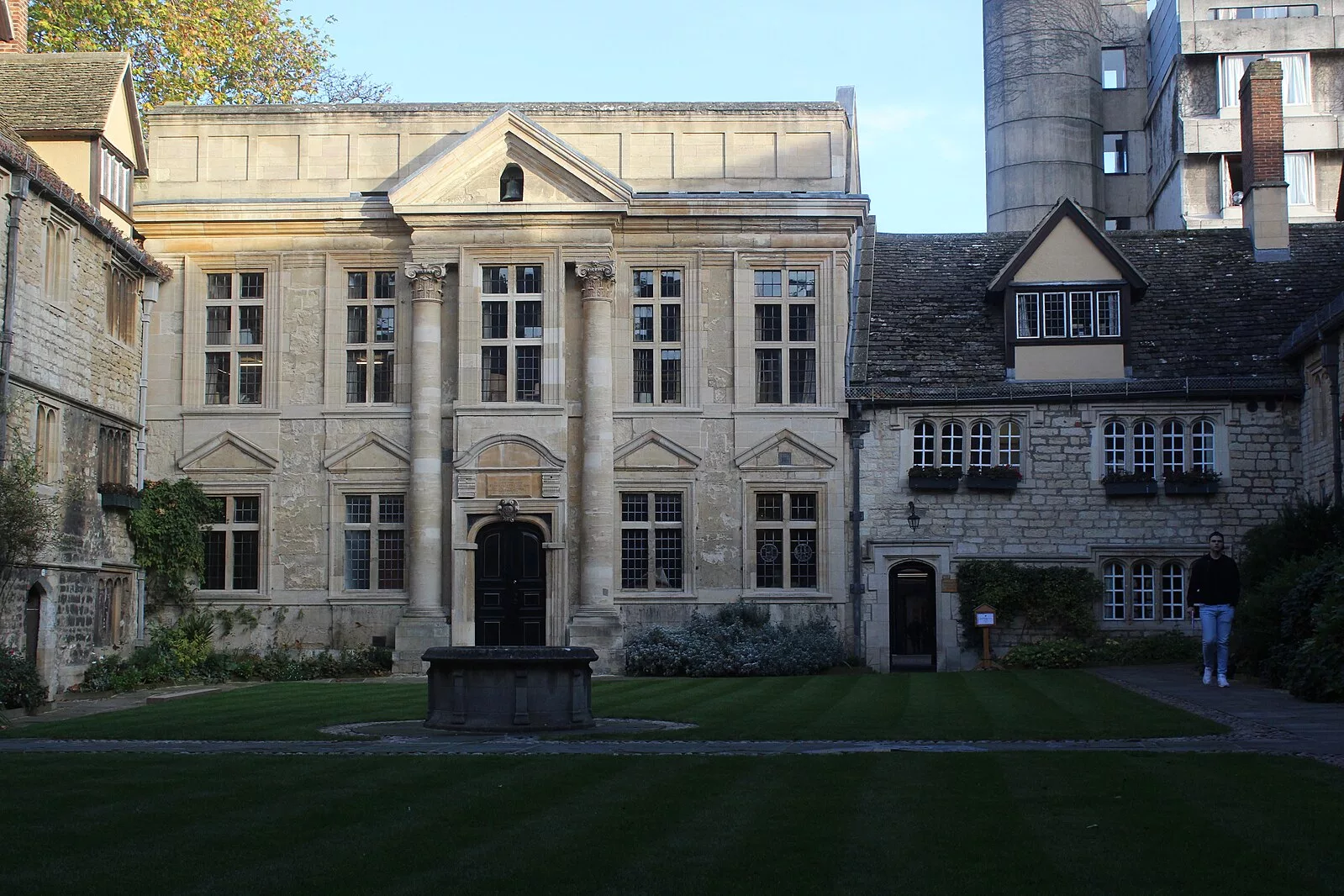
St Edmund Hall has opened new, sustainability-focused accommodation in Norham Gardens, one of Oxford’s most affluent neighbourhoods.
The College describes the buildings, which took three years to construct, as an “exemplar” of sustainability. Designed by architects Wright & Wright LLP, they are certified with a Passivhaus standard, widely regarded as the industry benchmark for energy efficiency, and were built using “sustainably sourced and low-embodied carbon materials”. According to a press release on the Teddy Hall website, the buildings will use 70% less energy than the typical modern building.
It contains 127 en-suite study rooms, split across three new buildings: Willis House, Ashton House, and Elliott House, on the nearly 50-year-old Norham St Edmund site. The buildings, which back onto University Parks, are powered at least in part by solar panels and are heated by air-source heat pumps.
The rooms include heated towel racks, big double beds, and dimmable lights. Despite the luxury, the College kept the nightly rate in line with the rest of its Norham housing. The College told Cherwell that it “recognises the need to keep rents as low as possible” and that its accommodation costs are “below the median of all Oxford colleges”. By that standard, tenants are expected to pay around £30 a night.
Rooms on the site will be reserved for Teddy Hall returning undergraduates. They will not be available to postgraduates and, by extension, not be offered through the Oxford University Collegiate Accommodation System, now in its second year of opening college rooms to students from other colleges. The accommodation will allow Teddy Hall to accommodate all undergraduates for their whole degree.
The development’s outdoor spaces are boasted as climate-resilient and biodiverse, with landscaped gardens and lawns. For budding geographers and biologists, the most intriguing feature may be an ecology pond.
Chancellor William Hague said in a press release: “Norham St Edmund is a world-leading blueprint for future student accommodation projects and sustainable building design, both in Oxford and beyond. I look forward to seeing it serve a thriving college community for generations to come.
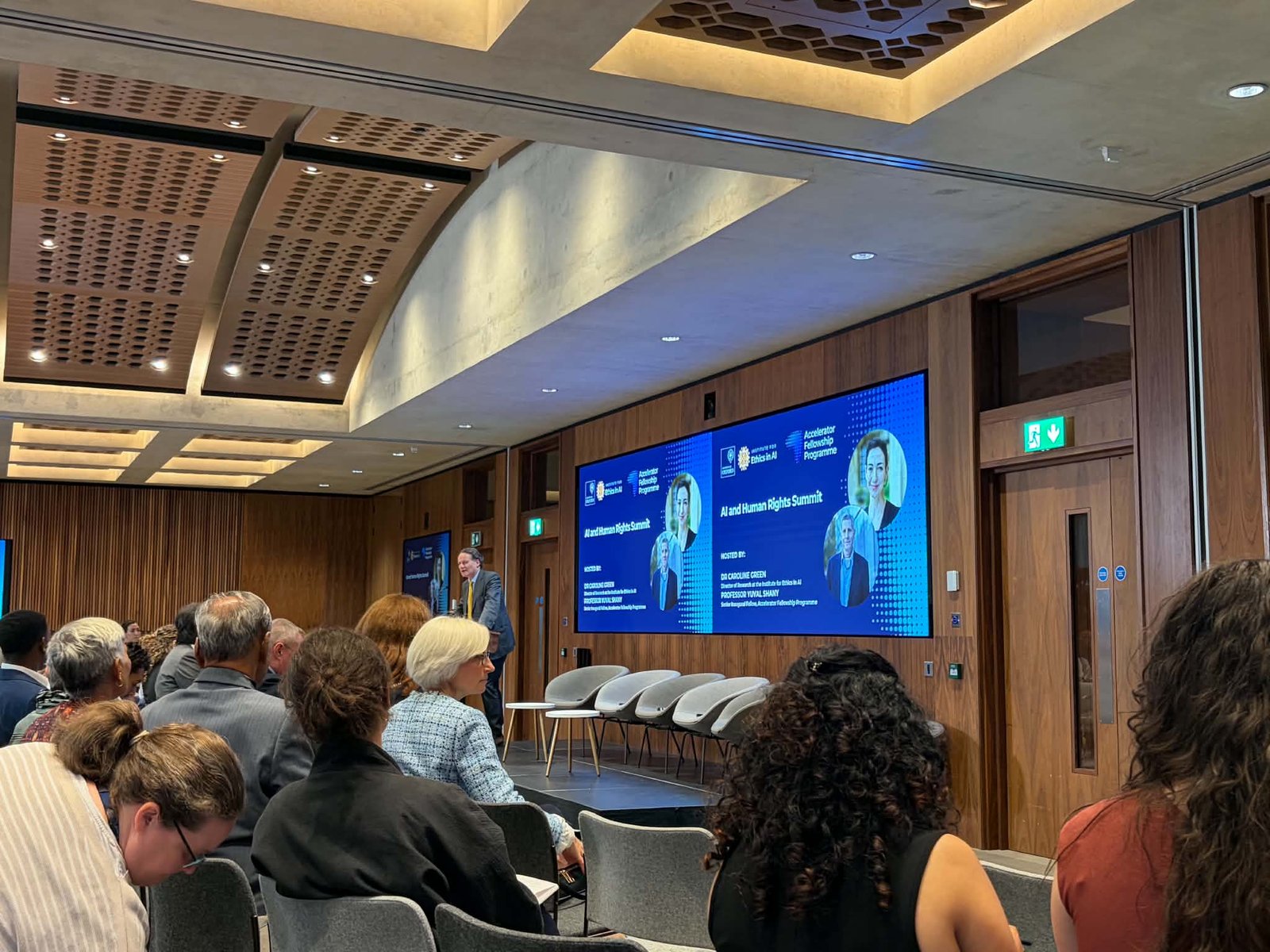
Human rights experts called for stronger legal protections against the risks posed by artificial intelligence (AI) at an Oxford AI and Human Rights Summit, with speakers arguing that human rights standards must be embedded into AI governance and technology.
The summit was hosted at the newly redeveloped Rhodes House in Oxford and organised by the Institute for Ethics in AI. It built upon Professor Yuval Shany’s consultation on a white paper, published in 2025, on the need for and feasibility of an international AI Bill of Human Rights, which proposes ways to adapt existing human rights standards so as to better address some of the unique challenges posed by AI systems and their uses.
An opening video address from the United Nations High Commissioner for Human Rights Volker Türk outlined how AI policy can keep pace with a fast-developing technology. He said that “great power demands responsibility on the same scale, and when the two don’t match, we have a problem”. Corporate control, he explained, means that AI policy stretches beyond existing national borders. He continued to praise this summit for bringing together leaders and representatives at the forefront of the discussion.
Speakers called on the UK government to establish legislation, recalling Labour’s manifesto commitment to an AI Bill of Human Rights. The panellists broadly agreed on the importance of human rights, but appeared less aligned on what enforcement should look like in practice.
In an exclusive interview, Michael O’Flaherty, the Council of Europe’s Commissioner for Human Rights, told Cherwell that political short-termism Continued on pg. 2 risks undermining efforts to address the long-term consequences of AI. “We are infected across our societies with shorttermist responses to the great issue of our societies and politics,” he said, adding that electoral cycles make it difficult for politicians “to think beyond the next election”.
O’Flaherty also noted that younger generations no longer take the international human rights system for granted. “There is no longer an assumption that the human rights system is safe, that it will survive,” he told Cherwell. He argued that political leaders increasingly treat human rights selectively, saying: “Increasingly, leaders are treating human rights, if they are respected at all, as an a la carte buffet. We take those rights because they serve our goal. We’ll ignore others because they get in the way.
The summit also heard concerns about the effects of AI-generated misinformation on communities that may have limited access to, or awareness of, the technology itself. An audience question asked human rights experts to consider the impacts of AI on populations, such as those in India, who might be unaware of its existence. The focus on the impact of AI on populations in developing countries more vulnerable to the power of big tech was a key theme of the summit.
Eileen Carter from the South African Human Rights Commission warned that underrepresentation of African languages in large language models could exacerbate existing inequalities. She also raised concerns about the effects of misinformation and deepfakes on elections, referring to more than 360 deaths associated with unrest and the amplification of narratives.
The third panel, which offered a civil society perspective on promoting human rights in AI systems, offered some hope. Across all speakers, the potential for AI to transform the beliefs that underpin human rights, including the rights to water, education, and an interpreter, was debated. When asked about AI’s potential to unravel and alter the definition of human rights, such as what is included in the ‘right to education’ O’Flaherty told Cherwell: “The damage that can be done by AI has hit more dramatically and more visibly than perhaps any other sector within education through the phenomenon of cognitive loss, of cognitive transfer. We’re only beginning to realise the extent to which we have allowed education to be fundamentally undermined for an entire generation.
“It’s time to seize that now and engage it. I’m not sure that the classic understanding of the human right to education is particularly well-framed for this extraordinary development.”
In a discussion on different countries’ regulatory approach to AI, Suresh Venkatasubramanian, professor at Brown University and former AI advisor to US President Joe Biden, argued that AI systems should not be treated as inevitable developments beyond human control. “We continue, I think, to talk about AI as a thing that emerged out of nowhere that we just have to deal with,” he said. “We forget that these aren’t coming from an alien planet and they were built by entities that choose to build them in a certain way.” He called for pressure on technology companies to make different choices about how AI systems are developed.
Questions of accountability also emerged during discussions about AI’s potential to improve access to justice. Research presented by Philippa Webb said that only 10% of people who have access to a lawyer can get one while there are thousands of bookings for an interpreter in a court covering 150 languages. However, this progress is not cemented as “general-purpose chatbots hallucinate 58% of the time on a legal task”. The use of AI in moderating legal proceedings raised fundamental questions about humanity and authority. Thompson Chengeta from Liverpool John Moores University said that “human rights is the last line of defence so when we say we want a human rights based governance… human rights is not an idea, it is an obligation. There is a gap that can only be recovered by a legally binding instrument”.
The event culminated in a panel offering an industry perspective. Co-host Dr Caroline Emmer De Albuquerque Green questioned representatives from Meta, Google, Microsoft, and OpenAI. Michael Karimian, who works in digital diplomacy at Microsoft, discussed the role of private sectors in engaging with AI, defining corporate responsibility as something which “provides transparency and identified risks”.
All companies supported having formal programmes to ensure that they have an AI policy in place. Within their own companies, they suggested protective measures such as specialised training to ensure that policies, such as whistleblowing, are understood. Alexandria Walden from Google described how consultations with stakeholders could be used to identify when the product breached users’ boundaries. These assessments, according to OpenAI’s spokesperson, “feedback into tangible technical input” and “benchmark it”.
Fundamentally, understanding the rationale behind human rights is imperative, though lacking. Alexandria Walden from Google said: “Whether or not they understand human rights, they care enough to infuse it in their company… we might not always get it right, but it is something we care about.”
Where former panels discussed controls to ensure human rights are considered in the development and implementation of AI products, this panel focused on mitigation. A spokesperson from Google pointed out that technology is inevitably going to move faster, so multiple tools are needed. Companies, OpenAI’s representative noted, still encounter issues such as discrimination and free speech. Consequently, they regard this as an additional policy which companies have a structured model to deal with, but newer companies, and newer industries, haven’t learnt it yet.
In her concluding remarks, Green called for policy makers to “make the abstract actionable” at both governmental and corporate levels. She argued that, by framing the issues posed by AI as human rights issues, we gain a “foundation” for recognising AI’s many societal impacts.
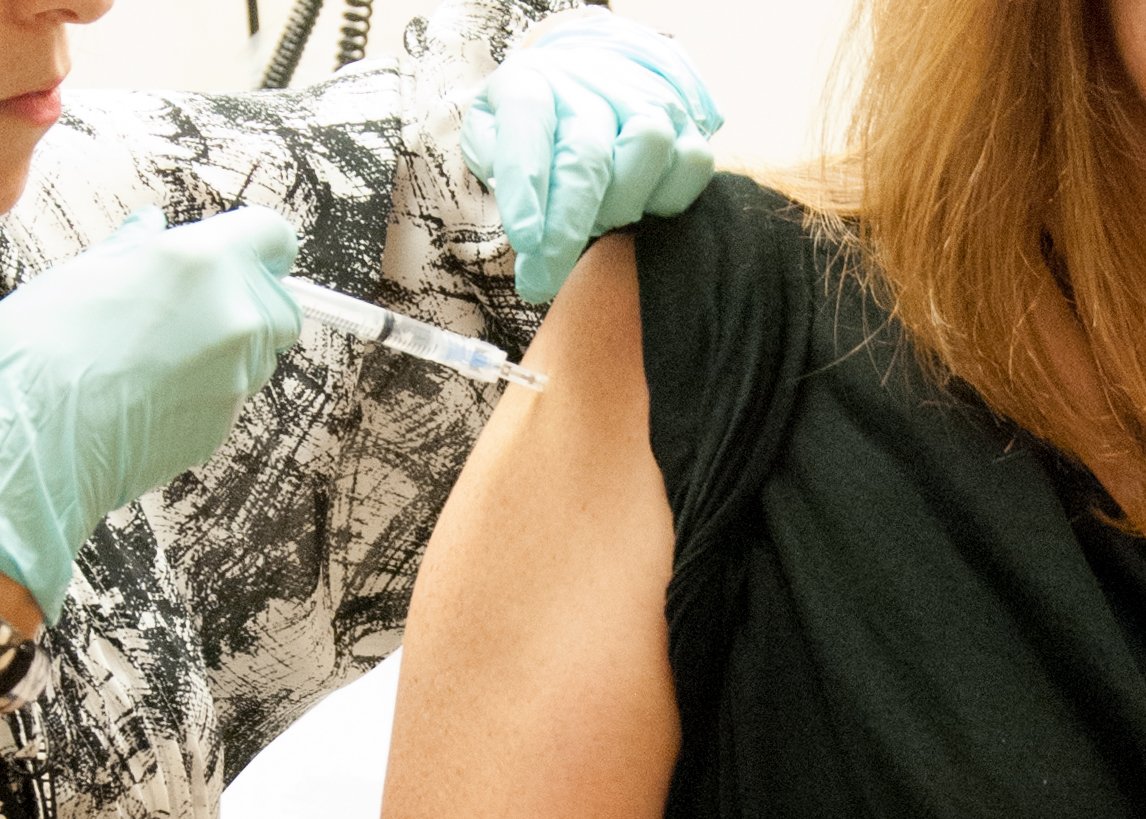
Ugandan participants in a clinical safety study received an Oxford developed Ebola vaccine this week.
Researchers vaccinated the first participants on 6th October in Masaka, Uganda. The phase follows the launch of a first-in-human Phase I trial in the UK evaluating the same vaccine candidate.
They received the vaccine as part of an evaluation of the safety and efficacy of a ChAdOx-based Bundibugyo Ebola vaccine candidate developed by the Oxford Vaccine Group (OVG) and the Pandemic Sciences Institute at the University of Oxford.
Development for this vaccine began in May this year in response to the ongoing Ebola outbreak in the Democratic Republic of the Congo (DRC). The research, led by OVG’s Professor Teresa Lambe and Professor Simon Drysdale, is funded by the Coalition for Epidemic Preparedness Innovations (CEPI). No licenced vaccine for the Bundibugyo strain of Ebola virus currently exists.
In a statement to Cherwell, OVG said its involvement includes collaborating with the Ugandan research team to support “the study’s scientific design, clinical trial coordination, safety oversight, and evaluation of vaccine safety and immunogenicity”. The Phase I clinical trial addresses a rare strain of Ebola virus affecting communities in the DRC since May. The phase is a collaboration between the Medical Research Council/ Uganda Virus Research Institute and the London School of Hygiene and Tropical Medicine (LSHTM).
Dr Nicole Lurie, CEPI’s Executive Director for Emergency Preparedness and Response, told Cherwell: “It [the Bundibugyo outbreak] remains the fastest-growing and second-largest Ebola outbreak ever recorded – and we currently remain without a licensed vaccine or treatment.” The Bundibugyo Ebola epidemic in the DRC has surpassed 8,600 cases, with almost half of infections proving fatal.
The outbreak was declared a Public Health Emergency of International Concern (PHEIC) by the World Health Organisation (WHO) in May.
OVG told Cherwell: “For more than a decade, the University of Oxford has performed many clinical trials of candidate viral-vectored vaccines. Some of the most promising vaccines used a modified chimpanzee adenovirus, a harmless version of a common cold virus. The Oxford-AstraZeneca (ChAdOx1) COVID-19 vaccine was approved for emergency use in the UK in December 2020 and was estimated to have saved six million lives during 2021 alone, and over 3 billion doses were used worldwide.” The adenovirus vector vaccine technology trialled in this study was successfully used worldwide as part of the Oxford-AstraZeneca COVID-19 vaccine.
More funding is necessary to ensure the development and approval of the Ebola vaccine. Lurie told Cherwell: “Without sufficient additional funding, we are at risk of not being able to develop these promising vaccine candidates… CEPI urgently needs US$128M now to keep our Bundibugyo emergency R&D response moving. Without it, we are putting the DRC, and the world, at tremendous risk.”



-

 Oxford united FC4 weeks ago
Chris Gunter steps away Wales role to focus on Oxford United
-

 Oxford University3 weeks ago
New to the Oxford English Dictionary this September
-

 Oxford united FC1 week ago
LIVE: Exeter City vs Oxford United – Jersey Mike's Trophy group stage
-
 Traffic & Transport2 weeks ago
How poor public transport policy is putting the brake on cities | Road transport
-

 Student Life3 weeks ago
Oxford partnership allows OpenAI to use rare Bodleian texts to train ChatGPT
-

 Traffic & Transport2 weeks ago
Why should I have to pay more for buses if I don’t use a smartphone? | Bus fares
-

 Oxford united FC2 weeks ago
Northern Ireland fans laud Oxford United defender Ciaron Brown
-

 Oxford Events4 weeks ago
Four days of equestrian spectacle at 2026 Blenheim Palace International Horse Trials