
Student Life
Three local authorities top applications for 52% of undergraduate courses


By NED REMINGTON
Three local authorities top domestic applications for over half of undergraduate courses at the University of Oxford, a Cherwell investigation has found.
Barnet, Buckinghamshire, and Wandsworth provided the most domestic applications for 52% of the 44 analysed courses. Over 70% of courses received the most applications from a London borough in the 2023-2025 application cycles, with 27% of courses receiving the most applications from the same London borough, Barnet. No local authorities outside of England housed the highest number of domestic applicants for any subject.
While Oxford publishes data on the total number of applications for each course, and the total number of applications to all subjects by local authority, this is the first time it has broken down applications by the geographical makeup for each subject. Cherwell obtained data for the 2022-2025 admissions cycles, grouped by subject code, through a Freedom of Information (FOI) request. The data excludes figures where fewer than three applications for a course came from a particular local authority over the three-year period, for privacy reasons. Cherwell analysed data for 44 Oxford undergraduate courses, excluding subjects for which figures were available for fewer than five local authorities. Most of those excluded were dual-honours Modern Languages degrees.
London and the South East dominate applications
With Barnet providing the most applications to 12 of 44 courses, the borough ranked in the top 3 local authorities for applications to half of the courses analysed (22). The south-eastern county of Buckinghamshire accounted for the most applications to nine subjects, including Classics, Human Sciences, and Music. The London borough of Wandsworth topped applications for five, including History (Ancient and Modern) and Theology and Religion.
London and South East England continued to dominate across almost all subjects. The exception was Birmingham, which provided the most applications for four popular Oxford subjects: Law, Medicine, History and Politics, and Biomedical Sciences. Some subjects received a joint-highest number of applications from multiple local authorities. Trafford, Leeds, and County Durham topped applications for one subject each.
Cherwell’s analysis exposes the geographical disparities clear in subject-by-subject applications. The figures complement existing data published by the University, which shows that Barnet accounted for the highest number of total applications to Oxford over the same period, with 258 applications, closely followed by Buckinghamshire with 256. Birmingham came third, submitting 235 applications, whilst Wandsworth and Richmond Upon Thames came in joint 4th place with 204. Eight out of the ten local authorities submitting the most Oxford applications were London boroughs.
Oxford applications do not consistently match national spread of A level
Annual figures published by the Department for Education allow us to compare Oxford applications to the total number of A level students in each English local authority, and to the percentage of students in each local authority achieving AAA or above in their A Level exams, the most common entry requirements for an Oxford undergraduate degree. This data does not account for domestic students studying other Level 3 qualifications, for example the International Baccalaureate.
In 2025, Barnet had the 13th highest number of state school students sitting A levels out of English local authorities, at 3504 students, with Buckinghamshire in 9th place at 3839, and Birmingham in 6th place at 4725 pupils. In the same year, Barnet had the 8th highest percentage of state school students achieving AAA or above in A level results in England at 25%, with Buckinghamshire coming 7th at 28% and Birmingham in 28th place at 17%.
Despite topping applications for the third highest number of Oxford subjects and accounting for a significant number of total applications, Wandsworth was only ranked 58th in England by number of A level students, and ranked 69th for percentage of students achieving AAA or above. Richmond Upon Thames was ranked 14th for percentage of A Level students receiving AAA or above at 21%, but 110th for total number of A level students at 934 pupils in 2025. The local authority with the highest percentage of students achieving AAA or above, Sutton, was ranked 36th in total number of Oxford applications for 2023-2025, and did not top applications for any subject.
Whilst many of the areas responsible for the most Oxford applications are also home to high numbers of A Level students with the grades to apply, it is clear a disparity remains between the two. Oxford’s latest Annual Admissions Statistical Report highlights the disparity on a larger regional level, with 28.3% of the University’s applicants coming from London in 2023-2025 and a further 20.3% coming from the South East, compared to just 2.1% from the North-East and 4.9% from the West Midlands.
Barnet tops applications for PPE, Birmingham leads in Law and Medicine
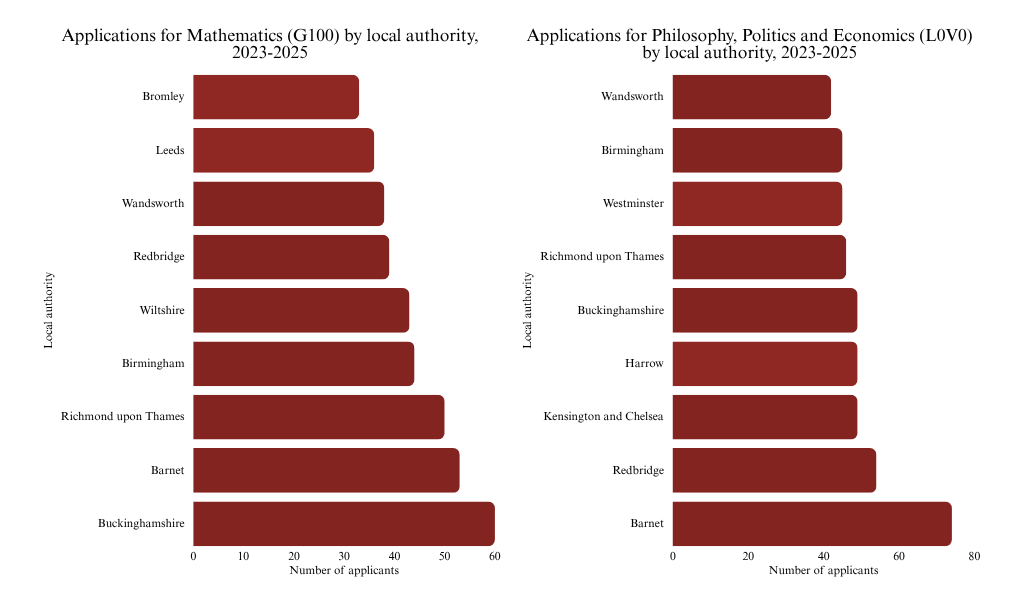
Oxford’s most popular subject by applications in 2025, Mathematics, received 60 applications from Buckinghamshire from the 2023 to 2025 application cycles, followed by Barnet with 53, the London borough of Richmond Upon Thames with 50 and Birmingham with 44 applications. Physics, Oxford’s next most popular STEM subject in 2025, received 46 applications from Barnet over the last three application cycles, followed by 43 from Buckinghamshire and 42 from Bromley.
Oxford’s PPE degree, which received the second-highest number of total applications last year, received 74 applications from Barnet alone from 2023-2025, followed by 54 from Redbridge and 49 each from both Kensington and Chelsea and Harrow. Economics and Management also received the most applications from Barnet at 57, followed by Buckinghamshire at 52 and Wandsworth at 51.
However, Law, Oxford’s third most popular subject, received the most applications from Birmingham by a large margin, with the UK’s second-largest city submitting 86 applications, followed by Buckinghamshire on 51 and Redbridge on 47. Birmingham similarly submitted the most applications for Engineering Science, followed closely by Ealing on 21. For Medicine, Birmingham submitted 102 applications, the highest number of applications from any local authority for any subject, followed by Buckinghamshire on 69.
London and South East lead across subject divisions
Of the 24 analysed undergraduate courses in the Humanities Division, only 2 received the most applications from a local authority outside London and the South East, with 16 out of 24 receiving the most applications from a London borough. Similarly, in the Social Sciences Division, 10 out of 12 analysed subjects received the most applications from a local authority in London or the South East. Cross-disciplinary dual honours degrees were counted for both relevant subject divisions.
In the Mathematics, Physical, and Life Sciences (MLPS) Division, two out of nine subjects received the most applications from a council outside London and the South East. Medicine and Biomedical Sciences, two out of the four undergraduate courses in the Medical Sciences Division, received the most applications from Birmingham, with Buckinghamshire topping the list for Experimental Psychology, and Biochemistry receiving its highest number of applicants from Richmond Upon Thames.
Disparity between UK nations continues at the subject level
Local authorities in Scotland, Northern Ireland, and Wales do not provide the most applications for any subject, according to data obtained by Cherwell, correlating with figures published by the University showing that only 3.4% of Oxford applicants were from Wales from 2023-2025, 1.8% from Scotland, and 0.7% from Northern Ireland.
Responding to Cherwell’s findings, the Oxford University Scottish Society told Cherwell: “It is very difficult for people to think of Oxford as a place where you could belong – even just for a couple years. To have this build-up of certain geographical areas means that students from other regions can often end up feeling on the outside, even after having made it to Oxford, or will be uneasy applying in the first place.
“The job of outreach should be to help applicants see Oxford as a possibility, regardless of where they come from, which would then help create a less geographically concentrated student body.”
Cymdeithas Dafydd ap Gwilym, the University’s Welsh society, told Cherwell: “It’s hardly surprising that Welsh students remain underrepresented when the University and its colleges continue to fall short in supporting Welsh students.
“Jesus College, historically regarded as Oxford’s Welsh college, illustrates this contradiction. The Meyricke Endowment, established in 1713 to maintain Welsh scholars, is now worth over £20 million. Yet in 2024/25, £631,000 was released into the College’s general income, while the only surviving Welsh-gated graduate award is worth just £900 a year, with a maximum of two recipients … an institution cannot celebrate its custodianship of Welsh heritage while failing to invest in the scholars who sustain it.”
In a response, Jesus College told Cherwell: “Jesus College is extremely proud of its Welsh heritage, and supports and celebrates the Welsh members of its community…The College’s financial report for the year 2024/25 shows that £421k of the £631k in unrestricted funds drawn from the Meyricke Endowment went directly towards grants, bursaries and prizes for both its undergraduate and postgraduate students – including those from Wales. Other (unpublished) funding directed to Welsh education comes from within the College’s core budgets.”

Many factors affect application numbers for different UK nations, including the guarantee of free university education at Scottish Universities for Scottish students. Among Scottish local authorities, the City of Edinburgh submitted the most applications for all the most popular Oxford undergraduate courses, including Mathematics, PPE, Law and Medicine. In Wales, Cardiff topped applications for Mathematics, Law, Economics & Management and Medicine, while Swansea accounted for the most applications for PPE, and Rhondda Cynon Taf was home to the most Physics applicants. The picture was more mixed in Northern Ireland, with Belfast topping applications for Mathematics, Antrim and Newtonabbey housing the most Physics applicants, and Ards and North Down topping the list for Law.
University Response
Responding to the findings, the University told Cherwell: “Oxford’s students come from a wide range of backgrounds and from across the UK. The regional distribution of applications to Oxford is influenced by a number of factors, including population size, educational attainment and regional differences in university application patterns.”
The University added: “We are committed over the long term to supporting educational aspiration and potential across the country, and engage with partners, schools and students through regional outreach and access initiatives to encourage more applications from under-represented parts of the UK, including through our Oxplore Festival which has recently visited Cornwall, Bradford and Birmingham, and BeUniq in Bradford, Birmingham and Oldham.”
Additional reporting by Anisha Mohammed

The University of Oxford has produced a guide to strengthen the link between the academic institution and local schools.
This resource, Opening Oxford, focuses on what the University can give to local communities, and how the University itself can benefit from interacting with the wider region. In the foreword, Vice-Chancellor Irene Tracey described the University’s commitment to “strengthening the University’s links with our local communities” and “ensuring young people across Oxfordshire can see opportunities in the University, whether that is study, employment, or interest in our cultural assets”. She added that universities “thrive when they are part of the life of their region”.
Within the guide, curriculum-linked workshops, enrichment opportunities, and lectures are recommended to realise the University’s vision. The activities featured are available for primary school students through to those navigating higher education and career choices.
It also emphasises helping educators through teacher development opportunities and classroom resources. Specific programmes and resources, such as a two-week research programme at Oxford University Museum of Natural History for sixth-formers and St Anne’s Super-Curricular club which offers online classes, are recommended for those considering applying to universities, including Oxford. It highlights post-school opportunities at the University, such as work experience, careers, and apprenticeships.
This guide contributes to the University’s 2025-2030 Strategic Plan, which outlines how the University will partner with the local community to “sustain excellence in education and research, extend our impact through innovation, and exercise leadership…for the benefit of society”.
The project also builds on the academic outreach that the University has previously developed. Similar to The Oxford College Twinning Project, it attempts to develop a reciprocal relationship between town and gown in the city.
Pro-Vice Chancellor for External Engagement, Sport, and Community, Professor Alex Betts, acknowledges that available initiatives and outreach are “not always visible or transparent to teachers across Oxfordshire”. In his introduction to the guide, he hopes it will help close the educational attainment gap and ensure Oxford is not viewed by young people as “distant and unrelated to their lives”.
The programme’s aim overall is to make the University “relevant and inspiring to all”, not only to its students.
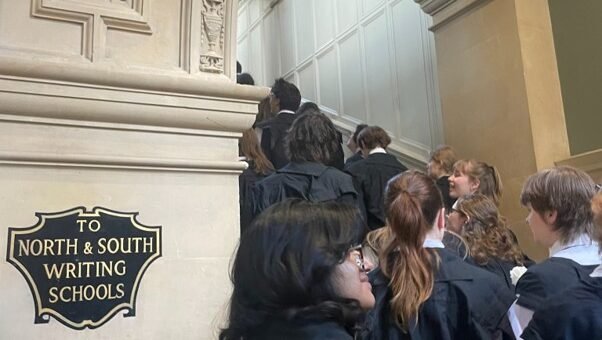
Oxford University’s BA Jurisprudence (Law) degree is under faculty review following concerns raised by external examiners and echoed by students, about teaching disparities between colleges.
In a 2026 report seen by Cherwell, both examiners outlined concerns about teaching disparities between Oxford colleges that could affect law students in Final Honour School (FHS) examinations. They questioned whether coordination between colleges was adequate and critiqued a “lack of process” in ensuring students are taught in a “roughly consistent way”.
“There seems to me to be a real possibility of unfairness depending on the topics chosen by the individual tutor in the College and the difficulty of individual questions on the paper,” the report said. One examiner suggested that these issues might not be resolved through simply broadening questions on the paper, while another questioned whether action was needed “to ensure a level playing field across the students in the University”.
Speaking to Cherwell, a final year law student described the situation as “problematic” for students. They said: “The faculty just don’t have enough control over what tutors put on their reading list.”
They told Cherwell that there is no set order for law tutors to teach topics. With the faculty reading list sometimes containing 10-12 weeks of content, this forces some students to teach themselves, especially if the topics not chosen by tutors are easier to score highly on in exams.
They also claimed that in rare instances, some tutors will not include mandatory cases on their reading lists. While these are available to find on the faculty reading list, “it’s on you to make sure you’ve been taught correctly”, according to the student.
Another student claimed that, in last year’s Administrative Law exam, finalists at their college were significantly disadvantaged because they were only taught the first eight weeks of content. They told Cherwell that at colleges where tutors were more versed in administrative law, students were taught more content which was less complex and more likely to come up in exams.
Another law student who graduated in 2025 told Cherwell that they found the tailoring of teaching to exams and the quality of essay feedback varied greatly between colleges.
A University spokesperson told Cherwell: “Undergraduate law teaching combines lectures and classes provided by the Faculty with tutorials arranged by individual colleges. While colleges are responsible for their own tutorial provision, we recognise the importance of ensuring that students are appropriately prepared for their examinations, regardless of their college.”
Cherwell understands that the Faculty of Law is currently reviewing the course and its teaching provision in a working group.

A collaboration between scientists at the University of Oxford and Wuhan University has made a major breakthrough in solar energy efficiency.
Researchers found that bismuth sulphide can absorb light strongly without losing the electrical charge it produces, making it a promising material for semiconductors, the part of a solar cell which converts sunlight into energy.
When a semiconductor absorbs sunlight, it uses its energy to free electrons and leaves tiny, positively charged ‘holes’ in their place. To produce electricity, these positive and negative charges must be rapidly harvested before they meet and cancel each other out. However, laws of physics state that a good absorber of light must also be a good emitter, and therefore the semiconductors that absorb light most strongly are also the ones that lose their charges most quickly.
Solar energy research has long been slowed by the difficulty of finding materials that balance semiconductor absorbency and efficiency.
The discovery of bismuth sulphide, published in Nature in October, unlocks a solution. The researchers discovered it has a rare quantum arrangement that allows it to absorb light efficiently while also making it harder for excited electrons and holes to recombine.
Solar energy constitutes only 6% of Britain’s electricity. Primarily because of Chinese investment, 91% of new global solar and wind facilities are cheaper than the cheapest available fossil-fuel power. However, weather, grid infrastructure, and technological limitations have created a firm ceiling on the UK’s solar energy harvesting. This comes as Prime Minister Andy Burnham has announced the launch of a new government body to invest in the national electricity grid, as concerns mount over the durability and capacity of the UK’s energy infrastructure.
The government projects that the solar sector will support 35,000 jobs by 2030. This includes roles within the solar technology company Oxford Photovoltaics, which contributed to the study. The company was founded in 2010 as a spin-out from the University and now claims to be “commercialising the world’s most efficient solar technology to power the next generation of clean energy”.
Solar energy is also expected to play a major role in the government’s plans for an Oxford-Cambridge ‘growth corridor’. A recent report suggests the UK’s premier innovation zone is falling behind its global rivals, as China continues to build as much as 74% of all solar and wind projects worldwide.
This discovery of the bismuth sulphide semiconductor may trigger changes in the renewable energy sector. To do so, however, requires rapid commercial implementation of the technology. Researchers have yet to establish whether the increased energy savings of bismuth sulphide are enough for it to turn a profit.



-

 Oxford united FC4 weeks ago
Oxford United beat Wigan Athletic 2-1 in League One victory
-

 Oxford united FC4 weeks ago
Ramsey on Oxford United’s Arsenal-inspired set-piece threat
-

 Oxford united FC4 weeks ago
Leicester City hit with same transfer embargo as Oxford United
-

 Traffic & Transport4 weeks ago
Andy Burnham launches campaign against ‘headphone dodgers’ on public transport | Transport policy
-

 Student Life3 weeks ago
“I am proud of being a Jew, and equally proud of being an Arab”: Professor Avi Shlaim on Iraq, Zionism and belonging
-

 Student Life4 weeks ago
I no longer want to be an astronaut
-

 Student Life3 weeks ago
The Vinted paradox: Consuming our way out of overconsumption
-
 Property & Housing4 weeks ago
Oxfordshire’s Equinox 2035 strategy launched at House of Commons