
UK News
The ‘big durian’: one day in Jakarta, the world’s largest city | Indonesia

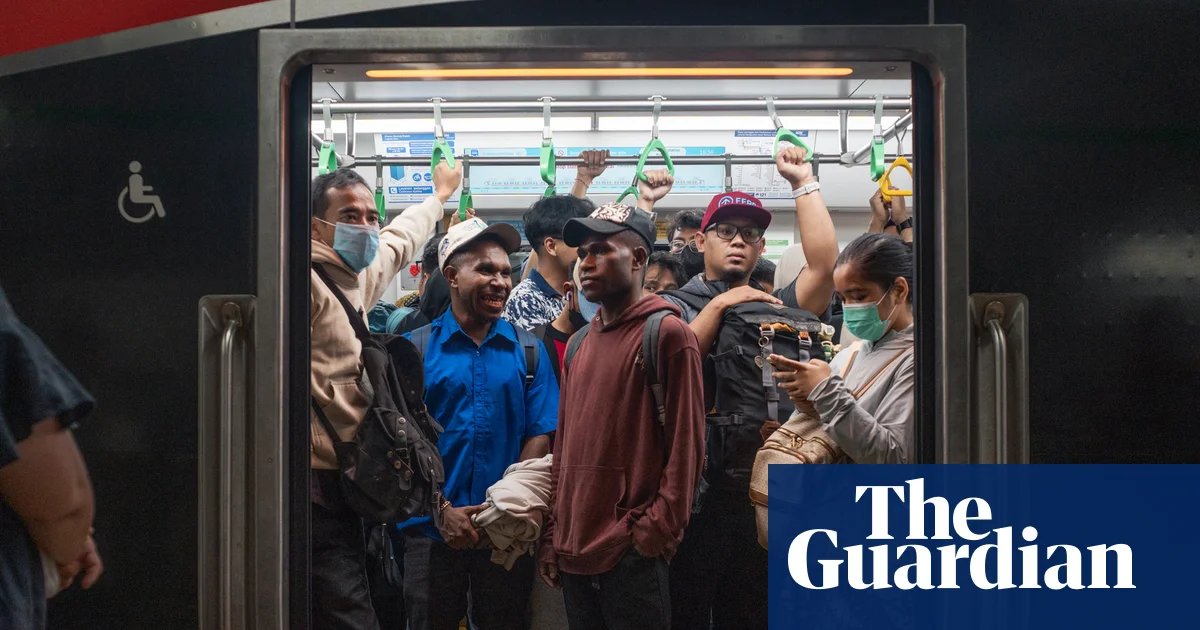
In December, the United Nations officially designated Jakarta the world’s largest city, hosting a staggering 42 million inhabitants. Michael Neilson speaks to several people who call the ‘big durian’ home – about the positives and the negatives – and how community and the city’s infamously dry humour get them through.
4am
Few things are more synonymous with Jakarta than the bright green jackets worn by the sprawling megacity’s more than a million ojek, or motorcycle taxi, drivers.
Like tens of millions in the world’s largest Muslim-majority nation, ojek driver Dicky Rio Suprapto, 48, wakes at 4am to pray. After dropping his two teenagers at school, he begins a 12-hour day navigating one of the world’s most congested cities.
Suprapto trained as an engineer, but has been out of formal work since 2017. After Covid-19, he turned to ojek driving, using ride-sharing apps.
In a city infamous for its deadlock traffic, Suprapto says he has to be creative. Rather than relying on maps, he draws upon his decades of knowledge of the city’s labyrinthine streets.
“I have already memorised it,” he says, “So it’s a shorter time.”
Utilising his knowledge of narrow alleyways, he transports people, food and packages through the city’s capillaries.
“[The customers] use our services, they want to [work to] earn money. That’s why I have the obligation to help the city, to make sure they reach their destination fast.”
Despite the grind, pollution, and relentless macet (traffic), humour persists. After surviving brain surgery, he jokes about the tube in his head.
“I have a tube … so I am like ‘Robocop’, you know.”
He stops work at sunset due to light sensitivity, earning Rp400,000–500,000 a day (US$23-$29), which he says is “more than enough” to support his family, provided they live simply.
“Enjoy while you have it,” he says.
10am
Dhewa Radya, 22, represents a different Jakarta: young, highly educated, and plugged into the city’s burgeoning tech sector.
He works in artificial intelligence and structures his life around avoiding the worst of the city’s congestion. Unlike many, he walks to work from his kost, or shared living space, in West Jakarta, which costs Rp1.6million ($92) a month to rent.
The pollution, however, is unavoidable. After a year, a check-up showed lung spots typical of passive smokers.
Jakarta is not his “favourite city,” he admits, but the best place to find work.
“In Jakarta, you can find everything … so it’s really good for [an] early career.”
Originally from Central Java, Radya is one of millions who move to Jakarta each year seeking better opportunities. He counts himself lucky, with youth unemployment about 17%, including many university graduates.
Longer term, he wants to go abroad, then return.
“The hope is I can go back to Indonesia, have a good impact, and also have better jobs, better life, better living quality.”
He is concerned about growing inequality, and – like many young Indonesians – isn’t shy to speak about politics, and apply a humorous Jakarta lens to current affairs.
“Even though the government screws us every day, the thing that we can only do is just to enjoy it,” he says, “No matter how hard it is, just go with it.”
1pm
By lunchtime, the city shifts again.
Neneng Muslimah, 45, runs a riverside family warteg, or traditional eatery, in the central business district of Kuningan, feeding office workers through a system born of necessity – and ingenuity.
The river highlights Jakarta’s evolution, and increasingly stark divide: crowded kampungs (villages) on one side, and five-star hotels and glass office towers on the other.
Her warteg’s most distinctive feature is a pulley system used to deliver food across a gap left when a bridge was removed.
Starting work at 5am, the rush hits at noon.
“At 12pm, we get through about 100 portions,” she says.
Traditional meals – fried chicken with pungent sambal, rice, vegetable, and egg dishes – cost as little as Rp10,000 ($0.60).
Orders are shouted across the river – or sent via WhatsApp – and often paid using smartphone scanners attached to the basket.
“We prefer WhatsApp. If you shout, sometimes the order is wrong – our voices get carried away by the wind,” she says, adding that mistakes are sometimes part of the fun.
“Sometimes when we mishear an order, we just laugh. They might ask for coffee, and we deliver an iced drink.”
Despite rising living costs and the constant risk of flooding – driven by the city’s subsidence and heavier rains – Neneng says Jakarta has its own special beauty.
“People from outside only know Jakarta for the traffic jams, the dirt, and the pollution … But once you’ve been here and felt it, then it becomes comfortable.
“The people are so friendly, so supportive. It is beautiful.”
6pm
As the day cools, the traffic returns.
At a busy intersection near the national monument – Monas – Faqih Ibnu Ali, 28, paints himself silver and steps into the road.
He is one of Jakarta’s street performing “manusia silver”, or “silvermen” – one of the city’s millions of informal workers.
On a good day he earns about Rp200,000 ($11).
He works the morning rush hour and, after a short rest, from the afternoon until sometimes midnight.
Behind the metallic paint is a harder story.
A former fisher, he says he lost everything when his ship burned down. He now lives under a bridge with his wife and children. Years ago, he lost a son in a traffic accident.
“It feels sad,” he says, “But that’s life on the street, brother.”
He says he feels judged and like an outsider, left behind in the world’s largest city.
“If people look at me, it’s with one eye.”
His workplace reflects Jakarta’s growing inequality, as he weaves between air-conditioned SUVs and motorbike riders choking on exhaust fumes.
Phones are hidden when he approaches.
“People are afraid they’ll be taken. It’s like I am not considered.”
And yet, he keeps going – for his children.
“We shouldn’t lose hope, don’t give up, it’s for the sake of the family.”
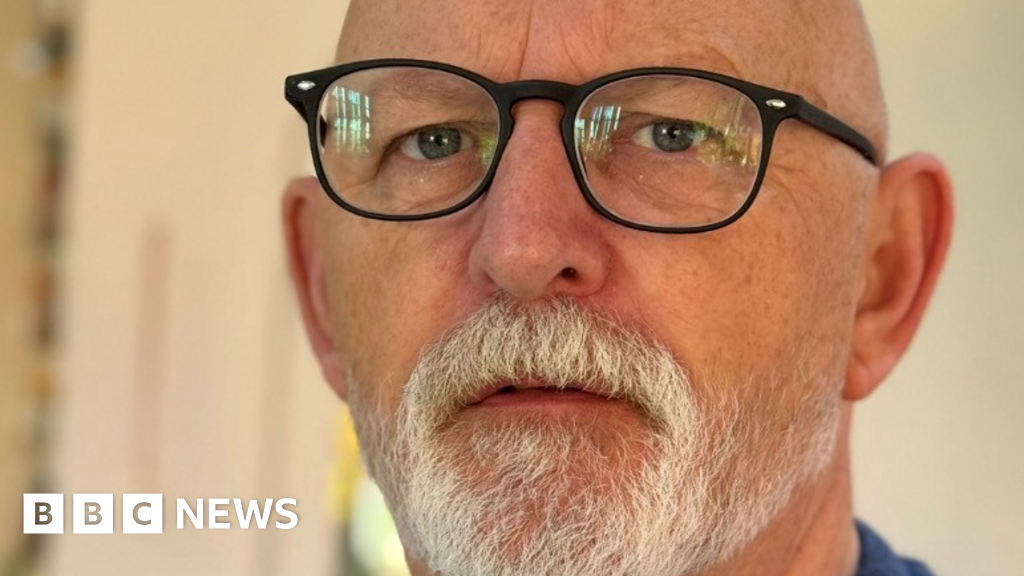
The family of Shaun Burton, say they are “devastated” by the loss.
Source link

Key events
In the opening half an hour against Cape Verde, Mikel Oyarzabal, the centre-forward, did not get a single touch.
Kyle Green gets in touch: “Your highlighting of Lalas and his absurdity is something that has prevented me from wanting to watch the coverage on Fox. While every channel has its pros and cons I just can’t.
“I’m 45 and probably the youngest of anyone who remembers him as a player instead of an opinionated insert insult here. As for the match this could be more competitive than it looks on paper Spain need a win the pressure is on them. Saudi Arabia could hold out for a draw and see what happens in their last match. “
News from the England camp, and it seems to be good news on Declan Rice.
“I’m ready and fit, raring to go. I was feeling a little bit of neural pain in my hamstring, which I was managing from after Christmas with Arsenal for a very long time. Obviously, not a lot of people would have known that. It was all behind-the-scenes stuff but it was a smart decision.
“In the end, that last 20 minutes is probably where you pick up the most, and it’s where you play a 70-minute match. But that last 20 is where you really feel your body going for it. And I think it was a smart decision because the last few days I felt really, really good.”
Alex Reid has penned today’s weekend special Football Daily.
Portugal v Uzbekistan on Tuesday enticingly pits the incredibly nice, incredibly 41-year-old-superstar-tolerant Roberto Martínez against Fabio Cannavaro, who’s won a Ballon d’Or as a player and the Chinese Super League as a coach. While the fixture following that game really does see the dream of Thomas Tuchel – in his first international job with England – taking on Queiroz, who is in charge of his ninth national side with Ghana.
The expected formations are 4-2-3-1 for Spain, and 5-3-2 for the Saudi Arabians.
The Saudi team features two Donis changes: Ali Lajami, a defender, and Nasser Al Dawsari, a midfielder, are preferred to Mohammed Abu Al Shamat and Mohamed Kanno. You may recall Salem Al Dawsari, the Saudi captain, as the man who scored the winner against Argentina.
An entertaining read, even for those of us who have just seen the clips.
In a conversation where his co-panelist is casually reminiscing about his days playing alongside Messi or exchanging shirts with Ronaldo Nazário at the World Cup, what exactly is Lalas going to talk about – coming on as a second-half substitute for Earnie Stewart in a friendly against Scotland in 1998? Helping the Kansas City Wizards finish last in the 1999 MLS Western Conference? Did Lalas enjoy an elite playing career? No. But does he do the background reading that could compensate for his relative lack of standing in a conversation with titans like Henry and Zlatan? Also no. But is he charming or funny or charismatic or otherwise magnetic on screen? Eh, no.
For the record, I once interviewed Alexi Lalas on the challenge of playing against Romario in the 1994 World Cup. He had this to say:
“He could kill you in so many different ways. If you remember from that World Cup, he scored so many types of goals. That ranged from solo adventures to an outside-of-the-right-foot half-volley off a corner kick. Romario was both the most difficult to play against and the best that I have faced.
“Roberto Baggio was doing his thing, but in terms of consistency and living up to the hype, he [Romario] was the best. As with all stars, there was a moment when the fans sit up in their seats, and that was a feeling I got with Romario. When it got close to him and the potential for his involvement in a play was there, everybody sat up in their seat. They knew that something spectacular would be happening.”
Saturday’s match reports here.
The Saudi Arabia coach, and Blackburn legend, Georgios Donis, spoke about the challenges facing his team: “Spain is not the same team when Yamal or Williams are on the bench.
“While they still have plenty of possession, they lack the individual one-on-one penetration when these two are missing. I’m not saying it’s a problem for Spain, but when those players are missing, they play in a different way. We saw this very clearly against Cape Verde.
“We are playing against one of the best teams in the world, and it’s very important that when you play against these kinds of teams, you should enjoy the experience and respect the opponent, but not too much.
“It is very hard for any team playing against Spain to have any time in possession. So what we must do is to be more in control of our movement and compact, and when the ball goes through the lines, be able to defend dynamically.
“It’s nice to see miracles in football, and we’ve seen favourites losing against underdogs. Of course, it’s great for Saudi football to have a great memory of the result against Argentina, but we aren’t drawing anything from that.
“I think we’ll feel more pressure in that [Cape Verde] game than we will against Spain.”
The Spain coach, Luis De La Fuente had this to say in his Saturday press conference: “This generation of footballers is highly competitive and really fired up… It’s going to be a completely different story,” he said at his pre-match press conference on Saturday. There is no drama or crisis. The bottom line is simply that we need to win tomorrow.”
Four changes for Spain: Lamine Yamal, Pedro Porro, Dani Olmo and Alex Baena also come into the side with Marcos Llorente, Fabian Ruiz, Ferran Torres and Gavi dropping out.
The teams – Lamine Yamal starts
Spain: Simon, Porro, Cubarsi, Laporte, Cucurella, Gonzalez, Rodri, Yamal, Olmo, Baena, Oyarzabal. Subs: Raya, Joan Garcia, Pubill, Grimaldo, Eric Garcia, Llorente, Merino, Torres, Fabian, Gavi, Pino, Williams, Zubimendi, Munoz, Iglesias.
Saudi Arabia: Al Owais, Abdulhamid, Tambakti, Lajami, Al Amri, Al Harbi, Nasser Al Dawsari, Al Khaibari, Al Juwayr, Al Buraikan, Salem Al Dawsari. Subs: Al Aqidi, Al Kassar, Majrashi, Yahya, Al Shehri, Al Boushal, Kadesh, Al Johani, Al Ghannam, Al Hajji, Al Hamdan, Mandash, Kanno, Thakri, Abu Al Shamat.
Referee: Raphael Claus (Brazil)
Perhaps one of the Saudi -players can write themselves into this high-grade selection?
Perhaps it can be their goalkeeper.
Madrid screening of Spain v Saudi Arabia cancelled due to heat
The public screening of Spain’s World Cup match against Saudi Arabia in Madrid on Sunday has been cancelled because of extreme heat forecast for the Spanish capital, officials said.
The match, due to kick off at 6pm local time on Sunday, had been scheduled to be shown on a giant screen installed by the Spanish football federation (RFEF) at a fan zone in Plaza de Colón in central Madrid.
Madrid city council and the federation decided to cancel the screening after national weather agency AEMET issued an orange heat warning – the second-highest level – for the Madrid region, with temperatures forecast to reach 40C.
“The decision has been taken with the aim of protecting the health of attendees, event staff and support services involved in the event,” Madrid city hall said in a statement, apologising for any inconvenience.
Officials urged supporters to watch the match indoors in air-conditioned spaces and avoid prolonged exposure to the heat.
Large parts of Spain are experiencing unusually high temperatures for June as a mass of hot air from North Africa moves across the Iberian Peninsula.
A total of 13 of Spain’s 17 regions are on orange alert for heat on Sunday, while the northern Basque Country bordering France is on red alert, the highest level.
Authorities advised residents and visitors to take precautions during the heatwave, including drinking water regularly, staying in cool environments, limiting outdoor physical activity during the hottest hours of the day and taking extra care of vulnerable people. AFP
Can Saudi Arabia repeat the magic of 2022?
Argentina arrived in Qatar on a 36-game unbeaten run. When Lionel Messi opened the scoring from the penalty spot after 10 minutes, a comfortable afternoon seemed in the offing. Saleh al-Shehri and Salem al-Dawsari had other ideas, Argentina had three goals disallowed for offside in the space of 13 minutes and the greatest comeback in Saudi Arabia football history was made. Argentina went on to lift the trophy, while defeats to Poland and Mexico meant the Saudis did not reach the knock-out stage.
Unai Simon over David Raya is a controversial choice for De la Fuentes. The Arsenal keeper could lay claim to being Europe’s best this season.
“Those at the Champions League final had a few more days, so I got there on the Wednesday night,” Raya says. “I arrived a bit before Fabián [Ruiz]. I was saying hello to some of the others in reception when he arrived. I went to say congratulations; that was almost the first thing I did. I couldn’t really talk [to him] after the final; I just didn’t have it in me. The next day we talked about the game properly. Just two mates chatting … I was happy for him that he could lift the trophy for a second time.”
A high pressure game for the European champions, as Sid Lowe reports.
“If we had scored one, the game would have changed,” Martín Zubimendi said. Immediately after the game, De la Fuente had offered a simple analysis: when the ball doesn’t want to go in it doesn’t want to go in, he insisted. Spain had racked up 27 shots, after all. Ferran Torres had hit the bar and seen another clear opportunity saved. Vozinha, the 40-year-old goalkeeper who stopped that, saved six more and was named the man of the match. “There’s nothing to reproach the team for,” Rodri said. “We generated chances but couldn’t put it away; the good thing is they created almost nothing.”
We wait to see what role Lamine Yamal will play today. His coach would surely like to be able to use him.
The worst mistake we could make would be to compare him to anyone. He is the midst of a process. He has exceptional footballing maturity and lives it all with total naturalness. He has great serenity and strength. We have to let him follow his path but those players who have something different are ready for that. They’re geniuses, like Dalí [who] can paint a picture, or Michelangelo. They’re different. What is exceptional to us, isn’t to them. In those extremes, they feel comfortable. Why? Because they are different. What we think is exceptional, they consider normal.
Preamble
Spain’s campaign did not get off to a flying start, and Luis de la Fuentes may wake up in the night to visions of Cape Verde’s Vozinha. He will have Georgia on his mind ever since Monday. Saudi Arabia are no pushovers and gave Uruguay a scare in their opening match. Memories of downing Argentina four years ago still abound, and so Spain might beware. They can ill afford to go into the final game with Uruguay at a disadvantage. All eyes on Lamine Yamal, whose fitness situation remains opaque, though Spain need their other forwards to come to the party.
Kick-off 5pm UK, 1pm ET, 2am AEST. Join me.

A topless man can be seen driving erratically in Edinburgh before abandoning his car and attacking a black man and a delivery rider.
Source link



-

 Oxford University4 weeks ago
New to the Oxford English Dictionary this September
-

 Oxford united FC4 weeks ago
Chris Gunter steps away Wales role to focus on Oxford United
-

 Oxford united FC2 weeks ago
LIVE: Exeter City vs Oxford United – Jersey Mike's Trophy group stage
-

 Traffic & Transport3 weeks ago
Why should I have to pay more for buses if I don’t use a smartphone? | Bus fares
-

 Traffic & Transport3 weeks ago
How poor public transport policy is putting the brake on cities | Road transport
-

 Student Life3 weeks ago
Oxford partnership allows OpenAI to use rare Bodleian texts to train ChatGPT
-

 Oxford united FC2 weeks ago
Oxford United lose to Exeter City on penalties in Jersey Mike’s Trophy
-

 Oxford united FC3 weeks ago
Northern Ireland fans laud Oxford United defender Ciaron Brown