
Oxford University
Oxford Law Pro recognized for two 2026 EPIC Awards

We have been named a finalist for two 2026 EPIC Awards, presented by the Society for Scholarly Publishing (SSP).
Oxford Law Pro, our knowledge resource for legal professionals and researchers, has been nominated for consideration in two categories: Hosting Platform Features and Branding.
The Hosting Platform Features category highlights technical innovations that improve how scholarly content is hosted, accessed, and experienced, while the Branding category recognizes outstanding efforts to build and maintain a strong brand identity in scholarly publishing.
About the platform
Launched less that one year ago, Oxford Law Pro brings together more than 9,000 journal articles and over 600 award-winning, peer-reviewed books from our portfolio of authoritative and timely legal analysis, all on our Oxford Academic platform.
Oxford Law Pro is powered by a conversational AI research assistant, developed with Silverchair, making legal research more efficient without compromising on accuracy. Unlike generic AI search tools, Oxford Law Pro employs retrieval-augmented generation (RAG) frameworks specifically tuned for legal content, ensuring responses are grounded exclusively in OUP’s authoritative materials.
The platform equips legal professionals with tools that match the realities of modern practice, and by reducing time spent on initial source identification, the AI assistant allows them to allocate more time to substantive analysis, strategic thinking, and client service.
The branding
For many years, we have served the academic market with legal research materials, developing a reputation for publishing the highest quality research from globally respected authors. Oxford Law Pro delivers this content in a way that’s designed for legal professionals’ needs. Backed by our research and workshops, a process supported by legal technology expert Jenifer Swallow, we developed product branding and messaging to both reflect our established reputation and resonate with practitioners who may not have encountered OUP before.
“The breadth and quality of content on Oxford Law Pro is impressive and highly valuable for legal research. Expert Essentials stands out as a truly unique offering—I haven’t seen anything quite like it.”
Barrister, Hong Kong
Mirkka Jokelainen, Product Portfolio Manager, said:
“These nominations recognize and reward the combined efforts of colleagues working with Oxford Law Pro over time. It reflects strong execution underpinned by clear direction, a deep understanding of our users and customers, and the ability to carry that insight through to high-quality delivery enriched by OUP expertise at every step.”
The EPIC Awards celebrate teams and individuals in the publishing, information technology, and communications sectors for their significant contributions to scholarly communication through innovation, creativity, and dedication. Winners of the 2026 EPIC Awards will be announced on 28 May.
You can find out more about Oxford Law Pro here.
A newly-discovered fossil from the Jiangchuan Biota. Credit: Gaorong Li.
One of the most transformative events in Earth’s history was the rapid diversification of animal life, resulting in a dramatic increase in complexity and diversity from simpler life forms. Up to now, this was thought to have occurred at the start of the Cambrian Period, in an event known as the Cambrian explosion, starting around 535 million years ago. The new study, however, shifts this timeframe back by at least 4 million years, to the end of the Ediacaran period.
Lead author Dr Gaorong Li (Yunnan University at the time of the study, now Museum of Natural History, Oxford University), said: ‘Our discovery closes a major gap in the earliest phases of animal diversification. For the first time, we demonstrate that many complex animals, normally only found in the Cambrian, were present in the Ediacaran period, meaning that they evolved much earlier than previously demonstrated by fossil evidence.’
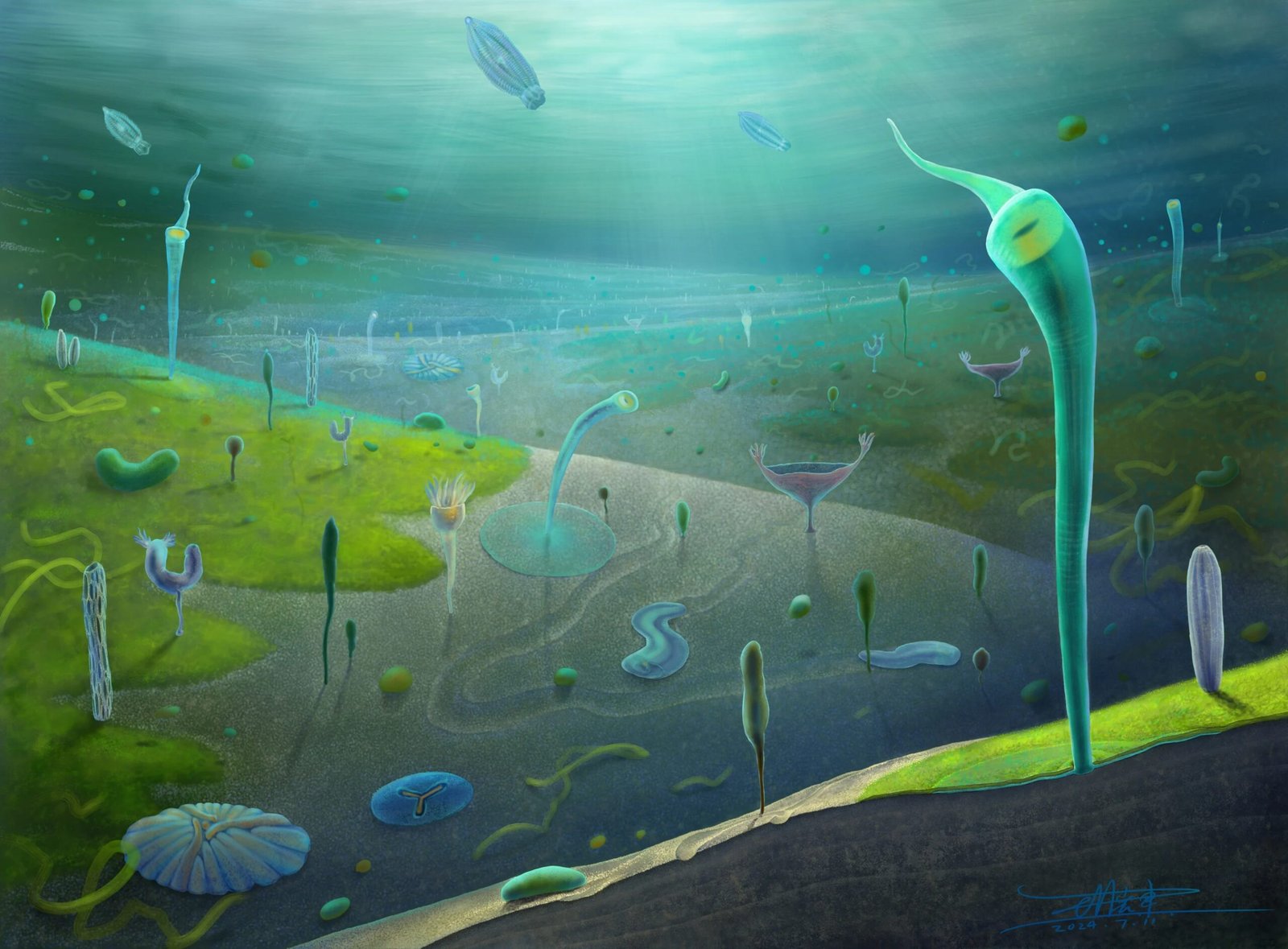
The discovery comes from the Jiangchuan Biota in Yunnan Province, southwest China, where more than 700 fossil specimens were recovered, aged between 554 and 539 million years old. The fossil site revealed a diverse community of Ediacaran organisms – both new, undescribed animal forms and groups known from the Cambrian period. Most strikingly, the international team identified fossils thought to be the oldest known relatives of deuterostomes – the broader group that today includes vertebrates such as humans and fish. The new fossils push the fossil record of deuterostomes back into the Ediacaran Period for the first time.
Among these fossil specimens were ancestors of modern starfish and their closest relatives, the acorn worms (the Ambulacraria*). These fossils have a U-shaped body and were attached to the seafloor with a stalk, with a pair of tentacles on their head used to catch food.
Co-author Dr Frankie Dunn (Museum of Natural History, Oxford University) said: ‘The presence of these ambulacrarians in the Ediacaran period is really exciting. We have already found fossils which are distant relatives of starfish and sea cucumbers and are looking for more. The discovery of ambulacrarian fossils in the Jiangchuan biota also means that the chordates – animals with a backbone – must also have existed at this time.’
For the first time, we demonstrate that many complex animals, normally only found in the Cambrian, were present in the Ediacaran period, meaning that they evolved much earlier than previously demonstrated by fossil evidence.
Lead author Dr Gaorong Li (Museum of Natural History, Oxford University)
Other ancestral groups among the fossils included worm-like bilaterian animals (having bilateral symmetry), some with complex feeding adaptations, alongside rare fossils interpreted as early comb jellies.
Many specimens showed novel combinations of anatomical features (such as tentacles, stalks, attachment discs, and feeding structures that can be turned inside out) that do not match any known Ediacaran or Cambrian species. ‘For instance, one specimen looks a lot like the sand worm from Dune!’ Dr Dunn added.
Co-author Associate Professor Luke Parry (Department of Earth Sciences, Oxford University) said: ‘This discovery is extremely exciting because it reveals a transitional community: the weird world of the Ediacaran giving way to the Cambrian, the following time period where the animals are much easier to place in groups that are alive today. When we first saw these specimens, it was clear that this was something totally unique and unexpected.’
The new findings help to resolve a long-standing puzzle in evolutionary biology. While molecular studies and trace fossils suggested that animal lineages diversified well before the Cambrian explosion, up to now fossils of many of these groups of complex animals have been missing from the Ediacaran period.
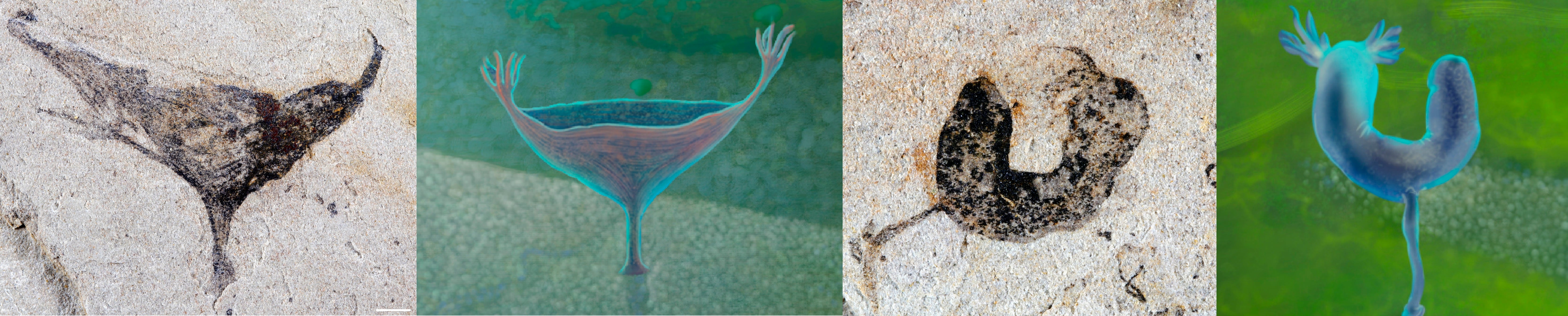
Left: Haootia-like fossil (an early cnidarian – the phylum that includes jellyfish, sea anemones and corals) from the Jiangchuan Biota (scale bar: 2 mm) and artist’s reconstruction. Right: A deuterostome cambroernid fossil from the Jiangchuan Biota (scale bar: 2mm) and artist’s reconstruction. Credits: Gaorong Li (fossil photographs) and Xiaodong Wang (artistic reconstruction).
Unlike most Ediacaran fossil sites, which preserve organisms mainly as impressions on sandstone surfaces, the Jiangchuan Biota fossils are preserved as carbonaceous films, a mode of preservation more typical of famous Cambrian sites such as the Burgess Shale in Canada. This exceptional preservation reveals anatomical details such as feeding structures, guts and locomotory organs.
Co-author Associate Professor Ross Anderson (Museum of Natural History, Oxford University) said: ‘Our results indicate that the apparent absence of these complex animal groups from other Ediacaran sites may reflect differences in preservation rather than true biological absence. Carbonaceous compressions like those at Jiangchuan are rare in rocks of this age, meaning that similar communities may simply not have been preserved elsewhere.’
 A deuterostome cambroernid fossil from the Jiangchuan Biota. Credit: Gaorong Li.
The new fossils were discovered by a research group in Yunnan University, China, led by Professor Peiyun Cong and Associate Professor Fan Wei, who have spent nearly ten years looking for diverse Ediacaran animal fossils. The rocks from Eastern Yunnan were already known to contain fossils but previously had yielded only remains of algae and not animals.
Associate Professor Fan said: ‘After years of fieldwork, we finally found several sites with the right conditions where animal fossils are preserved together with the abundant algae.’
Professor Feng Tang from the Chinese Academy of Geological Science, Beijing, whose previous work on the site inspired the team’s decade-long fieldwork effort, said: ‘The new fossils provide the most compelling evidence for the presence of diverse bilaterian animals at the end of the Ediacaran, evidence people have searched for across decades.’
* Ambulacraria, from the latin ambulacrum, meaning ‘a walk planted with trees.’
The study ‘The dawn of the Phanerozoic: a transitional fauna from the late Ediacaran of Southwest China’ has been published in Science.
For more information about this story or republishing this content, please contact [email protected]
 Part of the research team from the University of Oxford and Yunnan University during June 2024 fieldwork in the section of Jiangchuan Biota. From left to right, Dr. Wenwen Wen, Professor Peiyun Cong, Dr Frances Dunn, Associate Professor Luke Parry, Associate Professor Fan Wei and Dr Gaorong Li. Credit: Gaorong Li.
This year, Oxford Big Read brought together students from 15 countries in a truly global celebration of reading, creativity, and collaboration.
The Oxford Big Read is an international competition that encourages students to read OUP books and complete a creative project based on their reading. With three competition levels aligned to school classes, Oxford Big Read continues to foster literacy development at every stage.
This year, participation soared across participating countries, which included Colombia, Chile, Costa Rica, Peru, Mexico, Japan, South Korea, Taiwan, Vietnam, Thailand, China, Indonesia, Cambodia, Malaysia, and India—which saw a 363% year-on-year increase in submissions.
After months of reading, creativity, and exceptional student participation across continents, we are delighted to announce the Oxford Big Read Global 2025 winners. Their entries demonstrated outstanding imagination, storytelling skills, and deep engagement with their reading.
Level 1 – ages 5-8
Participants read an OUP book and then designed a new cover.
Winner: Mu Zha
From Mainland China
Entry: A New Home by Jan Burchett and Sarah Vogler
“I am a big fan of this book. The pictures are funny. And I love the different shoe homes best. If I had a shoe as my home, I would wish it to be a roller skate. It would have enough room for my family and friends, and it could move fast just like a roller skate.”

Runner-up: Raniah Raiziel Battad Bumutay
From Thailand
Entry: Let’s Make Pizza by Rachel Wilson

Level 2 – ages 9-12
Participants either: read an OUP book and wrote a response describing what they found interesting about the book; OR designed a poster representing their understanding of the book.
Winner: Pham Chau Anh
From Vietnam
Entry: Hachiko by Nicole Irving
“The story of Hachiko, an Akita dog, is one of the most touching stories in Japan. This picture is very important because it makes us feel both sadness and admiration. When we see Hachiko sitting alone, we feel the pain of waiting, but also the beauty of never giving up.”

Runner-up: Yufei Shen
From Mainland China
Entry: Decline and Fall by Evelyn Waugh
“The slogan I give the poster, “Going, Going, Gone”, is the cruel sound of a society making a deal, much like the voice-over in the movie The Truman Show. Though my poster has a vintage-chic style, if you look closely, you will find the cold interior.”

Level 3 – ages 13-15
Participants either: read an OUP book and wrote critical review describing the theme, plot, and characters; OR compared and contrasted two books.
Winner: Lại Anh Khôl
From Vietnam
Entry: Madame Marie Tells the Future by Lynne Marie Robertson
“The book teaches me that everyone has a dream and a special talent. I have learned that if we believe in ourselves, we can feel stronger and try harder. The message of the story is that kind and positive words can give us courage, and this makes me think about my own future too.”

Runner-up: Leyang Li
From Mainland China
Entry: Pride and Prejudice by Jane Austen
“Austen’s message is clear: true love and happiness come from understanding, respect, and the willingness to confront one’s own flaws. She rejects the idea that marriage should be based solely on social status or financial gain, instead arguing that emotional connections and shared values are far more important.”

For each level, students were rewarded for their contributions with prizes—from certificates and digital subscriptions to national prizes sponsored by Faber Castell, Amazon, and The Hindu Young World. The prestigious global awards included iPads and even an internship opportunity with our English Language Teaching Graded Reader team.
With global winners representing Mainland China, Vietnam, and Thailand, Oxford Big Read continues to connect students across continents through the joy of reading. Congratulations to all our winners and runners-up for their exceptional achievements.
Find out more about the Oxford Big Read here.

The Max Planck Encyclopedia of Public International Law has reached its goal for renewals and will continue to publish on a Subscribe to Open model, through to at least March 2027.
The Max Planck Encyclopedia of Public International Law is the leading resource in the field, containing peer-reviewed articles on every aspect of international law—a discipline which provides a common legal framework for the whole world.
By converting this comprehensive, analytical resource to an open access, Subscribe to Open model, we have made it possible for students, scholars, practitioners, and governments worldwide to access this content freely without financial barriers.
Subscribe to Open in practice
The Max Planck Encyclopedia of Public International Law is OUP’s first experiment with the Subscribe to Open model – a model typically applied to journals rather than books. Thanks to the support of our institutional and library customers, this valuable content is freely accessible to all for a second year.
As a result of the Subscribe to Open model, usage of the encyclopaedia has increased substantially from 2024 to 2025:
- An increase in usage by 1,291%
- An increase in usage from low- and middle-income countries by 556%
- Access from users in 235 different territories around the world, an increase from 199, including all 196 United Nations member states.
Professor Anne Peters, Director at the Max Planck Institute for Comparative Public Law and International Law, Heidelberg, and General Editor of the Max Planck Encyclopedia of Public International Law, said:
“We are delighted to have this opportunity to participate in a pioneering open access project, particularly in view of the foundational role played by the Max Planck Society in launching the move towards open scholarship. Open access can contribute to epistemic justice and pluralism—and what we call “encyclopaedic knowledge” should not only be distributed freely, but also be built up from a globally diverse set of standpoints.”
Rhodri Jackson, Director of Open Access Publishing and Strategy, shared:
“Innovation in open access models is in line with our mission: not only to publish excellent research and scholarship but to make it available worldwide. We are committed to learning from all our initiatives—successful and less successful—and to sharing our results transparently. The first year of Subscribe to Open for the Max Planck Encyclopedia of Public International Law has been a great success and we’re excited to see what happens in year two.”
While we have reached our goal for renewals this year, we still need to reach our renewal goals annually to keep this resource open access. By renewing your subscription, you help to ensure that this valuable resource remains open and accessible to all, year after year.”
Find more information, including about renewals, here.



-
 Oxford Events4 weeks ago
Michelin Guide Oxfordshire Restaurants – The Oxford Magazine
-

 Crime & Safety3 weeks ago
Oxford: ‘Next generation’ LimeBikes in city from today
-
 Jobs & Careers3 weeks ago
Explore our Careers
-
 Jobs & Careers3 weeks ago
Why Join Oxford | Oxford University Jobs
-
 Oxford Events3 weeks ago
Oxford News and Events, What’s on in Oxford, Exhibitions
-

 Jobs & Careers3 weeks ago
Internal Job Board for University vacancies
-

 Student Life3 weeks ago
The Art of Personalised Jewellery: Why Engraved Bracelets Are the Ultimate Keepsake
-
 Student Life3 weeks ago
Chancellor of Oxford University hosts special honorary degree ceremony