
Oxford University
Spectacular fossil treasure trove pushes back origins of complex animals

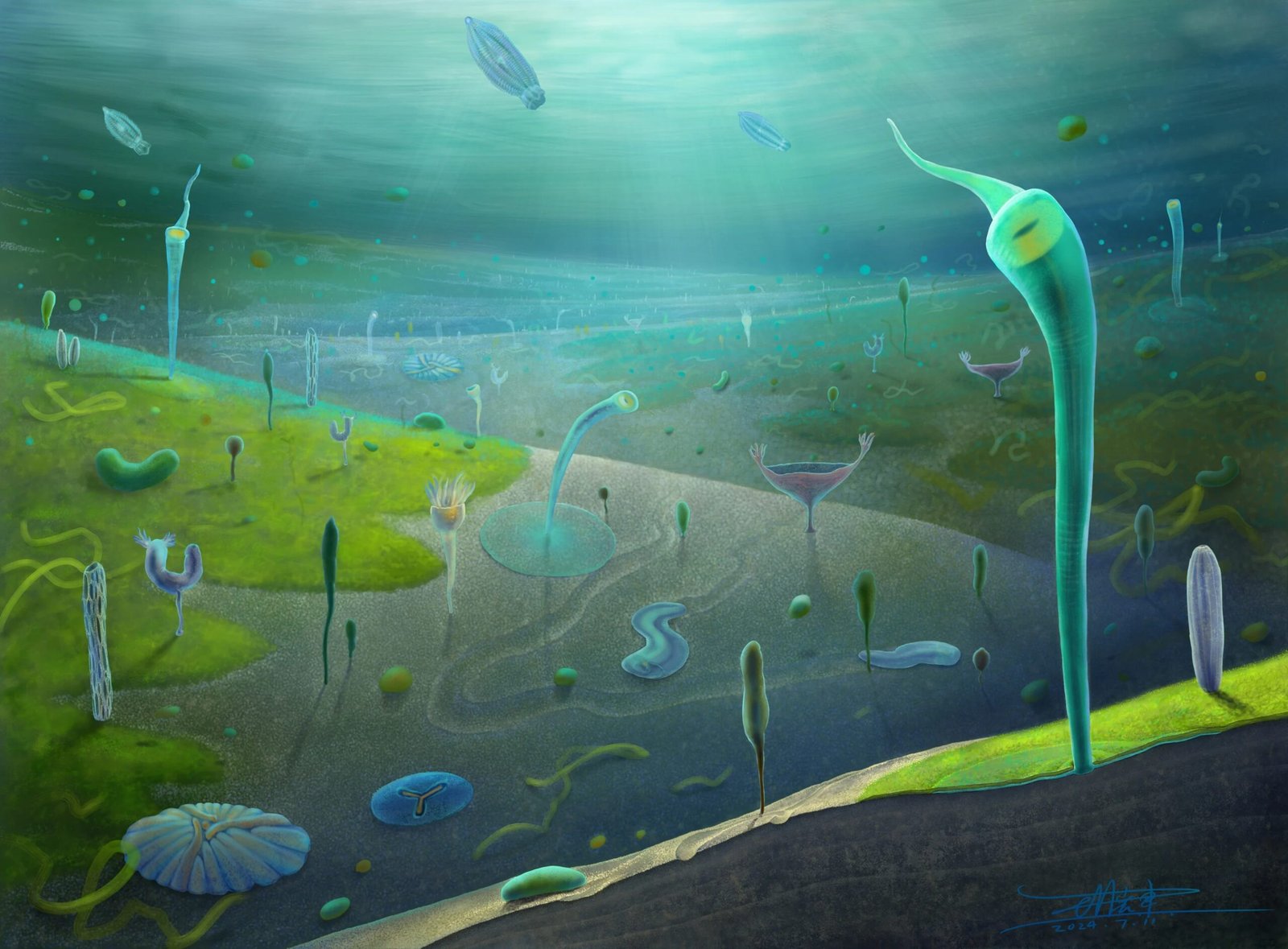
A newly-discovered fossil from the Jiangchuan Biota. Credit: Gaorong Li.
One of the most transformative events in Earth’s history was the rapid diversification of animal life, resulting in a dramatic increase in complexity and diversity from simpler life forms. Up to now, this was thought to have occurred at the start of the Cambrian Period, in an event known as the Cambrian explosion, starting around 535 million years ago. The new study, however, shifts this timeframe back by at least 4 million years, to the end of the Ediacaran period.
Lead author Dr Gaorong Li (Yunnan University at the time of the study, now Museum of Natural History, Oxford University), said: ‘Our discovery closes a major gap in the earliest phases of animal diversification. For the first time, we demonstrate that many complex animals, normally only found in the Cambrian, were present in the Ediacaran period, meaning that they evolved much earlier than previously demonstrated by fossil evidence.’
The discovery comes from the Jiangchuan Biota in Yunnan Province, southwest China, where more than 700 fossil specimens were recovered, aged between 554 and 539 million years old. The fossil site revealed a diverse community of Ediacaran organisms – both new, undescribed animal forms and groups known from the Cambrian period. Most strikingly, the international team identified fossils thought to be the oldest known relatives of deuterostomes – the broader group that today includes vertebrates such as humans and fish. The new fossils push the fossil record of deuterostomes back into the Ediacaran Period for the first time.
Among these fossil specimens were ancestors of modern starfish and their closest relatives, the acorn worms (the Ambulacraria*). These fossils have a U-shaped body and were attached to the seafloor with a stalk, with a pair of tentacles on their head used to catch food.
Co-author Dr Frankie Dunn (Museum of Natural History, Oxford University) said: ‘The presence of these ambulacrarians in the Ediacaran period is really exciting. We have already found fossils which are distant relatives of starfish and sea cucumbers and are looking for more. The discovery of ambulacrarian fossils in the Jiangchuan biota also means that the chordates – animals with a backbone – must also have existed at this time.’
For the first time, we demonstrate that many complex animals, normally only found in the Cambrian, were present in the Ediacaran period, meaning that they evolved much earlier than previously demonstrated by fossil evidence.
Lead author Dr Gaorong Li (Museum of Natural History, Oxford University)
Other ancestral groups among the fossils included worm-like bilaterian animals (having bilateral symmetry), some with complex feeding adaptations, alongside rare fossils interpreted as early comb jellies.
Many specimens showed novel combinations of anatomical features (such as tentacles, stalks, attachment discs, and feeding structures that can be turned inside out) that do not match any known Ediacaran or Cambrian species. ‘For instance, one specimen looks a lot like the sand worm from Dune!’ Dr Dunn added.
Co-author Associate Professor Luke Parry (Department of Earth Sciences, Oxford University) said: ‘This discovery is extremely exciting because it reveals a transitional community: the weird world of the Ediacaran giving way to the Cambrian, the following time period where the animals are much easier to place in groups that are alive today. When we first saw these specimens, it was clear that this was something totally unique and unexpected.’
The new findings help to resolve a long-standing puzzle in evolutionary biology. While molecular studies and trace fossils suggested that animal lineages diversified well before the Cambrian explosion, up to now fossils of many of these groups of complex animals have been missing from the Ediacaran period.
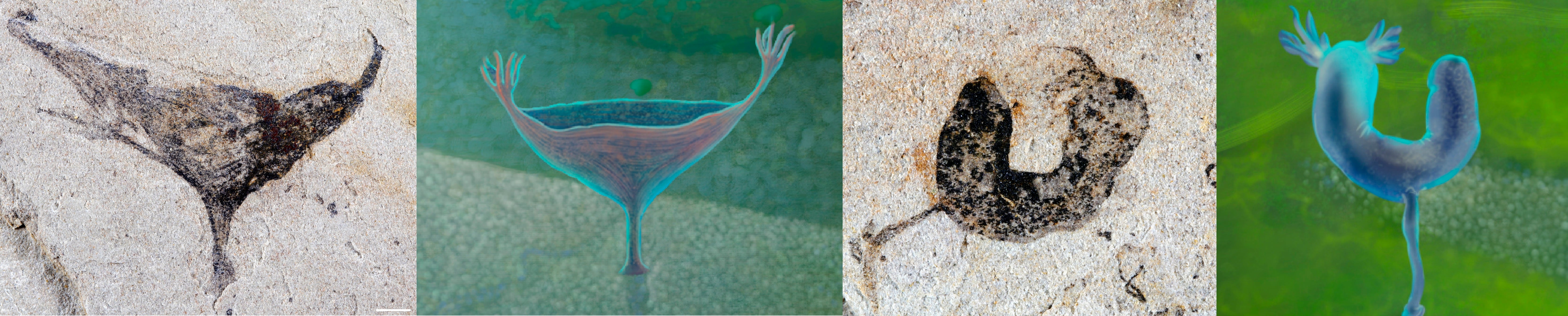
Left: Haootia-like fossil (an early cnidarian – the phylum that includes jellyfish, sea anemones and corals) from the Jiangchuan Biota (scale bar: 2 mm) and artist’s reconstruction. Right: A deuterostome cambroernid fossil from the Jiangchuan Biota (scale bar: 2mm) and artist’s reconstruction. Credits: Gaorong Li (fossil photographs) and Xiaodong Wang (artistic reconstruction).
Unlike most Ediacaran fossil sites, which preserve organisms mainly as impressions on sandstone surfaces, the Jiangchuan Biota fossils are preserved as carbonaceous films, a mode of preservation more typical of famous Cambrian sites such as the Burgess Shale in Canada. This exceptional preservation reveals anatomical details such as feeding structures, guts and locomotory organs.
Co-author Associate Professor Ross Anderson (Museum of Natural History, Oxford University) said: ‘Our results indicate that the apparent absence of these complex animal groups from other Ediacaran sites may reflect differences in preservation rather than true biological absence. Carbonaceous compressions like those at Jiangchuan are rare in rocks of this age, meaning that similar communities may simply not have been preserved elsewhere.’
 A deuterostome cambroernid fossil from the Jiangchuan Biota. Credit: Gaorong Li.
The new fossils were discovered by a research group in Yunnan University, China, led by Professor Peiyun Cong and Associate Professor Fan Wei, who have spent nearly ten years looking for diverse Ediacaran animal fossils. The rocks from Eastern Yunnan were already known to contain fossils but previously had yielded only remains of algae and not animals.
Associate Professor Fan said: ‘After years of fieldwork, we finally found several sites with the right conditions where animal fossils are preserved together with the abundant algae.’
Professor Feng Tang from the Chinese Academy of Geological Science, Beijing, whose previous work on the site inspired the team’s decade-long fieldwork effort, said: ‘The new fossils provide the most compelling evidence for the presence of diverse bilaterian animals at the end of the Ediacaran, evidence people have searched for across decades.’
* Ambulacraria, from the latin ambulacrum, meaning ‘a walk planted with trees.’
The study ‘The dawn of the Phanerozoic: a transitional fauna from the late Ediacaran of Southwest China’ has been published in Science.
For more information about this story or republishing this content, please contact [email protected]
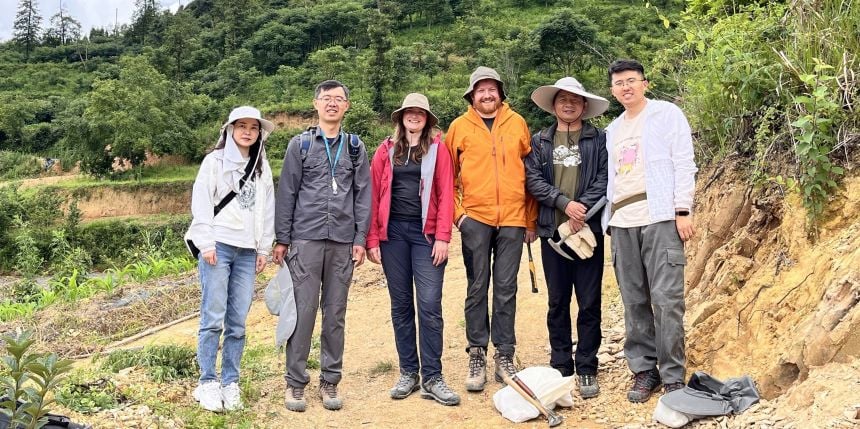 Part of the research team from the University of Oxford and Yunnan University during June 2024 fieldwork in the section of Jiangchuan Biota. From left to right, Dr. Wenwen Wen, Professor Peiyun Cong, Dr Frances Dunn, Associate Professor Luke Parry, Associate Professor Fan Wei and Dr Gaorong Li. Credit: Gaorong Li.

Chair of the Global Prize Committee and Professor of International History and Politics at the Geneva Graduate Institute
“This year’s pool of submissions was remarkably strong. A large number of manuscripts made genuine contributions to their respective fields and were worthy of serious consideration. The judging process was accordingly tough and energizing. I, for one, learned an enormous deal about themes as diverse as Caribbean environments, Vietnamese cities, and Latin American rivers.
“The ECR First Book Prize is invaluable. It doesn’t just recognize excellent books, but helps launch them.”
Rhea Realo, Head of Digital Product at OUP ANZ, said:
“Oxford Digital brings together proven education research, recognized accessibility standards, and ongoing feedback from teachers. Being named a finalist on the global stage is a strong endorsement of the practical, inclusive learning experience we’ve worked with educators to create.”

The Oxford English Dictionary (OED) is a historical dictionary, containing over 500,000 entries and 3.5 million quotations to capture over 1,000 years of English.
Every quarter, we update the OED by revising versions of existing entries as well as defining new words and senses. These updates subtly broaden our understanding of the English language and its use around the world.
10 highlights from this quarter’s update
1. We added more than 400 new words, phrases, and senses to the OED this quarter, including hot yoga, fantabulosa, will-they-won’t-they, and auto-reply.
2. By happy coincidence this update lands just before International Coffee Day (1 October). Coffee drinks new to the OED include Café Cubano, café con leche, cafezinho, and cold brew.
3. This release sees additions from across the world, including contributions from East Africa, Caribbean, Bermuda, New Zealand, Wales, and the Isle of Man. Learn more from Executive Editor, Danica Salazar.
4. From shadeesh to hamma, we welcome several Bermudian English additions, as part of a valuable new collaboration with the Bermuda Spelling Bee. This is an annual spelling competition for 9- to 13-year-olds designed to foster a love of language and learning among young Bermudians.
5. Several new words for supernatural creatures appear in this update. From Welsh folklore we have a bwbach, from Caribbean folklore a jablesse, and we also have the Trinbagonian addition of douen.
6. An important feature of the OED’s New Words team’s work is its Monitor Lexicography (MonLex) programme. This is our way of monitoring, collecting, and prioritizing contemporary language for inclusion in the OED, looking at sources including trending words on language corpora, social media, material generated by our reading programmes, and suggestions made by colleagues on our own internal database. Every other quarter we gather the items collected and assess them for inclusion, prioritizing so that we include the most relevant and important.
Some new words added this quarter from our MonLex programme include: the social media sense of timeline, the sense of slammed meaning very busy or overcome with work, the chiefly North American English word bothsidesism, and lastly, overnight oats.
7. Craig Leyland, Executive Editor, notes the welcome of two reference related words – thesaural and mountweazel. The latter is defined as ‘an invented or fake entry in a reference work (esp. a dictionary or an encyclopedia), a database, etc., typically used by the publisher to identify plagiarism that constitutes an infringement of copyright’. Does the OED contain any mountweazels? We can’t say, of course. You can read more from Craig about both here.
8. More than 700 entries have been revised as part of this update, including ‘gym’ and ‘kanaka’ words. Read more in this commentary from Andrew Ball, OED Editor.
9. The words newly revised this quarter show an especially rich variety of etymologies. In the month that the Bayeux Tapestry goes on view in London, it is fitting that we have a healthy crop of Middle English borrowings from French, or more specifically Anglo-Norman (i.e. French as used in medieval Britain), including doubt, equity, fantasy, and garner. Read more from Philip Durkin, OED Deputy Chief Editor.
10. And finally, being asked about ‘scone’ usually raises a groan for pronunciation editors, but it was good to have the opportunity to provide the ‘skoon’ pronunciation appropriate for the Stone of Scone in this update. Hear more from Catherine Sangster, OED Pronunciation Editor.
Explore the update in more depth here.


Oxford United player ratings in bizarre Mansfield Town draw

Number of cloned number plates on UK roads at record high, data shows | Transport

LIVE: Mansfield Town 1-1 Oxford United – Two red cards as U's down to nine men
-

 Oxford united FC4 weeks ago
Chris Gunter steps away Wales role to focus on Oxford United
-

 Oxford University3 weeks ago
New to the Oxford English Dictionary this September
-

 Traffic & Transport2 weeks ago
How poor public transport policy is putting the brake on cities | Road transport
-
 Student Life3 weeks ago
Oxford partnership allows OpenAI to use rare Bodleian texts to train ChatGPT
-

 Traffic & Transport2 weeks ago
Why should I have to pay more for buses if I don’t use a smartphone? | Bus fares
-

 Oxford united FC1 week ago
LIVE: Exeter City vs Oxford United – Jersey Mike's Trophy group stage
-

 Oxford united FC2 weeks ago
Northern Ireland fans laud Oxford United defender Ciaron Brown
-

 Oxford Events3 weeks ago
Four days of equestrian spectacle at 2026 Blenheim Palace International Horse Trials