
Student Life
Oxford is not an aesthetic


My social media algorithm has successfully tracked my profile closely enough to have figured out where I study. To my regret. For every now and then, I’ll be confronted with yet another bird’s-eye view of central Oxford glistening at sunset, or an edit of a glorified study session in Duke Humfrey’s library.
I often find my feed accosted with these montages of Oxford life, with the formal dinner being a classic. A short clip will introduce a carefully crafted montage of a candle-lit dining hall, proudly gowned students, and the evening’s luxurious menu. A recent video featuring Keble Hall encouraged the viewer to “imagine walking into a hall so long you can barely see the end of it. Candles everywhere, everyone in black robes. The waiters looking like they’ve been doing this since 1887”. They are paired with statements such as ‘come with me to the fanciest dinner ever’, or worse yet, framed as a ‘POV’. “POV: you are studying at the world’s second oldest university” or “POV: Oxford students on a Wednesday night”. These captions are followed by the same sequence of an ornate room full of chatter, clinking glasses, and tailcoats, all set to a trending audio to polish off this curated atmosphere. It frames life in Oxford like a film reel, where every interaction is one of intellect and every evening one of extravagance.
I suppose it sounds enticing, especially to those who do not attend Oxford. Does it feel completely familiar? Not at all. These videos desperately lack any kind of nuance, especially in how they project student experience. They contain dregs of truth amongst what is mostly a fabricated existence, abandoning any personal insight in pursuit of the same generic presentation of Oxford’s ‘hallowed halls’. The content drools over the ‘aesthetic’ of academia or what it would feel like to be an esteemed guest at these exclusive dinners; they are snapshots that glorify opulence, venerating what they and the viewer romanticise as the peak of sophistication.
This leads to a particular grievance of mine, which is the Oxford ‘influencers’ – those who create content that thrives and capitalises on a purely idealistic version of the institution they study at. Accounts such as @observingoxford chase after this ‘aesthetic’ in their endless snapshots of Radcliffe Square and the Bodleian Libraries, making out that every moment, every walk down the street, every study session is made of magic. These content creators participate in a strange kind of tourism of their own lives. When I see Meagan Loyst’s edit of Christ Church ball, I can’t help but feel that the 1.1 million people who have liked the post have been done an injustice. It presents an enchanting evening of ballgowns and bubbles, all set to Michael Bublé’s ‘Feeling Good’ for a little extra dose of (what is perceived to be) perfection. Yet there is something forced, and dare I say cringeworthy, about filming yourself and self-consciously documenting your experience for the viewer. Having attended this ball myself, I am again struck by how little personality or actual insight brought to these representations in favour of this imaginary world.
The effect of this illusion is confirmed by the awestruck comments that idealise Oxford as their dream university. I would go so far as to say that an injustice is done to the University itself, reduced to an image that compacts its wealth of history, beautiful architecture and impressive events (as well as the reality of admissions and its reputation as a world-class centre of teaching and research) into this ‘aesthetic’. These viral videos feed off this perceived perfection, and even assume the viewer’s desire to one day attend themselves.
I do not mean to say that Oxford is not full of incredibly unique experiences, traditions and opportunities – it is an undeniably special place. Perhaps my sentiments stem from my impartiality towards my own experience of Oxford. I never romanticised Oxford when applying, and now that I’m here, I often find Oxford to be a beautiful yet self-satisfied and overwhelming city. As much as I’ve tried to feel at home here, I find it impossible to be constantly enamoured or consumed with wonder – if I were to be so, I would have to remove myself from my experience of the place. I feel guilty when people back in London question me about Oxford and assume it must be glorious. The reality, however, is that, at least for me, the city of Oxford is a place I’ve taken a long time to grow used to and still am not fully able to give my heart to. I greatly appreciate studying at Oxford, yet I have never found it to be a place where I feel at peace. I can’t, nor do I desire to, discard my personal preferences and blindly throw my affection towards where I end up studying; prestige changes nothing. Crucially, I don’t think a student’s experience should be one that buys into this generic ‘aesthetic’ or an expected all-encompassing love for Oxford, but rather a compromise between lived experience, individual personality and all that Oxford has to offer.
Perhaps I’m too harsh. Perhaps these influencers merely perceive Oxford differently from me, and I should appreciate their apparent overwhelming adoration. Perhaps their experience is different to mine, given that most of these influencers are postgraduates. Yet I still can’t help but wince at the all-consuming My Oxford Year taint to it all. I would expect their attitude to be that of a tourist, or a film director – not of a student. Surely there’s more to their time here than this – how can one produce such unnuanced content of their own lived experience? Surely they don’t still see Christ Church as the “Harry Potter hall”, or gowned students matriculating as a fantastical procession – it does Oxford’s much more interesting reality an injustice.
My stance is not one of pessimism, but actually a plea for the individuality of student experience, both in our own attitudes and social media content, to be championed. The holistic nature of one’s personal journey in Oxford is largely unspoken about. Students’ lives here should comprise both the individual and the institution: there is a beauty to this that is much more captivating than living in an ‘aesthetic’. In fact, if we play this game of stereotyping Oxford, surely the plethora of endlessly intellectual and individually minded students that it’s renowned for can do more than just generically idolise where they study. Otherwise, there’s a danger of becoming just a faceless figure in a tailcoat, sipping champagne behind a phone screen.

Ugandan participants in a clinical safety study received an Oxford developed Ebola vaccine this week.
Researchers vaccinated the first participants on 6th October in Masaka, Uganda. The phase follows the launch of a first-in-human Phase I trial in the UK evaluating the same vaccine candidate.
They received the vaccine as part of an evaluation of the safety and efficacy of a ChAdOx-based Bundibugyo Ebola vaccine candidate developed by the Oxford Vaccine Group (OVG) and the Pandemic Sciences Institute at the University of Oxford.
Development for this vaccine began in May this year in response to the ongoing Ebola outbreak in the Democratic Republic of the Congo (DRC). The research, led by OVG’s Professor Teresa Lambe and Professor Simon Drysdale, is funded by the Coalition for Epidemic Preparedness Innovations (CEPI). No licenced vaccine for the Bundibugyo strain of Ebola virus currently exists.
In a statement to Cherwell, OVG said its involvement includes collaborating with the Ugandan research team to support “the study’s scientific design, clinical trial coordination, safety oversight, and evaluation of vaccine safety and immunogenicity”. The Phase I clinical trial addresses a rare strain of Ebola virus affecting communities in the DRC since May. The phase is a collaboration between the Medical Research Council/ Uganda Virus Research Institute and the London School of Hygiene and Tropical Medicine (LSHTM).
Dr Nicole Lurie, CEPI’s Executive Director for Emergency Preparedness and Response, told Cherwell: “It [the Bundibugyo outbreak] remains the fastest-growing and second-largest Ebola outbreak ever recorded – and we currently remain without a licensed vaccine or treatment.” The Bundibugyo Ebola epidemic in the DRC has surpassed 8,600 cases, with almost half of infections proving fatal.
The outbreak was declared a Public Health Emergency of International Concern (PHEIC) by the World Health Organisation (WHO) in May.
OVG told Cherwell: “For more than a decade, the University of Oxford has performed many clinical trials of candidate viral-vectored vaccines. Some of the most promising vaccines used a modified chimpanzee adenovirus, a harmless version of a common cold virus. The Oxford-AstraZeneca (ChAdOx1) COVID-19 vaccine was approved for emergency use in the UK in December 2020 and was estimated to have saved six million lives during 2021 alone, and over 3 billion doses were used worldwide.” The adenovirus vector vaccine technology trialled in this study was successfully used worldwide as part of the Oxford-AstraZeneca COVID-19 vaccine.
More funding is necessary to ensure the development and approval of the Ebola vaccine. Lurie told Cherwell: “Without sufficient additional funding, we are at risk of not being able to develop these promising vaccine candidates… CEPI urgently needs US$128M now to keep our Bundibugyo emergency R&D response moving. Without it, we are putting the DRC, and the world, at tremendous risk.”

Spoilers Ahead!!
East of Eden is a special book in many ways. It is beautiful, for one, and loving too. John Steinbeck dedicated it to his editor and long-term friend Pascal ‘Pat’ Covici. In the preface, he describes East of Eden as though it were a box, a wrapped gift; for his dear friend, the author has packaged “the pleasure of design and some despair and the indescribable joy of creation”, there is also “on top of these” “the love I have for you”. Above that “gratitude and love,” trapped with all the “joy” and “despair,” is the empty space of human potential: “Still the box is not full.”
Steinbeck was born in 1902 in Salinas; thus, an unmistakable personal nostalgia colours the voice of the semi-autobiographical narrator. “I remember my childhood names for grasses and flowers,” he begins on the first page, “I remember where a toad might live and what time the birds awaken in the summer”. Throughout, despite, or perhaps because of, the various horrors the author explores, he always makes time for nature. In chapter eight we meet Cathy, one of those “monsters born in the world to human parents”. Amongst the schemes of her girlhood, Steinbeck remembers to mention “the young grass” that “bristled under the sun” and “the yellow dandelions”. In part, I think the explosion in East of Eden’s popularity is due to Steinbeck’s affection for Salinas Valley. The compulsiveness of his characters is present, as always, so is his ability to render any landscape powerful, visceral in prose. But there is something, ironically, lapsarian about East of Eden: it is a relic of the author’s own childhood.
Everyone enjoys beauty; a beautiful book, written in a determinedly readable style, is bound to become popular, not to mention the endless power of nostalgia. But there is something else in East of Eden, I believe, that has catapulted it from the fame of every book-tok influencer’s favourite lists to a multi-million dollar Netflix show. I read the book in 2023, perhaps a little ahead of the curve – if that’s possible for a book published in 1925. Since then, I have recommended East of Eden to everyone who asks. But, I would not say it is my favourite book; it might not be in my top five. Rather, I recommend East of Eden in the same way a film buff recommends Good Will Hunting.
It’s feel-good; it’s the ultimate feel-good book because it tells you that your life is your choice. Be good, be bad, be a little bit the one and a little bit the other: just don’t imagine for a second that it is not under your control to be so. The message emerges slowly over the first few hundred pages, but arrives suddenly at the forefront in chapter 24, through the voice of Lee, a Chinese man who cares for Adam Trask’s boys when both father and mother have abandoned them. Adam Trask, of course, embodies his biblical namesake as husband to the ‘monster’ Cathy, and father to the Cain/Abel parallel, Cal and Aran.
Lee describes the arduous process of translating Hebrew with four elderly Chinese gentlemen who live in San Francisco, smoking opium and solving whatever problems people bring them. After two years, he and the four elderly gentlemen can translate the passage – thus resolving a discrepancy in English translations of the Bible. “The American version orders men to triumph over sin… The King James translation makes a promise… But the Hebrew word, the word timshel – ‘thou mayest’ – that gives a choice,” Lee concludes, “It might be the most important word in the world”. Regardless of whether or not Steinbeck’s Hebrew translation is correct, which it likely isn’t, he’s right that ‘may’ is the most important word in the world: it is the belief in choice, the hope at the bottom of the jar, the empty space in the box that is “still not full”.
If it weren’t couched in the natural beauty of Salinas Valley, or the fascinating moral drama of the Trask and Hamilton families, Steinbeck’s message wouldn’t work so well. That said, the message is central to the book. Whilst other authors of his period reach for obscurity, designing their work to be a puzzle, a dream that requires clever interpretation, Steinbeck teaches a lesson. He delivers an earnest sermon. East of Eden is didactic; it is a fantastic book, it has beautiful language and compelling characters, but it is ultimately didactic. People enjoy reading it because it gives them a sense of control: Netflix could gamble millions on its popularity because they knew it was something that made people feel good about themselves, something they would want to watch on the screen.
East of Eden is a book like Pandora’s Box. It is well crafted, beautiful to look at. Inside, the author examines what he sees as the fringes of humanity, our best and worst parts: “Pain and excitement are in it, and feeling good or bad and evil thoughts and good thoughts.” When all this has been discarded, when we think the box is nearly empty and the indomitable Trask lies dying, Steinbeck presents us with the final gift. It is the word timshel, the choice to be good or bad in our lives: hope.
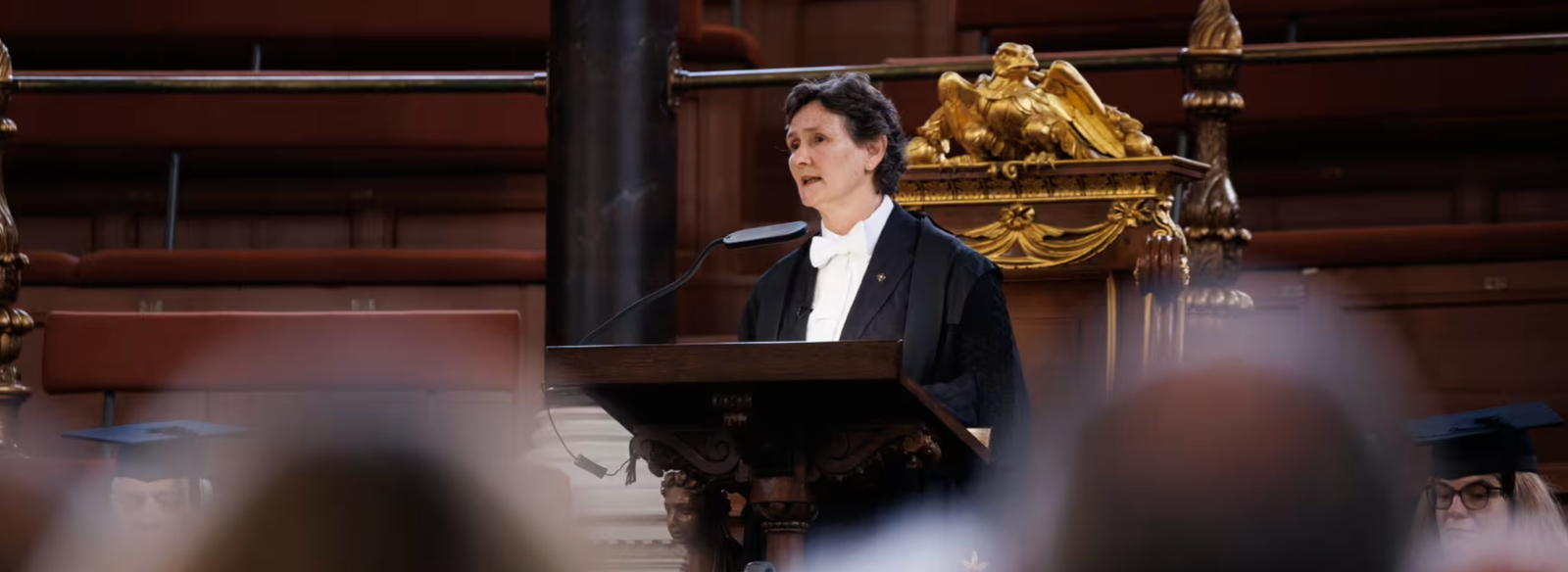
Vice-Chancellor Professor Irene Tracey opened the new academic year on Wednesday, 7th October, with the annual Oration at the Sheldonian Theatre.
The Oration allows the Vice-Chancellor to define the priorities of the University’s highest office and reflect upon the past year at the University. This year, these include AI ethics, bridging the gap between “town and gown”, and the increasing importance of scientific innovation for the University.
The Vice-Chancellor commented on the University’s influential role in shaping the AI landscape, both through technical research and noting work on AI governance from the newly launched Oxford Institute of Technology and Justice. Tracey referenced the university-wide rollout of ChatGPT-5 last year, while stressing the need for places where “students are taught to think critically and independently”. She identified Oxford’s tutorial system as a “unique asset” in combating the potential pitfalls of AI in learning.
Tracey also spoke about local community work, such as partnering with the homelessness charity Emmaus Oxford: “I want my hometown people to actually feel that having the world’s number one university on their doorstep really does make their lives better.”
From the start, the Vice-Chancellor also referenced that the turmoil facing British politics today might reflect “a nation not sure of its identity”.
As for Oxford’s identity, Tracey pointed at the role of innovation and STEM, lauding a dizzying array of successes.“It is estimated that over two billion people worldwide are using or benefiting from a piece of research that came from Oxford… that’s impact,” the Vice-Chancellor said.
The Vice-Chancellor also praised the “eye-watering investment” that Oxford quantum spin-outs have attracted. One such spinout, Oxford Ionics, was acquired for $1.075 billion by US-listed IonQ last year, while Oxford Quantum Circuits (OQC) closed a £260 million funding round this June – the highest ever won in Europe by a quantum computing company.
“I sense we’re more comfortable now owning [innovation] as part of our identity,” the Vice-Chancellor said.
For a university traditionally prized for the humanities and philosophy, with eight out of the last eleven prime ministers studying at Oxford, this is a notable shift.
The Vice-Chancellor went on to link these achievements in innovation to strong investment, referencing the University’s £6.9 billion in net asset value. In it, she thanked the Syrian-Saudi Arabian businessman and philanthropist Wafic Saïd for a “transformational” £15 million donation to the new Global Leadership Centre.
The Vice-Chancellor then spoke about Oxford’s unique financial stability amongst struggling UK universities, calling for “that difficult national conversation about how we fund the UK higher education sector”. Just last week Nottingham University confirmed the closures of all modern language and music degree courses. However, Oxford is not immune to financial pressures. Oxford University Press workers are also still striking over offshoring jobs to India.
The Vice-Chancellor also affirmed her support for diversity in higher education. She said: “If you are serious about excellence, the potential for excellence and finding top talent, you will end up with a diverse team.” “Look at the Premier League, or my beloved Everton”, she said.
As said at the beginning of this year’s oration, the Vice-Chancellor concluded by arguing that “at this critical point in our collective history”, the University would make a mark on Britain’s identity as a “place of ambition, excellence, kindness and hope”.


Oxford United player ratings in bizarre Mansfield Town draw

Number of cloned number plates on UK roads at record high, data shows | Transport

LIVE: Mansfield Town 1-1 Oxford United – Two red cards as U's down to nine men
-

 Oxford united FC4 weeks ago
Chris Gunter steps away Wales role to focus on Oxford United
-

 Oxford University3 weeks ago
New to the Oxford English Dictionary this September
-

 Traffic & Transport2 weeks ago
How poor public transport policy is putting the brake on cities | Road transport
-

 Student Life3 weeks ago
Oxford partnership allows OpenAI to use rare Bodleian texts to train ChatGPT
-

 Oxford united FC1 week ago
LIVE: Exeter City vs Oxford United – Jersey Mike's Trophy group stage
-

 Traffic & Transport2 weeks ago
Why should I have to pay more for buses if I don’t use a smartphone? | Bus fares
-

 Oxford united FC2 weeks ago
Northern Ireland fans laud Oxford United defender Ciaron Brown
-

 Oxford Events4 weeks ago
Four days of equestrian spectacle at 2026 Blenheim Palace International Horse Trials