
UK News
Middle East crisis live: US launches rescue mission as official says Iran has shot down fighter jet | US-Israel war on Iran

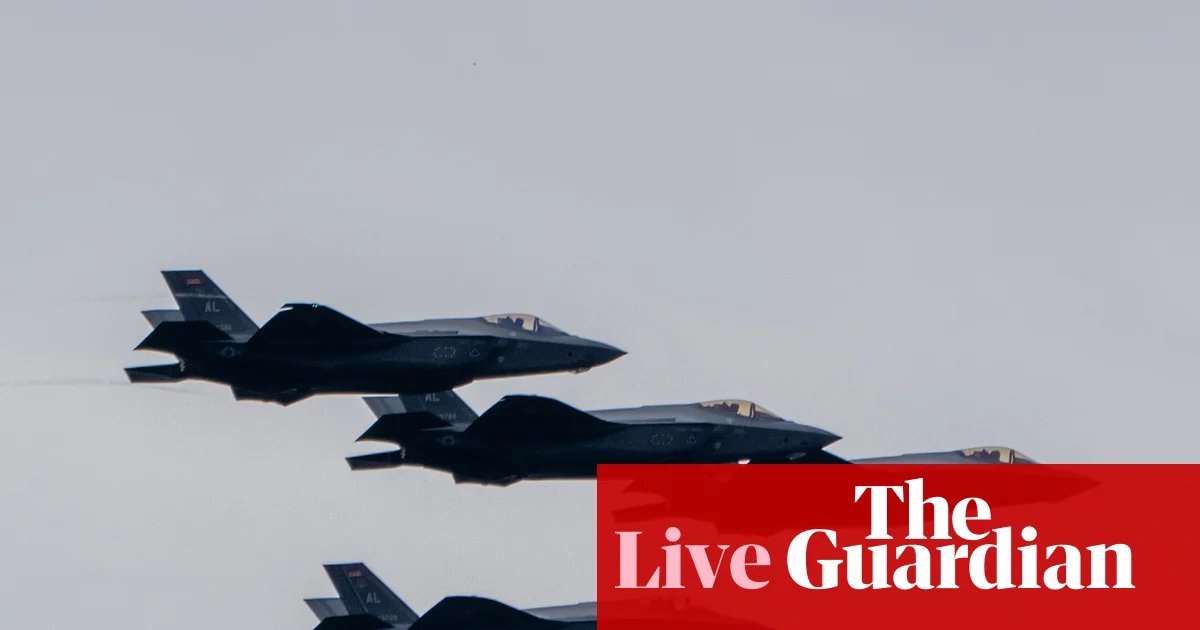
Iran shot down a US fighter jet
A search is under way for the crew of a US fighter jet that was shot down by Iran, a person familiar with the matter has confirmed.
As we reported earlier, Iran claimed that it had shot down a US fighter jet, with state media reporting it was an F-35 warplane.
The fate of the crew remains unclear.
It follows reports by Iranian state media that the US military is searching for an American pilot of a downed aircraft in Iran, following earlier reports that Tehran had shot down a US F-35 fighter jet.
Iran’s semi-official Tasnim news agency claimed that the US military is searching for a pilot “of a fighter jet that was attacked by the Iranian armed forces this morning”. In an earlier report, it published photos purporting to show the wreckage of a downed US aircraft, although it appears to be an F-15E Strike Eagle based out of RAF Lakenheath.
Peter Layton, a visiting fellow at the Griffith Asia Institute in Australia, told NBC News: “I think the structure looks like an F-15 and from the tail flash stripe markings from the 48th Fighter Wing, based at RAF Lakenheath in the United Kingdom.”
US officials have not publicly commented on the claims.
The Associated Press news agency reported that a channel affiliated with Iranian state television broadcast news of the pilot. The channel is in Kohkilouyeh and Boyer-Ahmad province, a rural and mountainous region that spans over 15,500 sq km (5,900 sq miles).
Key events
Reuters news agency has also reported that a search is under way for the crew of a US fighter jet shot down over Iran, citing US officials.
We will bring you more updates as we get it.
Iran shot down a US fighter jet
A search is under way for the crew of a US fighter jet that was shot down by Iran, a person familiar with the matter has confirmed.
As we reported earlier, Iran claimed that it had shot down a US fighter jet, with state media reporting it was an F-35 warplane.
The fate of the crew remains unclear.
It follows reports by Iranian state media that the US military is searching for an American pilot of a downed aircraft in Iran, following earlier reports that Tehran had shot down a US F-35 fighter jet.
Iran’s semi-official Tasnim news agency claimed that the US military is searching for a pilot “of a fighter jet that was attacked by the Iranian armed forces this morning”. In an earlier report, it published photos purporting to show the wreckage of a downed US aircraft, although it appears to be an F-15E Strike Eagle based out of RAF Lakenheath.
Peter Layton, a visiting fellow at the Griffith Asia Institute in Australia, told NBC News: “I think the structure looks like an F-15 and from the tail flash stripe markings from the 48th Fighter Wing, based at RAF Lakenheath in the United Kingdom.”
US officials have not publicly commented on the claims.
The Associated Press news agency reported that a channel affiliated with Iranian state television broadcast news of the pilot. The channel is in Kohkilouyeh and Boyer-Ahmad province, a rural and mountainous region that spans over 15,500 sq km (5,900 sq miles).
In today’s episode of Today in Focus, the Guardian’s editor for rights and freedom, Tess McClure, reports on the US bombing of the Shajareh Tayyebeh school in southern Iran, and the families who lost loved ones in the attack.
“The impact of dropping a 2,000-plus pound bomb on a primary school full of children mostly seven to 12 years old and their teachers is just unimaginable,” Tess tells Nosheen Iqbal of the strike on the school in Minab on 28 February.
“The loss of 130-plus girls and about 30 teachers is just an incredible loss for those families. And I think what comes through as well when you listen to their voices, listen to them describing their children, is this incredible ordinariness of family life up until that moment that just has transformed all of their lives forever.”
Tess describes how 28 February unfolded for two of the families that suffered in the bombing, based on her reporting. She also explains the evidence that points to the United States being responsible for the tragedy.
You can listen to the episode here:
Analysis: is the US committing war crimes?

Peter Beaumont
Donald Trump, other senior US officials and their cheerleaders appear to be embracing attacks – and threats of attacks – on Iranian civilian infrastructure, which legal experts say appears to constitute serious war crimes under international law.
In his rambling national address on Wednesday, the US president warned that if Iran did not reach an unspecified deal with him, US forces would “hit each and every one of their electric-generating plants” and “bring [Iran] back to the stone ages – where they belong”.
Following through on that threat a day later, Trump posted images of a strike on an the unfinished B1 bridge near Tehran, warning: “Much more to follow!”
Erika Guevara Rosas, Amnesty International’s senior director of research, advocacy, policy and campaigns said: “Intentionally attacking civilian infrastructure such as power plants is generally prohibited.
“Even in the limited cases that they qualify as military targets, a party still cannot attack power plants if this may cause disproportionate harm to civilians.
“Given that such power plants are essential for meeting the basic needs and livelihoods of tens of millions of civilians, attacking them would be disproportionate and thus unlawful under international humanitarian law, and could amount to a war crime.”
Read on here:
Trump claims US could ‘easily’ open up strait of Hormuz but needs ‘more time’
Donald Trump has been posting on his social media platform, Truth Social.
On Iran, he has written:
With a little more time, we can easily OPEN THE HORMUZ STRAIT, TAKE THE OIL, & MAKE A FORTUNE. IT WOULD BE A “GUSHER” FOR THE WORLD??? President DONALD J. TRUMP
As we mentioned earlier, Iran said earlier today that it had shot down an US fighter jet.
The Associated Press is now reporting that an affiliate of Iran state TV claims the fighter pilot ejected from an aircraft in southwest Iran.
AP said the US did not respond immediately to requests for comment over the claim.
We’ll bring you more on this when we get it…

Joanna Partridge
The world has become well versed in the importance of the strait of Hormuz to the world’s energy flows, but attention is increasingly turning to its vital role in another market – the fertiliser on which harvests depend.
A third of the global trade in raw materials for fertiliser passes through the maritime choke point, which is also the route for 20% of shipments of natural gas, which is required to make it.
The waterway’s near-total shipping blockade is a “food security timebomb”, the head of the International Rescue Committee, David Miliband, said this week, adding: “The window to avert a massive global hunger crisis is rapidly closing.”
“Fertilisers are the No 1 issue of concern today,” according to the World Trade Organization, while the UN World Food Programme says the total number of people facing acute levels of hunger could hit record numbers this year if the destabilising conflict continues.
So how worried should we be? You can read our visual guide to the crisis here:
Half of Iran’s missile launchers still intact – report
US intelligence has assessed that roughly half of Iran’s ballistic missile launchers are still intact despite over a month of US and Israeli strikes against military targets in the country, CNN has reported, citing three sources familiar with the intelligence.
Some of the launchers may not be accessible at present, such as those buried underground by strikes but not destroyed, according to the report. Still, Iran is “very much poised to wreak absolute havoc throughout the entire region”, one source said.
US intelligence assessments have also indicated that Iran still has thousands of one-way attack drones in its arsenal and “a large percentage” of its coastal defence cruise missiles, which play a key role in Tehran’s threats to shipping in the strait of Hormuz.
The findings are at odds with Donald Trump’s claims earlier this week that Iran’s ability to launch missile and drone attacks have been “dramatically curtailed” and that the war was “nearing completion”.
The White House and the Pentagon denied the report.
Iran’s Islamic Revolutionary Guard Corps (IRGC) has denied responsibility for the attack on a Kuwaiti power and water desalination plant, blaming it instead on Israel.
In a statement carried by Iran’s semi-official Tasnim news agency, the IRGC’s public relations department said:
The Zionist regime’s unconventional and illegitimate attack on Kuwait’s desalination plants is a sign of the vileness and baseness of the Zionist occupiers, and the Revolutionary Guards condemn this inhumane act and declare that American bases and military personnel in the region and the Zionist regime’s military and security centres in the occupied Palestinian territories are our powerful targets.
In a statement earlier today, the Kuwait ministry of electricity, water and renewable energy said an Iranian attack had damaged the plant.
UK prime minister Keir Starmer has condemned the “reckless” Iranian attack that set an oil refinery ablaze in Kuwait, in a call with the country’s crown prince.
A Downing Street readout of the conversation said:
The prime minister spoke to his highness the Crown Prince of Kuwait Sheikh Sabah Al-Khaled Al-Hamad Al-Mubarak Al-Sabah this morning.
The prime minister began by condemning the reckless overnight drone attack on a Kuwaiti oil refinery.
He reiterated that the UK stands with Kuwait and all our allies in the Gulf.
They discussed the deployment of the UK’s rapid sentry air defence system to Kuwait, which will protect Kuwaiti and British personnel and interests in the region, while avoiding escalation into wider conflict.
Regarding ongoing disruption to global shipping through the strait of Hormuz, the prime minister and crown prince welcomed the meeting convened by the foreign secretary yesterday on a viable plan to reopen the Strait.
They agreed to continue to work together on this and stay in close contact over the coming weeks.
Summary of attacks in the Middle East as war nears 6th week
Several Gulf nations came under missile and drone attacks throughout the night and this morning as the US-Israeli war on Iran entered its 35th day.
Here’s a recap of the latest developments:
Kuwait
The state-run Kuwait Petroleum Corporation said the Mina al-Ahmadi oil refinery was struck by Iranian drones, sparking fires at the facility. The oil refinery has been hit multiple times during the war.
Kuwait also said that an Iranian attack caused “material damage” to a power and water desalination plant. Such plants are responsible for most of the drinking water for Gulf states.
Bahrain
Bahrain’s interior ministry said that sirens sounded three times overnight. It urged people to head to the nearest safest location, without providing further details. Sirens are normally activated when potential threats or attacks are detected.
UAE
Authorities in Abu Dhabi reported two incidents of debris falling from intercepted aerial threats in the UAE capital.
The official Abu Dhabi Media Office said authorities responded to an incident of falling debris at the Habshan gas facilities. “Operations have been suspended while authorities respond to a fire,” it said in a post on X, adding that no injuries were reported.
A separate incident of falling debris was reported in the Ajban area “following successful interception by air defence systems”, the media office said, without providing further details.
Saudi Arabia
The Saudi defence ministry announced on X that it intercepted and destroyed more than a dozen drones overnight and this morning, without providing further details.
Elsewhere:
-
The Israel Defense Forces (IDF) said it detected a ballistic attack from Iran targeting northern Israel earlier today. Israel’s Magen David Adom emergency service said one person was injured in a missile attack in Kiryat Ata, near Haifa.
-
The IDF has killed 15 members of the Iran-backed Hezbollah group following an attack on southern Lebanon, according to the Israeli military’s Arabic-language spokesperson Avichay Adraee. Hezbollah did not immediately comment on the claim.
UK to deploy air defence system to Kuwait
The UK will deploy its Rapid Sentry air defence system to Kuwait to help protect British and Kuwaiti interests in the Gulf, Keir Starmer’s office said.
The UK prime minister discussed the deployment in a call with Kuwait’s emir, Sheikh Meshal al-Ahmad al-Sabah, this morning, a Downing Street spokesperson said.
“The prime minister began by condemning the reckless overnight drone attack on a Kuwaiti oil refinery,” the spokesperson said. “He reiterated that the UK stands with Kuwait and all our allies in the Gulf.”
The Rapid Sentry is a ground-based short-range air defence system aimed at countering drone threats.
All Easter masses in Dubai have been cancelled because of the Middle East war, AFP news agency reported.
In a statement on its website, the St Francis of Assisi Church at Jebel Ali in Dubai said “all Masses at our Church are cancelled until further notice” as per government directives. The Jebel Ali coastal area has been hit several times by missiles and drones fired by Iran, after its port was designated a “legitimate target” due to alleged US military presence.
St Mary’s Catholic Church in Dubai published a similar announcement on its website, and said Good Friday’s mass would be livestreamed online instead.

Rebecca Ratcliffe
Human remains have been found onboard the Thai-flagged cargo ship that was hit by unknown projectiles in the strait of Hormuz in March.
Thailand’s ministry of foreign affairs said in a statement a specialised search and rescue team had boarded the vessel, Mayuree Naree, for a second time and carried out a detailed inspection of accessible areas. The vessel has sustained damage from fire and was flooded in the engine room and nearby areas, it said.
“The team found human remains in the damaged area on board, but has not been able to verify or identify those remains,” the ministry said, adding that the owner of the vessel, Precious Shipping PLC, had informed the families of the crew members of the development.
“The ministry is saddened by this development and will coordinate closely with the relevant Thai embassies, the Iranian side and related agencies in order to receive the results of any forensic identification conducted at the earliest possible opportunity. The ministry will provide further updates in due course,” it said in a statement.
Reuters news agency reported a container ship belonging to French shipping group CMA CGM has passed through the strait of Hormuz, according to the French television network BFM TV.
It was not immediately clear how the vessel secured safe passage through the strait, which has been effectively closed since the beginning of the Middle East war on 28 February.
Reuters said CMA CGM did not immediately respond to a request for comment while France’s foreign ministry declined.
Here are some of the latest images on the newswires from across the Middle East:

Daniel Boffey
‘Every night they are bombarding’: at border crossing, some Iranians are fleeing war and some are heading home
He could not help but splutter out a laugh at the question. Amir, whose name has been changed for his safety, had just crossed the Kapıköy border point in eastern Turkey, a mountain pass between snow-topped peaks that is one of the few gateways to the west from Iran.
Until a few weeks ago, this was a busy place, popular among Iranian daytrippers coming across to Turkey to do some shopping in the lively city of Van, a further two hours drive west, or to spend a couple of nights out in its discreet Iranian-only nightclubs and bars serving alcohol.
Back then, there had been plenty of reasons that an Iranian might give for making this trip. But today, just about visible behind Amir, was the lifeless black flag raised a month ago by the Iranian regime after the death under US and Israeli strikes of the supreme leader Ali Khamenei.
“Why? Amir asked back with a smile when questioned as to his motivation for leaving Iran. “Boom,” he responded. “Because of the war. Every night they are bombarding.”
Not that Amir, who had come from Tehran, was bitter about the American and Israeli campaign. “We must want to get rid of the regime,” he said. “Thank you to Trump,” he added with a weary nod of the head.
You can read the full report here:
The family of Shaun Burton, say they are “devastated” by the loss.
Source link

Key events
In the opening half an hour against Cape Verde, Mikel Oyarzabal, the centre-forward, did not get a single touch.
Kyle Green gets in touch: “Your highlighting of Lalas and his absurdity is something that has prevented me from wanting to watch the coverage on Fox. While every channel has its pros and cons I just can’t.
“I’m 45 and probably the youngest of anyone who remembers him as a player instead of an opinionated insert insult here. As for the match this could be more competitive than it looks on paper Spain need a win the pressure is on them. Saudi Arabia could hold out for a draw and see what happens in their last match. “
News from the England camp, and it seems to be good news on Declan Rice.
“I’m ready and fit, raring to go. I was feeling a little bit of neural pain in my hamstring, which I was managing from after Christmas with Arsenal for a very long time. Obviously, not a lot of people would have known that. It was all behind-the-scenes stuff but it was a smart decision.
“In the end, that last 20 minutes is probably where you pick up the most, and it’s where you play a 70-minute match. But that last 20 is where you really feel your body going for it. And I think it was a smart decision because the last few days I felt really, really good.”
Alex Reid has penned today’s weekend special Football Daily.
Portugal v Uzbekistan on Tuesday enticingly pits the incredibly nice, incredibly 41-year-old-superstar-tolerant Roberto Martínez against Fabio Cannavaro, who’s won a Ballon d’Or as a player and the Chinese Super League as a coach. While the fixture following that game really does see the dream of Thomas Tuchel – in his first international job with England – taking on Queiroz, who is in charge of his ninth national side with Ghana.
The expected formations are 4-2-3-1 for Spain, and 5-3-2 for the Saudi Arabians.
The Saudi team features two Donis changes: Ali Lajami, a defender, and Nasser Al Dawsari, a midfielder, are preferred to Mohammed Abu Al Shamat and Mohamed Kanno. You may recall Salem Al Dawsari, the Saudi captain, as the man who scored the winner against Argentina.
An entertaining read, even for those of us who have just seen the clips.
In a conversation where his co-panelist is casually reminiscing about his days playing alongside Messi or exchanging shirts with Ronaldo Nazário at the World Cup, what exactly is Lalas going to talk about – coming on as a second-half substitute for Earnie Stewart in a friendly against Scotland in 1998? Helping the Kansas City Wizards finish last in the 1999 MLS Western Conference? Did Lalas enjoy an elite playing career? No. But does he do the background reading that could compensate for his relative lack of standing in a conversation with titans like Henry and Zlatan? Also no. But is he charming or funny or charismatic or otherwise magnetic on screen? Eh, no.
For the record, I once interviewed Alexi Lalas on the challenge of playing against Romario in the 1994 World Cup. He had this to say:
“He could kill you in so many different ways. If you remember from that World Cup, he scored so many types of goals. That ranged from solo adventures to an outside-of-the-right-foot half-volley off a corner kick. Romario was both the most difficult to play against and the best that I have faced.
“Roberto Baggio was doing his thing, but in terms of consistency and living up to the hype, he [Romario] was the best. As with all stars, there was a moment when the fans sit up in their seats, and that was a feeling I got with Romario. When it got close to him and the potential for his involvement in a play was there, everybody sat up in their seat. They knew that something spectacular would be happening.”
Saturday’s match reports here.
The Saudi Arabia coach, and Blackburn legend, Georgios Donis, spoke about the challenges facing his team: “Spain is not the same team when Yamal or Williams are on the bench.
“While they still have plenty of possession, they lack the individual one-on-one penetration when these two are missing. I’m not saying it’s a problem for Spain, but when those players are missing, they play in a different way. We saw this very clearly against Cape Verde.
“We are playing against one of the best teams in the world, and it’s very important that when you play against these kinds of teams, you should enjoy the experience and respect the opponent, but not too much.
“It is very hard for any team playing against Spain to have any time in possession. So what we must do is to be more in control of our movement and compact, and when the ball goes through the lines, be able to defend dynamically.
“It’s nice to see miracles in football, and we’ve seen favourites losing against underdogs. Of course, it’s great for Saudi football to have a great memory of the result against Argentina, but we aren’t drawing anything from that.
“I think we’ll feel more pressure in that [Cape Verde] game than we will against Spain.”
The Spain coach, Luis De La Fuente had this to say in his Saturday press conference: “This generation of footballers is highly competitive and really fired up… It’s going to be a completely different story,” he said at his pre-match press conference on Saturday. There is no drama or crisis. The bottom line is simply that we need to win tomorrow.”
Four changes for Spain: Lamine Yamal, Pedro Porro, Dani Olmo and Alex Baena also come into the side with Marcos Llorente, Fabian Ruiz, Ferran Torres and Gavi dropping out.
The teams – Lamine Yamal starts
Spain: Simon, Porro, Cubarsi, Laporte, Cucurella, Gonzalez, Rodri, Yamal, Olmo, Baena, Oyarzabal. Subs: Raya, Joan Garcia, Pubill, Grimaldo, Eric Garcia, Llorente, Merino, Torres, Fabian, Gavi, Pino, Williams, Zubimendi, Munoz, Iglesias.
Saudi Arabia: Al Owais, Abdulhamid, Tambakti, Lajami, Al Amri, Al Harbi, Nasser Al Dawsari, Al Khaibari, Al Juwayr, Al Buraikan, Salem Al Dawsari. Subs: Al Aqidi, Al Kassar, Majrashi, Yahya, Al Shehri, Al Boushal, Kadesh, Al Johani, Al Ghannam, Al Hajji, Al Hamdan, Mandash, Kanno, Thakri, Abu Al Shamat.
Referee: Raphael Claus (Brazil)
Perhaps one of the Saudi -players can write themselves into this high-grade selection?
Perhaps it can be their goalkeeper.
Madrid screening of Spain v Saudi Arabia cancelled due to heat
The public screening of Spain’s World Cup match against Saudi Arabia in Madrid on Sunday has been cancelled because of extreme heat forecast for the Spanish capital, officials said.
The match, due to kick off at 6pm local time on Sunday, had been scheduled to be shown on a giant screen installed by the Spanish football federation (RFEF) at a fan zone in Plaza de Colón in central Madrid.
Madrid city council and the federation decided to cancel the screening after national weather agency AEMET issued an orange heat warning – the second-highest level – for the Madrid region, with temperatures forecast to reach 40C.
“The decision has been taken with the aim of protecting the health of attendees, event staff and support services involved in the event,” Madrid city hall said in a statement, apologising for any inconvenience.
Officials urged supporters to watch the match indoors in air-conditioned spaces and avoid prolonged exposure to the heat.
Large parts of Spain are experiencing unusually high temperatures for June as a mass of hot air from North Africa moves across the Iberian Peninsula.
A total of 13 of Spain’s 17 regions are on orange alert for heat on Sunday, while the northern Basque Country bordering France is on red alert, the highest level.
Authorities advised residents and visitors to take precautions during the heatwave, including drinking water regularly, staying in cool environments, limiting outdoor physical activity during the hottest hours of the day and taking extra care of vulnerable people. AFP
Can Saudi Arabia repeat the magic of 2022?
Argentina arrived in Qatar on a 36-game unbeaten run. When Lionel Messi opened the scoring from the penalty spot after 10 minutes, a comfortable afternoon seemed in the offing. Saleh al-Shehri and Salem al-Dawsari had other ideas, Argentina had three goals disallowed for offside in the space of 13 minutes and the greatest comeback in Saudi Arabia football history was made. Argentina went on to lift the trophy, while defeats to Poland and Mexico meant the Saudis did not reach the knock-out stage.
Unai Simon over David Raya is a controversial choice for De la Fuentes. The Arsenal keeper could lay claim to being Europe’s best this season.
“Those at the Champions League final had a few more days, so I got there on the Wednesday night,” Raya says. “I arrived a bit before Fabián [Ruiz]. I was saying hello to some of the others in reception when he arrived. I went to say congratulations; that was almost the first thing I did. I couldn’t really talk [to him] after the final; I just didn’t have it in me. The next day we talked about the game properly. Just two mates chatting … I was happy for him that he could lift the trophy for a second time.”
A high pressure game for the European champions, as Sid Lowe reports.
“If we had scored one, the game would have changed,” Martín Zubimendi said. Immediately after the game, De la Fuente had offered a simple analysis: when the ball doesn’t want to go in it doesn’t want to go in, he insisted. Spain had racked up 27 shots, after all. Ferran Torres had hit the bar and seen another clear opportunity saved. Vozinha, the 40-year-old goalkeeper who stopped that, saved six more and was named the man of the match. “There’s nothing to reproach the team for,” Rodri said. “We generated chances but couldn’t put it away; the good thing is they created almost nothing.”
We wait to see what role Lamine Yamal will play today. His coach would surely like to be able to use him.
The worst mistake we could make would be to compare him to anyone. He is the midst of a process. He has exceptional footballing maturity and lives it all with total naturalness. He has great serenity and strength. We have to let him follow his path but those players who have something different are ready for that. They’re geniuses, like Dalí [who] can paint a picture, or Michelangelo. They’re different. What is exceptional to us, isn’t to them. In those extremes, they feel comfortable. Why? Because they are different. What we think is exceptional, they consider normal.
Preamble
Spain’s campaign did not get off to a flying start, and Luis de la Fuentes may wake up in the night to visions of Cape Verde’s Vozinha. He will have Georgia on his mind ever since Monday. Saudi Arabia are no pushovers and gave Uruguay a scare in their opening match. Memories of downing Argentina four years ago still abound, and so Spain might beware. They can ill afford to go into the final game with Uruguay at a disadvantage. All eyes on Lamine Yamal, whose fitness situation remains opaque, though Spain need their other forwards to come to the party.
Kick-off 5pm UK, 1pm ET, 2am AEST. Join me.

A topless man can be seen driving erratically in Edinburgh before abandoning his car and attacking a black man and a delivery rider.
Source link



-

 Oxford University4 weeks ago
New to the Oxford English Dictionary this September
-

 Oxford united FC4 weeks ago
Chris Gunter steps away Wales role to focus on Oxford United
-

 Oxford united FC2 weeks ago
LIVE: Exeter City vs Oxford United – Jersey Mike's Trophy group stage
-

 Student Life3 weeks ago
Oxford partnership allows OpenAI to use rare Bodleian texts to train ChatGPT
-

 Traffic & Transport2 weeks ago
Why should I have to pay more for buses if I don’t use a smartphone? | Bus fares
-

 Traffic & Transport2 weeks ago
How poor public transport policy is putting the brake on cities | Road transport
-

 Oxford united FC3 weeks ago
Northern Ireland fans laud Oxford United defender Ciaron Brown
-

 Oxford united FC2 weeks ago
Oxford United lose to Exeter City on penalties in Jersey Mike’s Trophy