
UK News
Middle East crisis live: US and Iranian envoys arrive in Islamabad for conditional peace talks | US-Israel war on Iran

Interim summary
For those of you just joining us, welcome to our live coverage of events in the Middle East with talks between Iranian and US officials scheduled to begin in Islamabad. Stay tuned here for all the updates – but first, a quick recap.
-
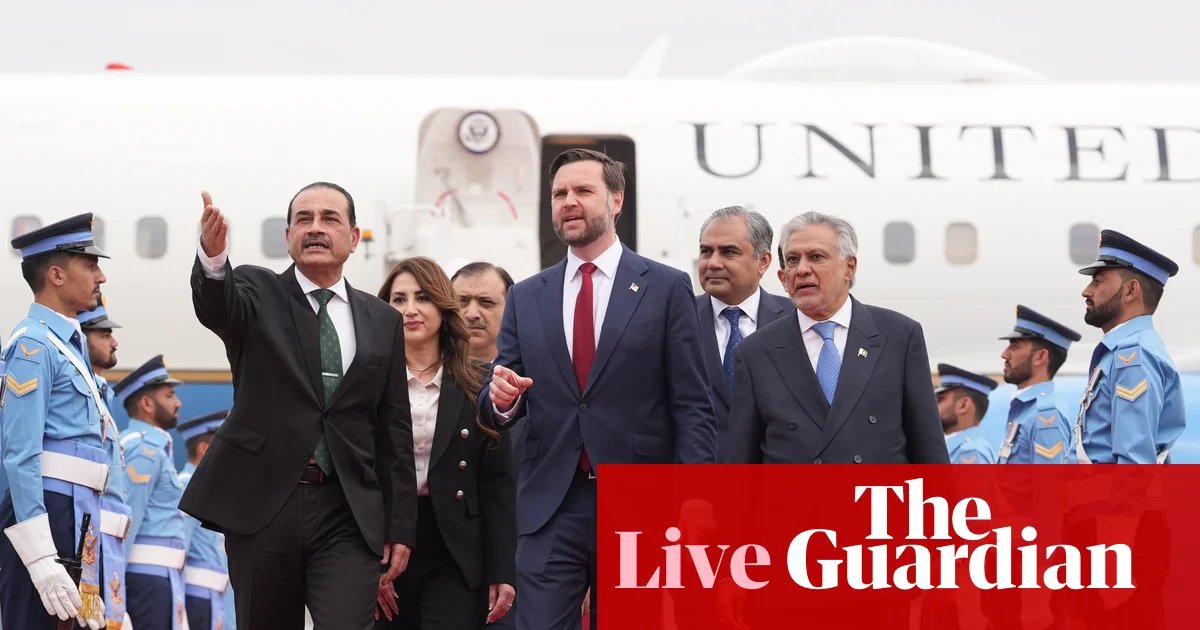
The US delegation has touched down ahead of high-stakes talks with the United States on Saturday, joining Iran’s delegation which had arrived earlier. The US side is led by the vice-president, JD Vance, alongside the special envoy, Steve Witkoff and Jared Kushner.
-
Iran’s delegation is headed by the powerful parliamentary speaker Mohammad Bagher Ghaliba, reportedly accompanied by Abbas Araghchi, Iran’s foreign minister; Ali Akbar Ahmadian, secretary of Iran’s defence council; Abdolnaser Hemmati, governor of Iran’s central bank; and several members of the Iranian parliament. Ghalibaf said earlier on Friday that two previously agreed measures – a ceasefire in Lebanon and the release of Iran’s blocked assets – “must be fulfilled before negotiations begin”. Israel and the US have denied that the ceasefire extends to Lebanon.
-
The planned talks come as Trump threatened fresh strikes if talks fail, adding that the Iranians “have no cards” and the only reason they are alive “is to negotiate”. Trump told the New York Post that the US is loading its warships with the “best weapons” in case talks with Tehran fail. “And if we don’t have a deal, we will be using them and we will be using them very effectively,” he said.
-
Meanwhile, Lebanon and Israel have agreed to meet in Washington on Tuesday to discuss a ceasefire and to set a date to begin talks. The conversation on Tuesday will be mediated by the US and take place at the state
-
Lebanon’s health ministry has updated the death toll from Israel’s most brutal strikes on the country in years on Wednesday to 357 killed. It brings the total killed in Lebanon since Israel renewed its offensive on 2 March to more than 1,953 people. The number of people wounded stands at 6,303, the health ministry added.
-
US intelligence reports that China is preparing to send new air defence systems to Iran over the new few weeks, CNN reports, citing anonymous sources. The US state department, White House and Chinese embassy in Washington did not immediately respond to requests for comment from Reuters.
Key events
Shah Meer Baloch
In an address to the nation before the talks, Pakistani prime minister Shehbaz Sharif said the upcoming US-Iran talks in Islamabad were “make or break,” warning the next phase will determine whether a lasting ceasefire can be secured.
An Iranian delegation led by speaker Mohammad-Bagher Ghalibaf landed in Islamabad on Friday night, with Pakistani jets escorting the Iranian planes as they entered the country’s airspace. Pakistan’s army chief, Asim Munir, and foreign minister, Ishaq Dar, received the Iranian delegation led by Ghalibaf.
Ghalibaf said in a statement after reaching Islamabad: “Iran has come in good faith, but doesn’t trust the US. Iran is ready for an agreement if the US presents a genuine deal and recognises Iran’s rights.”
A statement by the foreign minister, Dar, expressed hope for constructive talks. Dar said Pakistan would continue to facilitate sustainable and long-lasting solution between the parties. He said he hoped the both parties would engage in constructive talks.

Hannah Ellis-Petersen
Here’s the full list of members of the Iranian delegation.
-
Mohammad Bagher Ghalibaf, the head of the delegation and the Iranian parliamentary speaker;
-
Seyed Abbas Araghchi, the foreign minister;
-
Reza Amiri Moghadam, the ambassador to Pakistan;
-
Ali Akbar Ahmadian, a member of the Supreme National Security Council of Iran;
-
Ali Bagheri Kani, the deputy to the Supreme National Security Council and former acting foreign minister;
-
Esmael Ahmadi Moghadam, the president of the National Defense university;
-
Mohammad Jafari, the assistant to the secretary of the Supreme National Security Council;
-
Naser Hemati, the governor of Iran’s central bank;
-
Kazim Gharibabadi, a deputy foreign minister;
-
Majid Takht e Ravanchi, a deputy foreign minister;
-
Valiollah Nouri, a deputy foreign minister;
-
Esmail Baghaei, a deputy foreign minister and spokesperson for the Iranian ministry of foreign affairs;
-
Abolfazl Amouei, an Iranian MP;
-
and Mohammad Nabavian, an Iranian MP.
As we wait for the Islamabad talks to commence, the conflict in the Middle East continues as we see in these images from the last 24 hours.
The UK will host a strait of Hormuz meeting next week, bringing together multiple countries aiming to restore free movement of ships through the strait, which has been blockaded by Iran since the beginning of the war and inflicted heavy damage on the global economy.
A British official told AP that the meeting will oppose the idea of tolls being charged for passage through the waterway, as proposed by Iran as part of ceasefire negotiations.
The meeting follows a foreign minister’s call on 2 April involving about 40 countries and a military planning meeting attended by about 30 nations. The UK prime minister, Keir Starmer, said that it is essential to have a “viable plan” to reopen the strait and get the global economy moving.
Photograph: Morteza Nikoubazl/NurPhoto/Shutterstock
US delegation touches down in Islamabad
A plane carrying the US envoys headed for talks with Iran has touched down in Pakistan’s Islamabad, sources told Reuters.
The delegation is led by the US vice-president, JD Vance, and includes president Donald Trump’s special envoy, Steve Witkoff, and son-in-law, Jared Kushner. The Iranian delegation had already arrived earlier.
About 100 members of an advance US team are already in the city, a Pakistani source told Reuters.
The meeting is the first since the outbreak of the war more than a month ago. Both sides have claimed conditions before the onset of negotiations, with Iran demanding an end to Israeli strikes in Lebanon and the US concerned with nuclear weapons and the fate of transit through the strait of Hormuz.
The Athens-based Marine Traffic said on Friday that only 14 vessels – only half of which were loaded – have crossed the strait of Hormuz since a ceasefire was declared, according to AP.
Vessels exiting the Gulf accounted for 70% of vessels, the group posted on X, with “sanctioned or shadow-fleet-linked vessels account[ing] for nearly two-thirds of all crossings”.
Before the conflict, over 100 ships passed through the strait each day – most with oil outbound to Asia.
US intelligence reports China preparing to send air defence systems to Iran in next few weeks
US intelligence indicates China is preparing to deliver new air defence systems to Iran within the next few weeks, CNN reports, citing three people familiar with recent intelligence assessments, according to Reuters.
The network said Beijing could be routing shipments of shoulder-fired anti-air missiles known as MANPADs through third countries to mask their origin, citing unnamed sources. The US state department, the White House and the Chinese embassy in Washington did not immediately respond to requests for comment from Reuters.
President Trump and Pakistani officials have confirmed that China helped step in to push Iran to accept a tentative ceasefire. But while the Chinese government says it backs the ceasefire, it has not to date tried to claim any diplomatic credit as a security guarantor, with a spokesperson for the Chinese embassy in Washington merely saying “as a responsible major power, China will continue to play a constructive role and make efforts to de-escalate tensions”.
Lebanon’s health ministry say the provisional death toll from Israeli strikes on Wednesday had risen from 303 to 357, with 1,223 people wounded, AFP reports, with Israel claiming to have killed 180 militants in those attacks. The Israeli military say Hezbollah had fired around 30 projectiles into Israel and claims to have “dismantled” more than 4,300 Hezbollah sites in Lebanon since fighting began.
Digital monitor Netblocks says Iran’s internet blackout has lasted over a thousand hours, AFP reports.
While Iran’s domestic intranet remains operational, access to the global internet has been restricted since February.
“It is the Israeli public that holds Netanyahu’s fate in its hands,” writes Jonathan Freedland, writing on the role of the Israeli PM in the current Middle East tensions.
“What record will he be able to present to that domestic electorate, the one that judges him by his own lights? … Netanyahu-ism has gained nothing, and it has come at a monstrously high price.”
Read more of his analysis below:
In Islamabad, mutual mistrust remained the order of the day, Agence France-Presse reports.
“We have good intentions but we do not trust,” Iranian state TV quoted the head of the Iranian delegation, parliamentary speaker Mohammad-Bagher Ghalibaf, as saying upon his arrival. “ Our experience in negotiating with the Americans has always been met with failure and broken promises”.
JD Vance, the US vice-president and head of their delegation, was equally wary. “If [the Iranians are] going to try and play us, they’re going to find the negotiating team is not that receptive,” he told reporters.
Donald Trump has said his top priority is to ensure the Islamic republic cannot have a nuclear weapon – “That’s 99% of it” – but stopping the continuing Israeli strikes on Lebanon, a key demand from Iran as a condition of the truce, as well as the precise terms for allowing shipping traffic through the blockaded strait of Hormuz will also play a key part.
The Iranian side say negotiations cannot begin without commitments on Lebanon and on unblocking Iranian assets seized as part of sanctions. Israel and the US’s position is that that Lebanon is not part of the ceasefire.
Trump, posting on social media, said “The Iranians don’t seem to realize they have no cards, other than a short term extortion of the World by using International Waterways. They only reason they are alive today is to negotiate!”
Pakistan’s prime minister Shehbaz Sharif says making progress will be hard work. “This is the stage which, in English, is called the equivalent of ‘make or break’,” he said.
In Islamabad, all routes leading to the Serena hotel, which is hosting the talks, were blocked off with heavy security, with banners and signs along the expressway heralding the “Islamabad Talks”. But in Tehran, a 30-year-old local told AFP he was skeptical negotiations would be successful, describing most of what Trump says as “pure noise and nonsense”.
Islamabad continues to prepare for the upcoming ceasefire talks and the arrivals of delegates in Pakistan’s capital. Here are some new images coming into the newsroom today.
Opening summary
Hello, and welcome to our live coverage of events in the Middle East with talks between Iranian and US officials scheduled to begin in Islamabad in just a matter of hours.
Stay tuned here for all the updates. If you are just joining us, below is a quick recap of the latest news
-
Iran’s delegation has arrived in Islamabad ahead of high-stakes talks with the United States on Saturday, which the Pakistani prime minister described as “make or break” for achieving a permanent ceasefire. The delegation is headed by Iran’s powerful parliament speaker Mohammad Bagher Ghalibaf, and he is reportedly accompanied by Abbas Araghchi, Iran’s foreign minister, Ali Akbar Ahmadian, secretary of Iran’s defence council, Abdolnaser Hemmati, governor of Iran’s central bank, and several members of the Iranian parliament. Ghalibaf said earlier on Friday that two previously agreed measures – a ceasefire in Lebanon and the release of Iran’s blocked assets – “must be fulfilled before negotiations begin”.
-
US vice-president JD Vance, who is en route to Islamabad, said he was “looking forward to negotiations” and expected them to be positive – though he warned Iran not to “play” the US. He is leading the US delegation and will be accompanied by Donald Trump’s special envoy Steve Witkoff and Trump’s son-in-law Jared Kushner.
-
The planned talks come as Trump threatened fresh strikes if talks fail, adding that the Iranians “have no cards” and the only reason they are alive “is to negotiate”. Trump told the New York Post that the US is loading its warships with the “best weapons” in case talks with Tehran fail. “And if we don’t have a deal, we will be using them and we will be using them very effectively,” he said.
-
Meanwhile, Lebanon and Israel have agreed to meet in Washington on Tuesday to discuss a ceasefire and to set a date to begin talks. The conversation on Tuesday will be mediated by the US and take place at the state department.
-
Lebanon’s health ministry has updated the death toll from Israel’s most brutal strikes on the country in years on Wednesday to 357 killed. It brings the total killed in Lebanon since Israel renewed its offensive on 2 March to more than 1,953 people. The number of people wounded stands at 6,303, the health ministry added.
-
Lebanon’s president, Joseph Aoun, said on Friday that 13 state security personnel were killed in an Israeli strike on a governmental building in the southern city of Nabatieh. In a statement, Aoun condemned continued Israeli attacks and said targeting state institutions would not deter Lebanon from defending its sovereignty.

Four people in a minibus were also taken to hospital, Leicestershire Police say.
Source link

Sion documented his weight loss journey online and was shocked to find a company was using his photos.
Source link
UK News
American Classic review – I defy you not to fall in love with Kevin Kline and Laura Linney’s tender comedy | Television

Ah, the roar of the greasepaint – the smell of the crowd! Who doesn’t love the theatre? Or at least the idea of the theatre. Not the fact of the theatre – spending a fortune on a ticket, getting dressed up and going into town, either hungry or with too early a dinner inside you, trying to suspend enough disbelief to engage with Actors doing Big Acting in front of you when you’re too used to Small Acting watched from the sofa in front of a streaming platform. Then home too late to recover properly before bed.
It’s not just me. I know it isn’t.
But I defy even my fellow philistines not to fall in love, even if just a little bit, with American Classic, a new light comedy created and written by Michael Hoffman and Bob Martin. It follows the return of Richard Bean (Kevin Kline), once considered the future of American theatre (and now the subject of viral footage showing him drunkenly lambasting the New York Times critic for a bad review of his current performance in and as King Lear), to his small home town of Millersburg after his mother’s unexpected death. His brother Jon (Jon Tenney) broke the news about his mum. “Did she read the review?” replied Richard. Fortunately, Jon knows his brother is an actor and one suspects long ago made the decision to love him anyway.
Jon has stayed in Millersburg with his wife, Kristen (Laura Linney), taking care of the boys’ father Linus (Len Cariou), who is now in the early-plus stages of dementia. Together, they also look after the other remaining member of the family – the Millersburg Festival Theater, established by the Beans and where Richard learned the fundamentals of his craft. The modern small-town economy being what it is, however, means – Richard is horrified to learn – that it now stages dinner theatre rather than original production. Jon is the chef, daughter Miranda is a waitress (though dreaming, naturally, of becoming an actor in New York), and Kristen is everything else. She is also mayor of the town (which includes the adjudication of the Concerned Parents’ Bookburning Summit) because a Laura Linney character’s work is almost never done.
Richard packs his bags in disgust, planning to leave even before the funeral, until his agent Alvy (Tony Shalhoub, having the time of his life, as all actors do when allowed to play an agent) reminds him that he’s “still a meme” and needs to keep his head down. So he pivots to planning the funeral at the theatre instead. The rehearsals become extravagant. Jon points out the ludicrousness. “I’m sacrificing everything for cheap spectacle,” realises Richard. “I’m not trusting the material.”
The line is pure Richard, the underlying truth pure beauty. You may not have fog machines and a lighting rig to play with, but who hasn’t got caught up in the fervent need, born of grief, to make everyone know how much a person meant and meant to you? And what do you have to do in the end but trust the material – trust the memories, trust the love in the room, trust the common humanity of everyone.
This is what American Classic is really all about. Richard (because he remains himself, though Kline always tempers his narcissism with enough – eventual – self-awareness to keep us on side) announces at the end of the eulogy that he is going to restore the theatre’s fortunes by “producing, directing … possibly even starring in” Thornton Wilder’s classic Our Town. Beneath the comedy of small-town manners, Hoffman/Martin’s show becomes a meditation on … God, it’s going to make me say it, I think … the power of art. Not a laboured one – the story and the people and the jokes come first, especially once casting starts – but a sweet and moving one. It’s made all the more touching by the authentic belief in that power, which suffuses the series, stacked as it (presumably deliberately) is with actors known at least as much in their native US for their stage work as for their film and television careers.
American Classic’s combination of charm, wit and tenderness – and especially the encouragement to forgive ordinary human frailties – is reminiscent of Ted Lasso and Schitt’s Creek. Its retro-tropes can take us all the way back to plucky young Mickey Rooney and Judy Garland putting the show on right here. Just as those endeavours took audiences’ minds off the pandemic, Trump #1 and World War #2 respectively, American Classic will doubtless offer its own comfort now.
You could object, as you could with Lasso and the Creek, to the fact that there is nothing wildly new here, but that would be to miss the point. Recombinant delights are how we know ourselves, how a society remains bound. The only duty is to recombine things well, to keep them fresh and funny as well as comforting, and it’s fully discharged here over eight swift, sure and never-too-schmaltzy episodes.
Goddammit. Maybe the play is the thing.



-

 Crime & Safety3 weeks ago
Police race to crash on Oxfordshire A34 with severe traffic building
-

 Oxford News4 weeks ago
Schwarzman Centre to open doors to public with major celebration
-

 Oxford News4 weeks ago
Gary Lineker’s nephew-in-law death inquest to be next week
-

 Oxford Events4 weeks ago
Michelin Guide Oxfordshire Restaurants – The Oxford Magazine
-

 Jobs & Careers4 weeks ago
Explore our Careers
-

 Oxford News4 weeks ago
Professor Rebecca Eynon elected to prestigious Academy of Social Sciences Fellowship
-

 Crime & Safety7 days ago
American Akita and a French Bulldog seized after dog killed
-

 Oxford News4 weeks ago
Expert Comment: The Pentagon-Anthropic dispute reflects governance failures – with consequences that extend well beyond Washington