
Student Life
Meet the candidates: Oxford Union Election Michaelmas 2026

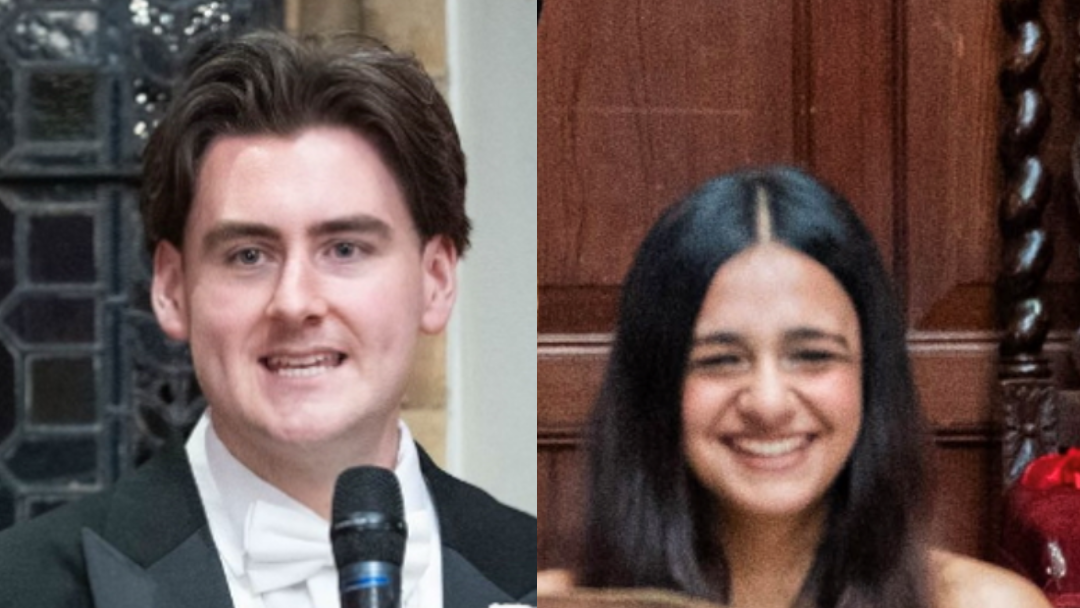
The election for Oxford Union Presidency for Trinity 2027 is set to take place on Friday 27th November. Tomorrow’s poll is the first with new rules requiring voters to display two forms of ID, after election fraud scandals affected the last two end of term elections.
The candidates running to be President in Trinity Term 2027 – current Librarian Harry Aldridge and current Secretary Saara Lunawat – spoke to Cherwell about the current state of the Oxford Union, their reason for running, and their dream debate. Below is a shortened version of the full conversation, to hear the full interviews listen to Cherwell Spoken on Spotify.
First tell us who you are and why you’re running for Union President?
Harry Aldridge: My name is Harry. I’m a finalist at New College and I’m the Union’s Librarian this term. I grew up in Plymouth and I was the first student really from my school to come to Oxford…Before I came to Oxford, I didn’t really have any experience in public speaking, so the Union’s been the place which has allowed me to build up those skills. The reason I’m running for President quite simply is because I want the Union to give that opportunity to other members as well, allow them to have that same experience, and allow them to get engaged with the opportunities the Union offers. Far too often I think the Union has simply become this endless election society instead of the debating society which we all signed up to when we got here in Oxford.
Saara Lunawat: I’m Saara. I’m a second-year law student at St. John’s. I come from India and I used to be a debater back home in India. I’m serving as the secretary of the Oxford Union right now. It’s a pretty exciting role, pretty busy role.
In your opinion, what does the Union stand for?
Harry Aldridge: I’ve served for over five terms on committee now. During my first year, I served as Schools Outreach Officer, and in that role I tried to do something very different: I organised eight different state school visits. It was a chance for students from underrepresented backgrounds to come along to the Union, see some of our debates, see some of our speakers, and then to have the chance to build up those skills themselves.
For me, the Union has two core purposes. I think our driving mission very much is free speech: allowing the free exchange of ideas, allowing members to engage with one another, allow[ing] them to talk about the contentious issues of the day. Not only has hosting the brilliant speakers at the Union been one of the highlights, but it’s also the other students I’ve met and having a chance to actually engage with other students who care about the same issues I do, who are interested in the same subjects I am. I think the Union is the best place here at Oxford to have the contentious discussions outside of necessarily university context and with some of the brightest minds in the world. I think the second focus, which I think the Union over the years has lost its way, is that when we were founded, the Union was not just a free speech society but also a society where we have social events. We have our library, we have our bar. For far too long the Union hasn’t been lively enough. We’ve not done enough to actually keep that running. For me, if I was elected as President, one of my key pledges is very much to try and bring back the fun.
Saara Lunawat: The pretty straightforward answer is that the Union was founded on the principles of free speech, and the way we approach free speech in our society today, even the words ‘free speech’,has itself become contentious. Like I spoke about in the Week Five debate about censorship and extremism, this is something I really strongly believe in. When we talk about ‘what the Union can do’ and ‘what it stands for’, it is this fundamental idea that everyone deserves a right to speak, like I quoted in my speech that “I may not agree with what you said, but I will defend until death your right to say it.” I think that’s something we can all agree on.
What manifesto commitment are you most passionate about?
Harry Aldridge: The fun answer I’d have to give you is one of my pledges – and I did this when I ran for Secretary as well before the idea was eventually vetoed – is I would want to run a Minecraft ball. I know it sounds completely ridiculous. I know it sounds a little bit nuts, but I think very much for me in a Trinity term when the Union isn’t as lively as it could be, it’s ridiculous ideas like that which will actually get members to come back, get involved, come along to our socials, and to actually spend a little bit more time at the Union.
Talking about some of my more serious pledges, there’s two I want to talk about. Firstly, one of the big things which I’ve experienced when I’ve been in the Union, and something I’ve very much felt as someone who came from an underrepresented state school is that throughout my time in the Union I’ve experienced, to be honest, quite a degree of classism. I very much want to tackle that and the feeling that [those] people in the Union aren’t welcome. I want to make sure that every member who walks through our doors actually does feel welcome and is able to enjoy our events and our socials, because for far too long a lot of students have felt deterred by our reputation. I think they’ve felt deterred by often some of the remarks we see online made by members of the Union’s committee, even. For me, I really want to increase the accessibility of the Union.
I also want to bring that focus back to competitive debating. I think when I got to Oxford, not only was I interested in the brilliant speakers, but I was also interested in the debating the Union had to offer. You know, that was the first time I’d ever had the opportunity to do public speaking. It was really the first chance I was able to build up my confidence. So I really want the Union to kind of hone back on its key purpose. Fundamentally, the Union needs to operate much more as a society where the main interaction everyone has with the Union every term—if you don’t go that often, frankly – is a bunch of messages from people you’ve never met saying, “Come and vote for me.”. I think that needs to change. The thing people should be engaging with is our brilliant socials and our brilliant speakers, and very much if I was elected as President, that’s what I’d be trying to bring back.
Saara Lunawat: This is the kind of question, if we had an hour, I could speak for an entire hour about it. I don’t think there’s a lot that the Union needs to improve on. I think it’s our approach towards what we need to change that matters more. So if it goes from the simplest thing, like how we approach this idea of student engagement and student governance, the first step is making sure that these committees and students are more involved and more informed about what their role is. From my personal experience, when I joined the Secretaries Committee, the way it was presented was ‘Oh, it’s a very simple role, you just have to help around the debates and the events.’ But the Union can be a lot more. It doesn’t matter what level you run on, it matters how you approach that role. So the first thing I would want to do as President is have clearer briefings about what people can and cannot do. And empower these people to care more about it.
Beyond that, of course, I would hopefully be the first female Indian citizen who becomes a president. And I think that’s a big pressure for my country. But I’m really excited to do it. I’m really excited to platform speakers from all across the world, especially the Global South.
Finally, as a woman I care about gender parity on the Committee, about equal representation and rights, and continuing with this tradition of having an all-women debate.
It’s a time of year when many members are inundated with these hack messages for the first time. Do you support Milo Donvoan’s, next term’s president, proposal to ban them?
Harry Aldridge: I might be guilty of sending a few too many hack messages during my time here in Oxford. But look – I think Milo’s completely right. Fundamentally, the incentive structure in the way elections operate at the moment is simply to soullessly spam every single member you possibly can with endless messages, to see whether they’ll come out and support you and support your candidacy. That’s not how the Union should operate. Not only does it deter people from getting involved in the Union, not only does it deter people who would run in elections and do brilliant jobs because they think it would harm their social reputation, but more fundamentally, when people talk about the Union’s reputation – when I first came to Oxford and told people I was going to join the Union, people said, “No, don’t do it because you’ll be inundated with all these hack messages.” And I think very much it really deters people from getting involved in the Union.
Saara Lunawat: It is a pledge that seems extremely well founded. However, I would be lying if I said I didn’t have some concerns, because from a public policy standpoint. I believe the reason hack messages are sort of the easiest way to express your enthusiasm or your motivation to run. My concern would be what comes next. If you imagine a world where hack messages are banned, firstly, from a legalistic point of view, it’s not really clear what that means. If I say something like ‘Hey, I’m running for Secretaries committee’ and that’s suddenly banned, I can still message you saying ‘ I’m really interested in the Union.’ There are a lot of ways to present a message where you can’t really, without seeming like autocratic, control messaging. Beyond that, even if we pass that barrier, what comes next? I assume people can continue calling or they can show up to colleges.I’m not really sure whether that snowball stops rolling. At the end of the day, I do think it’s a great idea – it’s more about how we can envision it in practice in a way that it does not turn into something worse.
Moving on to your opponent, what’s something you admire about them?
Harry Aldridge: I first met Saara, I think, at G&D’s in Michaelmas of her first year and in my second year. And I think the thing which I always admired about her is that she’s an incredibly determined person. When I met her I could tell she was going to go really far in Oxford – she was always going to make her mark on student politics here. I’ve always got on with her really well.
Saara Lunawat: I think he’s a big fan of peace and love. And so am I. So I’m glad to see we’re on board with that.
The Union has become known for its invitation of controversial speakers, particularly the Tommy Robinson and Laurence Fox invitations. Where should the Union draw the line on who it invites?
Harry Aldridge: For me, the line we have to draw is when bringing in a speaker or a guest is going to actively cause harm to our members. The invites of both of those people, not only for some of the extreme views they espouse, but Tommy Robinson has faced a significant amount of trouble with, frankly, the law. He’s not someone who I think would particularly be appropriate to speak here at the Oxford Union. It’s a privilege for speakers to come in and speak at the Union. I want to give that platform to as many speakers as we can, and I have no issue debating some of the toughest ideas: The Union should be the place where we challenge people, where we test people, where we scrutinise people. That is the Union’s core mission. But there is a difference when a speaker is actively going to cause harm to our members.
Saara Lunawat: I do understand that this has become a contentious question. At the same time, I don’t understand why it needs to be, because free speech as a fundamental right, of course, allows everyone to speak about what they believe in.
However, the line is pretty clear when it comes to people, perhaps that have criminal charges or have said problematic things that amount to inciting violence or can be attributed to hate speech. That is very clearly where we should draw the line, which is why I was very happy to support candidates in the past who have been vocal about their condemnation of these invitations. Beyond this, this really importantly loops into this idea of what we should do if we are future presidents., I really take pride in the fact that the Union is an independent organization. That’s what we love about this place. That is good. At the same time, we must not forget that the Union is an institution at the heart of Oxford. If we see that there are dangers of protests, violence, people feeling uncomfortable, basic welfare, the fact that we have this independence should not be used beyond the limits of what is right for society. I remember when the Tommy Robinson invitation happened, I was one of the people that could not even go in because of how much the protests had taken over the city. I think if that isn’t a clear enough line for why someone might be problematic, I don’t see it as any more clear than that.
Who would be your dream speaker event and what would be your dream debate?
Harry Aldridge: My dream debate motion would be: “This House would abolish grammar schools.” I’m passionate about that motion because, as you can probably tell from some of the things I’ve said earlier, I’m really passionate about access. It’s getting people to have the opportunities which often are not afforded to students from lower-income or underrepresented backgrounds. I think grammar schools are frankly a debate about meritocracy and who gets opportunity. They’re also a debate in which everyone has a stake. If you went to a comprehensive school, you have a stake in students who went to grammar schools. If you went to a private school, it’s a very similar case. If you went to a grammar school yourself, you’re directly affected by the issue, or if you’re like me then you also have a stake in it. It really touches on the things I would want to bring to the presidency, debating things like meritocracy and ensuring young people have a level playing field.
In terms of a dream speaker, there’s two answers. The serious answer is probably Jacinda Ardern: she’s someone I’ve long admired, former Prime Minister of New Zealand, who very much always talked about having kindness in politics. I think leading with empathy is a leadership style which is not only incredibly fascinating, but is something of which we need to do more. In terms of a fun answer, the best speaker event I ever went to was in Trinity term: it was with Abby Lee Miller. She was incredible. I went to the meet and greet and got a photo with her – it was, like, the best day of Trinity. So, I would want to bring in Cathy Nesbitt-Stein. She was Abby Lee Miller’s rival on Dance Moms and I think the Union needs a bit more joy, a bit more fun, and having more speakers like that is the way to do it.
Saara Lunawat: I would kind of like to twist the question a little because there’s not one singular speaker I want – there are so many speakers, and the way I approach this question, the same way I did in my manifesto, is that the Union does its best work when we platform those who need a platform rather than those who already have one. We need to strike a better balance between inviting people that already have, how the kids say, ‘clout’, and then people who deserve that platform. The way I see it, there’s a lot of countries around the world where people do not have the same freedom of speech that the Western liberal order sees, and if they don’t have those platforms available in their own countries, the Union can take more of an active activism route in its idea of free speech and invite these people, and give them a new platform outside their own country.
Moving from an individual speaker’s idea, I would say a panel of speakers should be able to have a platform where they can have free speech and a panel of people all around the world would be very interesting, especially a panel of activists who are fighting a cause that we do not really hear about in common news. that really irks me is this idea that you do not need a person from a certain background to get elected for those ideas to be spoken about, even if that pattern seems apparent – like, ’We should not wait for someone from Rwanda to speak about the civil order’, ‘we should not have to wait from someone for Haiti to talk about what is happening with the blue helmets there’. A combined panel of us, firstly, putting in the effort of recognizing where these countries and people and these issues come from, and then bringing them all together to have a larger multipolar discussion of ‘hey, where should the world go? What are the avenues which we can discuss?’ That’s what excites me the most.
A debate I’m really excited about is an ode to the debater I used to be in high school, what made me want to do human rights law and public international law, was a motion I did in a debating competition: ‘This House believes that developing countries should bear less of a burden than developed countries when it comes to the climate crisis’. That was like a ‘whoa’ moment for me, because we think of many of these world issues as a global challenge, but we do not look at it from the lens of equity. When you talk about, for example, renewable energy, it is very easy to say that the entire world should adopt it, but what about a country like Bangladesh or India, that haven’t really gone through the industrial revolution the West…Do we think that we should divide that burden more equitably rather than equally? It will be a very cute full circle moment for me to debate that with climate activists like Greta Thunberg, for example.
This is an edited version of a full interview. To listen to the whole interview, visit Cherwell Spoken on Spotify.
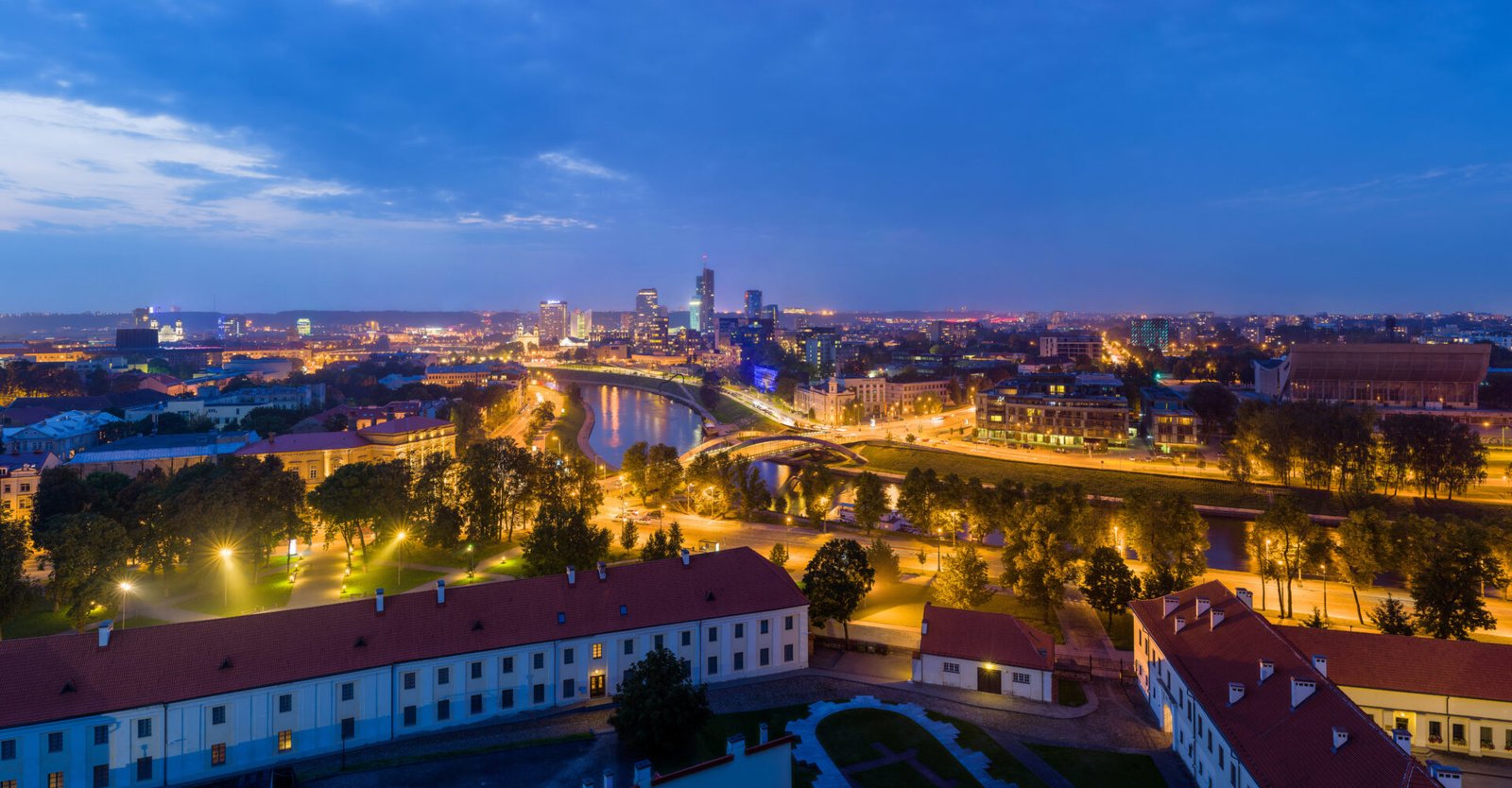
There are multiple levels of severity to a Lithuanian air raid alert – white, yellow, and red. White means the threat has been resolved; yellow urges people to locate their nearest bomb shelter; and red orders everyone to take cover immediately.
Last spring, people in Vilnius, the Lithuanian capital, received a red air raid alert. Children were hauled out of schools, and some were incomprehensibly led to football stadiums, while many people realised that their nearest bomb shelters were much further away than could possibly be reached in a true emergency. Because this wasn’t, after all, a ‘true’ emergency – a drone had entered Lithuanian airspace, but no attack ensued. Still, it was an emergency in the way that it forced people to face the unsettling fact that Lithuania no longer lives in a time of peace. Russia’s full-scale invasion of Ukraine, now in its fifth year, has slowly but very tangibly expanded into a hybrid war against the Baltic states, Finland, Poland, and several other countries.
It’s nothing out of the ordinary these days to open the Lithuanian news and see an alert for an air raid, or to receive one on your phone. Even just five years ago such an event would have caused national chaos and uproar; now it happens almost every month, some months multiple times. During the vacations, when I am back in Lithuania and hear an airplane go by that seems to be louder than usual, the question is always forced into my mind: is this it? Is this the moment it starts? I know that in those 30 seconds, everything about my life as I know it could change.
I feel greater unease when I am here, in Oxford – when, for instance, I open LRT, the Lithuanian national broadcaster, and see that multiple air raid alerts have been announced. Even more so when I read that NATO fighter jets were mobilised, yet did not succeed in destroying the drones, as happened in early November. I feel guilty being away from my family for half of the year; I have to consider the deeply uncomfortable question of what happens to them in the event that Russia escalates its war.
Having spent a year studying in Oxford and engaging in political discussions with people from the UK, I find it jarring how much focus there is on domestic issues, with problems outside of this country often left as an afterthought or not mentioned at all. While caring about domestic issues is perfectly understandable and necessary, the apparent lack of interest in international problems shocks me because I come from an environment where outside events, more often than not, take precedence in our political discourse. While Lithuania’s situation is, of course, nothing compared to the situation of Ukrainians who are currently fighting and dying for their country, Lithuanians still experience the reality of living next to a country that wants nothing more than to wipe ours off the map.
International news coverage of Russian aggression against Ukraine has been measurably declining in recent years. Analysing millions of news article titles from thousands of sources in 194 countries between January 2013 and December 2024, Vianini et al found that coverage is heavily dependent on major geopolitical events, with peaks around Russia’s annexation of Crimea in 2014 and full-scale invasion in 2022. Evidently, as the shock of the initial event wears off and people get accustomed to the new status quo, news media no longer sell as many copies or generate the same number of clicks, so they switch to other topics.
Perhaps it is therefore unsurprising that, as a percentage of GDP, northern European and Baltic countries have been leading in bilateral aid to Ukraine. The danger of Russian expansion is, after all, more acute the closer Russia is, especially given the threat that Russia has posed to many of these countries’ sovereignty in the past.
This is in no way meant to imply that other countries, such as the US and the UK, have made less valuable contributions, as their aid to Ukraine has been immense. It is just that with the much greater geographical separation from Russia, there is also a mental detachment. It is much more difficult for people here to understand the urgency – not just of February 2022, but every day – almost five years into Russia’s full-scale invasion. For us, this is not just a war; it is a threat to our very existence.
Countries like Lithuania are mostly powerless in bringing about any sort of resolution to this war, but countries like the US and UK are not. It is therefore particularly concerning to Lithuanians when, for instance, the will of these countries’ leaders to continue enforcing sanctions on Russian exports and individuals benefiting from Russia’s war appears to dwindle. This becomes especially disconcerting when coupled with implicit or explicit statements that Russia’s illegal war can only be resolved if Ukraine agrees to give up a portion of its territory. The United Nations’ new Equal Earth world map, adopted in September 2026, for instance, depicted Crimea in a different colour – not as part of Ukraine, capitulating to Russia’s expansionist aspirations. Crimea, which Russia illegally occupied and annexed in 2014, remains Ukrainian territory under international law.
Such acts of complacency give Russia the confidence to violate boundaries further and further. If the world goes on as it has, Russia will kill more people in Ukraine, will continue to establish its concentration (‘filtration’) camps, which have already been used to abduct more than 20,000 Ukrainian children, and will expand its hybrid war. Just in the last round of peace talks in mid-November, Russia reintroduced its demands that NATO remove its forces from its eastern flank, leaving Poland and the Baltic states profoundly vulnerable, halt all supplies of Western military support to Ukraine, as well as permanently rule out further enlargement.
The urgency that we as Lithuanians feel is because we know that in any sort of escalation, the Baltic states are very likely the next targets, an urgency that people in the UK, US, and western Europe have the privilege of not feeling. But if Ukraine, the Baltics, Poland, Finland, or any other country targeted by Russia falls, then the UK and western Europe will be forced to remember a lesson that should have been learned 80 years ago: appeasement does not work. The threat of annihilation is at their doorstep – like it has been at ours, for centuries.
I sconce anyone who hasn’t heard of a crew date, BOP, or Barty. Words which have no real meaning beyond the high stone walls of Oxford University and its colourful college social term cards; students here clearly have a propensity for always doing it a tad differently, beyond just exam attire and bizarre names for our semesters. God forbid we call a party in a bar a party in a bar. Why must we expose our lack of spontaneity so unashamedly? For although it is hard to admit, a BOP does not refer to the action of ‘bopping’ to music but rather an assertion that the party is both big and organised. Maybe it is simply the love of a ritual which trickles down from centuries-old University-wide traditions into the modern-day Oxford student’s social schedule.
A ‘social’ history
I highly doubt that back in 1096, the University’s founding year, students of theology and canon law were daring one another to drink beer from their shoes or toss pennies into one another’s glasses. Granted, there is little evidence to say they absolutely did not partake in such games; so let’s not write off the social scene of the High Middle Ages just yet. However, a series of traditions, recognisable today, soon began to emerge. For instance, ‘pennying’, first debuted by dons and students in the 14th century, is still a familiar ritual at rowing formals and crew dates.
Merton College dining hall was built in 1277 and, following suit, each college built a form of this dedicated social and dining facility to provide a space beyond lecture halls and teaching rooms. Many traditions, notably ‘pennying’, ‘doing a shoe’ and ‘sconcing’, find their roots in such hallowed halls. The latter dates back to 1617, when a small monetary fine was imposed for a mispronunciation when saying grace, no doubt a major faux pas in that era. Today a dreaded sconce promises to expose your most embarrassing secret to a football team’s worth of recent strangers.
Since the medieval period, Oxford’s love of rituals, especially when aided by cheap alcohol, has come to be part of the very fabric of its reputation. For better or for worse, students here are readily associated with supposed debauchery, as they had but ‘no choice’ but to indulge in the rituals of their predecessors. The Bullingdon Club instantly springs to mind when considering this facet of the University, with members famously including Boris Johnson and David Cameron. Known for questionable treatment of staff and premises, using sport as a respectable front, and outrageous drinking habits, the club is no longer recognised by either the University or Oxford University Conservative Association (OUCA). They almost certainly explain why students have gained a reputation for obnoxious and entitled behaviour. Even though crew dates today at Angrid Thai are more BYOB and cold chips as opposed to duck confit and port, this air of impunity still remains strong. Similarly, their respect for tradition does not waver.
Obsession from night to day
This reliance on ritualistic structure is still seen across university events. Multiple times a year, an army of penguins donned in academic dress marches towards Examination Schools. Many can be seen adopting the white, pink, and red carnations symbolic of their exam progression. The carnations are not mandatory; however, many still rush to the Covered Market, frantically hunting for replacement pins when theirs is lost, all in the name of a retro tracking system. Whilst expected for exams, I personally have never seen anyone refused entry for not wearing sub fusc. Oxford students were even given the option to remove the demand for academic dress in 2015, but 75.8% chose to keep it. The panic of what to cram last minute, as well as deciding what to wear, was clearly too daunting for students at the University. I, for one, am grateful. Albeit monotone and a tad school uniform-esque, the shirt, skirt, gown, ribbon combo means one less decision must be made.
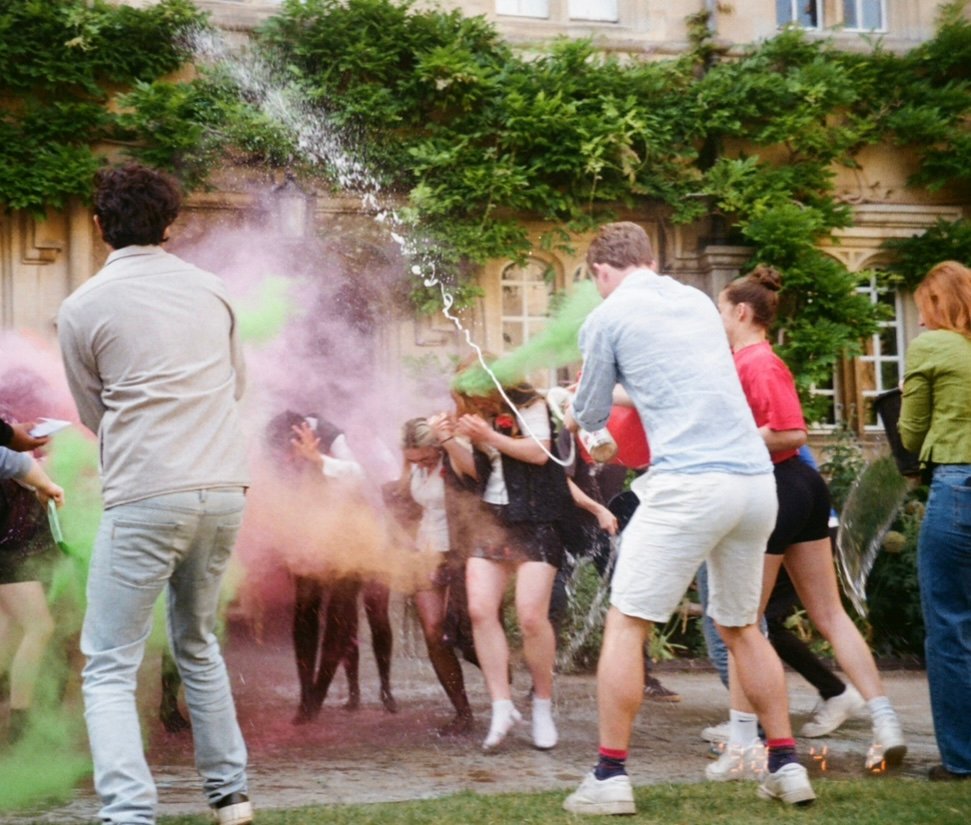
Even after exams, there is a step-by-step process to celebration. Upon exiting Examination Schools, one is met with flowers from the Garden of Oxford if they are lucky. Although banned, many still partake in the tradition of ‘trashing’. A low-level ‘trash’ would see students douse cheap prosecco on a freshly pressed shirt: a mother’s nightmare but not particularly damaging to the environment. However, more extreme examples could see finalists covered in coloured powder, eggs, or confetti, which often end up in Oxford’s waterways. The University has, of course, caught wind of this post-exam ritual and implemented a £150 fine for any student found partaking as part of its Celebrate SMART guideline. Oddly enough, this ritual does not see extensive roots in Oxford’s social history; the Oxonian’s affinity for making a mess seemingly did not take form through the ‘trashing’ tradition until recently. Therefore, one is left questioning as to why it occurs. We cannot simply blame tradition. Perhaps this is but a further example of our need to mark every occasion – entering the University, finishing an exam and so on – through the means of ritual. Its mode is almost baptismal, albeit far less sacred.
The crew date
A crew date, or a ‘swap’ in Cambridge, usually consists of a male and female sports team from different colleges enjoying a joint social at Angrid Thai or Jamal’s (and as of recently, Bridge and Plush). One must mention that women are a new addition to this unique Thursday ritual. The ‘laddish’ culture that would have been commonplace prior to the entrance of women has thankfully started to see its demise (#ThursdaysAreForTheGirls). However, one can still witness instances of it permeating the social scene in recent years. In 2013, the Pembroke College rugby social secretary was found to have circulated emails amongst members encouraging them to spike the drinks of fresher girls prior to a Thursday crew date “with a substance of [their] choice”. The captain stepped down, and a statement of apology was released. However, the only tangible punishment was a two-week playing ban from the first round of the league and a relegation to Division 3. I would argue a couple of weeks off is unlikely to teach a strong enough lesson.
Thai, the son of the owner of Angrid Thai, told Cherwell about his extensive experience hosting Wednesday and Thursday crew dates in his family’s restaurant. He explained how Angrid’s was not the original location for such socials; however, due to students requesting use of the premises for crew dates, they began offering them in a slightly more official fashion and soon became the widely understood spot for college and university sports teams. I was relieved to hear that the “relationship with students has improved”, with attendees “rarely disrespectful to staff” and “not abusive”. Naturally, there are still exceptions. Thai noted that St. Hughs rugby and football teams as common perpetrators of physical damage and disorder following their socials, with “vegetable oil poured on the basement floor” and “light fixtures found ripped off”. Such activities have led to the team being completely banned from the venue. Despite damage at such an extreme level being rare, the restaurant still repaints and refits its furniture annually due to the extensive scuffing of walls and chairs that crew dates invite. When asked why Angrid’s has continued hosting crew dates, Thai responded that “you’ve got to do what you’ve got to do”. The physical damage and general rowdiness are “outweighed” by the business crew dates bring. It must be said that speaking with Thai did not necessarily give the impression that he or the restaurant has at all a negative view of crew dates. He praised “Worcester” and “St Catz football” as the most energetic and fun guests who also treat staff with respect and refrain from leaving a mess behind. Out of interest, I asked him why he thinks students act as they do, and he contended that it is simply “kids being kids”, and that Oxford’s “college system” allows for students to act as if they were “still in school”. I’m sure we make for excellent weeknight entertainment.
Speaking further to captains and social secs from various college sports teams, the social picture was as expected. A Magdalen women’s sports captain told Cherwell that she attends “a social or crew date every week, usually on a Wednesday or Thursday”. The strangest instances she has witnessed were “strange sex positions”. Nothing short of your average weeknight activities. At my home college, Balliol, the netball captain told Cherwell that a game of “Zimmy, Zimmy” was her most cherished crew date tradition. Similarly, a Jesus College sports social secretary named his favourite game as “Patrick, Patrick, Patrick” and noted his most memorable social moment as the time a club member “fell off the Schwarzman pen (statue)”. Group chanting, public humiliation, all sounds rather cult-like. Those involved simply call it “a bit of fun” and a chance for students to “just let go”.
But why?
These examples do not just happen because of history and tradition. Plenty of past rituals are not perpetuated today. However, Oxford has remained steadfast in many of its peculiar events that look extremely archaic and bizarre to those external to the University. So why do we continue to observe these rites and ceremonies, if not because it sets us apart from everyone else? From crew dates to BOPs to matriculation, Oxford students feel this indescribable obligation to do exactly as has been done before. Without intending to insult, perhaps we lack spontaneity and creativity; it is very easy to just copy the actions of those who came before us. We make many decisions -academic or otherwise -every day. Perhaps we follow tradition to reduce any further decision fatigue. Furthermore, with intense workloads and therefore few empty hours left unscheduled, we no doubt feel a need to justify any time spent away from the library. Perhaps we name every social and every occasion to provide such a reason. Our diaries are filled with professional and academic commitments, so ‘going out’ on an evening requires a recognisable title: crew date, court, or ‘où est le poulet?’.
A further theory perhaps is that we thrive under rules. Rituals come with rules, and Oxford socials have rules galore. Ever wondered why Boris Johnson pointed with his finger bent in parliament; no doubt because pointing was a fineable offence at an Oxford social, where international drinking rules are strictly enforced, and he simply cannot shake such a habit. This adherence finds itself expressed even during the daylight hours. Even at my less traditional college, I would find it plain wrong to tread on the grass of the front quad. I’m sure no one would bat an eyelid, but I cannot fathom breaking these rules. Like Johnson, perhaps Oxford students feel an innate obligation of adherence to the rules, even when they offer little in terms of justification.
One can easily rely on a strange cultural or psychological backing for why students here love social rules and ritual. Maybe the answer is far simpler. Maybe we partake because they are fun, silly, and cheeky, and prevent socials from all blending into one. Granted, there are common themes: drinking, dressing up and so on. However, each has a unique element to it, and many are unique further still because they are only enjoyed at Oxford. Much of our student lives are taken up by essay crises and tutorial prep, so perhaps we are just embracing the work-hard-play-hard lifestyle. Whatever the reason, these rituals have been enjoyed by students for centuries and, like many features of the University, I would be very surprised if they were to change anytime soon. They formed a large part of my freshers’ experience, and so I can only look back on them with fondness. Therefore, I sconce anyone who hasn’t ever attended a crew date, BOP, or Barty, and strongly recommend that they give it a go. Get in the mixer!
St. Hugh’s Football team (Hughdam FC) and St. Hugh’s Rugby team (St. Hughs/LMH RFC) were contacted for comment. They told Cherwell: “Firstly, we have not been given notice of any ban on our club holding rugby socials at Angrid Thai. We understand that the restaurant has, on occasion, asked student groups not to return for a period following socials. The only incident we believe you could be referring to occurred at a social a few weeks ago, when a bottle of vegetable oil was accidentally spilled in the private room. We apologised for the mess at the time, and the restaurant retained our £90 deposit, which we would hope was sufficient to cover any necessary cleaning. However, we do not believe that this spillage constitutes ‘physical damage’ to the premises. It was an accidental incident and our deposit was retained to cover any associated costs. We have enjoyed a positive relationship with Angrid Thai over many years and have always appreciated the opportunity to visit the restaurant.”
Student Life
Imperial photographs, imperial shadows: The Ashmolean’s ‘Colonial Views of India’ in review
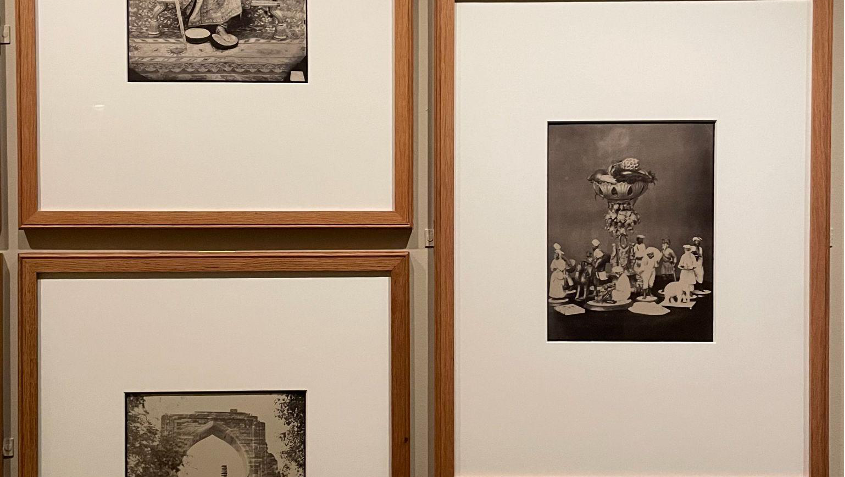
A Bengal tiger, strangely docile, stares vacantly out of the surreal sepia-grey of an albumen print. A heavy chain snakes from its neck to a nearby tree, whilst the shadow of a photographer with a tripod looms larger-than-life from the left. Such is the view that opens Colonial Views of India: Photographs by Eugene Clutterbuck Impey, now in its final month at the Ashmolean. The fact that I managed to drag myself out of Fifth Week blues to see this exhibition is testament to the promise I thought it held. But much like the figure, presumably Impey himself, overshadows the photograph of the tiger, the shadows of imperialism and its legacies loom large over the exhibition, at times clouding its merits.
For the museum’s approximately one million annual visitors, the exhibit is, in theory, a treasure trove of insights into how pioneering mid-19th-century photographers propagated the ideologies of British imperialism through visual culture. Impey and his contemporaries produced some of the first images Britons saw of the subcontinent their ‘mother country’ had subjugated for over a century. Visitors to the exhibition see India through Impey’s lens, in the same way that readers of his 1865 Delhi, Agra, and Rajpootana Illustrated (note the Anglicisation!), an early collection of eighty of the displayed photographs, would have done.
As the exhibition’s curator Mallica Kumbera Landras stated, the works displayed are “visual representation[s]… of imperial purpose”. Impey’s passion for photography, the captions note, developed during a transitional period of colonial rule, in which he served as a soldier, official, and political agent for the East India Company and, after 1857, the Crown. The desire to reinforce the Orientalist stereotypes that justified the imperial ‘civilising mission’, therefore, conspicuously permeates his work. It is the same upper classes that Impey ‘managed’ as an agent that his portraits depict in stage-managed poses of almost-narcotic greed. It is the same masses that Britain ‘divided and conquered’ that his framing forces into displays of imagined primitivity.
All of the above makes Colonial Views of India seem an invaluable resource, with the potential to stimulate direly needed conversations about British imperialism and its present-day aftershocks. Why, then, did it disappoint me so much?
The first problem is its location, a flaw already observed in many museums’ attempts to decolonise their collections. The exhibition is tucked away in Gallery 29 on the first floor, usually reserved for ‘Eastern Paintings’, but you could be forgiven for missing this information in the only place it is visibly available: the revolving digital display behind the ticket desk. By contrast, the museum’s Aphrodite: The Making of a Goddess exhibition imposes classical splendour on almost every entrance.
Does this prioritisation suggest an ulterior motive? Maybe not, but the exhibition’s physical space is certainly underwhelming; one would think that such a vast and previously unseen collection would be displayed on a grand scale, not stuffed into a seemingly random room. It displays only a select few of the 247 Impey photographs the museum possesses, and does so in a way that doesn’t render them any less mysterious than the works that remain archived. The presence (or lack thereof) of context for the photographs leaves much to be desired.
Captions are not absent, but they hide on tiny plates tucked into nooks, and barely scratch the surface of the complexities that the photographs illustrate. It is of course true that Impey’s photography “reinforced stereotypes… to justify colonial efforts”, “profiled perceived indigenous criminality”, and, in the case of the allegorical tiger, “reflected views of Indians as cunning and deceptive”. But, according to the exhibition, that’s it. No further analysis is provided, and there are some questionable comments, too; one caption seems to take as fact the idea that imperial hill-stations, the setting of some of the portraits, provided “safe havens… from heat, diseases, and local populations”.
Such a comment, if one even manages to find it beneath the monotone rows of identically-sized frames, makes implicit the assumption that the racist views Impey and his contemporaries held of their photographic subjects remain salient. One needn’t even look beyond Oxford to see the issues this poses. I often regret buying a Union membership, but it did allow me to witness a debate last Michaelmas proposing that “The Sun Should Have Never Set on the British Empire”, nothing if not an overt exposé of the fact that imperialist ideas remain insidiously persistent in modern Britain.
To add insult to injury, work exploring imperial legacies is being done very well elsewhere in the Ashmolean. The Shedding Light installation in the European Ceramics gallery, curated in collaboration with Oxford’s African and Caribbean community, is a visually striking reimagination of a mid-20th century living room that masterfully implicates imperialism and the slave trade in the production of objects as quotidian as plates and teacups. In juxtaposing domesticity and historical atrocity, it simultaneously recognises the presence of the Windrush generation in Oxford and details the connections between the museum’s vast ceramic collections and their imperial origins.
Colonial Views of India could have done something similar, but the exhibition falls short of anything like the level of nuance required to contextualise its subjects. Whilst Impey’s photographs may have taken a long time to develop, their presentation in the Ashmolean offers only fleeting glimpses: glimpses of the imperial culture they represent and glimpses of the important role they could play in bringing about a sorely-needed reckoning of the British Empire’s legacy.
In place of citing another review of Colonial Views of India – there seem to be very few – I’ll leave you with the words of an American tourist, the only other visitor on the cold Fifth Week afternoon on which I found myself at the exhibition:
“Oh”, she said to her companion, “so these were supposed to promote colonialism?”
When asked for a response, the Ashmolean told Cherwell: ‘Colonial Views of India is the first exhibition at the Ashmolean dedicated to photography in colonial India. It is the result of extensive research led by Professor Mallica Kumbera Landrus, the Ashmolean’s Keeper of Eastern Art and a leading scholar of Indian art. The exhibition presents previously unseen photographs by Eugene Clutterbuck Impey, a British colonial officer, and examines the role of photography in documenting India and serving the interests of British imperial rule.
‘The exhibition is displayed in Gallery 29, the Museum’s dedicated gallery for Eastern Art works on paper. This purpose-designed space provides the controlled lighting and environmental conditions necessary to protect objects such as the sensitive photographic material featured in this exhibition. Its location is determined by the conservation requirements of the works, not by their subject matter.
‘The exhibition’s interpretation explicitly addresses the racist ideologies of British colonial rule and the use of photography to reinforce stereotypes and justify colonial dominance. The reference to hill stations as ‘safe havens’ describes how British colonial communities regarded these places and should be read in the context of the full caption, which examines the inequalities and prejudices of the period.
‘The exhibition is accompanied by the first Ashmolean publication dedicated to the use of photography in colonial India. This substantial scholarly volume, with contributions from eleven specialists, examines the photographs in greater depth, including the Ashmolean’s own historical connections with British colonial institutions. A copy is available in the gallery for visitors wishing to explore the subject further.’
The exhibition is at the Ashmolean until 13 December.



-

 Oxford united FC3 weeks ago
Dogs, drones and extra police powers for Oxford United game
-

 Oxford united FC4 weeks ago
LIVE: Barnsley 1-0 Oxford United – Yoganathan puts 10-man Tykes ahead
-

 Oxford united FC4 weeks ago
Oxford United leaders criticised as results hide concerns
-
 Student Life4 weeks ago
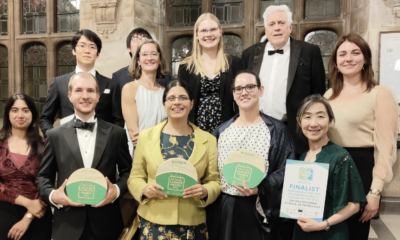
Oxford University wins at local climate awards
-

 Student Life4 weeks ago
St Anne’s to close nursery called a ‘lifeline’ for women at Oxford
-

 Oxford united FC4 weeks ago
Aaron Ramsey explains Brannagan and Brown Oxford United absence
-

 Oxford united FC3 weeks ago
Oxford United player ratings in landmark Reading derby win
-

 Oxford united FC3 weeks ago
Reading FC boss criticises Oxford United red card appeal timing