Connect with us

Traffic & Transport

London tube strike to go ahead after 11th-hour talks fail to find resolution | London Underground

Published

on


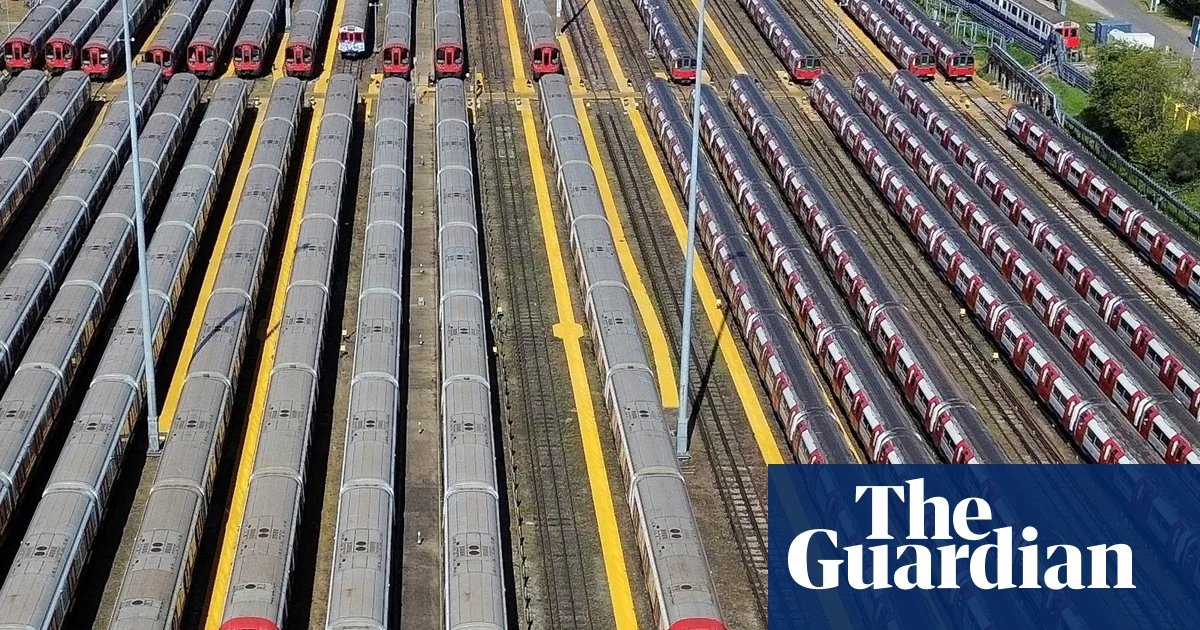
The strike on the London Underground will go ahead on Tuesday after a day of talks failed to avert industrial action.

About half of London’s tube drivers will take action, bringing widespread transport disruption to the capital. A second strike is planned for Thursday.

Hopes of a resolution were high after previous threatened action was suspended in May. However, despite 11th-hour negotiations at Acas between RMT union representatives and Transport for London (TfL), RMT drivers will strike on Tuesday and Thursday in a dispute over the introduction of a four-day working week.

TfL urged customers to check before travel, although it hopes to run about half of all tube services. Drivers in Aslef, a slight majority of those working on the tube, have welcomed the four-day week proposals and will not be on strike, limiting the impact of the RMT’s action.

Nonetheless, no service is expected on the Circle or Piccadilly lines, or in central sections of the Metropolitan and Central lines, during the strike. Tube services will also finish earlier and later than usual on functioning lines.

Other rail services, including the Elizabeth line, the London Overground and the Docklands Light Railway, will run as normal. Buses will operate as usual but are likely to be very busy and slowed by additional traffic on the roads.

The RMT union blamed TfL’s “refusal to engage meaningfully” with concerns over the proposed working patterns. A spokesperson said: “Despite our best efforts in ACAS talks, TfL have failed to provide assurances on our members deeply held concerns around fatigue, reduced flexibility, shift lengths and the impact these proposals could have in a safety-critical role like tube driving.

“We remain available for meaningful talks, but strike action tomorrow will now go ahead.”

A TfL spokesperson said: “It is bitterly disappointing that despite five hours of meetings with the RMT at ACAS and repeated assurances that the four-day working week proposals will remain voluntary, RMT has chosen to continue with its disruptive strike action. We will do all we can to provide as much service as possible during this action.”

TfL’s chief operating officer, Claire Mann, said: “Our proposals are, and have always been, clear. The completely voluntary four-day week has been designed to improve work-life balance and any of our tube drivers who do not wish to take up the new proposed way of working and associated changes to working arrangements can remain on a five-day working pattern.”

The strikes will take effect for 24 hours from 00.01 on both Tuesday and Thursday – potentially slightly less disruptive than the previous walkouts that ran over two 24-hour periods starting from midday, affecting four days in April.

Business groups said that even the threat of strikes had already been disruptive. Ed Richardson of BusinessLDN said: “For many businesses that rely on people visiting in person, the impact of these strikes will have already been felt through cancelled bookings and people changing their plans.

“We urge both sides to reach a sustainable agreement to put an end to the damaging uncertainty hanging over businesses and London’s economy.”


Source link

Continue Reading
Click to comment

Leave a Reply

Your email address will not be published. Required fields are marked *

Traffic & Transport

London tube strikes to go ahead on Tuesday and Thursday, RMT says | London Underground

Published

on


Strikes by drivers on London Underground next week will go ahead, the RMT union has announced, paving the way for more days of transport disruption.

Two 24-hour stoppages are to take place, from 00.01 to 23.59 on Tuesday 2 June and Thursday 4 June, because of differences over a planned four-day week.

An RMT spokesperson said: “Strike action by London Underground drivers next week is scheduled to go ahead following TfL’s continued refusal to engage meaningfully with the union’s concerns over the proposed compressed four-day working arrangements.

“Our members have raised serious concerns around fatigue, longer shifts, reduced flexibility and the impact these proposals could have in a safety-critical role.”

Transport for London said it expected services on most tube lines during the strike, but has told commuters to expect disruption. It added that other services including the Elizabeth line, London Overground, DLR and tram would run as scheduled, but would be busier than normal.

TfL has said its proposals for a four-day week would be trialled on a voluntary basis. Its proposal has been endorsed by the Aslef union, which represents a slight majority of tube drivers.

Claire Mann, the chief operating officer at TfL, said it was disappointed that the RMT was continuing its industrial action.

“We still believe that the points they have raised can be worked out in time, through more detailed discussions and we are continuing to talk to the union’s representatives to find a way to avoid disruption to London,” she said.

She urged the RMT to work with TfL to resolve the dispute, adding: “A significant number of drivers have indicated that they want us to progress plans for the pilot of this new working pattern on the Bakerloo line, bringing benefits both for our colleagues and our customers.”

The RMT’s opposition to London Underground plans for a voluntary four-day week has already led to industrial action, most recently in April.

Hopes were raised that differences between the two sides might soon be resolved when the RMT called off at the last minute a two-day strike planned for mid-May.

However, at the same time the union also moved forward further strikes planned for 16 and 18 June to 2 and 4 June, saying the dispute was not over and that it was prepared to take more industrial action if the two sides failed to make sufficient progress.

The RMT said it remained “available for meaningful talks” with TfL, but cautioned London Underground against carrying out what it called a change to drivers’ working conditions “while refusing to properly address legitimate safety and workplace concerns”.

Previous waves of industrial action by the RMT over the four-day week proposals had found little public sympathy and had also mystified Aslef, which felt the proposal presented a significant improvement in working conditions for tube drivers.


Source link

Continue Reading

Traffic & Transport

HS2: white elephant or vital addition to Britain’s rail network? | HS2

Published

on


Simon Jenkins’ argument is shortsighted and ignores the fundamental reason that HS2 was designed in the first place – the west coast mainline is full and the UK is rattling towards its worst transport bottleneck (HS2 is the wildest white elephant in British history. Please put it out of its misery, 21 May). Cost and schedule overruns invite legitimate scrutiny and reflect failures that must be addressed. But they do not invalidate the need for additional rail capacity that will deliver transformational benefits to the north, including vital freight capacity and improved regional connectivity.

With unemployment on the rise, major infrastructure programmes aren’t just about capacity and connectivity. They are critical to creating high-quality careers and supporting the UK supply chain. HS2 is already doing both. From tunnel facilities in Hartlepool to working with local West Midlands firms, HS2 is supporting more than 30,000 jobs, sustaining highly skilled workers and apprenticeships, and strengthening small and medium-sized enterprises across every region. The bridges, viaducts and tunnels delivered so far are a testament to this country’s continued engineering excellence.

These benefits are rarely discussed, yet cannot be ignored. HS2 is already starting to generate £20bn in development benefits across the West Midlands and west London. Abandoning HS2 now would not save money. It would leave taxpayers with an enormous bill while delivering none of the benefits that the project will continue to provide. Cancellation costs and the inevitable need for an alternative solution to the capacity crisis would impose their own huge bills, leaving the north permanently disadvantaged and sending a damaging signal that Britain no longer has the confidence to deliver major infrastructure at all.

The question is not whether HS2 should be cancelled, it is what a congested, unreliable rail network would ultimately cost this country. The priority now is for industry, government and HS2 Ltd to work together to deliver HS2 within its revised scope.
Deb Carson
Head of operations, High Speed Rail Group

Simon Jenkins is right to call HS2 “the wildest white elephant in British history”, but the same culture of institutional denial and sunk-cost thinking is already metastasising elsewhere in Britain’s rail sector. East West Rail, particularly the controversial eastern section route option known as CS3, risks becoming HS2 in miniature: another prestige infrastructure scheme insulated from scrutiny while taxpayers are expected to foot the bill indefinitely.

The most alarming aspect is that the Department for Transport continues to resist freedom of information requests seeking disclosure of the business case underpinning CS3. If ministers and officials genuinely believed that the numbers stacked up, they would publish them. Instead, campaigners and affected communities are left piecing together fragments of evidence while decisions of enormous consequence are made behind closed doors.

What has emerged already should concern anyone serious about public value. The scheme’s own figures reportedly point towards a benefit-cost ratio as low as 0.3 – an extraordinary admission for a project supposedly justified on economic grounds. A railway that returns barely 30p of value for every pound spent would never survive scrutiny in the private sector, yet in Whitehall such projects acquire a momentum of their own, propelled by consultants, lobbying networks and a revolving-door culture of rail industry cheerleaders recycling between public agencies and infrastructure bodies.

Meanwhile, billions are frittered away on speculative masterplans, consultations and promotional exercises while local transport priorities struggle for funding. Like HS2, East West Rail has become insulated from the basic question that should govern all public expenditure: is this genuinely the best use of scarce national resources?

Britain urgently needs ministers prepared to think the unthinkable. Cancelling failing projects is not weakness, it is responsible government. East West Rail deserves the same ruthless reassessment now being demanded of HS2 before even more public money disappears into another avoidable infrastructure fiasco.
Stephen Mallinson
Little Eversden, Cambridgeshire

I completely disagree with Simon Jenkins on HS2. While it is disgraceful that the project has cost so much and been poorly managed, he does not offer an alternative to the problems facing existing railways. The west coast mainline is full to capacity. There is no easy way of increasing the number of seats available without building a new line. If HS2 is not built, it will simply mean even worse overcrowding on all services between London, Birmingham and Manchester. Fares will have to be set higher to limit demand, as has been the system since the second world war, regardless of whether the railway is nationalised or not. If we are to follow Jenkins’ advice on cancelling the project, we are dooming future generations to higher rail fares, worse road congestion and even more crowded trains.
Alex Stewart
London

More than 20 years ago, I had a conversation with a colleague at the Northwest Regional Development Agency. We were pretty junior in that organisation, so our opinions counted for nothing. We agreed that while there was an argument for increasing rail capacity, there was no argument that we could see for a high-cost option to shave a few minutes off the journey time from Manchester to London. My colleague expressed his reservations in a pithy manner inappropriate for a family newspaper.

A London meeting realistically meant a day away from our Warrington office, and a half-hour saving would not change that. So the high-speed train went ahead as a costly vanity project for engineers and politicians. It remains so today, and Simon Jenkins is quite right to call for it to be cancelled.
Julian Roberts
Great Bookham, Surrey

Simon Jenkins is correct to call for the grossly expensive HS2 vanity project to be scrapped. HS2 was first mooted in 2009 and, we are informed, will possibly be operational between 2036 and 2039. In 2009, work started on a 34-mile bridge and tunnel linking Hong Kong and Macau. That is was open to the public in 2018. The incompetent management and oversight of major infrastructure projects in the UK is pathetic and highly embarrassing.
David Campbell
Portishead, Somerset

Have an opinion on anything you’ve read in the Guardian today? Please email us your letter and it will be considered for publication in our letters section.


Source link

Continue Reading

Traffic & Transport

Monday briefing: Why ​public ​patience ​with ​privatis​ation ​has ​finally ​run out | Transport

Published

on


Good morning. At the height of the privatisation bonanza of the 1980s, Margaret Thatcher’s government was spending vast sums on TV and billboard adverts urging us to “tell Sid” that he could pick up shares in British Gas. It was the era of the Great Flog-off, and “Sid” was promised a stake in a bright, shareholder-led future.

Now, in 2026, the sheen has well and truly come off Sid’s investment. Whether it is the state of our railways, or our rivers in England and Wales, the argument for private ownership of public essentials is looking increasingly threadbare.

But, as Dr Simon Griffiths, reader in politics at Goldsmiths, explains for me in today’s newsletter, nationalisation isn’t a “magic wand” either. We spoke about the fiscal trauma of the Liz Truss era, the “pragmatic” case for public ownership of the railways, and why Keir Starmer is so terrified of spooking the markets even when the public is on his side. First though, this morning’s headlines.

Five big stories

  1. Middle East | Donald Trump defended himself against criticism from fellow Republicans on Sunday as he appeared on the verge of agreeing a deal with Iran to end the war.

  2. UK news | Parts of the UK are officially in a heatwave as temperatures soared to within reach of May records.

  3. Ukraine | Russia used its powerful hypersonic Oreshnik ballistic missile for a third time in Ukraine as part of a massive attack on Kyiv and its surrounding region that killed at least four people and injured about 100.

  4. UK politics | Andy Burnham has sought advice from Keir Starmer’s former chief of staff, on how to manage a potential transition into Downing Street if he succeeds the prime minister.

  5. UK news | Police investigating Andrew Mountbatten-Windsor are looking into an allegation that he behaved inappropriately towards a woman at Royal Ascot, according to a report.

In depth: ‘The public mood has shifted, the government’s hand remains hesitant’

Labour could save the Scunthorpe steelworks by bringing it into public hands. Photograph: Christopher Thomond/The Guardian

The 80s Tory promises of a “shareholding democracy” feels like a lifetime ago. Today, we are less concerned with dividends and more concerned with whether our trains turn up on time, or if our local beach is safe to swim at, as shareholders appear to be raking it in. But while the public mood has shifted, the government’s hand remains hesitant.


What did Keir Starmer promise on nationalisation?

During the 2024 general election campaign, Starmer’s Labour pitched a vision of “national renewal” that included significant moves toward public ownership. The pledges were specific: a state-owned Great British Energy, the renationalisation of the railways as private contracts expired, and a “tougher” stance on the water companies. It was a platform designed to look radical to the base but “fiscally responsible” to the City. But, Simon Griffiths points out, “as [Starmer’s] position became more secure he became increasingly cautious.” That was already a step back from his leadership campaign, and nationalisation was slowly replaced by the “pragmatism” of the doorstep.

Optics are another consideration. “Nationalisation implies a left-of-centre government rather than the centrist one Starmer is leading. It also costs an awful lot of money. With the exception of rail – which you can do as the contracts run out, a sort of ‘nationalisation on the cheap’ – nationalising steel or water would be a massive financial commitment when money is very tight.”


What has Labour done in government?

So far, the results are mixed. The railways are the big win for Starmer: as Great Western Railway and others see their contracts lapse, they are being folded back into public hands. Cambridge South station will open shortly, the first station to be badged Great British Railways (GBR), and trains with the new livery have been seen on the network. Derby’s labour market will be the beneficiary of the new GBR headquarters, and Aberdeen is set to benefit from the creation of a Great British Energy HQ there.

Elsewhere, the government has been forced into more “activist” roles. The recent Steel Industry (Nationalisation) Bill – introduced this month as Starmer promised yet another government reset following the disastrous May elections – gives the government the power to bring British Steel into public ownership to prevent a total collapse at Scunthorpe. It’s not an ideological choice; it’s a “break glass in case of emergency” measure.


How popular is nationalisation?

The short answer: very … in certain spheres. “Nationalisation was popular with Labour members in particular, but it isn’t necessarily popular overall,” Griffiths says. Campaign group We Own It argue that “support for public ownership has increased substantially between 2017 and 2024”, gathering together a range of polling stats from YouGov to make their case – for example 66% of people want buses in public ownership, 64% want care homes in public ownership, 64% want energy in public ownership, 55% want to see more services run in-house by councils and 76% want to nationalise the railways.

“The demographic of the electorate who associates inefficiency with nationalisation is a shrinking one,” says Griffiths. To a voter in 2026, the private sector hasn’t delivered the efficiency it promised; it has delivered high bills, sewage and a struggle to find an Avanti West Coast train that runs.


Why has Labour been so cautious?

This is where it gets complicated. Nationalising a company like Thames Water would be an “easy win” with voters. In a rare moment where a Guardian journalist found themselves agreeing with Jacob Rees-Mogg, I found myself nodding along when he argued for allowing Thames Water to simply go bust, letting administrators take over while shareholders lose their equity.

But the government is spooked, and the culprit is Liz Truss. The memory of the 2022 mini-budget – and the market’s violent reaction to it – is baked into the Labour psyche. “It demonstrated that there were limits to what you could do without the market getting involved and pushing up interest rates,” Griffiths says.

Even if, as I suspect, all money is somewhat fictional, the reaction of the bond markets is terrifyingly real. Labour fears that “seizing” assets or ignoring shareholders would trigger a crisis of market confidence. They are governed by a fear of the markets that, as Griffiths says, exists “perhaps for very good reason.”


Would an alternative prime minister make a difference?

Andy Burnham is all but certain to join the challenge for the Labour leadership, and therefore Number 10, should he win the Makerfield byelection next month. He has suggested that a programme of mass renationalisation would be at the centre of his policy platform.

“We need a different path completely. Put more things back under stronger public control: energy, housing, water, transport,” Burnham said earlier this month. With deindustrialisation, privatisation and deregulation, the policy decisions of the 80s have left services that, he said, “just work for the private shareholders and not for the paying public.”

Whether the supposed “King in the North” trumpeting his achievements in uniting Manchester’s public transport into the Bee Network, can actually persuade the bond markets remains the £40bn question. Burnham’s pitch is a direct challenge to the “ultra-caution” that has defined the last two years of Labour in government. Thames Water has already said Burnham even floating the idea of nationalisation is damaging its prospects for recovery.

For decades, the ghost of the 1970s was used to scare us away from public ownership. But as sewage flows and bills rise, it seems more and more voters are deciding that the only thing scarier than the past is more of the same.

What else we’ve been reading

‘There is little doubt that Putin is entering the most challenging period of his long rule.’ Photograph: Alexander Nemenov/EPA
  • Russia-watchers Pjotr Sauer and Shaun Walker have a deeply reported piece speaking to Kremlin insiders, intelligence officials and business leaders on the wavering faith in the “increasingly isolated” Vladimir Putin. Charlie Lindlar, newsletters team

  • Hannah Murray was in Skins and Game of Thrones, but the main focus of this interview by Charlotte Edwardes is her recovery after being drawn into a wellness cult. Martin

  • This week’s advice column from Annalisa Barbieri is a belter: what do you do if you suspect your colleague is lying about having cancer? Charlie

  • Photographer Taryn Segal spent an evening in Arkansas at the somewhat bewildering – to British eyes – event of mass auditions to become one of the Dallas Cowboys cheerleaders. Martin

  • Sport dorks and public transport dorks alike will love Benton Graham’s report on how Amtrak is preparing for a boom in ridership from the hordes of fans from public transit-adoring nations during this summer’s World Cup. Charlie

Sport

Arsenal’s Martin Ødegaard lifts the Premier League trophy Photograph: Tom Jenkins/The Guardian

Football | Arsenal celebrated being Premier League champions for the first time since 2004 by recording a comfortable victory at Selhurst Park, where they beat Crystal Palace 2-1.

Tennis | Emma Raducanu lost 6-0, 7-6 (4) against Argentina’s Solana Sierra but Fran Jones won at a slam for the first time, beating Beatriz Haddad Maia in three sets.

Formula One | Kimi Antonelli won the F1 Canadian Grand Prix, his fourth consecutive win for Mercedes, with Lewis Hamilton and Max Verstappen completing the podium.

The front pages

Photograph: The Guardian

“US close to peace deal with Iran as Trump faces fury from own party”, is the Guardian’s splash today. The FT leads with “Trump warns US will not rush into peace deal with Iran as talks drag on”, while the Telegraph’s headline is “Iran to give up uranium for peace, says US”.

The i Paper’s top story is “‘Embarrassing’ texts to expose ministers’ cosy relationships with Mandelson”. The Times says “Money for parents spur young into work”.

The Daily Mail runs with “Soft justice makes police ‘caretakers for criminals’”, and the Express writes “Criminals are taking over our high streets”. Lastly, the Mirror says “Russian spies … for real, Nige?”

Today in Focus

Israel’s national security minister, Itamar Ben-Gvir, was one of the bill’s strongest backers. Photograph: Oren Ben Hakoon/Reuters

The death penalty returns to Israel

The Guardian’s senior Middle East correspondent, Emma Graham-Harrison, discusses a pair of laws recently passed by the Israeli parliament to bring back the death penalty – seemingly only for Palestinians.

Cartoon of the day | Tom Gauld

Illustration: Tom Gauld

The Upside

A bit of good news to remind you that the world’s not all bad

The Wye looking downriver from the Brockweir Bridge spanning Monmouthshire and Gloucestershire. Photograph: Nick Jenkins/Alamy

The River Wye’s entire catchment has been granted intrinsic rights in a new charter​ – the first full river‑catchment charter in the UK. Adopted by Herefordshire and Powys councils and expected soon in Gloucestershire and Monmouthshire, it recognises the Wye’s rights to flow, biodiversity, freedom from pollution, regeneration, and representation. The move aligns with the global rights of nature movement, echoing similar protections in New Zealand, Ecuador and Canada.

The Wye has suffered severe ecological decline, largely blamed on nutrient pollution from intensive poultry farming and sewage. More than 4,500 residents have joined a high court claim against Avara Foods and Dŵr Cymru, who deny responsibility.

Jackie Charlton, the county council’s cabinet member for a greener Powys, said: “This is about working together with partners and communities to restore the river and safeguard it for generations to come.”

Sign up here for a weekly roundup of The Upside, sent to you every Sunday

Bored at work?

And finally, the Guardian’s puzzles are here to keep you entertained throughout the day. Until tomorrow.


Source link

Continue Reading

Trending