
Traffic & Transport
Glasgow Central main concourse to partly reopen after fire disruption | Glasgow


Scotland’s busiest station, Glasgow Central, will partially reopen its main concourse on Wednesday, including for cross-border services, after a fire gutted the Victorian building next to it.
There will be a reduced timetable, including a scaled-down service to London Euston, and passengers are asked to check journeys before travelling.
An estimated 953,000 passenger journeys were affected over the last week after a fire believed to have started in a vape shop on Union Street ravaged the Category B-listed building adjoining the station.
Glasgow Central typically handles about 116,000 journeys a day, with approximately 103,000 through the high-level station to destinations across the UK and 13,000 local services through the city, suburbs and outlying towns through the low-level station.
With demolition work ongoing to bring down the remaining structure of the building, much of the station will remain closed off and travellers will only be able to gain access via entrances to low-level platforms and the Hope Street carriage driveway, which is normally used for vehicle access.
David Ross, ScotRail’s chief operating officer, said the timetable would be kept under regular review and more services would be added “when it is safe”.
He said: “We realise the closure is causing significant disruption for our customers and we’re very sorry for the impact it is still having on journeys. Resuming services on more than half the high-level platforms in the station is a big step forward and will ensure as many people as possible can travel into Glasgow city centre.
“The safety of our customers and staff remains our absolute priority, and while we have limited platforms and access points to the station available, we will operate as many services as we can.”
Avanti West Coast said 220 weekday trains were diverted or cancelled last week, with trains stopping at Motherwell or being rerouted to Edinburgh. More than 140 trains run by TransPennine Express were cancelled or diverted, while CrossCountry said 35 of its trains were affected last week.
ScotRail, which operates nearly all domestic rail services in Scotland, said it was unable to say immediately how many of its trains were affected because the disruption to its services to both high-level and low-level platforms had been so extensive.
Traffic & Transport
Arctic blast to bring snow, hail and icy conditions across UK this weekend | UK weather
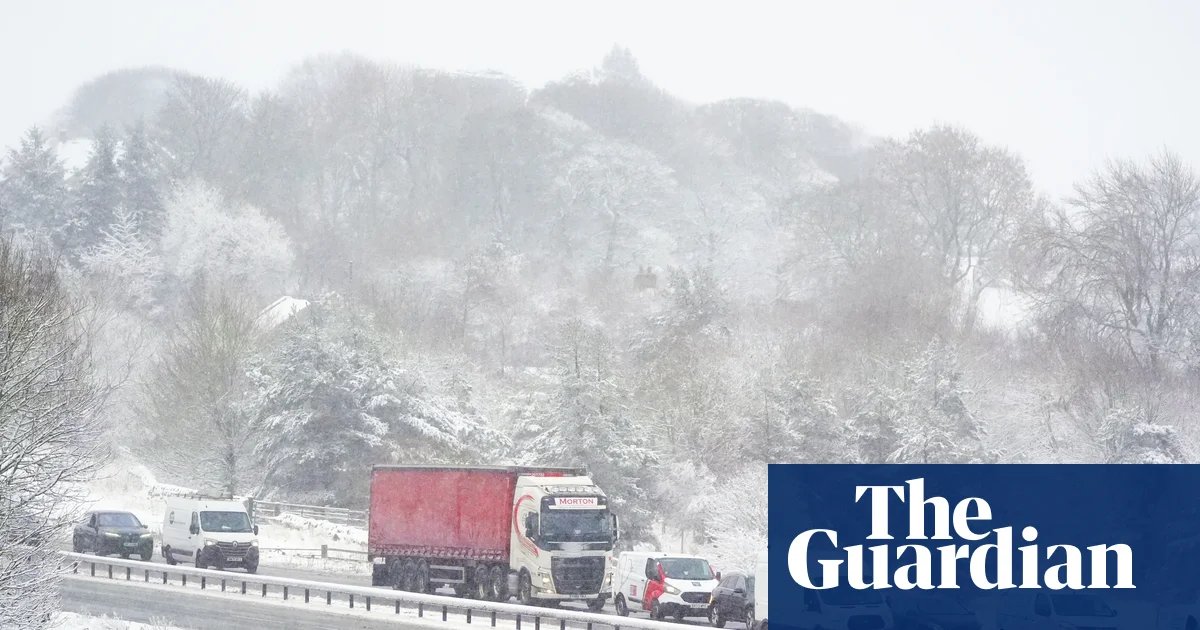
An Arctic blast of very cold air will this weekend bring snow, sleet, hail, freezing rain and icy conditions across most of the UK, forecasters have said.
The Met Office issued new yellow warnings for wintry conditions and potential travel disruption lasting until Sunday morning. Previous snow and ice warnings for Scotland and northern England expired at noon on Friday. Freezing temperatures have also led to a four-day health alert for cold weather.
In northern Scotland and coastal areas of north-east England and Yorkshire from 4pm until 10am Saturday there are warnings of snow, sleet and hail showers. Across Wales, south-west England, northern England, the Midlands, the east of England down to London the warning is for ice between 5pm and 10am on Saturday.
A yellow warning for ice has been issued for Northern Ireland, which will be in place from 8pm on Friday until 10am on Saturday.
A further snow and ice yellow warning comes into place between 9pm on Saturday and 10am on Sunday. It covers Scotland and northern England, with forecasters predicting potentially heavy snow and freezing rain.
The wintry conditions would mean hazardous ice on untreated roads and pavements, forecasters said. The Met Office said the wintry weather was the result of an Arctic maritime air mass bringing colder conditions from the north of Scotland southwards.
On Friday morning, National Highways said the A66, a major route across the Pennines, was closed between the A67 near Bowes in County Durham and the A685 near Brough in Cumbria because of “concentrated snowfall”.
It said: “National Highways area team crews are on scene with winter treatment vehicles working to clear and treat the carriageway, however forecasts predict that snowfall will continue in the area throughout the morning. Units from Cumbria police are also on scene assisting to clear the traffic. Road users travelling across the Pennines are advised to plan ahead and consider alternate routes.”
The UK Health Security Agency issued yellow alerts for cold weather across northern England and the Midlands from 6am on Friday until 8am on Monday. The alerts warn of a greater risk to life for vulnerable people and increased use of healthcare services by vulnerable people.
The wintry weather comes after a strikingly wet start to 2026 for large parts of the UK. People in parts of Devon, Cornwall and Worcestershire had rain for 40 days, the Met Office said this week. On Friday in England there were 76 flood warnings and 154 flood alerts in place. In Wales there were four flood alerts.
For others it was the absence of sun, with Aberdeen going through 21 days of sunless weather until, finally, it came out for about 30 minutes on Thursday afternoon.
Traffic & Transport
Heathrow isn’t crowded, it’s travellers walking on the wrong side, boss says | Heathrow airport

Heathrow airport has revealed a crowding problem that a third runway cannot solve: British and foreign travellers walk on different sides, and keep colliding, according to its chief executive.
Thomas Woldbye said that while Heathrow serviced more passengers in a smaller overall area than comparable European hubs, part of the London airport’s trouble was the differing continental sense of direction.
Speaking at an industry event, the Danish boss said one reason people thought Terminal 5, the main terminal used by British Airways, was crowded was that people were “in the wrong place”.
In comments to the Aviation Club UK, he said: “The problem is that all the British people keep to the left and normally Europeans keep to the right. And they do that in both directions.
“So we can be crashing into each other, and I see that from personal experience.”
Woldbye said that while “I have jokes with our people”, it was an issue that could be changed. “We just need to make sure that everybody going this way keeps to the left and this way to the right. I know that’s simplified but that is the sort of thinking that we need,” he said.
Heathrow will build more satellite terminals should it succeed with plans for a third runway, which could add about 40 million extra passengers of varying directional preferences to the mix. The 240,000 extra flights a year will be guided by air traffic control.
Woldbye said even with expansion, backed by the government, rival international hubs would grow faster than Heathrow. “London will lose market share every single year for the next 10 years. I think that should be a serious concern,” he said.
Meanwhile, the airport is attempting to address concerns that a third runway is incompatible with the UK’s 2050 net zero goals by accelerating the use of sustainable aviation fuels (SAF).
It has established an £80m pot – paid from landing charges – to subsidise airlines that choose to use more SAF on top of the minimum required under national mandates.
The mix of aviation fuel in the UK must average at least 3.6% SAF over the course of 2026, but Heathrow expects to hit a self-imposed target of 5.6%, helping airlines to cover some of the additional cost of the more expensive cleaner fuel.
Planes running on SAF – so far largely produced from recycled cooking oil – emit equal amounts of CO2 in flight as those using fossil fuels, but the net carbon footprint is calculated as lower because of the “life cycle”, ie how it is produced compared with normal jet fuel. SAF is regarded as a potential solution to significantly decarbonise long-haul aviation, although many remain sceptical.
Matt Gorman, Heathrow’s director of sustainability, said: “We have looked to use our scale and influence to attract SAF and we’ve shown you can get SAF flowing. The next challenge is stimulating domestic production – from a carbon, but also a energy security and growth perspective.”
Duncan McCourt, the chief executive of industry group Sustainable Aviation, said government pledges to start building five UK fuel plants by 2025 had been “optimistic”, with none yet under construction, but added they were making progress. “There is a real economic growth opportunity, for tens of thousands of jobs in the UK by 2050,” McCourt said.
Provisional figures published this week showed that the 2025 supply met the UK’s first annual fuel mandate of 2% SAF, with high uptake in the final months of the year after fears that the industry would miss the target.

Rafael Behr says many voters see Keir Starmer as “the archetypal status quo politician” (Keir Starmer is the bandage that Labour can’t rip off for fear of opening old wounds, 11 February). They could be on to something, since the band of that name is renowned for its dull, predictable output, which has included Accident Prone and, more optimistically, Come On You Reds and The Party Ain’t Over Yet.
Mike Hine
Kingston upon Thames, London
You published a number of letters critical of Keir Starmer, but let us be thankful that he has not inflicted as much damage as Margaret Thatcher or David Cameron.
Richard Bartholomew
Colchester
I understand “spad” at Westminster means special adviser. I spent my career working for British Rail. We also used the acronym “spad” – signal passed at danger. It seems they have both the same outcome – a train crash.
David Carter
Wakefield
The “large wire cage with an infrared lightbulb in the centre” (Letters, 15 February) was a Glow Baby. It was invented by my uncle, John Chew, and was sold in the 1960s and 70s before electric blankets became popular. We sold them in our ironmonger’s shop and my mother used one for years. We still have it tucked away in the loft.
Cal Weatherald
Belper, Derbyshire
I was pleased that Gwyneth Lewis (Country diary, 14 February) took expert advice and found that her overgrown tree was not the infamous leylandii but a western red cedar (Thuja plicata). It is also favoured for beehives – bees appear to love its aroma, and unpainted hives survive outdoors for decades.
John Edmondson
Holywell, Flintshire



-

 Crime & Safety2 weeks ago
Oxford: ‘Next generation’ LimeBikes in city from today
-

 Jobs & Careers2 weeks ago
Why Join Oxford | Oxford University Jobs
-
 Jobs & Careers2 weeks ago
Explore our Careers
-

 Student Life2 weeks ago
The independent cinema battling Oriel College to stay open
-

 Oxford Events2 weeks ago
Michelin Guide Oxfordshire Restaurants – The Oxford Magazine
-

 Oxford Events2 weeks ago
Oxford News and Events, What’s on in Oxford, Exhibitions
-

 Jobs & Careers2 weeks ago
Internal Job Board for University vacancies
-

 Crime & Safety2 weeks ago
Crash partially blocks A40 and causes severe Oxfordshire traffic