
UK News
Girls arrested as 'online trends' fuel disturbance


Six teenage girls are arrested after online trends spark anti-social behaviour in south London, the Met says.
Source link

A man in his 20s suffers potentially life-changing injuries in a shooting in Bristol.
Source link
UK News
Artemis II, Nasa’s first crewed lunar rocket in more than half a century, prepares for launch – watch and follow live | Space
The Artemis II mission
Artemis II is the second flight, and first crewed mission, of the core component of Nasa’s Moon to Mars initiative, which aims to build a permanent, habitable lunar base as a prelude to eventual human flights to the red planet.
Assuming a successful launch on Wednesday, it will be a 10-day fly past of the moon, with no landing, in which the four astronauts will travel farther into space, just short of 253,000 miles, than any human beings before them.
The objectives are to test crucial spacecraft and life support systems, monitor extensively the astronauts’ health during a long-duration spaceflight, specifically the enhanced effects of radiation and microgravity, and confirm the ability of the Orion capsule to withstand temperatures up to 3,000F (1650C) at re-entry.
The highlight for the crew will be on flight day six, when Orion will slingshot around the moon and pass between 4,000 and 6,000 miles from the lunar surface, providing opportunities to photograph the moon’s south pole where the next human landing will take place as early as 2028.
Nasa has published a comprehensive, day-by-day schedule of the Artemis II mission timeline here.
Key events
What to know about the spacecraft
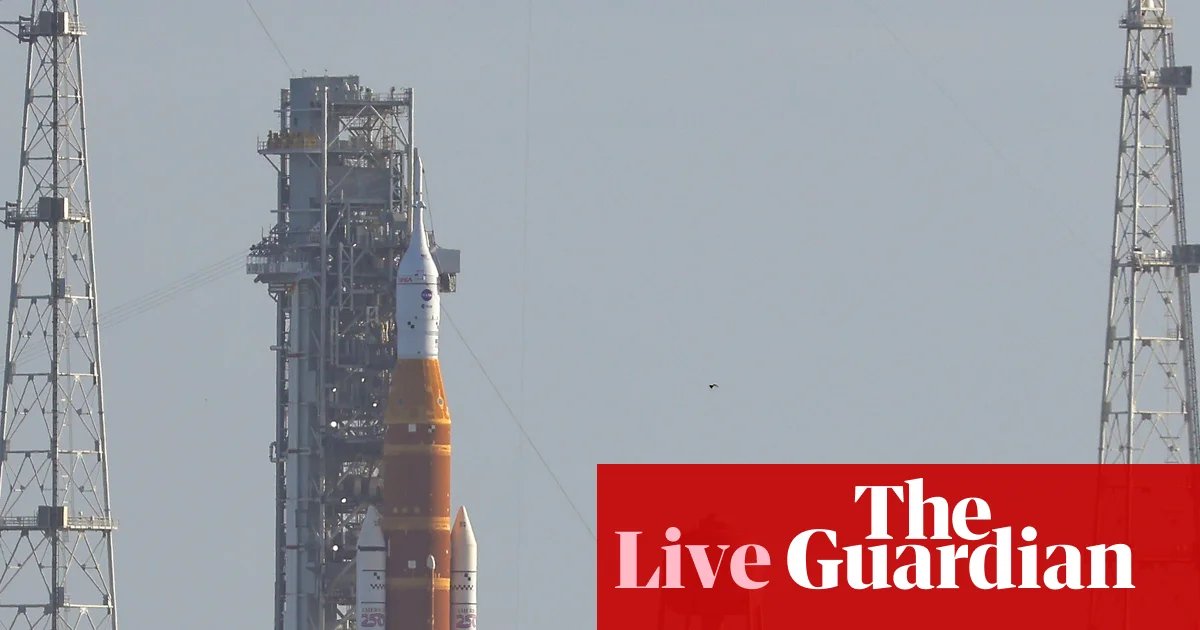
The Artemis II launchpad stack comprises Nasa’s Space Launch System (SLS) rocket, and the Orion crew capsule, a five-meter diameter craft with the interior volume similar to that of a small camper van.
The height of the rocket assembly is 322ft (98m), slightly higher than the Statue of Liberty (305ft), and London’s Elizabeth Tower, commonly known as Big Ben, at 316ft.
Four RS-25 engines, remnants from Nasa’s space shuttle program that ended in 2011, will provide almost nine million pounds of thrust at lift-off, making SLS the most powerful fully operational space rocket in history.
Two solid rocket boosters and the main tank fuel fall away after main engine cut-off and stage separation early in flight, and Orion will be powered to the moon by the European Service Module (ESM), built by Airbus for the European Space Agency.
The ESM will separate from Orion about 45 minutes before the crew’s splashdown in the Pacific ocean at the end of the 10-day mission. Unlike the solid rocket boosters at the start of the mission, which will be recovered, the ESM is designed to burn up on re-entry to Earth’s atmosphere.
The Artemis II crew will be arriving at the launchpad shortly after an emotional farewell with their families at the Neil A Armstrong operations and checkout building at Kennedy Space Center.
They posed for photographs and waved their goodbyes with heart signs and air kisses, not being allowed to hug their loved ones because of quarantine protocols.
Commander Reid Wiseman thanked the throngs who gathered to see them off. “It’s a great day for us. It’s a great day for this team,” Wiseman called out.
The astronauts boarded a silver astrovan for the journey to launchpad 39B, with military helicopters overhead and several security vehicles following at a close distance.
The next launch milestone will be the crew walking around and checking out their 322ft (98m) rocket ship from the ground before ascending in the elevator to the Orion crew capsule.
The Artemis II mission
Artemis II is the second flight, and first crewed mission, of the core component of Nasa’s Moon to Mars initiative, which aims to build a permanent, habitable lunar base as a prelude to eventual human flights to the red planet.
Assuming a successful launch on Wednesday, it will be a 10-day fly past of the moon, with no landing, in which the four astronauts will travel farther into space, just short of 253,000 miles, than any human beings before them.
The objectives are to test crucial spacecraft and life support systems, monitor extensively the astronauts’ health during a long-duration spaceflight, specifically the enhanced effects of radiation and microgravity, and confirm the ability of the Orion capsule to withstand temperatures up to 3,000F (1650C) at re-entry.
The highlight for the crew will be on flight day six, when Orion will slingshot around the moon and pass between 4,000 and 6,000 miles from the lunar surface, providing opportunities to photograph the moon’s south pole where the next human landing will take place as early as 2028.
Nasa has published a comprehensive, day-by-day schedule of the Artemis II mission timeline here.
First photos of Artemis II crew in their space suits
The first photos of the Artemis II crew on launch day are appearing on the news wires now. Canadian astronaut Jeremy Hansen and Nasa astronauts Victor Glover, Reid Wiseman and Christina Koch were posing for pictures with their families before they’re expected to set off on a 10-day journey around the moon.
They were seen smiling and waving to the crowd ahead of the launch later expected later today:
Who is on the Artemis II crew
Three of Artemis II’s four crew members are Nasa astronauts and spaceflight veterans extended stays on the international space station (ISS).
Commander Reid Wiseman, 50, is a retired US Navy captain from Baltimore, Maryland. He was selected as an astronaut in 2009, spent six months on the ISS from May to November 2014, and is a former chief of Nasa’s astronaut office.
He has two daughters with his wife Carroll, who died in 2020 from cancer. He has said he is taking a notepad and pencil with him to space to record his thoughts during the mission.
Pilot Victor Glover, 49, will become the first astronaut of color to fly beyond lower Earth orbit. From Pomona, California, he joined the astronaut corps in 2013, and flew to the ISS on the maiden operational flight of SpaceX’s Dragon capsule in 2020.
He is married with four children. His callsign, Ike, is an acronym bestowed lovingly by colleagues for “I know everything”. Glover said he will carry his Bible, wedding ring, and book of quotations from Apollo 8 astronaut Rusty Schweickart.
Mission specialist Christina Koch (pronounced Cook), 47, is already a record holder for the longest single spaceflight by an American woman, 328 days on the ISS from March 2019 to February 2020.
Koch, from Grand Rapids, Michigan, is a married engineer who became an astronaut in 2013. She will become the first woman to travel to the moon. Her personal items in space will be handwritten notes from loved ones.
Mission specialist Jeremy Hansen, 50, is the only non-American crew member, and has no previous spaceflight experience. A fighter pilot in the Royal Canadian air force, Hansen was recruited to the country’s astronaut training program in 2009.
Hansen is married with three children. Born in London, Ontario, he plans to take with him four moon-shaped pendants for his family, and maple syrup and cookies.
How to watch the Artemis II mission
Unlike the Apollo moon landings from 1969 to 1972, when millions of people had to gather around small TV sets to watch missions unfold in often grainy and ghosting black and white video, every moment of Artemis II will be a fully online, high-resolution multimedia experience.
The Guardian has a live feed at the top of this blog you can follow.
Nasa has countless webpages dedicated to every aspect of the flight from its homepage at nasa.gov, and the space agency has a significant presence on numerous social media platforms including X, YouTube, Instagram and Twitch.
Additionally, it runs a free, on-demand streaming channel, Nasa+, which will provide live coverage from before launch to after splashdown, including all press briefings. It also has a dedicated app for smart devices.
The Artemis II commander Reid Wiseman maintains a prominent social media presence, and has been posting prolifically ahead of the flight, although it remains to be seen how often he is able to update during the mission itself.
Also worth keeping an eye on is the X account of the new Nasa administrator Jared Isaacman.
How the launch is expected to unfold
A two-hour launch window for Artemis II opens at 6.24pm EST (11.24pm BST) after an almost four-hour fueling process. Nasa’s final weather briefing on Tuesday reported an 80% chance of favorable conditions for launch.
Mission managers will be watching closely data from launchpad 39B at the Kennedy Space Center, as well as real-time and forecast weather information. Any last-minute technical issue or weather violation can cause a scrubbed launch attempt, or a delay, right up to T-0 (the moment the countdown clock reaches zero).
After lift-off, the 322ft (98m) rocket will take about 6.5 seconds to clear its tower, and accelerate quickly to 17,500mph and an altitude of about 531,000ft. Once there, main engine cut-off and core stage separation take place a little more than eight minutes into flight.
The real journey to the moon begins on flight day two, after several revolutions in Earth’s orbit, with the so-called translunar injection burn, the final major engine firing of the mission.
Welcome to our launch blog for Wednesday’s scheduled launch of Artemis II, Nasa’s first crewed lunar rocket in more than half a century that is set to lift-off from Florida’s Kennedy Space Center at 6.24pm ET (11.24 BST).
I’m Richard Luscombe at the press site in Cape Canaveral with a close-up view of launchpad 39B, where the Space Launch System (SLS) rocket and Orion crew capsule will depart on their 10-day, 685,000-mile journey to the moon and back.
Hundreds of thousands of spectators will pack the beaches and causeways of Florida’s space coast to watch humans travel beyond lower Earth orbit for the first time since the final Apollo mission in December 1972.
Three Nasa astronauts, Americans Reid Wiseman, Victor Glover and Christina Koch, join Jeremy Hansen of the Canadian Space Agency on a mission that will slingshot around, but not land on the moon, before returning to a Pacific ocean splashdown.
Follow our coverage as we bring you the latest from the space center leading up to the opening of tonight’s two-hour launch window.
Read our preview of the mission here:
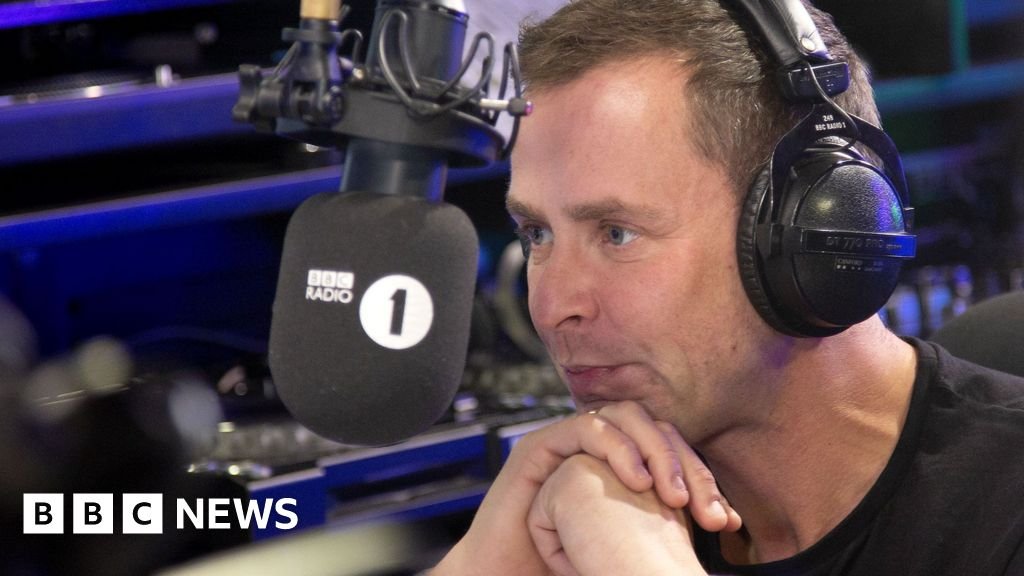
“Since the investigation related to an allegation that dates back nearly 30 years and the police investigation was closed seven years ago, I hope that the public and the media will understand and respect my wish not to make any further public comment on this matter,” the former BBC Radio 2 presenter said.



-

 Crime & Safety2 weeks ago
Oxford: ‘Next generation’ LimeBikes in city from today
-

 Jobs & Careers2 weeks ago
Why Join Oxford | Oxford University Jobs
-

 Oxford Events2 weeks ago
Oxford News and Events, What’s on in Oxford, Exhibitions
-

 Jobs & Careers2 weeks ago
Explore our Careers
-

 Student Life2 weeks ago
The independent cinema battling Oriel College to stay open
-

 Oxford Events3 weeks ago
Michelin Guide Oxfordshire Restaurants – The Oxford Magazine
-

 Crime & Safety2 weeks ago
Radiohead promising ’20 gigs for 2027′ after sell-out shows
-

 Jobs & Careers2 weeks ago
Internal Job Board for University vacancies