
UK News
French Open 2026: Kalinskaya v Chwalinska; Sabalenka v Shnaider as quarter-finals continue – live | French Open 2026

Key events
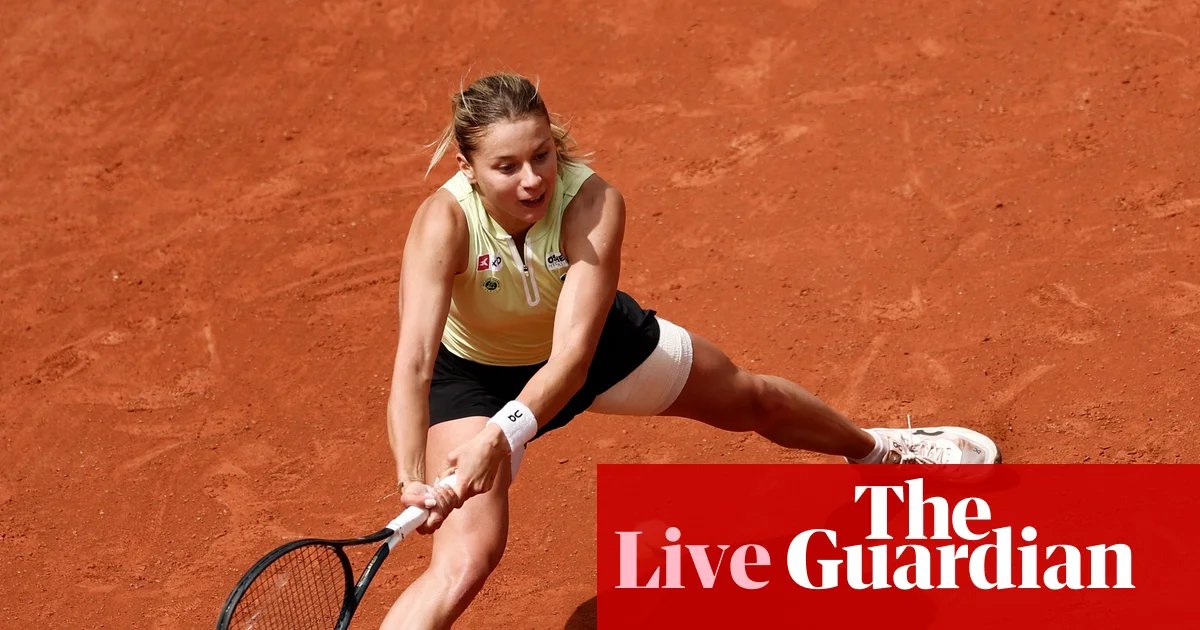
Chwalinska has fine hands but her racket must feel as if it weighs about 100kg as she steps up to serve. She still moves to within two points of victory at 30-15, before Kalinskaya lets go of some of her frustrations with a brutal return winner. So will it become match point or break point? Break point, as Kalinskaya again comes out swinging. Chwalinska is still able to think clearly enough to confound Kalinskaya with a body serve. Deuce. Advantage Kalinskaya. And Chwalinska goes well long with a clunky forehand! A fourth successive break! Sacre bleu!
But here’s a sudden, jarring shift in momentum as Kalinskaya, hitting slightly freer now she has nothing to lose, tears through Chwalinska’s serve, 0-15, 15-all, 15-30, 15-40 … and Kalinskaya gets one of the breaks back with a fizzing forehand winner! But no sooner does she give herself a glimmer, she slumps 30-40 down on her own serve, and she balloons a backhand long! Yet another break – the 10th of the match – and now Chwalinska will serve for the match!
Kalinskaya’s face hardly ever betrays emotion but she is clearly rattled here, and is now arguing with her coach about tactics. With her focus gone, she slips 30-40 down, and is totally wrong-footed as Chwalinska clobbers a forehand winner beyond her! Chwalinska has the comfort of a double break (which she’ll be thankful for given the way the first set went) and she’s potentially two games away at 7-6, 4-1!
Chwalinska’s first serve is slower than Kalinskaya’s second serve, but she shows great variation to back up the break by holding to 30. The qualifier, with one grand slam match win to her name before this tournament, is now three games away (!) from the semi-final. Words not even Chwalinska would have thought possible a couple of weeks ago. Or possibly even half an hour ago when Kalinskaya was making her comeback.
After that wildly see-sawing opener, a couple of straightforward holds get the second set under way. Kalinskaya then finds herself under a bit of pressure on serve, at 30-all, before dealing with Chwalinska’s loopy ball with a perfectly executed drop shot. 40-30. But Chwalinska comes straight back at her for deuce and advantage and game, or more accurately Kalinskaya self combusts with three errors, to hand Chwalinska the break! The qualifier leads 7-6, 2-1.
Fancy some post-set entertainment? Sure you do:
Chwalinska wins the first-set tie-break 7-3
Kalinskaya concedes another point on serve to drop 4-3 behind. A high-quality clay-court rally complete with moon balls, net charges and lobs ends in Chwalinska’s favour for 5-3. And having waited so long for a point to be won on serve, two come along at once! It’s 6-3, three set points, to add to the two it feels like Chwalinska had yesterday. And this time, after all of Kalinskaya’s resistance, the Russian fires long! It’s been tortuous at times and very tense, but Chwalinska finally has the first set after 69 minutes.
The first five points of the breaker go against the server, make that six, as Chwalinska’s vicious slice stops dead on the clay, leaving Kalinskaya with little chance. So they change ends at 3-all …
Kalinskaya, perhaps panicked, rushes the opening points on her serve, losing the controlled aggression she has found as the set has progressed, and she slides 15-30 down. Credit to her for the way she comes back for 30-all, 40-30 and game. So much of the narrative here is on the Chwalinska, the qualifier, that it’s easy to forget this is only Kalinskaya’s second grand slam quarter-final and she’ll be feeling the nerves. This will be a tense, tense tie-break.
Kalinskaya looks to be the favourite from here, with her greater experience and power, though having said that the key to her comeback has been staying a bit more patient in the rallies and not trying to pull the trigger so quickly. At 30-all on Chwalinska’s serve, the Pole pushes Kalinskaya deep before sprinting to the net to finish off the point. Smart play. And Chwalinska takes the next point too to staunch the flow of games against her and nudge 6-5 ahead.
Kalinskaya is never a player to show much emotion, and with her game face on, she works her way to 40-15 with minimal fuss. Before crunching away a winner to settle matters. From 5-1 down, they’re back on serve at 5-5! So who will feel the pressure now? Chwalinska, having conceded such a commanding lead and missed those two set points, or Kalinskaya, now she has something to lose again?
Kalinskaya holds to 30 to further reduce her arrears, to 5-3. But Chwalinska will get another chance to serve this out … and comes out on top after a lung-busting 27-shot rally, finished off with a drop shot/lob combination, for 30-15! Even Kalinskaya is applauding. Chwalinska delves into her box of tricks again to bring up 40-30, so here’s another set point to add to the one the Pole had at at 5-1. Some big, brave hitting from Kalinskaya saves it. The wind is really ripping around Chatrier now, just to add to the drama. And this goes exactly the same way as game seven, as Kalinskaya breaks on a second BP! Remarkably, they’re back on serve.
So Chwalinska is serving for the set … and she’s playing as if this is her 34th grand slam quarter-final rather than her first. From 30-all, she advances to 40-30 … but Kalinskaya saves the best for last, fending off the set point with a backhand winner! Chwalinska, perhaps still thinking about that SP, makes a total hash of a smash at deuce, giving Kalinskaya the chance to break. And while the Russian doesn’t on the first break point, she does on the second. Could the comeback be on? Kalinskaya trails 5-2 but at least she’s starting to ask some questions of Chwalinska.
Make that four, although the Pole is make to work for the hold, saving a break point at 30-40. Chwalinska is giving Kalinskaya so little rhythm and the Russian is totally befuddled in the next game as Chwalinska zips 15-40 ahead. Now Kalinskaya is trying to get in on the drop-shot act … but it’s not her natural game, it doesn’t work and Chwalinska charges forward before dispatching a winner into the open court! It’s now 5-1. Phew.
The 5ft 5in left-hander Chwalinska, who makes up for her lack of height and power with intelligence, is drop-shotting and slicing Kalinskaya into submission here, and it gives her a break point at 30-40. Kalinskaya saves it with a big backhand – but soon enough it’s break point again and after a nine-shot rally Kalinskaya’s forehand drifts wide! Chwalinska breaks for 3-1 and that’s three games on the spin.
Now it’s Chwalinska’s turn to recover from 40-15 down on Kalinskaya’s serve to break … and then she rattles through four successive points on serve to hold! The world No 114 is on the board and leads 2-1. This interview with Chwalinska and Swiatek as 15-year-olds is a good watch, btw. How good is their English, given their age?!?!
Chwalinska looks anything but stressed as she swiftly moves 40-15 ahead on serve in the opening game. But Kalinskaya comes back at her for deuce. Despite this being only a second grand slam quarter-final for Kalinskaya, the 22nd seed knows this match is on her racket, and she’s trying to stamp her authority from the off. She has the greater firepower, which she demonstrates to get to her advantage. Chwalinska craftily works Kalinskaya around the court and saves the break point. But the next two points go Kalinskaya’s way and the Russian breaks in the opening game.
The qualifier Chwalinska (pronounced Hfa-leen-ska in case you were wondering) is having the time of her life in Paris, having won all but one of her seven matches in straight sets, upsetting Zheng Qinwen, Elise Mertens and Maria Sakkari along the way. Her solitary grand slam match victory before this tournament came at Wimbledon four years ago, after she’d taken a break from tennis because of depression. She has said she associated the sport with “pressure, stress and crying” but now has a more balanced approach: “The results don’t define me as much as they did before. I just couldn’t differentiate Maja and tennis player. I was just one.”

Tumaini Carayol
Marta Kostyuk was her own toughest rival for so long during the early stages of her career. As she tried to navigate the pressure that accompanied her status as a teenage prodigy, she often struggled to think clearly on the court without her emotion, fears and desperation to succeed torpedoing her form.
The path towards unlocking her potential has been tough, requiring the Ukrainian to be honest with herself and encounter the right people to help take her forward. That work continues to pay off. Kostyuk made another significant breakthrough by ending the Ukraine derby as the victor, holding her nerve to defeat Elina Svitolina 6-3, 2-6, 6-2 and reach a grand slam semi-final for the first time in her career.
Although Kostyuk has broken new ground in Paris, this is simply a continuation of the form she has put together during what is looking increasingly like a career-defining clay-court season. She is now on a 17-match winning run, having secured titles in Rouen and Madrid in the buildup to Paris. Considering the clarity and temperament she is playing with each time she steps on the court, she can clearly go further.
After firing down a final unreturned serve, Kostyuk struggled to hold back her emotions as she digested such a significant result. Still, even in her personal triumph, she started her speech on the court by referencing the war back home, earning a long, standing ovation.
“I want to start with this historical match that we played today with Elina,” she said. “We had a very difficult night again in Ukraine, especially Kyiv. So many people dead. I want to give this match to Ukrainian people and to their resilience.”
This tournament has provided ample reminders of the horrors still unfolding in Ukraine. It started with Kostyuk waking up to the news that Russia had fired a missile within 100 metres of her family home, where her sister, mother and great aunt were staying, yet she had to compose herself and play her first-round match. Meanwhile, their compatriot Oleksandra Oliynykova has levelled stinging criticisms of the sport’s handling of Russian players.
Another duel between a Russian and Ukrainian player beckons. Kostyuk will next face the 19‑year‑old Mirra Andreeva, who produced a stellar performance to dismantle Sorana Cirstea 6-0, 6-3 and reach her second Paris semi-final. It will be a rematch of their recent final at the Madrid Open. Asked what it is like to play a Ukrainian player in these matches, Andreeva said: “For me it doesn’t matter who I play. I really try to play against the ball that is coming at me. Usually it doesn’t matter to me who I’m playing against, so I’m trying to really focus on the game and on the game plan that I have to use on the court.”
The full report:
Tumaini Carayol
For at least a few fleeting moments, it appeared that something significant might be unfolding on Tuesday beneath the Court Philippe-Chatrier roof. Rafael Jódar had started his first grand slam quarter-final desperate to make his mark and he spent the first 40 minutes eviscerating the ball off both sides, lasering groundstrokes that seemingly struck every line. He built a 5-2 lead over Alexander Zverev, a game away from starting with a statement in the biggest match of his career.
Normalcy resumed quickly. Jódar’s attempts to serve out the set ended in a break to love for the second seed, who quickly took control and refused to relinquish his position until the end of the match.
Zverev offered Jódar minimal breathing room for the rest of the encounter, serving extremely well and striking his forehand freely. In the process, the German took another step towards winning an elusive first grand slam title as he returned to the semi-finals of the French Open with a 7-6 (3), 6-1, 6-3 win.
The past 10 days in Paris have been unlike any in the recent history of men’s tennis, with so many of the top players suffering early upsets. As the dust has begun to settle on the early defeats for Jannik Sinner and Novak Djokovic, the central question surrounding the men’s draw in the final rounds is simple: can anyone beat Zverev?
After being repeatedly blocked by Sinner, Carlos Alcaraz, Djokovic and others, the door is clearly wide open. Beyond him, the world No 6, Félix Auger-Aliassime, is the only remaining top-10 player. There are still some shooters left in the draw, quality players with big enough weapons to take him out, but while Zverev has navigated his section with few problems, reaching the semi-finals without facing a player ranked inside the top 25, the rest of the field has been in a frantic rush to take advantage of an opportunity that may never come again.
So many players have already worn themselves out in multiple five-set matches as they have battled to get through.
Jódar was a perfect example of this. Seeded 27th, he has been one of the revelations of the clay-court season. He entered the match leading the ATP with clay-court wins this year, compiling a record of 19 wins and three defeats, with quarter-finals in Madrid and Rome before his run at Roland Garros. But he navigated consecutive five-set matches for the first time in his career to reach the quarter-finals. After squandering his opportunity in the opening set, he quickly ran out of steam.
The top half of the draw, meanwhile, now more closely resembles a wrestling match than anything like tennis. So many players in the top section have been embroiled in marathon matches, not least Italy’s Matteo Arnaldi, whose 17 hours and 54 minutes on court to reach the last eight is an open era record by, astoundingly, over two hours.
You can read the rest here:
Yesterday’s showers have departed, there’s even a bit of sunshine in Paris and the Philippe Chatrier roof is off as Kalinskaya and Chwalinska arrive on court. While we wait for the action to begin, here’s Tumaini’s take on what happened yesterday …
Today’s singles order of play
COURT PHILIPPE CHATRIER – 11am (10am BST)
Anna Kalinskaya (22, Russia) v Maja Chwalinska (Poland)
Aryna Sabalenka (1, Belarus) v Diana Shnaider (25, Russia)
Felix Auger-Aliassime (4, Canada) v Flavio Cobolli (10, Italy)
Not before 8.15pm (7.15pm BST)
Matteo Berrettini (Italy) v Matteo Arnaldi (Italy)
Preamble
Bonjour et bienvenue au jour onze de Roland Garros, where there’s something of an eastern European and Italian takeover on Philippe Chatrier.
First it’s the qualifier Maja Chwalinska – not the Pole who everyone thought would still be standing – against the 22nd seed Anna Kalinskaya. Chwalinska, who came through the junior ranks with Iga Swiatek before their careers went in very different directions, had won only one grand slam match before this tournament, but the 24-year-old is now in the quarter-finals – a stage the 27-year-old Kalinskaya has admitted she didn’t expect to reach either, having got this far at a major only once before, at the 2024 Australian Open.
This, of course, is anything but uncharted territory for Aryna Sabalenka, who has remained utterly unaffected by the chaos around her, as the only grand slam champion left in one piece in the women’s and men’s draws, on her way to a meeting with another surprise quarter-finalist, Russia’s Diana Shnaider. Sabalenka laid down the biggest of markers in the red dirt with her blistering win over Naomi Osaka in the previous round – prompting even Shnaider to concede that today’s match is most likely a chance to “get experience for the future”.
Sabalenka knows her time is now – while it could be now or never for Felix Auger-Aliassime, the former wonderkid who is, for the first time in his slam career, the highest-ranked player left in his half of the draw that may have lost the greatest Italian of all in Jannik Sinner but still features three others in Flavio Cobolli, Matteo Berrettini and Matteo Arnaldi. Auger-Aliassime faces Cobolli in a much-anticipated match that is so hard to call (Auger-Aliassime has the big-match experience; Cobolli is such a fine talent) – before in the night session the renaissance man Berrettini, back after his injury hell, meets the marathon man Arnaldi, who’s already played 18 sets to get this far.
Play begins: à 11h ( 10am BST). On y va!
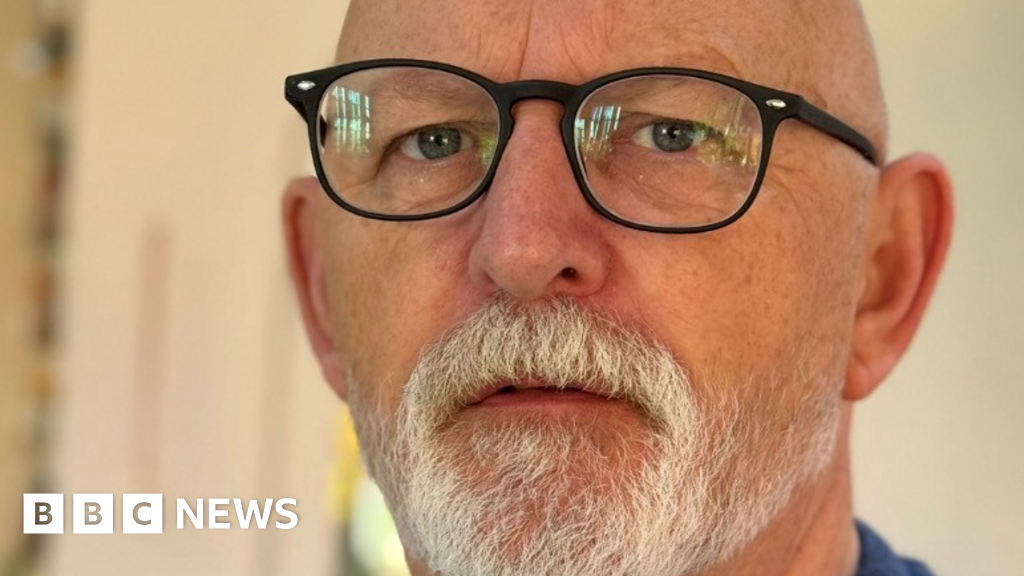
The family of Shaun Burton, say they are “devastated” by the loss.
Source link
Key events
In the opening half an hour against Cape Verde, Mikel Oyarzabal, the centre-forward, did not get a single touch.
Kyle Green gets in touch: “Your highlighting of Lalas and his absurdity is something that has prevented me from wanting to watch the coverage on Fox. While every channel has its pros and cons I just can’t.
“I’m 45 and probably the youngest of anyone who remembers him as a player instead of an opinionated insert insult here. As for the match this could be more competitive than it looks on paper Spain need a win the pressure is on them. Saudi Arabia could hold out for a draw and see what happens in their last match. “
News from the England camp, and it seems to be good news on Declan Rice.
“I’m ready and fit, raring to go. I was feeling a little bit of neural pain in my hamstring, which I was managing from after Christmas with Arsenal for a very long time. Obviously, not a lot of people would have known that. It was all behind-the-scenes stuff but it was a smart decision.
“In the end, that last 20 minutes is probably where you pick up the most, and it’s where you play a 70-minute match. But that last 20 is where you really feel your body going for it. And I think it was a smart decision because the last few days I felt really, really good.”
Alex Reid has penned today’s weekend special Football Daily.
Portugal v Uzbekistan on Tuesday enticingly pits the incredibly nice, incredibly 41-year-old-superstar-tolerant Roberto Martínez against Fabio Cannavaro, who’s won a Ballon d’Or as a player and the Chinese Super League as a coach. While the fixture following that game really does see the dream of Thomas Tuchel – in his first international job with England – taking on Queiroz, who is in charge of his ninth national side with Ghana.
The expected formations are 4-2-3-1 for Spain, and 5-3-2 for the Saudi Arabians.
The Saudi team features two Donis changes: Ali Lajami, a defender, and Nasser Al Dawsari, a midfielder, are preferred to Mohammed Abu Al Shamat and Mohamed Kanno. You may recall Salem Al Dawsari, the Saudi captain, as the man who scored the winner against Argentina.
An entertaining read, even for those of us who have just seen the clips.
In a conversation where his co-panelist is casually reminiscing about his days playing alongside Messi or exchanging shirts with Ronaldo Nazário at the World Cup, what exactly is Lalas going to talk about – coming on as a second-half substitute for Earnie Stewart in a friendly against Scotland in 1998? Helping the Kansas City Wizards finish last in the 1999 MLS Western Conference? Did Lalas enjoy an elite playing career? No. But does he do the background reading that could compensate for his relative lack of standing in a conversation with titans like Henry and Zlatan? Also no. But is he charming or funny or charismatic or otherwise magnetic on screen? Eh, no.
For the record, I once interviewed Alexi Lalas on the challenge of playing against Romario in the 1994 World Cup. He had this to say:
“He could kill you in so many different ways. If you remember from that World Cup, he scored so many types of goals. That ranged from solo adventures to an outside-of-the-right-foot half-volley off a corner kick. Romario was both the most difficult to play against and the best that I have faced.
“Roberto Baggio was doing his thing, but in terms of consistency and living up to the hype, he [Romario] was the best. As with all stars, there was a moment when the fans sit up in their seats, and that was a feeling I got with Romario. When it got close to him and the potential for his involvement in a play was there, everybody sat up in their seat. They knew that something spectacular would be happening.”
Saturday’s match reports here.
The Saudi Arabia coach, and Blackburn legend, Georgios Donis, spoke about the challenges facing his team: “Spain is not the same team when Yamal or Williams are on the bench.
“While they still have plenty of possession, they lack the individual one-on-one penetration when these two are missing. I’m not saying it’s a problem for Spain, but when those players are missing, they play in a different way. We saw this very clearly against Cape Verde.
“We are playing against one of the best teams in the world, and it’s very important that when you play against these kinds of teams, you should enjoy the experience and respect the opponent, but not too much.
“It is very hard for any team playing against Spain to have any time in possession. So what we must do is to be more in control of our movement and compact, and when the ball goes through the lines, be able to defend dynamically.
“It’s nice to see miracles in football, and we’ve seen favourites losing against underdogs. Of course, it’s great for Saudi football to have a great memory of the result against Argentina, but we aren’t drawing anything from that.
“I think we’ll feel more pressure in that [Cape Verde] game than we will against Spain.”
The Spain coach, Luis De La Fuente had this to say in his Saturday press conference: “This generation of footballers is highly competitive and really fired up… It’s going to be a completely different story,” he said at his pre-match press conference on Saturday. There is no drama or crisis. The bottom line is simply that we need to win tomorrow.”
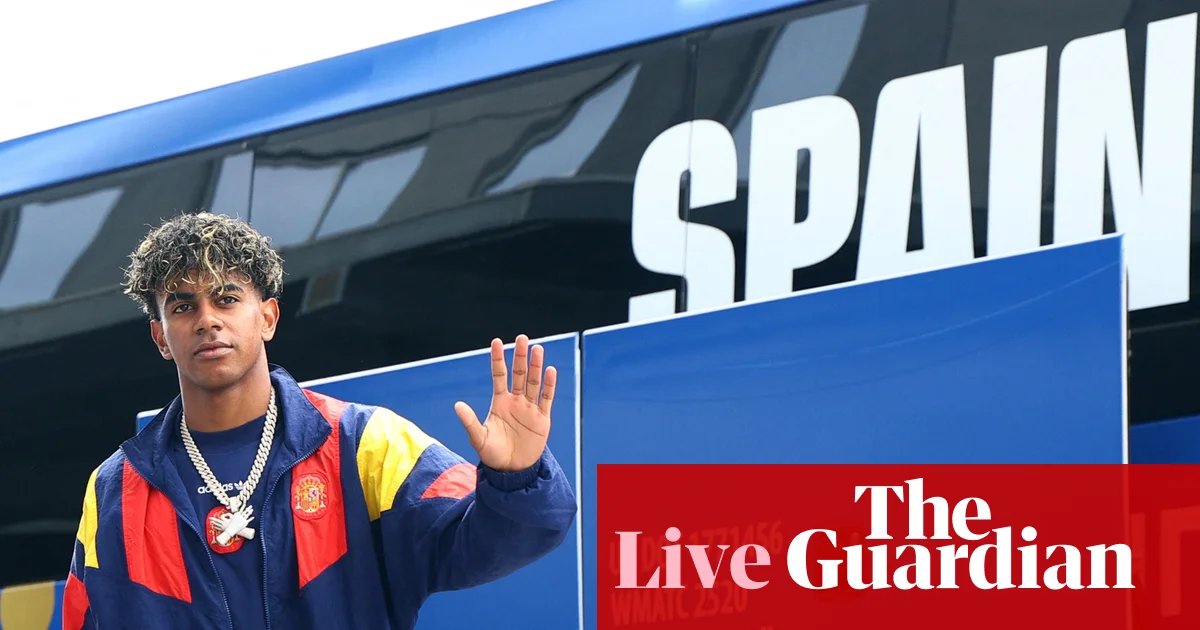
Four changes for Spain: Lamine Yamal, Pedro Porro, Dani Olmo and Alex Baena also come into the side with Marcos Llorente, Fabian Ruiz, Ferran Torres and Gavi dropping out.
The teams – Lamine Yamal starts
Spain: Simon, Porro, Cubarsi, Laporte, Cucurella, Gonzalez, Rodri, Yamal, Olmo, Baena, Oyarzabal. Subs: Raya, Joan Garcia, Pubill, Grimaldo, Eric Garcia, Llorente, Merino, Torres, Fabian, Gavi, Pino, Williams, Zubimendi, Munoz, Iglesias.
Saudi Arabia: Al Owais, Abdulhamid, Tambakti, Lajami, Al Amri, Al Harbi, Nasser Al Dawsari, Al Khaibari, Al Juwayr, Al Buraikan, Salem Al Dawsari. Subs: Al Aqidi, Al Kassar, Majrashi, Yahya, Al Shehri, Al Boushal, Kadesh, Al Johani, Al Ghannam, Al Hajji, Al Hamdan, Mandash, Kanno, Thakri, Abu Al Shamat.
Referee: Raphael Claus (Brazil)
Perhaps one of the Saudi -players can write themselves into this high-grade selection?
Perhaps it can be their goalkeeper.
Madrid screening of Spain v Saudi Arabia cancelled due to heat
The public screening of Spain’s World Cup match against Saudi Arabia in Madrid on Sunday has been cancelled because of extreme heat forecast for the Spanish capital, officials said.
The match, due to kick off at 6pm local time on Sunday, had been scheduled to be shown on a giant screen installed by the Spanish football federation (RFEF) at a fan zone in Plaza de Colón in central Madrid.
Madrid city council and the federation decided to cancel the screening after national weather agency AEMET issued an orange heat warning – the second-highest level – for the Madrid region, with temperatures forecast to reach 40C.
“The decision has been taken with the aim of protecting the health of attendees, event staff and support services involved in the event,” Madrid city hall said in a statement, apologising for any inconvenience.
Officials urged supporters to watch the match indoors in air-conditioned spaces and avoid prolonged exposure to the heat.
Large parts of Spain are experiencing unusually high temperatures for June as a mass of hot air from North Africa moves across the Iberian Peninsula.
A total of 13 of Spain’s 17 regions are on orange alert for heat on Sunday, while the northern Basque Country bordering France is on red alert, the highest level.
Authorities advised residents and visitors to take precautions during the heatwave, including drinking water regularly, staying in cool environments, limiting outdoor physical activity during the hottest hours of the day and taking extra care of vulnerable people. AFP
Can Saudi Arabia repeat the magic of 2022?
Argentina arrived in Qatar on a 36-game unbeaten run. When Lionel Messi opened the scoring from the penalty spot after 10 minutes, a comfortable afternoon seemed in the offing. Saleh al-Shehri and Salem al-Dawsari had other ideas, Argentina had three goals disallowed for offside in the space of 13 minutes and the greatest comeback in Saudi Arabia football history was made. Argentina went on to lift the trophy, while defeats to Poland and Mexico meant the Saudis did not reach the knock-out stage.
Unai Simon over David Raya is a controversial choice for De la Fuentes. The Arsenal keeper could lay claim to being Europe’s best this season.
“Those at the Champions League final had a few more days, so I got there on the Wednesday night,” Raya says. “I arrived a bit before Fabián [Ruiz]. I was saying hello to some of the others in reception when he arrived. I went to say congratulations; that was almost the first thing I did. I couldn’t really talk [to him] after the final; I just didn’t have it in me. The next day we talked about the game properly. Just two mates chatting … I was happy for him that he could lift the trophy for a second time.”
A high pressure game for the European champions, as Sid Lowe reports.
“If we had scored one, the game would have changed,” Martín Zubimendi said. Immediately after the game, De la Fuente had offered a simple analysis: when the ball doesn’t want to go in it doesn’t want to go in, he insisted. Spain had racked up 27 shots, after all. Ferran Torres had hit the bar and seen another clear opportunity saved. Vozinha, the 40-year-old goalkeeper who stopped that, saved six more and was named the man of the match. “There’s nothing to reproach the team for,” Rodri said. “We generated chances but couldn’t put it away; the good thing is they created almost nothing.”
We wait to see what role Lamine Yamal will play today. His coach would surely like to be able to use him.
The worst mistake we could make would be to compare him to anyone. He is the midst of a process. He has exceptional footballing maturity and lives it all with total naturalness. He has great serenity and strength. We have to let him follow his path but those players who have something different are ready for that. They’re geniuses, like Dalí [who] can paint a picture, or Michelangelo. They’re different. What is exceptional to us, isn’t to them. In those extremes, they feel comfortable. Why? Because they are different. What we think is exceptional, they consider normal.
Preamble
Spain’s campaign did not get off to a flying start, and Luis de la Fuentes may wake up in the night to visions of Cape Verde’s Vozinha. He will have Georgia on his mind ever since Monday. Saudi Arabia are no pushovers and gave Uruguay a scare in their opening match. Memories of downing Argentina four years ago still abound, and so Spain might beware. They can ill afford to go into the final game with Uruguay at a disadvantage. All eyes on Lamine Yamal, whose fitness situation remains opaque, though Spain need their other forwards to come to the party.
Kick-off 5pm UK, 1pm ET, 2am AEST. Join me.

A topless man can be seen driving erratically in Edinburgh before abandoning his car and attacking a black man and a delivery rider.
Source link



-

 Business & Technology3 weeks ago
HSBC UK & Visa test AI shopping with live payments
-

 Business & Technology4 weeks ago
Mouser warns against viral hacks to cool overheating phones
-

 Business & Technology3 weeks ago
Valarian lands USD $50 million backing for sovereign AI
-

 Oxford News4 weeks ago
DWP now checking bank accounts for Universal Credit and Pension Credit
-

 Oxford Events4 weeks ago
Henley Festival 2026 highlights: Five nights of unforgettable performances and festival moments
-

 Oxford united FC3 weeks ago
Oxford United three players who be kept after transfer ban
-
 Business & Technology4 weeks ago
Ode launches free AI voice service for poem recommendations
-

 Business & Technology4 weeks ago
ZYMIX uses Henley event to pitch social app to Gen Z