
UK News
Four people die in Channel small-boat sinking | UK news

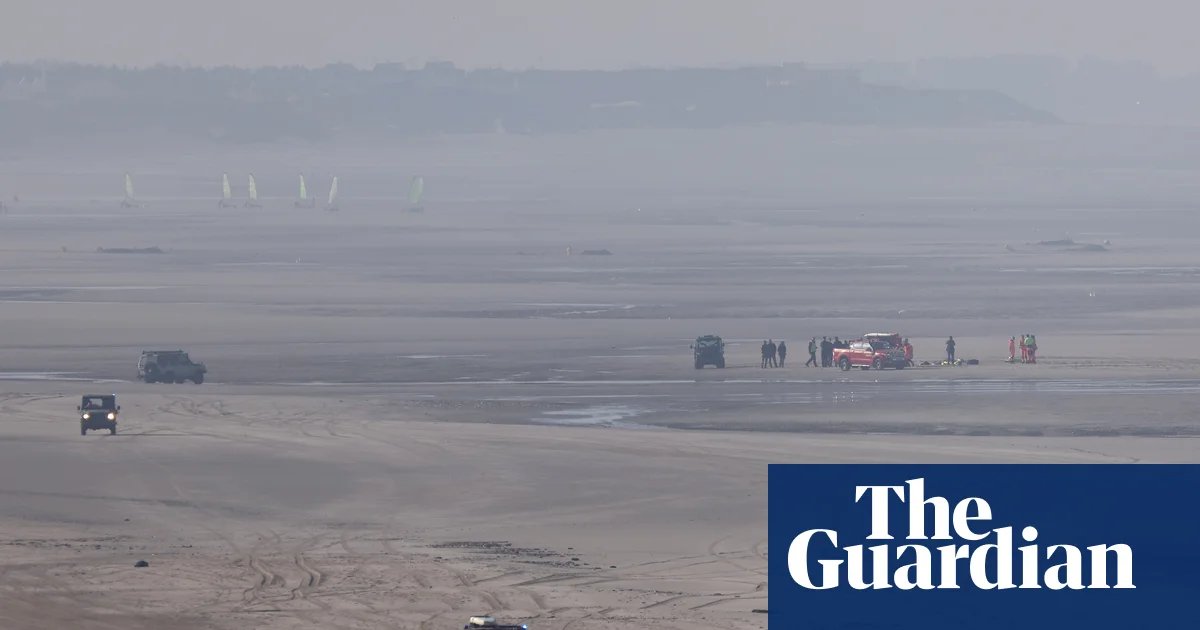
Two men and two women have died after a small boat sank in the Channel between France and Britain, French local authorities have said.
“A taxi-boat sinking occurred today. The situation is still being assessed and remains subject to change,” local authorities in Calais stated.
According to the French media outlet La Voix du Nord, rescue services were called to Équihen-Plage early on Thursday morning.
In the past year, people smugglers have been using motoring dinghies along stretches of the northern French and Belgian coasts, picking migrants up along the shore. Authorities refer to them as “taxi-boats”.
Wednesday’s incident came the day after 102 people got into difficulty trying to cross the Channel and had to be rescued.
In another recent incident, two people died trying to cross the Channel at the beginning of April.
The use of taxi-boats by people smugglers is controversial as they move along the coast picking up people at different points rather than having one fixed launching point into the sea. There have been reports that some of these taxi-boats are starting their journey from Belgium and then moving along the French coast.
The UK and France are negotiating a fresh deal to stop small boats crossing the Channel, with an interim arrangement in place after they failed to renew an agreement that expired on 31 March.
About 2,200 refugees and migrants crossed the Channel, one of the world’s busiest shipping lanes, to the UK in the first two months of 2026, according to data from the University of Oxford’s Migration Observatory. About 41,500 people made the crossing last year.
Jermaine Grant is accused of attended a training camp in Somalia and other terrorist activities.
Source link
Rescue efforts remain under way after the incident off the coast of northern France, local media is reporting.
Source link
UK News
Oil rises and Asian stocks fall amid worries over ‘fragile’ ceasefire deal in Middle East – business live | Business
Introduction: Oil prices rise and Asian stocks fall amid worries over uncertain ceasefire deal
Good morning, and welcome to our rolling coverage of business, the financial markets and the world economy.
Uncertainty over the US-Iran ceasefire deal has triggered a rise in oil prices this morning.
Brent crude, the international benchmark for oil prices, rose by 2.1% to $96.77 a barrel, while New York light crude rose by almost 3% to $97.23 a barrel. Yesterday, Brent crude dropped by more than 10% after initial news of the ceasefire emerged.
Meanwhile Asian stocks have been choppy overnight: Japan’s Nikkei has slipped by 0.7% and the South Korean Kospi has dropped sharply by 2%. Both countries are highly exposed to the conflict in the Middle East as they rely on oil and gas supplies from the region.
In China, the CSI300 index fell 0.5% and Hong Kong’s Hang Seng also slipped 0.2%.
It comes as investors worry about the ‘fragile’ nature of the US-Iran ceasefire deal announced yesterday, as Israel continues its assaults on Lebanon and the impasse in the strait of Hormuz continues.
Jim Reid, a strategist at Deutsche Bank, says this morning:
Those overnight losses follow several indications that the ceasefire isn’t holding quite as expected on Tuesday night. For instance, both the UAE and Kuwait said yesterday that their air defences had been intercepting drones from Iran. And on the Iranian side, their Parliament’s Speaker Ghalibaf said that three points of the ceasefire agreement had been violated.
Moreover, the IRGC warned of a “regret-inducing response” if Israel’s strikes against Lebanon didn’t stop immediately, whilst the Fars news agency said that the passage of oil tankers through the Strait of Hormuz was halted because of Israel’s continued strikes on Lebanon. So collectively, that’s raised concern about how durable this ceasefire will prove, particularly with it only being a two-week truce.”
Reid notes that US president Donald Trump posted on social media a couple of hours ago that US forces would “remain in place, and around, Iran, until such time as the REAL AGREEMENT reached is fully complied with”, and that if not military action would be “stronger than anyone has ever seen before”, and that the US military was “looking forward, actually, to its next Conquest”.
He also criticised NATO in a separate post overnight, saying that they weren’t “there when we needed them”, and called on people to “remember Greenland, that big, poorly run, piece of ice!!!”. So that raised concerns about a repeat of mid-January, when Trump’s call for the US to take Greenland and the threat of European tariffs drove a risk-off move in global markets.
The agenda
-
8.30am BST: Bank of England governor Andrew Bailey appears before the European parliament committee on economic and monetary affairs
-
9.30am BST: Bank of England credit conditions survey for Q1 2026
-
1.30pm BST: US gross domestic product, initial jobless claims, PCE inflation measure and wholesales inventories
-
3pm BST: IMF managing director Kristalina Georgieva expected to deliver a speech on the outlook for the global economy and outline key policy priorities for member countries
Key events
Israel instructs Energean to reopen natural gas platform
Perhaps a sign that Israel expects the ceasefire to hold: the Israeli energy ministry has instructed Energean to reopen operations at its Karish natural gas platform, Reuters has reported.
The gas platform, which is off Israel’s Mediterranean coast, has been shut down for more than a month since the outbreak of war with Iran.
Mohit Kumar, of the broker Jefferies, says the “fragile” nature of the ceasefire deal has started to show cracks after Iran accused the US and Israel of breaking the terms due to attacks on Lebanon – but that the agreement could still hold.
Despite the fragile nature of the ceasefire, we believe that the truce will hold. Not because we believe that a solution has been found but because of the MAD (mutually assured destruction) principle.
…US and Israel have realised that without a solution to cheap drone interceptors and someway to bypass the Strait of Hormuz, it’s a war that cannot be won. IRGC will be struggling with a destroyed economy which can pave the path for an uprising later. Hence, need time to consolidate their power particularly after a number of senior leaders have been killed. Given the interest of both parties, we believe that an uneasy truce will hold.
But as argued yesterday, it’s an unstable equilibrium. The biggest losers of this arrangement have been the Gulf countries who would face an emboldened Iran. Iran’s ideology to export the Islamic Revolution would not bode well for the other gulf countries. Economically too, they have taken a setback with the path of projecting Middle East as an investment hub potentially delayed by a few years.
Hence, we do not see oil going back to pre war levels. We also think that a geopolitical risk premium would need to be priced in different asset classes.
From a market perspective, we have been in the low risk mode but with a positive bias. The positive view remains beyond the war, but we are not ready to sound all clear. Hence for investors who are long risk, we would recommend using yesterdays rally to take some profits which still keeping a positive risk bias. Market positioning is still small short to neutral and hence we would definitely not want to be short this market.
Here’s Trump’s full post on his social media platform, Truth Social:
All U.S. Ships, Aircraft, and Military Personnel, with additional Ammunition, Weaponry, and anything else that is appropriate and necessary for the lethal prosecution and destruction of an already substantially degraded Enemy, will remain in place in, and around, Iran, until such time as the REAL AGREEMENT reached is fully complied with. If for any reason it is not, which is highly unlikely, then the “Shootin’ Starts,” bigger, and better, and stronger than anyone has ever seen before. It was agreed, a long time ago, and despite all of the fake rhetoric to the contrary – NO NUCLEAR WEAPONS and, the Strait of Hormuz WILL BE OPEN & SAFE. In the meantime our great Military is Loading Up and Resting, looking forward, actually, to its next Conquest. AMERICA IS BACK!
Introduction: Oil prices rise and Asian stocks fall amid worries over uncertain ceasefire deal
Good morning, and welcome to our rolling coverage of business, the financial markets and the world economy.
Uncertainty over the US-Iran ceasefire deal has triggered a rise in oil prices this morning.
Brent crude, the international benchmark for oil prices, rose by 2.1% to $96.77 a barrel, while New York light crude rose by almost 3% to $97.23 a barrel. Yesterday, Brent crude dropped by more than 10% after initial news of the ceasefire emerged.
Meanwhile Asian stocks have been choppy overnight: Japan’s Nikkei has slipped by 0.7% and the South Korean Kospi has dropped sharply by 2%. Both countries are highly exposed to the conflict in the Middle East as they rely on oil and gas supplies from the region.
In China, the CSI300 index fell 0.5% and Hong Kong’s Hang Seng also slipped 0.2%.
It comes as investors worry about the ‘fragile’ nature of the US-Iran ceasefire deal announced yesterday, as Israel continues its assaults on Lebanon and the impasse in the strait of Hormuz continues.
Jim Reid, a strategist at Deutsche Bank, says this morning:
Those overnight losses follow several indications that the ceasefire isn’t holding quite as expected on Tuesday night. For instance, both the UAE and Kuwait said yesterday that their air defences had been intercepting drones from Iran. And on the Iranian side, their Parliament’s Speaker Ghalibaf said that three points of the ceasefire agreement had been violated.
Moreover, the IRGC warned of a “regret-inducing response” if Israel’s strikes against Lebanon didn’t stop immediately, whilst the Fars news agency said that the passage of oil tankers through the Strait of Hormuz was halted because of Israel’s continued strikes on Lebanon. So collectively, that’s raised concern about how durable this ceasefire will prove, particularly with it only being a two-week truce.”
Reid notes that US president Donald Trump posted on social media a couple of hours ago that US forces would “remain in place, and around, Iran, until such time as the REAL AGREEMENT reached is fully complied with”, and that if not military action would be “stronger than anyone has ever seen before”, and that the US military was “looking forward, actually, to its next Conquest”.
He also criticised NATO in a separate post overnight, saying that they weren’t “there when we needed them”, and called on people to “remember Greenland, that big, poorly run, piece of ice!!!”. So that raised concerns about a repeat of mid-January, when Trump’s call for the US to take Greenland and the threat of European tariffs drove a risk-off move in global markets.
The agenda
-
8.30am BST: Bank of England governor Andrew Bailey appears before the European parliament committee on economic and monetary affairs
-
9.30am BST: Bank of England credit conditions survey for Q1 2026
-
1.30pm BST: US gross domestic product, initial jobless claims, PCE inflation measure and wholesales inventories
-
3pm BST: IMF managing director Kristalina Georgieva expected to deliver a speech on the outlook for the global economy and outline key policy priorities for member countries



-

 Oxford Events4 weeks ago
Michelin Guide Oxfordshire Restaurants – The Oxford Magazine
-

 Crime & Safety3 weeks ago
Oxford: ‘Next generation’ LimeBikes in city from today
-

 Jobs & Careers3 weeks ago
Explore our Careers
-

 Jobs & Careers3 weeks ago
Why Join Oxford | Oxford University Jobs
-

 Oxford Events3 weeks ago
Oxford News and Events, What’s on in Oxford, Exhibitions
-

 Jobs & Careers3 weeks ago
Internal Job Board for University vacancies
-

 Student Life3 weeks ago
The Art of Personalised Jewellery: Why Engraved Bracelets Are the Ultimate Keepsake
-

 Student Life3 weeks ago
Chancellor of Oxford University hosts special honorary degree ceremony