
UK News
Creaking Cristiano Ronaldo’s presence at World Cup is more a curse than a blessing | Cristiano Ronaldo

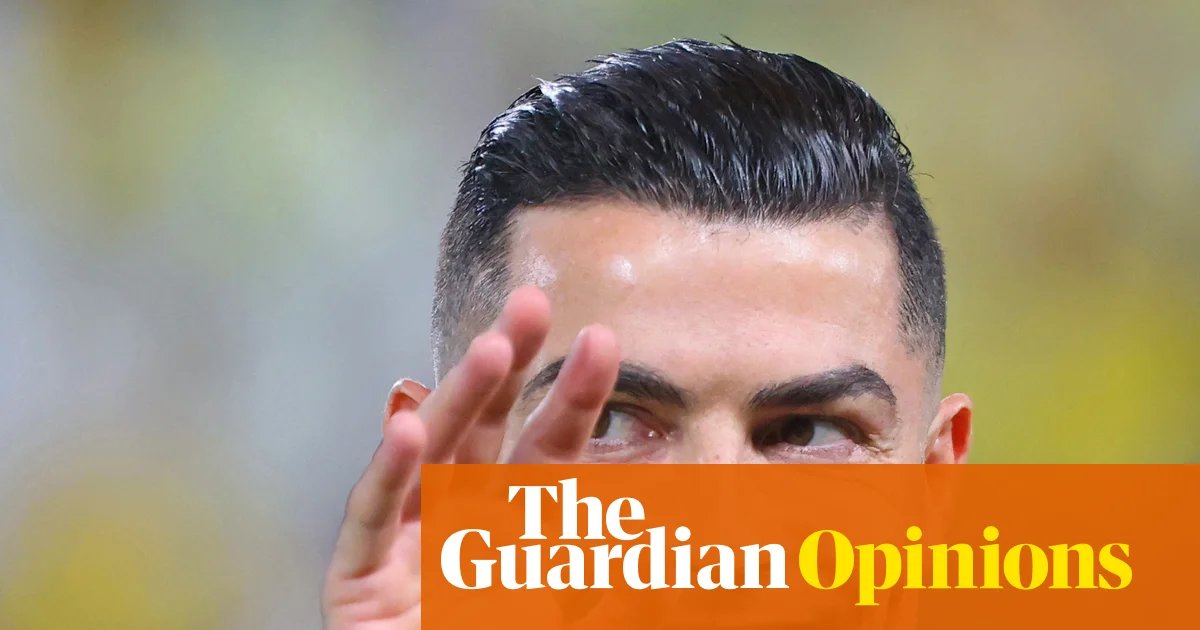
It turns out that 2022 wasn’t Lionel Messi’s last dance after all. He will turn 39 during the World Cup, but despite concerns over the “muscular overload” that led to him limping out of Inter Miami’s 6-4 win over Philadelphia Union on Sunday, he remains the figure on whom Argentinian hopes rely.
Messi won’t be the only veteran in Canada, the US and Mexico: Cristiano Ronaldo, aged 41, will also be there – inevitably, given how his career and Messi’s seem inextricably bound. So will Luka Modric and Edin Dzeko, plus the goalkeepers Manuel Neuer, Craig Gordon, Guillermo Ochoa and Vozinha, all of whom are 40. And there is one 39-year-old other than Messi: the Japan defender Yuto Nagatomo.
That is seven players aged 40 or older, a remarkable number given that only seven players have previously played at the World Cup having reached that age. The oldest was Essam El Hadary, who played in goal at the age of 45 years and 161 days when Egypt lost to Saudi Arabia in 2018. Both countries were already out and there were some qualms that he had been picked out of sentiment, a tribute to one of the undoubted greats of the Egyptian game, but he saved a penalty and performed well enough to justify selection.
Goalkeepers, not surprisingly, make up the majority of the previous seven. Faryd Mondragón, aged 43 years and 3 days, came on with five minutes remaining in Colombia’s 4-1 win over Japan in 2014. In his case, there was no doubt he was being introduced purely so he could become the oldest player at a World Cup.
There was no such favouritism, though, being shown to Pat Jennings in 1986, Peter Shilton in 1990 or Tunisia’s Ali Boumnijel in 2006, and certainly not to Dino Zoff when he captained Italy to World Cup victory in 1982. He had been heavily criticised after the 1978 tournament, but his late save, plunging on to an Oscar header, was just as vital in the 3-2 win against Brazil as any of Paolo Rossi’s three goals.
The exception is Roger Milla who, after coming out of retirement to inspire Cameroon in 1990, returned in 1994, aged 42, to become the oldest outfielder at a World Cup. He came off the bench against Brazil and Russia, scoring in the latter game, although his side were already 3-0 down and went on to lose 6-1.
But whatever the details, the comparison is striking: there could be more players over the age of 40 at this World Cup than in the 22 previous tournaments put together. In part, that is perhaps because of the expansion of the tournament. Vozinha is a regular for Cape Verde – he’s certainly not going for sentimental reasons – but would his team have qualified for a 32-team World Cup? And would a team ranked higher than 69th in the Fifa standings be going to the World Cup with a goalkeeper who plays for Chaves in the Portuguese second division?
And in part it’s because sports science has improved. Injuries that once would have ended a career can be overcome. Nutrition is far better. Footballers no longer sink double digits of pints every time they get a day off. Understanding of recovery, stretching, prehab and rehab have all improved. While the 500-game rule still seems to hit some players, others are going on for longer. To take just two examples, James Milner, born 1986, and Robert Lewandowski, born 1988, have only recently begun to show signs of wear.
Modric and Dzeko are diminished by age, but they are, fairly clearly, the best Croatia and Bosnia and Herzogavena have to offer in their respective roles. Messi’s case is more questionable – however dangerous he looks in MLS, he is evidently not capable of operating at the highest level in Europe.
But it would be hard to say with any great certainty that Argentina would be better off had he been phased out. It remains just about conceivable, given the nature of international football, that Julian Álvarez and Messi’s clubmate Rodrigo De Paul can again do his running for him and that Messi’s capacity to produce a defence-splitting pass or other moments of inspiration will make it worth the sacrifice.
But Ronaldo is not the player he was. He is not even the player he became after he ceased to be the player he was. He lumbers about in an increasingly small sphere of influence, still decent in the air, still a good finisher, but barely able to move, lacking the explosive power that once made him great. He has won the Saudi Pro League this season, but that is less an endorsement of him than an indictment of the league.
Even at the last World Cup he seemed like a burden. When he was left out for Gonçalo Ramos against Switzerland, Portugal found renewed pace and verve and scored six, Ramos getting three of them. Yet still fans in the stadium called for Ronaldo, the biggest cheers coming as he came off the bench and then marked an obviously offside goal that was swiftly disallowed with his trademark celebration; a part of modern football is obsessed by personality and spectacle.
The danger is that Ronaldo’s presence could mean that a potentially brilliant generation of Portuguese creators is never truly unleashed. That is the irony of the suspension for his red card against Ireland being commuted; it may represent a preposterous injustice as Fifa ensures the biggest names are on the field as much as possible, but it will probably end up hampering Portugal.
There is no doubt Ronaldo is in incredible shape – for a 41-year-old. Nor is it wrong to point out that, Ronaldo aside, Portugal have not produced a world-class centre-forward since Eusébio. But there comes a point at which his immobility makes him an albatross and any halfway competent forward who can move is a better option.
The continued presence of familiar faces may be testament to how much better players are at looking after themselves than they used to be, but, in at least one case, it is also evidence of the modern world’s obsession with celebrity.
The family of Shaun Burton, say they are “devastated” by the loss.
Source link
Key events
In the opening half an hour against Cape Verde, Mikel Oyarzabal, the centre-forward, did not get a single touch.
Kyle Green gets in touch: “Your highlighting of Lalas and his absurdity is something that has prevented me from wanting to watch the coverage on Fox. While every channel has its pros and cons I just can’t.
“I’m 45 and probably the youngest of anyone who remembers him as a player instead of an opinionated insert insult here. As for the match this could be more competitive than it looks on paper Spain need a win the pressure is on them. Saudi Arabia could hold out for a draw and see what happens in their last match. “
News from the England camp, and it seems to be good news on Declan Rice.
“I’m ready and fit, raring to go. I was feeling a little bit of neural pain in my hamstring, which I was managing from after Christmas with Arsenal for a very long time. Obviously, not a lot of people would have known that. It was all behind-the-scenes stuff but it was a smart decision.
“In the end, that last 20 minutes is probably where you pick up the most, and it’s where you play a 70-minute match. But that last 20 is where you really feel your body going for it. And I think it was a smart decision because the last few days I felt really, really good.”
Alex Reid has penned today’s weekend special Football Daily.
Portugal v Uzbekistan on Tuesday enticingly pits the incredibly nice, incredibly 41-year-old-superstar-tolerant Roberto Martínez against Fabio Cannavaro, who’s won a Ballon d’Or as a player and the Chinese Super League as a coach. While the fixture following that game really does see the dream of Thomas Tuchel – in his first international job with England – taking on Queiroz, who is in charge of his ninth national side with Ghana.
The expected formations are 4-2-3-1 for Spain, and 5-3-2 for the Saudi Arabians.
The Saudi team features two Donis changes: Ali Lajami, a defender, and Nasser Al Dawsari, a midfielder, are preferred to Mohammed Abu Al Shamat and Mohamed Kanno. You may recall Salem Al Dawsari, the Saudi captain, as the man who scored the winner against Argentina.
An entertaining read, even for those of us who have just seen the clips.
In a conversation where his co-panelist is casually reminiscing about his days playing alongside Messi or exchanging shirts with Ronaldo Nazário at the World Cup, what exactly is Lalas going to talk about – coming on as a second-half substitute for Earnie Stewart in a friendly against Scotland in 1998? Helping the Kansas City Wizards finish last in the 1999 MLS Western Conference? Did Lalas enjoy an elite playing career? No. But does he do the background reading that could compensate for his relative lack of standing in a conversation with titans like Henry and Zlatan? Also no. But is he charming or funny or charismatic or otherwise magnetic on screen? Eh, no.
For the record, I once interviewed Alexi Lalas on the challenge of playing against Romario in the 1994 World Cup. He had this to say:
“He could kill you in so many different ways. If you remember from that World Cup, he scored so many types of goals. That ranged from solo adventures to an outside-of-the-right-foot half-volley off a corner kick. Romario was both the most difficult to play against and the best that I have faced.
“Roberto Baggio was doing his thing, but in terms of consistency and living up to the hype, he [Romario] was the best. As with all stars, there was a moment when the fans sit up in their seats, and that was a feeling I got with Romario. When it got close to him and the potential for his involvement in a play was there, everybody sat up in their seat. They knew that something spectacular would be happening.”
Saturday’s match reports here.
The Saudi Arabia coach, and Blackburn legend, Georgios Donis, spoke about the challenges facing his team: “Spain is not the same team when Yamal or Williams are on the bench.
“While they still have plenty of possession, they lack the individual one-on-one penetration when these two are missing. I’m not saying it’s a problem for Spain, but when those players are missing, they play in a different way. We saw this very clearly against Cape Verde.
“We are playing against one of the best teams in the world, and it’s very important that when you play against these kinds of teams, you should enjoy the experience and respect the opponent, but not too much.
“It is very hard for any team playing against Spain to have any time in possession. So what we must do is to be more in control of our movement and compact, and when the ball goes through the lines, be able to defend dynamically.
“It’s nice to see miracles in football, and we’ve seen favourites losing against underdogs. Of course, it’s great for Saudi football to have a great memory of the result against Argentina, but we aren’t drawing anything from that.
“I think we’ll feel more pressure in that [Cape Verde] game than we will against Spain.”
The Spain coach, Luis De La Fuente had this to say in his Saturday press conference: “This generation of footballers is highly competitive and really fired up… It’s going to be a completely different story,” he said at his pre-match press conference on Saturday. There is no drama or crisis. The bottom line is simply that we need to win tomorrow.”
Four changes for Spain: Lamine Yamal, Pedro Porro, Dani Olmo and Alex Baena also come into the side with Marcos Llorente, Fabian Ruiz, Ferran Torres and Gavi dropping out.
The teams – Lamine Yamal starts
Spain: Simon, Porro, Cubarsi, Laporte, Cucurella, Gonzalez, Rodri, Yamal, Olmo, Baena, Oyarzabal. Subs: Raya, Joan Garcia, Pubill, Grimaldo, Eric Garcia, Llorente, Merino, Torres, Fabian, Gavi, Pino, Williams, Zubimendi, Munoz, Iglesias.
Saudi Arabia: Al Owais, Abdulhamid, Tambakti, Lajami, Al Amri, Al Harbi, Nasser Al Dawsari, Al Khaibari, Al Juwayr, Al Buraikan, Salem Al Dawsari. Subs: Al Aqidi, Al Kassar, Majrashi, Yahya, Al Shehri, Al Boushal, Kadesh, Al Johani, Al Ghannam, Al Hajji, Al Hamdan, Mandash, Kanno, Thakri, Abu Al Shamat.
Referee: Raphael Claus (Brazil)
Perhaps one of the Saudi -players can write themselves into this high-grade selection?
Perhaps it can be their goalkeeper.
Madrid screening of Spain v Saudi Arabia cancelled due to heat
The public screening of Spain’s World Cup match against Saudi Arabia in Madrid on Sunday has been cancelled because of extreme heat forecast for the Spanish capital, officials said.
The match, due to kick off at 6pm local time on Sunday, had been scheduled to be shown on a giant screen installed by the Spanish football federation (RFEF) at a fan zone in Plaza de Colón in central Madrid.
Madrid city council and the federation decided to cancel the screening after national weather agency AEMET issued an orange heat warning – the second-highest level – for the Madrid region, with temperatures forecast to reach 40C.
“The decision has been taken with the aim of protecting the health of attendees, event staff and support services involved in the event,” Madrid city hall said in a statement, apologising for any inconvenience.
Officials urged supporters to watch the match indoors in air-conditioned spaces and avoid prolonged exposure to the heat.
Large parts of Spain are experiencing unusually high temperatures for June as a mass of hot air from North Africa moves across the Iberian Peninsula.
A total of 13 of Spain’s 17 regions are on orange alert for heat on Sunday, while the northern Basque Country bordering France is on red alert, the highest level.
Authorities advised residents and visitors to take precautions during the heatwave, including drinking water regularly, staying in cool environments, limiting outdoor physical activity during the hottest hours of the day and taking extra care of vulnerable people. AFP
Can Saudi Arabia repeat the magic of 2022?
Argentina arrived in Qatar on a 36-game unbeaten run. When Lionel Messi opened the scoring from the penalty spot after 10 minutes, a comfortable afternoon seemed in the offing. Saleh al-Shehri and Salem al-Dawsari had other ideas, Argentina had three goals disallowed for offside in the space of 13 minutes and the greatest comeback in Saudi Arabia football history was made. Argentina went on to lift the trophy, while defeats to Poland and Mexico meant the Saudis did not reach the knock-out stage.
Unai Simon over David Raya is a controversial choice for De la Fuentes. The Arsenal keeper could lay claim to being Europe’s best this season.
“Those at the Champions League final had a few more days, so I got there on the Wednesday night,” Raya says. “I arrived a bit before Fabián [Ruiz]. I was saying hello to some of the others in reception when he arrived. I went to say congratulations; that was almost the first thing I did. I couldn’t really talk [to him] after the final; I just didn’t have it in me. The next day we talked about the game properly. Just two mates chatting … I was happy for him that he could lift the trophy for a second time.”
A high pressure game for the European champions, as Sid Lowe reports.
“If we had scored one, the game would have changed,” Martín Zubimendi said. Immediately after the game, De la Fuente had offered a simple analysis: when the ball doesn’t want to go in it doesn’t want to go in, he insisted. Spain had racked up 27 shots, after all. Ferran Torres had hit the bar and seen another clear opportunity saved. Vozinha, the 40-year-old goalkeeper who stopped that, saved six more and was named the man of the match. “There’s nothing to reproach the team for,” Rodri said. “We generated chances but couldn’t put it away; the good thing is they created almost nothing.”
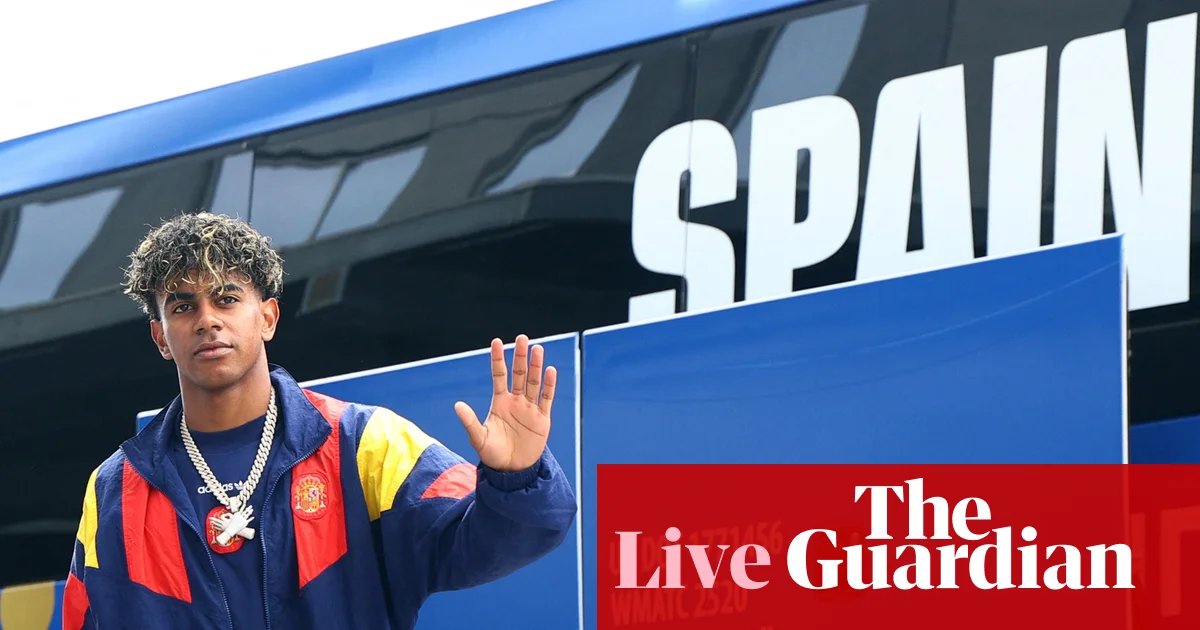
We wait to see what role Lamine Yamal will play today. His coach would surely like to be able to use him.
The worst mistake we could make would be to compare him to anyone. He is the midst of a process. He has exceptional footballing maturity and lives it all with total naturalness. He has great serenity and strength. We have to let him follow his path but those players who have something different are ready for that. They’re geniuses, like Dalí [who] can paint a picture, or Michelangelo. They’re different. What is exceptional to us, isn’t to them. In those extremes, they feel comfortable. Why? Because they are different. What we think is exceptional, they consider normal.
Preamble
Spain’s campaign did not get off to a flying start, and Luis de la Fuentes may wake up in the night to visions of Cape Verde’s Vozinha. He will have Georgia on his mind ever since Monday. Saudi Arabia are no pushovers and gave Uruguay a scare in their opening match. Memories of downing Argentina four years ago still abound, and so Spain might beware. They can ill afford to go into the final game with Uruguay at a disadvantage. All eyes on Lamine Yamal, whose fitness situation remains opaque, though Spain need their other forwards to come to the party.
Kick-off 5pm UK, 1pm ET, 2am AEST. Join me.

A topless man can be seen driving erratically in Edinburgh before abandoning his car and attacking a black man and a delivery rider.
Source link



-

 Business & Technology3 weeks ago
HSBC UK & Visa test AI shopping with live payments
-

 Business & Technology3 weeks ago
Valarian lands USD $50 million backing for sovereign AI
-

 Oxford News4 weeks ago
DWP now checking bank accounts for Universal Credit and Pension Credit
-

 Oxford Events4 weeks ago
Henley Festival 2026 highlights: Five nights of unforgettable performances and festival moments
-

 Oxford united FC4 weeks ago
Aaron Ramsey’s Oxford United hit with transfer ban until January
-

 Oxford united FC3 weeks ago
Oxford United three players who be kept after transfer ban
-
 Business & Technology4 weeks ago
Ode launches free AI voice service for poem recommendations
-

 Business & Technology4 weeks ago
ZYMIX uses Henley event to pitch social app to Gen Z