
Student Life
CalSoc misses the ‘Reel’ point


During my first week in Oxford, I stumbled upon a Scottish third year in the college bar. This was startling; I’d only come across one or two students from north of Newcastle so far, and none of them any older or wiser than I was. I quickly took advantage of the opportunity to ask what societies I should join at the Freshers’ fair the following day.
“Anything but CalSoc”, he said, referring to Oxford’s Caledonian Society. “They’re not actually Scottish. Closest they get is owning an estate up there.”
This was a sweeping and, I thought, probably inaccurate claim, but in those first few days—homesick, lonely, having my own accent parroted back at me during pre-drinks – I didn’t struggle to believe it. While I’d hoped vaguely that I might eventually be proven wrong, I found very little evidence to the contrary. Those I met who were eager for a ticket might not have been royalty, but they were invariably English, and drawn to the ball’s structure and glamour. Tickets were pricey, and seemed to come on the condition of technical ‘training sessions’. The society’s website provided a list of dances to be learned; I only recognised two. One night in Hilary, I saw a throng of kilts and tartan sashes clustered outside the Town Hall, but as I passed, I heard only the same clipped Southern accents I’d become used to in tutorials. I started to hate-watch the dance videos on their Instagram. All of this cemented in me a vehement – and, I always felt, slightly unfair – distaste for CalSoc. What was ostensibly a familiar cultural practice seemed to me somehow violated, alien. I felt worlds away from the dances of my teenage years, where I would often wake up with mysterious injuries from an over-violent Strip the Willow. Why was something ostensibly so familiar, so ‘Scottish’, so unrecognisable?
I was interested to read Nancy Robson’s recent article on reeling practice for the CalSoc ball – a fresh perspective on what has always been, for me, a very one-sided debate. Yet I was also somewhat disconcerted. The picture that emerged was of a strange fusion between English courtly balls à la Bridgerton and some kind of vaguely Scottish aesthetic (Robson makes a passing reference to ‘Braveheart’; the CalSoc website, more egregiously, to ‘ancient druidic roots’). This is a difficult one to square. The histories of ‘ceilidh’ and ‘reeling’ are intertwined, and equally culturally suspect. In his thoughtful essay on the subject, Greg Ritchie notes that both are the result of a 19th century ‘rediscovery’—and appropriation—of Highland culture, differing only in the use they make of a ‘Scottish identity’.
But this difference is still important. Caledonian Societies remain the preserve of the South, and of the Scottish elite, while ceilidh dancing is, for better or worse, part of Scotland’s shared social history. It’s taught in every school, and is the central feature of most weddings. I used to organise ceilidhs as community fundraisers. Reeling may not entirely pretend to be a ceilidh, but it does not exist in some kind of cultural vacuum. When we dress up in tartan, and (in the words of the CalSoc website), ‘party as only the Scottish can’, what kind of mythology are we appealing to? Why is CalSoc so English?
The answer comes in part from its connection to the glamorous ‘reeling circuit’: mainly based in London, this is a season of black and white-tie balls held in royal venues and private member’s clubs. But it’s also to do with the way Scottishness features in the English cultural imagination. As Robson’s article demonstrates, the practices are easily tangled up – and in England, ceilidh rarely comes out on top. She contrasts the formality of CalSoc rehearsals with her previous experience of ceilidh: in a stuffy basement, she found that ceilidh meant ‘descending into a hellish, slightly pagan underworld’. Here, as in reeling societies across the country, ceilidh and reeling are set up as sibling practices – equal in their Scottishness, diverging only in the etiquette they demand. But reeling tends to feel rather out of step with modern-day Scotland. It’s telling, perhaps, that it remains the preserve of lairds and Londoners; yet more telling is its insistence on propriety. The CalSoc website is strict on both dress (‘shorter dresses, jumpsuits, and skirts are not acceptable’) and training (mathematical dance diagrams are provided).While claiming to bring ‘Scotland to the South’, this codification of reeling misses what makes ceilidh so appealing – its inclusivity. CalSoc co-opts, only to gatekeep.
You absolutely should feel like you’re descending into the pits of hell. It will be very sweaty and you will probably be knocked over. It doesn’t matter if you don’t know the steps: someone else will lead the way. Ideally you should wake up with bruises. You don’t have to be dressed up, you don’t have to be drunk, and you absolutely do not have to be Scottish. What’s important is that it’s an inclusive and open practice. Ceilidhs have featured in my life since childhood, and still the moment I’ve felt closest to the tradition was in fact in Oxford. My friends and I held an impromptu ceilidh in our living room: there was absolutely no space and no one knew what they were doing. Yet the genuine attempt to engage, the joy and lack of pomp (and black tie) was what made it so special. I don’t disagree with the enthusiasm the CalSoc committee seem to demonstrate; ceilidh dancing is a wonderful practice which can absolutely improve your life. But you don’t need a dance card, training sessions, or an £80 ticket to do so.

As Michaelmas rolls around once again, I open my phone to the unmistakable signs of a new academic year at Oxford. Society committee pleas, ads for upcoming club nights, and emails welcoming a new wave of freshers fill my inbox and feed. But this year, scrolling through those familiar notifications leaves me with a feeling I did not expect.
Now in my third year, the time has finally come for the long-anticipated, even longer-in-the-making ‘year abroad’. While friends return to Oxford, I find myself watching the new academic year unfold from a distance – no collections to revise for, no frantic search for a last-minute BOP costume, and no Plush Thursday to inevitably mark the weekend drawing near.
As I sit writing this from Buenos Aires, Argentina, I feel deeply conflicted. Of course, there is a certain melancholy in watching friends slip so effortlessly back into the rhythms of university life. It can be oddly unsettling to see a place that has played such a significant part in my adult life carry on as though I had never left.
Yet simultaneously, I am glad not to be there. The concept of lining up for hall food, pulling an all-nighter in the library, or squeezing into the queue at Bully is significantly less appealing from 7,000 miles away. For all the nostalgia that comes with watching Oxford from afar, distance has also given me something I didn’t realise was needed: perspective.
And no, this is not going to be a long rambling of how I ‘found myself on my gap yah’. Although, somewhere between getting on the wrong bus to work and confidently preparing mate in entirely the wrong way, I have started to wonder why an experience this valuable should be reserved for students studying certain subjects.
There is something liberating about being somewhere where nobody knows your name, your college, or your subject. While abroad, I am no longer simply an Oxford student navigating the same routines of term-time life; I am an outsider, and, most importantly, a beginner again. The world suddenly feels much bigger than the few square miles I had grown accustomed to calling home.
It would be easy to romanticise this feeling. I am not Anthony Bourdain, travelling the world with a camera crew filming an episode of Parts Unknown. I am, instead, entirely reliant on a far less glamorous student loan, a questionably downloaded eSIM, and what appears to be a complete inability to read Google Maps.
Indeed, it can at times be overwhelming to think just how much I have left behind. Over two years’ worth of friendships, routines and rituals do not simply disappear because you board a flight. Friends are still there, returning to university for their final year, before graduating and stepping into the increasingly structured world of work. From a distance, it can feel as though everyone else is moving forward along a path that I have temporarily stepped away from.
For my friends back in Oxford, that step is becoming increasingly difficult to ignore. With 78% of graduates reportedly worried about finding employment, and 71.9% already in professional-level roles within just 15 months of graduating, it is hardly surprising that the job market can feel overwhelmingly competitive. Talks of internships now dominate a FaceTime catch-up, and for many, there is little choice but to climb to the first rung of the corporate ladder as soon as possible. The opportunity to travel, experiment, and explore a different way of living (both personally and professionally) can all too easily be pushed aside in favour of getting on with the ‘more serious’ route of starting a career.
That is precisely what makes the time away so valuable. It is a rare opportunity to step away from the well-trodden path for a while, without having to abandon it altogether. As more UK universities begin to offer years abroad across a wider range of subjects, it seems worth asking why Oxford should be any different.
The benefits are far from merely personal. I am now working at an Argentine news network, using a language I have spent years studying, but in an environment where getting the grammar right is rather less theoretical than it is in a classroom. Language students are fortunate in this respect: learning a language inevitably means learning something about the people and culture that speak it. But what about everyone else?
At its core, it is an exercise in empathy and human connection. A PPE student can encounter political and economic ideas outside the British context; a historian can experience another country’s relationship with its past; a scientist can apply their technical skills in a professional environment shaped by an entirely different set of assumptions. With funding available to make these experiences more accessible, there is little reason for the year abroad to remain the preserve of language students. Studying something is one thing; being forced to apply it somewhere unfamiliar is another.
With this may come the feeling of being out of one’s depth. But, certainly for me, that is the most important part. At a time when immigration, integration, and national identity occupy so much of British political debate, there is value in experiencing what it actually feels like to enter a society in which you do not automatically understand the language, the customs, or the unwritten rules.
Here, I am a newcomer trying to work out how things are done. More than once, I have forgotten to kiss the cheek of a superior at work, or have asked for completely the wrong thing at a supermarket. With that comes a certain humility, as you become constantly more aware that integration is not simply a matter of arriving somewhere and expecting to feel at home – an all-too common attitude of ‘Brits abroad’.
And perhaps that is the greatest argument for going abroad. Not because everyone needs to spend a Bourdain-esque year in South America, or because life in Oxford is somehow too small. It is because it is surprisingly easy to mistake the familiar for the universal. Living somewhere else forces you to question assumptions you did not even realise you had – about work, education, politics and culture, or even something as simple as whether a greeting calls for a firm handshake or a warm embrace and kiss on the cheek.
Eventually, I will return to Oxford, and life will presumably slip back into its familiar rhythms. But I hope to return with a little more perspective on the bubble I have spent two years inhabiting – less convinced that Oxford is the centre of the world, and considerably more curious about everything beyond it.

St Edmund Hall has opened new, sustainability-focused accommodation in Norham Gardens, one of Oxford’s most affluent neighbourhoods.
The College describes the buildings, which took three years to construct, as an “exemplar” of sustainability. Designed by architects Wright & Wright LLP, they are certified with a Passivhaus standard, widely regarded as the industry benchmark for energy efficiency, and were built using “sustainably sourced and low-embodied carbon materials”. According to a press release on the Teddy Hall website, the buildings will use 70% less energy than the typical modern building.
It contains 127 en-suite study rooms, split across three new buildings: Willis House, Ashton House, and Elliott House, on the nearly 50-year-old Norham St Edmund site. The buildings, which back onto University Parks, are powered at least in part by solar panels and are heated by air-source heat pumps.
The rooms include heated towel racks, big double beds, and dimmable lights. Despite the luxury, the College kept the nightly rate in line with the rest of its Norham housing. The College told Cherwell that it “recognises the need to keep rents as low as possible” and that its accommodation costs are “below the median of all Oxford colleges”. By that standard, tenants are expected to pay around £30 a night.
Rooms on the site will be reserved for Teddy Hall returning undergraduates. They will not be available to postgraduates and, by extension, not be offered through the Oxford University Collegiate Accommodation System, now in its second year of opening college rooms to students from other colleges. The accommodation will allow Teddy Hall to accommodate all undergraduates for their whole degree.
The development’s outdoor spaces are boasted as climate-resilient and biodiverse, with landscaped gardens and lawns. For budding geographers and biologists, the most intriguing feature may be an ecology pond.
Chancellor William Hague said in a press release: “Norham St Edmund is a world-leading blueprint for future student accommodation projects and sustainable building design, both in Oxford and beyond. I look forward to seeing it serve a thriving college community for generations to come.
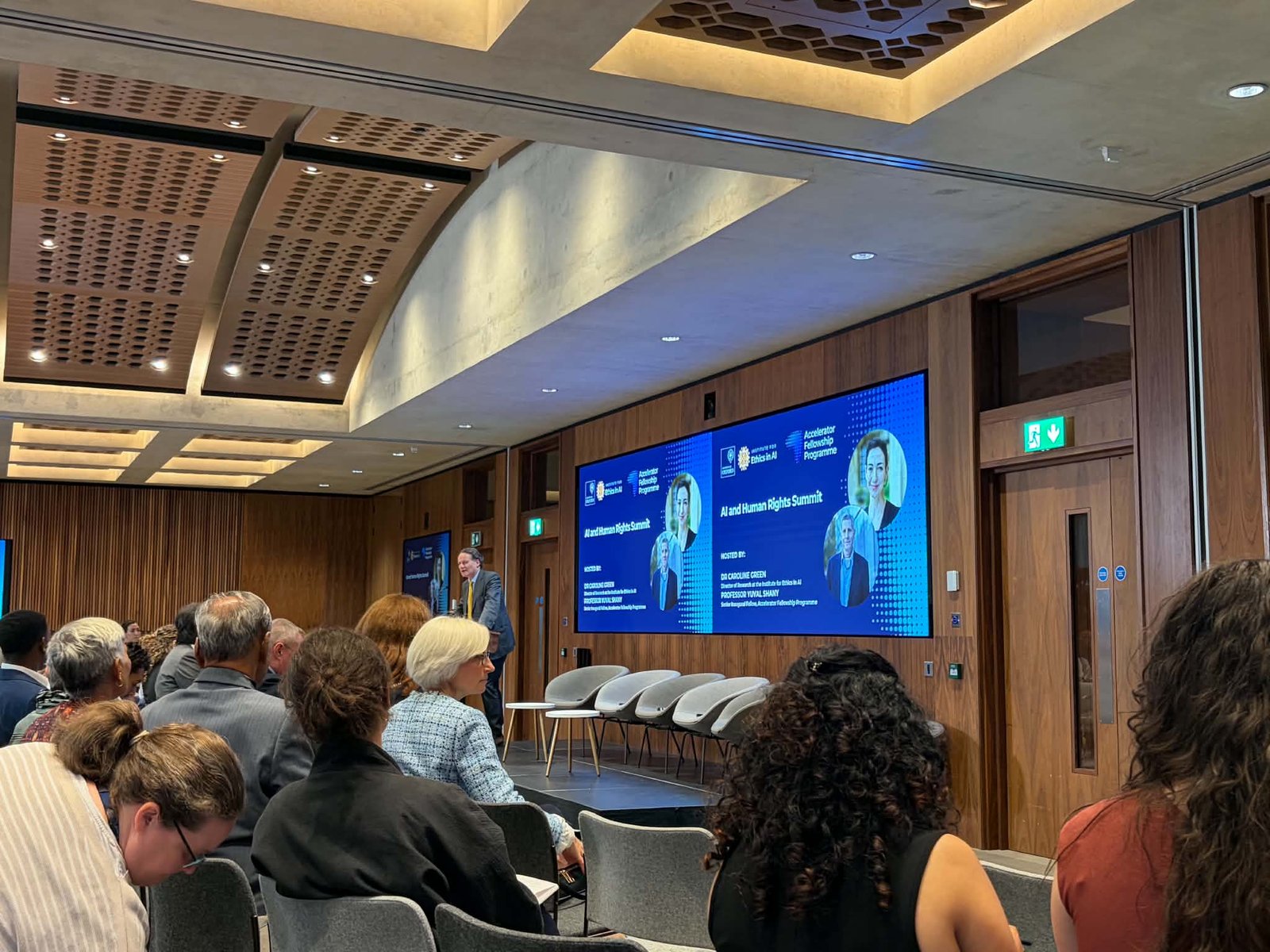
Human rights experts called for stronger legal protections against the risks posed by artificial intelligence (AI) at an Oxford AI and Human Rights Summit, with speakers arguing that human rights standards must be embedded into AI governance and technology.
The summit was hosted at the newly redeveloped Rhodes House in Oxford and organised by the Institute for Ethics in AI. It built upon Professor Yuval Shany’s consultation on a white paper, published in 2025, on the need for and feasibility of an international AI Bill of Human Rights, which proposes ways to adapt existing human rights standards so as to better address some of the unique challenges posed by AI systems and their uses.
An opening video address from the United Nations High Commissioner for Human Rights Volker Türk outlined how AI policy can keep pace with a fast-developing technology. He said that “great power demands responsibility on the same scale, and when the two don’t match, we have a problem”. Corporate control, he explained, means that AI policy stretches beyond existing national borders. He continued to praise this summit for bringing together leaders and representatives at the forefront of the discussion.
Speakers called on the UK government to establish legislation, recalling Labour’s manifesto commitment to an AI Bill of Human Rights. The panellists broadly agreed on the importance of human rights, but appeared less aligned on what enforcement should look like in practice.
In an exclusive interview, Michael O’Flaherty, the Council of Europe’s Commissioner for Human Rights, told Cherwell that political short-termism Continued on pg. 2 risks undermining efforts to address the long-term consequences of AI. “We are infected across our societies with shorttermist responses to the great issue of our societies and politics,” he said, adding that electoral cycles make it difficult for politicians “to think beyond the next election”.
O’Flaherty also noted that younger generations no longer take the international human rights system for granted. “There is no longer an assumption that the human rights system is safe, that it will survive,” he told Cherwell. He argued that political leaders increasingly treat human rights selectively, saying: “Increasingly, leaders are treating human rights, if they are respected at all, as an a la carte buffet. We take those rights because they serve our goal. We’ll ignore others because they get in the way.
The summit also heard concerns about the effects of AI-generated misinformation on communities that may have limited access to, or awareness of, the technology itself. An audience question asked human rights experts to consider the impacts of AI on populations, such as those in India, who might be unaware of its existence. The focus on the impact of AI on populations in developing countries more vulnerable to the power of big tech was a key theme of the summit.
Eileen Carter from the South African Human Rights Commission warned that underrepresentation of African languages in large language models could exacerbate existing inequalities. She also raised concerns about the effects of misinformation and deepfakes on elections, referring to more than 360 deaths associated with unrest and the amplification of narratives.
The third panel, which offered a civil society perspective on promoting human rights in AI systems, offered some hope. Across all speakers, the potential for AI to transform the beliefs that underpin human rights, including the rights to water, education, and an interpreter, was debated. When asked about AI’s potential to unravel and alter the definition of human rights, such as what is included in the ‘right to education’ O’Flaherty told Cherwell: “The damage that can be done by AI has hit more dramatically and more visibly than perhaps any other sector within education through the phenomenon of cognitive loss, of cognitive transfer. We’re only beginning to realise the extent to which we have allowed education to be fundamentally undermined for an entire generation.
“It’s time to seize that now and engage it. I’m not sure that the classic understanding of the human right to education is particularly well-framed for this extraordinary development.”
In a discussion on different countries’ regulatory approach to AI, Suresh Venkatasubramanian, professor at Brown University and former AI advisor to US President Joe Biden, argued that AI systems should not be treated as inevitable developments beyond human control. “We continue, I think, to talk about AI as a thing that emerged out of nowhere that we just have to deal with,” he said. “We forget that these aren’t coming from an alien planet and they were built by entities that choose to build them in a certain way.” He called for pressure on technology companies to make different choices about how AI systems are developed.
Questions of accountability also emerged during discussions about AI’s potential to improve access to justice. Research presented by Philippa Webb said that only 10% of people who have access to a lawyer can get one while there are thousands of bookings for an interpreter in a court covering 150 languages. However, this progress is not cemented as “general-purpose chatbots hallucinate 58% of the time on a legal task”. The use of AI in moderating legal proceedings raised fundamental questions about humanity and authority. Thompson Chengeta from Liverpool John Moores University said that “human rights is the last line of defence so when we say we want a human rights based governance… human rights is not an idea, it is an obligation. There is a gap that can only be recovered by a legally binding instrument”.
The event culminated in a panel offering an industry perspective. Co-host Dr Caroline Emmer De Albuquerque Green questioned representatives from Meta, Google, Microsoft, and OpenAI. Michael Karimian, who works in digital diplomacy at Microsoft, discussed the role of private sectors in engaging with AI, defining corporate responsibility as something which “provides transparency and identified risks”.
All companies supported having formal programmes to ensure that they have an AI policy in place. Within their own companies, they suggested protective measures such as specialised training to ensure that policies, such as whistleblowing, are understood. Alexandria Walden from Google described how consultations with stakeholders could be used to identify when the product breached users’ boundaries. These assessments, according to OpenAI’s spokesperson, “feedback into tangible technical input” and “benchmark it”.
Fundamentally, understanding the rationale behind human rights is imperative, though lacking. Alexandria Walden from Google said: “Whether or not they understand human rights, they care enough to infuse it in their company… we might not always get it right, but it is something we care about.”
Where former panels discussed controls to ensure human rights are considered in the development and implementation of AI products, this panel focused on mitigation. A spokesperson from Google pointed out that technology is inevitably going to move faster, so multiple tools are needed. Companies, OpenAI’s representative noted, still encounter issues such as discrimination and free speech. Consequently, they regard this as an additional policy which companies have a structured model to deal with, but newer companies, and newer industries, haven’t learnt it yet.
In her concluding remarks, Green called for policy makers to “make the abstract actionable” at both governmental and corporate levels. She argued that, by framing the issues posed by AI as human rights issues, we gain a “foundation” for recognising AI’s many societal impacts.



-

 Oxford united FC4 weeks ago
Chris Gunter steps away Wales role to focus on Oxford United
-

 Oxford University3 weeks ago
New to the Oxford English Dictionary this September
-

 Oxford united FC2 weeks ago
LIVE: Exeter City vs Oxford United – Jersey Mike's Trophy group stage
-

 Student Life3 weeks ago
Oxford partnership allows OpenAI to use rare Bodleian texts to train ChatGPT
-

 Traffic & Transport2 weeks ago
Why should I have to pay more for buses if I don’t use a smartphone? | Bus fares
-

 Traffic & Transport2 weeks ago
How poor public transport policy is putting the brake on cities | Road transport
-

 Oxford united FC3 weeks ago
Northern Ireland fans laud Oxford United defender Ciaron Brown
-

 Oxford united FC2 weeks ago
Oxford United lose to Exeter City on penalties in Jersey Mike’s Trophy