
UK News
Babies review – a very special gift indeed | Television


Lisa and Stephen are good. “You good?” asks Stephen (Paapa Essiedu), plonking himself next to his wife on the sofa. “Yeah,” replies Lisa (Siobhán Cullen) from the depths of her oversize fleece hoodie. “Good,” says Stephen. “All good.”
Lisa and Stephen love each other and when Lisa has a miscarriage, then another miscarriage, they don’t talk about it, not really, because you don’t, do you? It’s just one of those things. “Gotta stay positive,” as Stephen says. “Eyes up, move forwards.”
They refuse to let their losses define them. Besides, as Lisa points out, no one else understands, do they? Not really. “We are,” she says, “so alone.” And so they tighten the drawstrings of their relationship, pull together and, in their happy-sad amniotic cocoon, continue to do what they’ve always done. Chin up. Get on with it. Put it all behind them.
So, yeah, Lisa and Stephen are good. All good.
Created, written and directed by Stefan Golaszewski, Babies is a drama about communication. It’s about what happens when people don’t, or can’t, ask for what they need, either because this makes them feel vulnerable or embarrassed, or because they fear the response will reveal something about themselves they would rather not have to face.
So, here are Lisa and Stephen. And here, too, are Stephen’s best friend, Dave, and his new girlfriend, Amanda. Dave (Jack Bannon) is a passive-aggressive wide boy, whose relationship with his young son is abysmal and his lack of self-awareness significantly worse. An inveterate banterer, Dave longs for emotional connection, but his terror of intimacy and inability to not say things such as “I can’t stand the sanitisation of the global west” casts doubt on his capacity for long-term romantic success. He is, to echo the words of one observer, “a prick”.
Amanda (Charlotte Riley), meanwhile, is … well. It’s difficult to say. Of Babies’ four exquisitely complicated main characters, she is perhaps the most complex; a stiff-jawed, meticulously bloused acquisitions manager who vacillates between near-mute self-preservation and lacerating emotional veracity. I think. Nothing here is straightforward.
Over six episodes, we follow the couples as they navigate their relationships and attempt to find some degree of happiness.
As with Golaszewski’s previous creations – Marriage, Him & Her, and the quietly miraculous Mum – Babies doesn’t have much in the way of plot. Information is released slowly, with even relatively minor revelations – a loathed acquaintance is pregnant; a seemingly laid-back family member is an emotional manipulator – landing like bombs. We fear the fallout from our protagonists’ reactions to these discoveries. We want to protect them from themselves.
The thread – the umbilical cord, if you will – that wends through this extraordinarily tense jumble of emotions is Lisa and Stephen’s longing to conceive. There are gloriously quotidian montages of their efforts to board the pregnancy hamster wheel: the frantic sex, the laughing at the insensitivity of doctors (“yeah, we’re all good, hahaha”), the sitting on the edge of the bath while staring tearfully at a plastic wee-stick. The many hospital scenes are similarly well observed, albeit difficult to watch (as astute a director as he is a writer, Golaszewski knows precisely when not to look away).
Like 2022’s Marriage, Babies asks more questions than it answers. Does grief excuse selfishness? What makes one death more significant than another? At what point does a positive mindset become a cudgel with which to obliterate the truth?
The series is a feat of narrative engineering. So many expertly assembled little cogs and pistons working in harmony. It’s an unapologetically adult drama, too, albeit one unafraid to end an emotionally devastating scene with a joke about Chicken Cottage.
Quibbles? The themes of toxic masculinity and generational trauma are, at times, slightly overplayed. And the treacly, busker-ish theme tune (which is, inexplicably, performed by Golaszewski himself)? Best to scurry past it with head down and hands in pockets.
But enough carping. With this unsettling, compassionate, funny, moving, wildly unpredictable and beautifully acted series, Golaszewski has given us something very special indeed. Babies, then. It’s all good.

MV Isle of Islay is the first of four large new ferries ordered from a shipyard in Turkey.
Source link

The City regulator says 12.1 million mis-sold motor finance deals will be eligible for redress.
Source link
UK News
Israel passes law to give death penalty to Palestinians convicted of lethal attacks | Israel
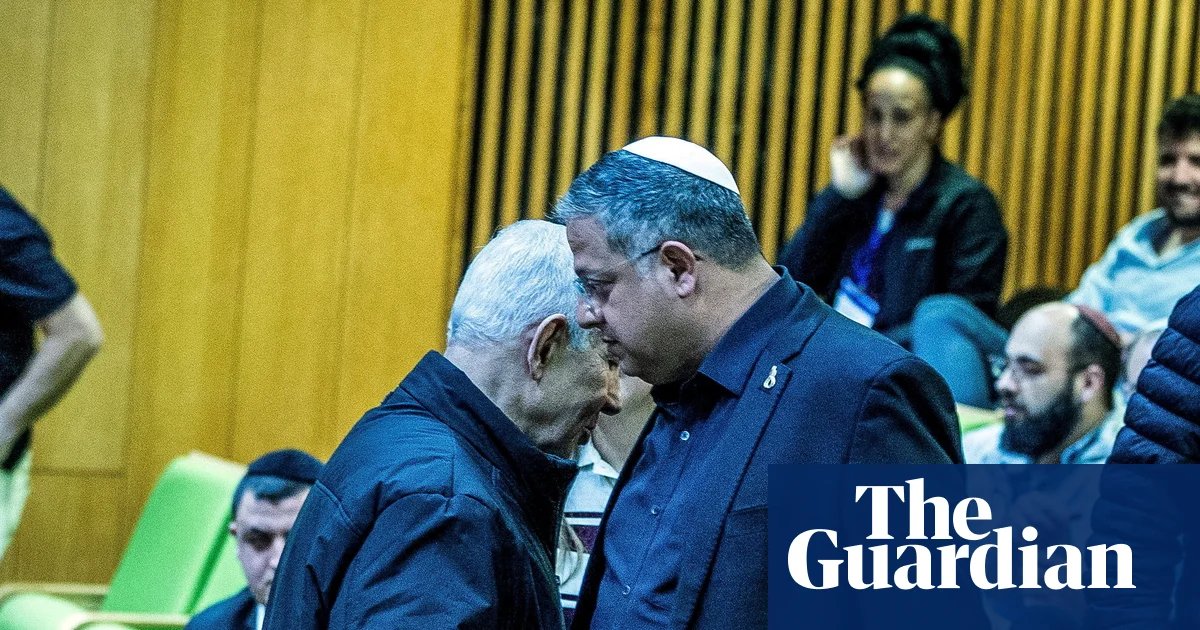
Israel’s parliament has passed a law imposing the death penalty on Palestinians convicted of fatal attacks, a measure sharply criticised as discriminatory by European nations and rights groups.
The legislation makes the death penalty the default punishment for Palestinians in the Israeli-occupied West Bank found guilty of intentionally carrying out deadly attacks deemed acts of terrorism by a military court.
According to the bill, those sentenced to death will be held in a separate facility with no visits except for from authorised personnel, with legal consultations conducted only by video link. Executions will be carried out within 90 days of sentencing.
Israel has rarely used the death penalty, applying it only in exceptional cases. The Nazi war criminal Adolf Eichmann was the last person to be executed, in 1962.
The national security minister, Itamar Ben-Gvir, one of the bill’s strongest backers, has repeatedly worn a noose-shaped lapel pin, symbolising executions under the proposal. He described hanging as “one of the options” alongside the electric chair or “euthanasia”, claiming some doctors had offered to assist.
A security committee made some amendments to the bill, which last week passed its first vote. Israel’s public broadcaster KAN reported that executions would be carried out by hanging.
The measure will allow courts to impose the death penalty without a request from prosecutors and without requiring unanimity, instead permitting a simple majority decision. Military courts in the occupied West Bank will also be empowered to hand down death sentences, with the defence minister able to submit an opinion.
For Palestinians under occupation, the bill closes off avenues for appeal or clemency, while prisoners tried inside Israel could see their sentences commuted to life imprisonment.
The legislation, initiated by the far-right Otzma Yehudit party led by Ben-Gvir, has drawn sharp criticism from opponents who warn it would mark a significant escalation in Israel’s penal policy.
Military officials and ministries have said the bill could breach international law and expose Israeli personnel to arrest abroad.
Once enacted, the law formally enters into force but it can still be reviewed – and potentially struck down – by Israel’s supreme court.
Directly before voting began, Ben-Gvir made a bellowing speech from the podium, describing the law as long overdue and a sign of strength and national pride.
“From today, every terrorist will know, and the whole world will know, that whoever takes a life, the state of Israel will take their life,” he said.
When the measure passed, the chamber erupted into cheers and Ben-Gvir brandished a bottle in celebration. The Israeli prime minister, Benjamin Netanyahu, who had come to the chamber to vote yes in person, sat motionless.
After the vote, a leading Israeli human rights group announced it had filed a petition with the country’s supreme court. “The Association for Civil Rights in Israel filed a petition today to the high court of justice, demanding the annulment of the Death Penalty for Terrorists Law, enacted by the Knesset,” it said.
The Palestinian Authority called the passing of the bill a “dangerous escalation”. In a post on X, the Ramallah-based Palestinian foreign ministry said that “Israel has no sovereignty over Palestinian land”, adding: “This law once again reveals the nature of the Israeli colonial system, which seeks to legitimise extrajudicial killing under legislative cover.”
Last month UN experts called on Israel to withdraw the bill, warning it would violate the right to life and discriminate against Palestinians in the occupied territories. They said the measure removed judicial discretion, preventing courts from weighing individual circumstances or imposing proportionate sentences. They said hanging constituted torture or cruel, inhuman or degrading punishment under international law.
The EU’s diplomatic service also condemned the proposal, saying capital punishment breached the right to life and risked violating the absolute prohibition on torture.
In February, Amnesty International urged Israeli lawmakers to reject the legislation, which it said “would allow Israeli courts to expand their use of death sentences with discriminatory application against Palestinians”.
On Sunday, Britain, France, Germany and Italy expressed “deep concern” over the legislation, which they said risked “undermining Israel’s commitments with regards to democratic principles”.



-

 Crime & Safety2 weeks ago
Oxford: ‘Next generation’ LimeBikes in city from today
-

 Jobs & Careers2 weeks ago
Why Join Oxford | Oxford University Jobs
-

 Jobs & Careers2 weeks ago
Explore our Careers
-

 Student Life2 weeks ago
The independent cinema battling Oriel College to stay open
-

 Oxford Events2 weeks ago
Michelin Guide Oxfordshire Restaurants – The Oxford Magazine
-

 Oxford Events2 weeks ago
Oxford News and Events, What’s on in Oxford, Exhibitions
-

 Jobs & Careers2 weeks ago
Internal Job Board for University vacancies
-

 Crime & Safety2 weeks ago
Crash partially blocks A40 and causes severe Oxfordshire traffic