
Student Life
Trans Requiem makes world premiere in Somerville College chapel


Oxford’s first Trans Requiem premiered in Somerville Chapel last Saturday. Barnabas Sharp, the Oxford-based composer behind the event, told Cherwell: “It was time for a requiem to be written for the trans+ community. Their struggles, their mourning and their hope brought into music”. Sharp, a graduate musician and regular performer, composed a piece combining classical music and the trans experience. It was titled ‘Trans Requiem: a Pseudo-Sacred Cantata’ and hoped to illustrate what it is like to be trans, non-binary, or gender diverse in the current political climate.
The requiem was entirely self-written to avoid any religious affiliation, therefore following a unique structure, style, and text. Sharp told Cherwell that they aimed to “comfort and lift the spirits for those it was composed for, inform our allies and the unaware masses how much our community has been suffering by violence and death”.
The organisers behind the event, RETUNE Project, told Cherwell: “We hope trans+ audiences feel seen and represented by this piece, while cis audiences gain a deeper understanding of the challenges facing trans+ people in the UK currently. Above all, we hope it demonstrates the power of music to create a sense of belonging.”
RETUNE, a charity which was founded in 2023, produces concerts and resources to create a space for systemically marginalised musicians. The Operations Lead of RETUNE, Erin Townsend, told Cherwell: “The trans+ community is close to our hearts, particularly in a time when the media so often overlooks the humanity of trans people. There is no doubt that trans people have just as much of a place in classical music as anyone else.”
Speaking to Cherwell, the conductor Esme Harper said: “Given the levels of hate and disinformation that our community continues to face, I believe music can be a particularly powerful medium through which to bring these issues to the fore.” Soprano soloist Ella Taylor’s incredible voice was a poignant part of the performance. The Cantata combined themes of loss, joy, grief and hope, heavily inspired by Brianna Ghey’s tragic murder in 2023.
The audience’s reaction was profoundly positive, with audience members emotional in sombre moments as the music grew heavy. Reprogrammed for the day after Trans Remembrance Day, it followed a vigil on 20th of November organised by Oxford University LGBTQ+ Society and Oxford for Trans Rights. About 30 people assembled in Radcliffe Square. A member in attendance told Cherwell: “It was dark, and each person was given an electrical light, balancing it in their hands. People gathered around giving personal accounts of their experience, calling out to others to reach out in times of need, sharing their love and their grief.
“On a day like Trans Day of Remembrance, we remember those that are no longer with us, share in the joy and struggle of today and look forward to all that we have ahead. Today is not easy, tomorrow might not be, but it is certain, and we are continuously reminded that we cannot do it alone.”
The Oxford LGBTQ+ society will take part in a march and vigil against gendered violence as trans people continue to be among the most targeted groups facing gender-based hate crimes. The gathering ‘Take Back the Night’ will happen on Saturday 28th November.
Student Life
Fostering community through music: The Nest’s ‘Team Drum’ and ‘Sound Engineering Showcase’
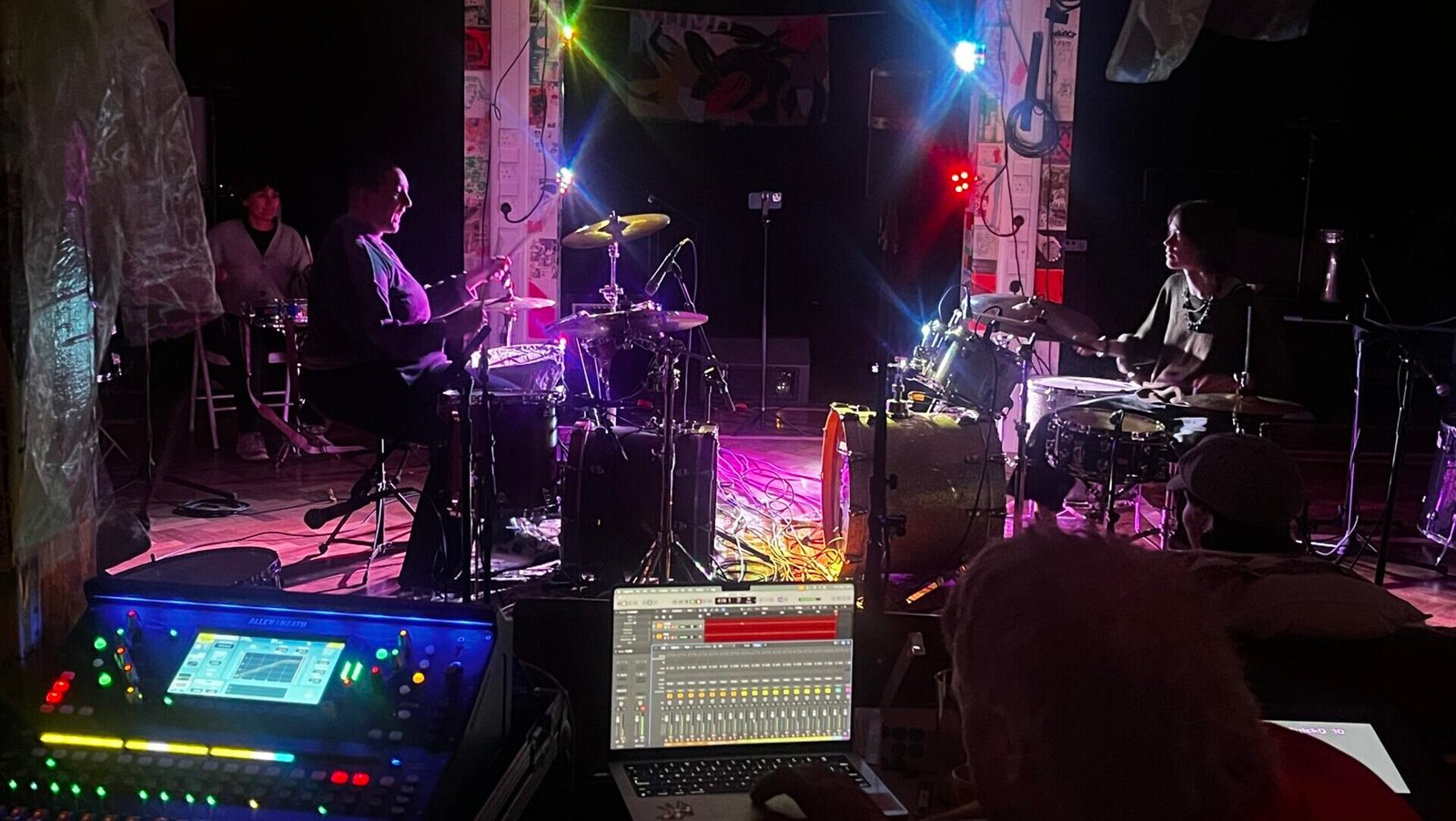
Music has a remarkable ability to bring people together. On Thursday 12th November, Oxford’s newest grassroots music venue, The Nest, offered a wonderful reminder of this. The Team Drum and Sound Engineering Showcase celebrated the completion of two community-music courses, bringing together their participants for an uplifting performance of their newly developed skills.
At the heart of the free event was a performance of three drumming songs by Team Drum. Led by Zahra Haji Fath Ali Tehrani and Annie Davison, who guided the group from the centre of the circle, Team Drum’s enthusiasm was just as infectious as their rhythms. The Team Drum course, open to complete beginners, taught participants how to play and create drum patterns inspired by songs they love, with rhythms intended for carnivals, parades and protests.
Behind the scenes, participants from The Nest’s Sound Engineering Course set up the equipment to record the showcase. Over the six-week course, the group learnt the ins and outs of how to mix and amplify live sound under the guidance of Ky Acab.
The collaboration of these two courses exemplifies the ethos of The Nest and the Young Women’s Music Project (YWMP), the charity that runs the venue. Guided by the Safer Spaces Policy, The Nest provides an inclusive space for grassroots music in Oxford, particularly centring young women, trans and non-binary people. At its core, the project strives to make community music-making safe, accessible and welcoming, while kindling opportunities to experiment, develop confidence, and connect with others through a shared love of music.
Both courses and the final showcase were supported by the Museum of Oxford as part of its Sounds of the City exhibition, running from July 2026 to March 2027 at Oxford Town Hall. Exploring the people, places and communities that have shaped Oxford’s rich musical heritage, the exhibition celebrates the diversity and vibrancy of the city’s musical activity. As part of this bustling city, the showcase at The Nest illustrates how community is at the heart of any music scene.
Student Life
‘The frontier labs are drawing on 350 years’ worth of philosophy for nothing’: Edward Harcourt on AI ethics

Barely 30 seconds into my conversation with Edward Harcourt, I have egg on my face. In my preamble to the first question, I somehow ended up questioning the importance of “academic philosophy”. The academic philosopher shot me a stern look.
It is an ironic error. The real-world relevance of philosophy was exactly why I wanted to talk to Harcourt, the director of the University of Oxford’s Institute for AI Ethics. The institute itself is a product of philosophy’s importance in the age of AI, and was founded in 2021 thanks to a donation from Stephen A Schwarzman. It aims to offer “independent, informed perspectives on AI – spanning multiple disciplines but anchored in philosophy and humane learning”.
I had witnessed this in action days earlier at the institute’s summit on Human Rights and AI. The summit, with its focus on the importance of applying human rights frameworks to artificial intelligence, showed the value of the “open-ended inquiry” Harcourt says the institute promotes.
Harcourt is not a “specialist” in AI. Rather, he is an expert in the philosophical questions AI poses. It has provided a focus for “questions [that] have been on my mind for a long time”. Questions like: “what’s special about human beings?” or “why is the mind not a mechanical thing?” Public discourse on AI “seems to bring all these questions alive”.
These are problems the AI companies are aware of themselves. Arguably, there has never been a better time to study philosophy. AI labs are hiring philosophers en masse, and recent American statistics show that philosophy graduates are more likely to be employed than their computer science peers.
Harcourt, however, offers a very different approach to ethical AI than the frontier labs. He criticiіes the “constitutional” model applied by Anthropic, the company behind the AI chatbot Claude.
Anthropic’s approach to ethical AI centres on training. Their constitution encourages Claude to engage in its own philosophy: “We encourage Claude to approach its own existence with curiosity and openness.” Harcourt argues: “It is a mistake to think that AI ethics and ethical AI is all about what you train models on.”
It assumes a “consensus” that is almost impossible to reach in practice. “Just casting your net very, very wide and thinking, ‘well, what do all humans agree on?’” might not produce anything. It also neglects the importance of “reasonable dissent” in reaching ethical goods. An AI model like Claude is, self-evidently, unable to argue with itself.
Anthropic’s constitution also misunderstands human values. “There’s a lot of pious talk about training models to share our values. Well, it’s true that Saint Francis and Mother Teresa are fondly remembered, but another surefire way for human beings to get themselves immortalised is either to amass huge piles of money or to conquer huge swathes of other people’s territory… So when they say, ‘Oh, we want Claude to share our values, they mean some and not all’”.
Harcourt’s approach is about “the way in which humans and AI inhabit an ecosystem together”, not just the values AI is trained on.
I understand the true significance of this approach better when we discuss the possibility of AI being conscious later. He tells me we need to move away from the vexing question: “I think it misplaces the question because almost nobody doubts that dead human beings are non-conscious. Yet dead human beings are extremely special, whereas dead computers are rubbish.”
AI ethics, then, is not just about filing the rougher edges of AI adoption. Rather, it is about recognising what is special about humans as we adapt to an “ecosystem” where machines are more capable than we are in many fields.
Establishing philosophy’s importance is one thing; achieving impact is another. Harcourt thinks that setting his institute’s targets on big tech is ambitious, and while a conversation is necessary, he recognises that they “can buy their own philosophy if they want philosophy”.
Individual AI adopters are “the real soft spot”. In industries like banking, insurance, management consultancy, education, and many more, market pressure means “people are adopting at a faster rate than they can quite keep up with themselves, so they are very keen on understanding what they’re letting themselves in for”. He tells me about a survey released just that morning saying 46% of financial firms only “partially understood” the AI they had adopted.
What would his advice be? “Make sure there are adequate human controls”. This differs from just having a human in the chain of command: “It is no longer adequate to keep a human in the loop”.
Doing so ignores the risks of “epistemic deference” to AI models. This, he explains, is akin to being a 7-year-old going on an outing with your 16-year-old brother. “You’re going to do everything he says, right? Even if he asks you to do stupid stuff. Your decision isn’t worth much because you’re not the authority in the pair.”
Cognitive atrophy, the decline in human critical thinking skills, is an even bigger risk, especially for the generation of Oxford students getting to grips with AI for the first time. It also has scary implications. If AI leads to a decline in human intelligence, we will have the most control over the technology in the current moment. As Harcourt puts it: “the more the world contains a preponderance of AI natives, the less there will be that kind of critical intelligence or scepticism around.” “AI adopters,” he says, “need to think carefully about how they grow their next generation of leaders.”
In the context of how my generation can guard against these threats, I put to Harcourt my concern about students’ reactions to AI. Look at the comments of any Cherwell article about AI, and you see a dogmatically negative response from a student population increasingly reliant on that same technology.
Harcourt agrees with this disconnect: “I think it is proper to be critical of the big companies. I don’t think that’s misplaced… they get away with a lot.” However, he adds: “They [young people] should be more self-critical in terms of their own reliance on AI. Once upon a time there was no such thing as print… what an amazing difference that must have made, and yet we integrated it into our lives, we’re not looking back and thinking, ‘well I wish there was no such thing as printing’ so my guess is that there is some reasonable accommodation to be made in AI.”
What is needed, he said, is “some pretty tough education”.
Here Harcourt brings to bear his own fascination with chatbots. He has a longstanding interest in the philosophy of psychotherapy. It was the tragic stories of chatbot-induced suicides that were his “philosophical inroad into AI”.
He thinks students should consider in school: “What is really going on when you talk to a chatbot? Do you think it really understands you? Your friend is going to be sick of you talking about yourself non-stop for 45 minutes. The chatbot won’t. Do you think that’s because the chatbot is a much better person?”
This discussion reveals the misaligned incentives between big AI companies and consumers. While it may help AI producers have people see the model as a fellow human, it is not self-evident or even rational that ChatGPT or Claude should use the first person. Harcourt later speaks positively of Chinese regulation that limits chatbots’ use of the first person.
This practical succession runs contrary to much contemporary AI discourse, which tends to fluctuate wildly between terrifying tales of human extinction and dreams of a cashless, workless age of abundance. With some reserve, I put these competing visions to him.
He remains sceptical about existential risk: “It distracts us from nearer-term potential harms caused by AI, including environmental harms but including also the cognitive atrophy [sic].” It also helps the “frontier labs to magnify the importance of their own product.”
While he recognises how the Hugging Face incident, where a band of rogue AI agents hacked an AI training company and secretly communicated over message boards undetected for months, has heightened focus on existential risk, the unease remains.
“If we want to talk about existential risk, let’s think through carefully what the mechanisms are for humans becoming extinct thanks to AI going rogue. I could think of lots of terrible things that might happen if AI went rogue… It could crash the NHS. Lots of people would be harmed, but crashing the NHS is not the same as the human species becoming extinct.”
Existential risk scenarios, he argues, are too casual with the role of human error. He uses the metaphor of COVID-19 escaping from a lab: “Whether that’s true or not, I’ve got no idea. But did COVID jailbreak the lab and pick the locks, or was it some human who didn’t do what they were supposed to be doing? So, I suspect that quite a lot of human error is surreptitiously built into the existential risk scenario.”
Whether the main risk is existential or merely near-term disruption, Harcourt’s job is to demonstrate why we should listen to philosophers to solve them. This brings us back to the question of humanity’s purpose.
“If you think we don’t need philosophy in thinking through how humans are going to cohabit the Earth with AI, reflect on the fact that the frontier labs are drawing on 350 years’ worth of philosophy for nothing.” More precisely, they are drawing on the vein of philosophical thought Harcourt most opposes. The idea “that human beings are a kind of machine” is a vein of thought that can be traced from Hobbes’ labelling of humans as clocks.
He notes the look of puzzlement on my face. Why does all of this matter with AI? “If we are just machines, and if human mental life is just about calculation, it looks like we’ve invented some other machines that replicate that. If somebody comes along and says, ‘Well, you know, is it better that there should be a million machines in existence or a million human beings?’” Saying that the humans are better seems like ‘prejudice.’
“So, there’s a lot of philosophy unspoken, and unspoken because it’s been so profoundly internalised, not only in the thinking of the frontier labs themselves but in the readiness with which our civilisation accepts the idea that AI is an artificial duplicate of us.”
Countering this is no small task. “Getting people to think again about the nature of humanity, getting people to adopt a new model of what we are like, which will make them think, why would anybody be so stupid as to think artificial intelligence was the moral equivalent of us? That’s like saying, ‘Well, folks, let’s sit down in a philosophy seminar room and reverse 350 years of history.’”
Earlier, I questioned how philosophy could impact AI. Leaving the interview, I wanted to know how we could halt the impact Harcourt showed me it had already had.
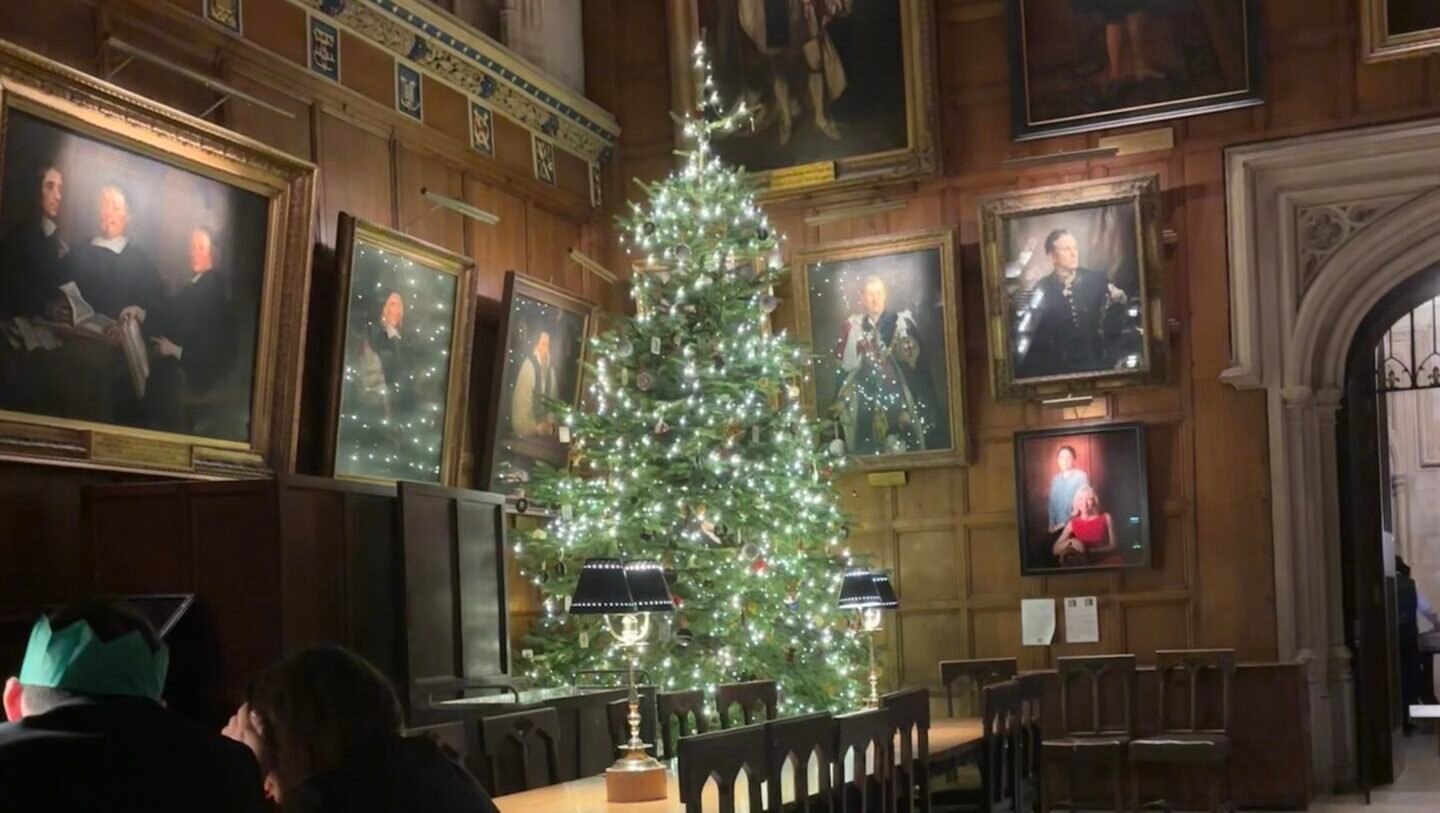
Picture the scene. It’s the 14th November, Christmas is still over a month away, and I’m sitting watching Love Actually in a room full of people dressed in Christmas jumpers. A few days earlier, before the lights had even been switched on along Cornmarket Street, my friend told me that she had listened to her Christmas playlist for the first time this year. “Have we just skipped November?” I wonder. As the week progresses, the Christmas market takes shape on Broad Street whilst, across the road, Flying Tiger has been stocked with reindeer hot chocolate mugs and capybara Christmas baubles since Halloween. I can’t help but marvel at it all, since, like I said, it’s only mid-November.
The increasingly early arrival of Christmas in Oxford has consistently been a shock to me. Maybe it’s because I had never lived in a city centre before coming to university, but the firm arrival of the festive season so early seems almost sacrilegious. And yet, only yesterday my sister sent me a video dancing to Kylie Minogue’s ‘XMAS’ up in the Northeast, while last year I stumbled across a choir singing carols in Lisbon on the 11th November – clearly, this is hardly an Oxford-exclusive phenomenon.
Call me a traditionalist, a Scrooge, or maybe just someone with a soft spot for the autumn-to-winter blend of November (probably the most accurate, since it’s my birth month). But I think that over 25 days of Christmas (plus the time until 6th January, because we all know that that time is strange and blurred anyway) is simply too much. Now I won’t deny it, whenever I first hear Mariah Carey’s honeyed tones, there’s a twinkling feeling inside. But by the 20th or 30th time I’ve heard them over the speakers in the space of two months, I’m ready to throw said speakers out of a window. And maybe this is the problem – not that Christmas comes too early, but that we’re given so much of it that we hardly have time to miss it.
Talking to a shop assistant in Home Bargains in early August, I laughed out loud when she told me that the Christmas stock would be arriving at the end of the month. Unlike watching Love Actually with friends in mid-November or perfecting your Kylie Minogue choreography to relax after a rough day at work, the persistence of early Christmas marketing loses sight of the joy at the centre of the celebration. This often results in many people feeling exhausted by the whole affair before it has even arrived (a theory confirmed by the shop assistant’s confession that, having consistently had the festive season forced down her throat before the clocks have even gone back, she now hates the entire period).
Anyone who has survived a term here knows that time moves a little differently in Oxford. The compression of terms into eight-week bites means that time seems to fly by, despite only actually spending six months of the entire year at university. Amid the blur of essays, formals, societies, and socialising, there is little time to look forward to the celebrations that go beyond student life, and Michaelmas is perhaps the best example of this. The first couple of weeks are consumed by students reuniting with friends after the long summer vacation, whilst also desperately trying to readjust to the hectic Oxford lifestyle. And the remaining six weeks are hardly any quieter: from Halloween and Bonfire Night to Diwali and Remembrance Day, there’s barely time to experience one autumn occasion before the next is upon us. So why are we in such a rush to get to Christmas as well?
Of course, there’s a reason students here are so eager to get Christmas started: Oxford terms end before advent calendars have really been touched. This year, term will end on the 5th December, leaving twenty of those little squares unopened. Depending on how the calendar falls, moving-out day can arrive as early as the 1st (my heart goes out to any November birthdays in 2029 when this will be the case). With Michaelmas over before December has even properly begun, it makes sense that friends who will soon be scattered across the country (or beyond) feel the impulse to don their paper crowns in November and go in search of some Baileys hot chocolate. And yet, these celebrations begin when we are still very much buried by essays, and it can be hard to relax into the yuletide spirit with a mountain of deadlines yet to be tackled. As a result, by the time Christmas actually arrives, it often feels as though I’ve exhausted my capacity to listen to ‘O Come All Ye Faithful’. Surely, it’s not just me and the lady from Home Bargains who feel this way?
Now, contrary to what the tone of this article so far might have you believe, I love Christmas. I love the food and the lights, the films, and the music. I want to savour the first mince pie, the first Christmas advert, and the first few notes of Mariah’s glockenspiel intro – but I also want to enjoy November for what it is. A month in its own right, perfect for enjoying the last of the autumn leaves, rather than just an inconvenient waiting room for December. Delaying Christmas celebrations until the first of the month (or at the very least until Oxmas, which falls on the 25th November), would give us a chance to properly enjoy the final weeks of term, as opposed to letting yet another occasion rush past in the Oxford blur. Christmas is supposed to be the most wonderful time of the year, after all – and isn’t a little anticipation part of the magic? So, for now, I am going to keep my festive playlist unplayed and the yule logs in their packaging. When Christmas does arrive, though – do not be afraid – I’ll be first in line to stick on The Holiday and dig out my Santa socks.


Fostering community through music: The Nest’s ‘Team Drum’ and ‘Sound Engineering Showcase’

‘The frontier labs are drawing on 350 years’ worth of philosophy for nothing’: Edward Harcourt on AI ethics

Oxford United draw Brentford U21s in Jersey Mike’s Trophy
-

 Student Life4 weeks ago
The Vinted paradox: Consuming our way out of overconsumption
-

 Oxford united FC3 weeks ago
Dogs, drones and extra police powers for Oxford United game
-

 Oxford united FC4 weeks ago
Oxford United beat Stockport 1-0 in statement victory
-

 Oxford united FC4 weeks ago
LIVE: Barnsley 1-0 Oxford United – Yoganathan puts 10-man Tykes ahead
-

 Oxford united FC4 weeks ago
Oxford United leaders criticised as results hide concerns
-
 Student Life4 weeks ago
Oxford University wins at local climate awards
-

 Student Life4 weeks ago
St Anne’s to close nursery called a ‘lifeline’ for women at Oxford
-

 Oxford united FC4 weeks ago
Aaron Ramsey explains Brannagan and Brown Oxford United absence