
Student Life
Debate Chamber: What the wave of student protests has taught us


Kiera O’Carroll: the Student Spring
Books, not saline solution against tear gas, are what you’d expect to find in a schoolbag. This isn’t the case for most of my friends back home right now. Since September in France, a wave of protests against failing education, austerity, and the far-right have swept the country. Many talk of a new May 1968, the glorified student movement and nationwide strike. But the failed promises of a revolution are no longer echoed in the halls of Sorbonne University. High schoolers as young as 13 have shown us that political action requires less intellectualism and more strategy, using Snapchat to mobilise because it is their only social media. It’s different from the movement at the end of the sixties because it’s reverberating all across the globe with the speed of the internet; a Student Spring is rising.
From school to university lectures, I have always found it difficult to learn about social justice and the merits of advocacy while being violently repressed for expressing these values. I feel anger, like most students do. When we were told that fascism never shows up as itself but instead as aestheticised popular trends, I had to practice cognitive dissonance to not notice it everywhere. At a university like Oxford, this discord didn’t get any better. I was directed toward Google Forms about collective grievances because “protesting inconveniences others”.
On a FlixBus back from Paris, I heard someone in the next seat criticising the protests. It felt alienating to hear someone misconstrue a struggle you so deeply care about in ten seconds. I thank this person, however, for calling the movement part of a wider Student Spring. Taking its name from the Arab Spring of 2011, those protests fundamentally changed how youth social movements interact with political power in a digital age, with platforms like Facebook helping millions to mobilise against dictatorship. The current Student Spring testifies to the resilience of our generation and the convergence among social struggles.
As I watch unarmed and peaceful students choke on chemical irritants in the water cannons aimed at them, I recall my own experiences of getting tear gas grenades thrown at my feet. Tear gas has recently been scrutinised for its long-term effects like miscarriages or total blindness. The illegality of all of these violent methods is what strikes me; most of the weapons used in France are classified as wartime artillery. UN experts have expressed their concern about the crackdown on these student protests, as France recently deployed the army as reinforcement. Medical reinforcement does not seem to be coming through; in October, my friends and I, along with a volunteer student medic, were the only ones available to help a man struck to the bone by a grenade.
As disproportionate as these measures may seem, they prove just how powerful students are. In under two years of daily protest across the country, students in Serbia achieved the resignation of their populist leader who had been in various positions of power for 14 years. I remember visiting my cousins during the holidays, and nothing had paused. We chanted through the streets of Novi Sad every single evening. In Albania, students are also taking the matter into their own hands, many of whom are playing an active role in their ongoing ‘Flamingo Revolution’. The ‘Cockroach Janta’ student party in India, as in France, called for the resignation of their education secretary. Repressed by lathi baton charges, a colonial-era tactic where police use batons to scatter crowds, reports from Reuters have shown that pellet guns and Varifocal bullet cameras are not territorially confined.
Back in the UK, there is currently less of a culture centred around protest. I believe this disadvantages students. When university fees in the UK tripled to £9,000 in 2010, the protests were vilified in the same way as those in France. The government hoped students would drown in specialised research and ignore their unemployability, recently exemplified by funding cuts to the humanities.
At times, my university feels like a self-contained universe, a playground for ideas, not action. Our moral and communal responsibilities are delayed by learning their history or debating their justifications. My tutorials on utilitarianism and contractualism have taught me this. Universities are both the machines and the victims of the ideology we are taught about. But fear not, a Student Spring is blooming.
Caterina Azzara: If democracy listens, why are the streets full?
I was always told to study. Education, the story went, was the price of a voice: learn enough, and one day people would have to listen. But what happens when the state forgets its side of that promise?
The first answer came from France. Students at Lycée Saint-Exupéry in Créteil, a suburb just south-east of Paris, joined a strike called by their teachers on 21st September and blocked the school, which had gone months without enough teachers or support staff. Within around ten days, the vacancies had been filled, and the blockade in Créteil came to an end. By then, however, the discontent had travelled via social media to other high schools around Paris, and by early October more than 1,000 schools across France had been disrupted. The main pupils’ union set out its demands: more teachers, safe buildings, smaller classes, and the abolition of Parcoursup, the platform that has controlled access to French universities since 2018. By 17th October, joined by teachers and trade unions, the movement had merged with a national protest against the cost of living, which brought nearly 800,000 people onto the streets according to the unions, while the Interior Minister put the figure at 550,000.
Inspired by the French, Italian students took to the streets on 16th October, marching through Milan, Turin, Rome, Naples, Bologna, and Genoa under the banner of “No Meloni Day”, in reference to Prime Minister Giorgia Meloni. They were protesting against crumbling school buildings, a decree imposing a 30% cap per class on students with non-Italian citizenship, and an inadequate education budget. The timing gave their protest particular force as it coincided with the government’s spending plans for next year: while Cittadinanzattiva recorded 68 structural collapses in Italian schools over the past year, the draft budget for 2027, approved by the cabinet on 13th October, makes room for roughly €7 billion in additional defence spending. Hence the central demand of the student collective Osa: that the €13 billion earmarked for new weapons be converted immediately into funds for school buildings.
As the marches grew, so did the violence. In France, 24 schools were burned or ransacked, while protests in Milan and Turin ended in clashes with police. I will not justify it for two simple reasons. The first is that it does nothing to help the cause. In Why Civil Resistance Works (2011), a study of 323 campaigns between 1900 and 2006, political scientists Erica Chenoweth and Maria Stephan found that nonviolent movements succeeded twice as often as violent ones, because they attract far more participants and because repressing peaceful crowds tends to cost a government support. Omar Wasow’s 2020 study of the 1960s American civil rights movement reached a similar conclusion: peaceful marches won public sympathy, whereas riots frightened voters into backing candidates who promised ‘law and order’, tougher policing rather than the reforms protesters demanded. The second reason is that violence buries the cause it claims to serve. Media scholars call this the protest paradigm, in which cameras linger on the burning bin rather than the classroom without a teacher. In France, the Education Minister called the movement “taken hostage by ultra-violent groups”, and the debate shifted from missing teachers to public order.
Yet to dwell on the violence is to miss the more pressing question: why do so many young people feel that protest is the only way to be heard? The question matters because being heard is what democracy promises, and both the French and Italian constitutions place power in the hands of the people. Political theorist Robert Dahl argued that a democracy is judged not only by its elections but by how well it listens to its citizens in between. By that standard, a 16-year-old who barricades her school in order to get a teacher is not attacking democracy; she is exposing its failure.

The University of Oxford has produced a guide to strengthen the link between the academic institution and local schools.
This resource, Opening Oxford, focuses on what the University can give to local communities, and how the University itself can benefit from interacting with the wider region. In the foreword, Vice-Chancellor Irene Tracey described the University’s commitment to “strengthening the University’s links with our local communities” and “ensuring young people across Oxfordshire can see opportunities in the University, whether that is study, employment, or interest in our cultural assets”. She added that universities “thrive when they are part of the life of their region”.
Within the guide, curriculum-linked workshops, enrichment opportunities, and lectures are recommended to realise the University’s vision. The activities featured are available for primary school students through to those navigating higher education and career choices.
It also emphasises helping educators through teacher development opportunities and classroom resources. Specific programmes and resources, such as a two-week research programme at Oxford University Museum of Natural History for sixth-formers and St Anne’s Super-Curricular club which offers online classes, are recommended for those considering applying to universities, including Oxford. It highlights post-school opportunities at the University, such as work experience, careers, and apprenticeships.
This guide contributes to the University’s 2025-2030 Strategic Plan, which outlines how the University will partner with the local community to “sustain excellence in education and research, extend our impact through innovation, and exercise leadership…for the benefit of society”.
The project also builds on the academic outreach that the University has previously developed. Similar to The Oxford College Twinning Project, it attempts to develop a reciprocal relationship between town and gown in the city.
Pro-Vice Chancellor for External Engagement, Sport, and Community, Professor Alex Betts, acknowledges that available initiatives and outreach are “not always visible or transparent to teachers across Oxfordshire”. In his introduction to the guide, he hopes it will help close the educational attainment gap and ensure Oxford is not viewed by young people as “distant and unrelated to their lives”.
The programme’s aim overall is to make the University “relevant and inspiring to all”, not only to its students.
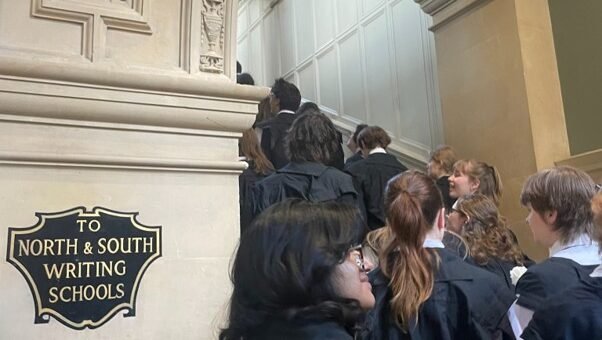
Oxford University’s BA Jurisprudence (Law) degree is under faculty review following concerns raised by external examiners and echoed by students, about teaching disparities between colleges.
In a 2026 report seen by Cherwell, both examiners outlined concerns about teaching disparities between Oxford colleges that could affect law students in Final Honour School (FHS) examinations. They questioned whether coordination between colleges was adequate and critiqued a “lack of process” in ensuring students are taught in a “roughly consistent way”.
“There seems to me to be a real possibility of unfairness depending on the topics chosen by the individual tutor in the College and the difficulty of individual questions on the paper,” the report said. One examiner suggested that these issues might not be resolved through simply broadening questions on the paper, while another questioned whether action was needed “to ensure a level playing field across the students in the University”.
Speaking to Cherwell, a final year law student described the situation as “problematic” for students. They said: “The faculty just don’t have enough control over what tutors put on their reading list.”
They told Cherwell that there is no set order for law tutors to teach topics. With the faculty reading list sometimes containing 10-12 weeks of content, this forces some students to teach themselves, especially if the topics not chosen by tutors are easier to score highly on in exams.
They also claimed that in rare instances, some tutors will not include mandatory cases on their reading lists. While these are available to find on the faculty reading list, “it’s on you to make sure you’ve been taught correctly”, according to the student.
Another student claimed that, in last year’s Administrative Law exam, finalists at their college were significantly disadvantaged because they were only taught the first eight weeks of content. They told Cherwell that at colleges where tutors were more versed in administrative law, students were taught more content which was less complex and more likely to come up in exams.
Another law student who graduated in 2025 told Cherwell that they found the tailoring of teaching to exams and the quality of essay feedback varied greatly between colleges.
A University spokesperson told Cherwell: “Undergraduate law teaching combines lectures and classes provided by the Faculty with tutorials arranged by individual colleges. While colleges are responsible for their own tutorial provision, we recognise the importance of ensuring that students are appropriately prepared for their examinations, regardless of their college.”
Cherwell understands that the Faculty of Law is currently reviewing the course and its teaching provision in a working group.

A collaboration between scientists at the University of Oxford and Wuhan University has made a major breakthrough in solar energy efficiency.
Researchers found that bismuth sulphide can absorb light strongly without losing the electrical charge it produces, making it a promising material for semiconductors, the part of a solar cell which converts sunlight into energy.
When a semiconductor absorbs sunlight, it uses its energy to free electrons and leaves tiny, positively charged ‘holes’ in their place. To produce electricity, these positive and negative charges must be rapidly harvested before they meet and cancel each other out. However, laws of physics state that a good absorber of light must also be a good emitter, and therefore the semiconductors that absorb light most strongly are also the ones that lose their charges most quickly.
Solar energy research has long been slowed by the difficulty of finding materials that balance semiconductor absorbency and efficiency.
The discovery of bismuth sulphide, published in Nature in October, unlocks a solution. The researchers discovered it has a rare quantum arrangement that allows it to absorb light efficiently while also making it harder for excited electrons and holes to recombine.
Solar energy constitutes only 6% of Britain’s electricity. Primarily because of Chinese investment, 91% of new global solar and wind facilities are cheaper than the cheapest available fossil-fuel power. However, weather, grid infrastructure, and technological limitations have created a firm ceiling on the UK’s solar energy harvesting. This comes as Prime Minister Andy Burnham has announced the launch of a new government body to invest in the national electricity grid, as concerns mount over the durability and capacity of the UK’s energy infrastructure.
The government projects that the solar sector will support 35,000 jobs by 2030. This includes roles within the solar technology company Oxford Photovoltaics, which contributed to the study. The company was founded in 2010 as a spin-out from the University and now claims to be “commercialising the world’s most efficient solar technology to power the next generation of clean energy”.
Solar energy is also expected to play a major role in the government’s plans for an Oxford-Cambridge ‘growth corridor’. A recent report suggests the UK’s premier innovation zone is falling behind its global rivals, as China continues to build as much as 74% of all solar and wind projects worldwide.
This discovery of the bismuth sulphide semiconductor may trigger changes in the renewable energy sector. To do so, however, requires rapid commercial implementation of the technology. Researchers have yet to establish whether the increased energy savings of bismuth sulphide are enough for it to turn a profit.



-

 Oxford united FC4 weeks ago
Oxford United beat Wigan Athletic 2-1 in League One victory
-

 Oxford united FC4 weeks ago
Ramsey on Oxford United’s Arsenal-inspired set-piece threat
-

 Oxford united FC4 weeks ago
Leicester City hit with same transfer embargo as Oxford United
-

 Traffic & Transport4 weeks ago
Andy Burnham launches campaign against ‘headphone dodgers’ on public transport | Transport policy
-

 Student Life3 weeks ago
“I am proud of being a Jew, and equally proud of being an Arab”: Professor Avi Shlaim on Iraq, Zionism and belonging
-

 Student Life4 weeks ago
I no longer want to be an astronaut
-

 Student Life3 weeks ago
The Vinted paradox: Consuming our way out of overconsumption
-
 Property & Housing4 weeks ago
Oxfordshire’s Equinox 2035 strategy launched at House of Commons