
Student Life
“I am proud of being a Jew, and equally proud of being an Arab”: Professor Avi Shlaim on Iraq, Zionism and belonging

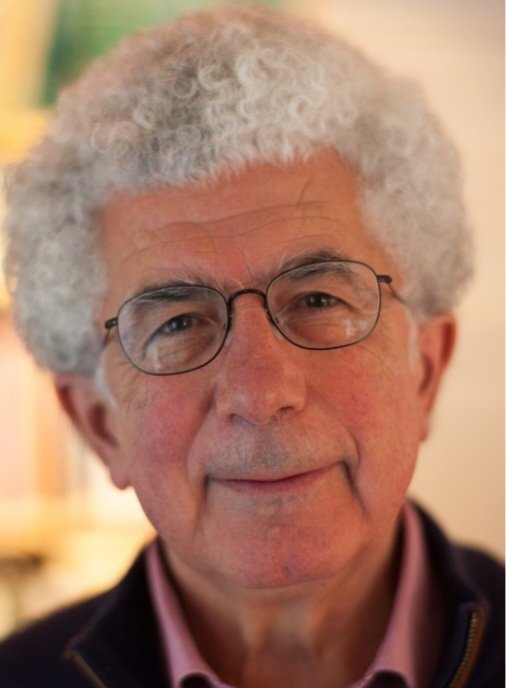
Long before he became one of Israel’s ‘new historians’, Avi Shlaim was a boy in Israel, self-conscious about the sound of his first language. Years earlier, that same boy had been growing up in Baghdad, a city that had been home to Iraqi Jews for two millennia, in a Jewish family that called Iraq home and felt, in his words, “very Iraqi”.
In Baghdad, Shlaim recalls only speaking Arabic growing up, and tells me the other main aspect of Arab culture that remained with him throughout his life was food: “very spicy” rice and chicken, a staple in his Iraqi household. Upon moving to Israel, he encountered Ashkenazi food which he said was “culturally alien” and, in comparison, tasted “incredibly bland and boring” to him.
“Religion didn’t mean very much to me then,” Shlaim says, as he describes his family as being culturally, rather than religiously, Jewish. Equally, he felt “very Iraqi”, and that in Iraq, his family “felt very much that this was our home. This was our country. We did well there. The Jews in general did very well.”
Shlaim points to the thriving Jewish communities that existed throughout the Middle East, the Levant, North Africa, Iran, and Turkey, before the creation of the state of Israel: “We were Iraqis whose religion happened to be Jewish.”
For him, a sense of belonging is the crucial difference between his experience in Iraq and that of Jews in Europe. “Iraq didn’t have a Jewish problem”, describing this as a problem that pertained instead to European Jews, in particular in Germany. In Iraq, however, “we had a sense of belonging, rather than feeling that we were a persecuted minority”. “We were not aliens, we were not intruders, we were not strangers.”
The turning point, as he sees it, was the establishment of the state of Israel on 14th May 1948. Following this, “any Arab who didn’t like Jews could say, ‘You are foreigners. You don’t belong here’”. Shlaim also singles out the Farhud, a violent pogrom against the Jewish population of Baghdad that took place on 1st and 2nd June of 1941, as a pivotal moment for Arab Jews. However, while Zionist historiography has often claimed Farhud as evidence of pervasive antisemitism in the Arab world, Shalim rejects this interpretation: “I don’t deny that there was an antisemitic element in it, but I attribute it mainly to British colonialism and the British policy of divide and rule and the British choice of the Jews as a scapegoat after the nationalist revolt of Rashid Ali al-Gaylani.”
This event was traumatic for the Jewish community. In his memoir, Three Worlds, Shlaim argues that Arab Jews were caught between Zionism and nationalism.
His own family, however, firmly belonged to the mainstream, which was non-nationalist and non-Zionist. Shlaim recalls once asking his mother, who always “loved talking about the wonderful Muslim friends we had in Baghdad”, whether their family had any Zionist friends. She responded: “No, Zionism is an Ashkenazi thing. It’s nothing to do with us.”
For Shlaim, his family’s attitude was “very typical and representative of the mainstream attitude towards Zionism.” His family were “Iraqis who were happy to stay in Iraq” and “Zionism was something alien”, something which “didn’t have the slightest appeal” to his Iraqi-Jewish family or community in Baghdad.
Shlaim says the alienation went both ways: “The leaders of the Zionist movement looked down on Arabs as backward and primitive,” and they also “looked down on Arab Jews as part of a backward and unenlightened society.” Indeed, his memoir opens with a scene from his childhood in which he feels embarrassed speaking to his father in Arabic in front of his non-Arab Jewish friends.
In Three Worlds, Shlaim challenges the idea that Israel was a haven rescuing Iraqi Jews from antisemitism. “I say that the Zionist movement was a ruthless and exclusive movement that only cared about Jews and didn’t care about Arabs, and that the state of Israel, the Mossad, played a part in uprooting Arab Jews from their homes and bringing them to Israel.”
He tells me that his family’s migration from Iraq to Israel was not something they actively chose: “My parents didn’t really understand how we were catapulted, how we were uprooted from Iraq, where we were very happy, and landed in this European-style country.” His mother found the transition from Iraq to Israel “really traumatic” but later recovered. His father never did.
He makes it clear that the encouraged migration was not a humanitarian mission nor noble support for Jews in trouble. Rather, it was intended to serve the interest of the newly born Israeli state, which was “very short of manpower”. When asked what his evidence for this claim was, Shlaim spoke about his research, which found that three out of five bombs that went off on the streets of Iraq between April 1950 and June 1951, which targeted Jewish gathering places and a synagogue in Baghdad, were instigated by the Mossad through Jewish Zionist activists. This led to panic-driven urgency to leave Iraq, and helped accelerate the exodus of roughly 120,000 Iraqi Jews through Operation Ezra and Nehemiah.
He also tells me about an elderly friend of his mother’s, Yakov Kuli, who worked in the Zionist underground, and confessed to forging documents and paying bribes to encourage Aliyah, the immigration of Jewish people to the Land of Israel, and named a colleague, Yusef Basri, as a Mossad controller in Iran. Basri and another Mossad operative who planted the bombs, Shalom Salih Shalom, were convicted and executed by Iraqi authorities in 1951.
Shlaim’s Zionist critics instead argue that the main reason for the Exodus was not Operation Ezra and Nehemiah, but persecution of the Jews by the Iraqi government after the 1948 Arab-Israeli War. In response to these claims, Shlaim says: “I don’t deny that there was persecution, but the bombs on Jewish premises was another factor that has to be taken into account.” He also says that even if not one Iraqi Jew had left because of them, he would still condemn Israel: “Israel wasn’t created in order to make life for Jews in the Arab world unsafe.”
I ask Shlaim how he, as an Arab-Jew himself, explains why many Arab-Jews look down on other Arabs, or reject their Arab identity. Shlaim replies that while the Zionist narrative says that Arab Jews were hostile to Arabs because they lived with them, “because they ‘knew what they were like’, because ‘the Arabs only respect the language of force’”. He rejects the premise that it grew out of their experience of life in Arab countries, saying “the experience, certainly, of my family’s experience, was not a negative one. It was a very positive one, living with Arabs”.
The hostility, he says, was learned later, when Mizrahi Jews in Israel were “indoctrinated to see the Arabs as the enemy and to hate Arabs”. He felt it himself at school, where he was only taught the Zionist narrative of the conflict: “I never learned anything else… we were only taught the history of the Jews in Europe.” His education in Israel involved “an attempt to erase Arab roots, to erase Arab history, to systematically de-Arabise anything that was Arab, including the language”. Shlaim points to Arab and Iraqi Jewish writers such as Sami Michael but says they “never entered the canon of Israeli literature”, as well as noting that there are “endless memoirs by European Jews and American Jews,” yet by comparison, “there are very few memoirs by Arab Jews like mine”. As a result, his memoir became a way to “assert my right to write our history as I understand it”. Shlaim would like all people, young and old, to understand from his memoir that “Zionism changed the course of Middle East history”.
The rich history of the Arab-Jews is certainly absent from not only the Israeli school textbooks that Shlaim encountered, but from political and historical discourse, especially with regard to the creation of the state of Israel. When asked whether the history of this community is misunderstood, Shlaim is quick to respond: “The whole history of the Jews of Iraq prior to 1950 is not just misunderstood. It’s completely absent.”
When asked why the history of Arab Jews has received very little attention in wider discussions of the creation of Israel, Shlaim explains that European Jews were dominant in the making and identity-building of the state of Israel, “they gave it a Eurocentric identity”. “They didn’t want to be part of the Middle East, but they regarded Israel because of its values and its culture as part of the West”.
Regarding his own personal schooling experience in the newly established state of Israel, Shlaim recalls carrying “a big chip on my shoulder and an inferiority complex for being an Iraqi boy,” something that governed his relationship with Israeli society and held him back at school. He did not challenge or rebel against this social order; instead, he “accepted it as a fact that I was inferior at the bottom of the pyramid”.
The change in his internal beliefs about his Arab-Jewish roots only came when he left Israel for England at the age of 15. “I could see Israel in perspective, and I could see that I wasn’t inferior”, he says. It was also his move to London that allowed his love for history to blossom. He credits this to his secondary school history teacher, who was a “classic example of one teacher who believed in me and encouraged me,” and he says that this was why he chose to study history at Cambridge University.
I ask Professor Shlaim about his sense of identity today and whether he feels more Iraqi, Jewish, Israeli, or British. But I quickly realise that this question is itself reductive and an oversimplification of his broad and multi-faceted, multi-layered identity. “It reflects the complexity of the notion of identity”, he tells me.
“In my case, it was Israeli society that shaped my identity as a Zionist. So I grew up as a Zionist”, but this was not an identity that Shlaim would choose for himself. Through Three Worlds, he has sought to “reinvent [himself] as an Arab Jew”. When asked how he explains an Arab-Jew identity to someone who considers it a juxtaposition, he tells me: “I don’t see the contradiction.” Linguistically and culturally, he says, his parents had “much more in common with other Muslims throughout the region than they did with Jews in Eastern Europe”.
Shlaim is proud of his Arab-Jewish identity, though he acknowledges that “the genocide in Gaza has made me distance myself more and more from Israel, and drawn me closer to Jews”. For him, the core values of Judaism are “truth, justice, and peace”. “The essence of Judaism is nonviolence,” he says, describing Netanyahu’s government as the “antithesis of these core Jewish values”.
Near the end of our conversation, he tells me he is “proud of being a Jew, and equally proud of being an Arab. The hyphen in Arab-Jews doesn’t divide Jews from Arabs; it unites Jews and Arabs”.
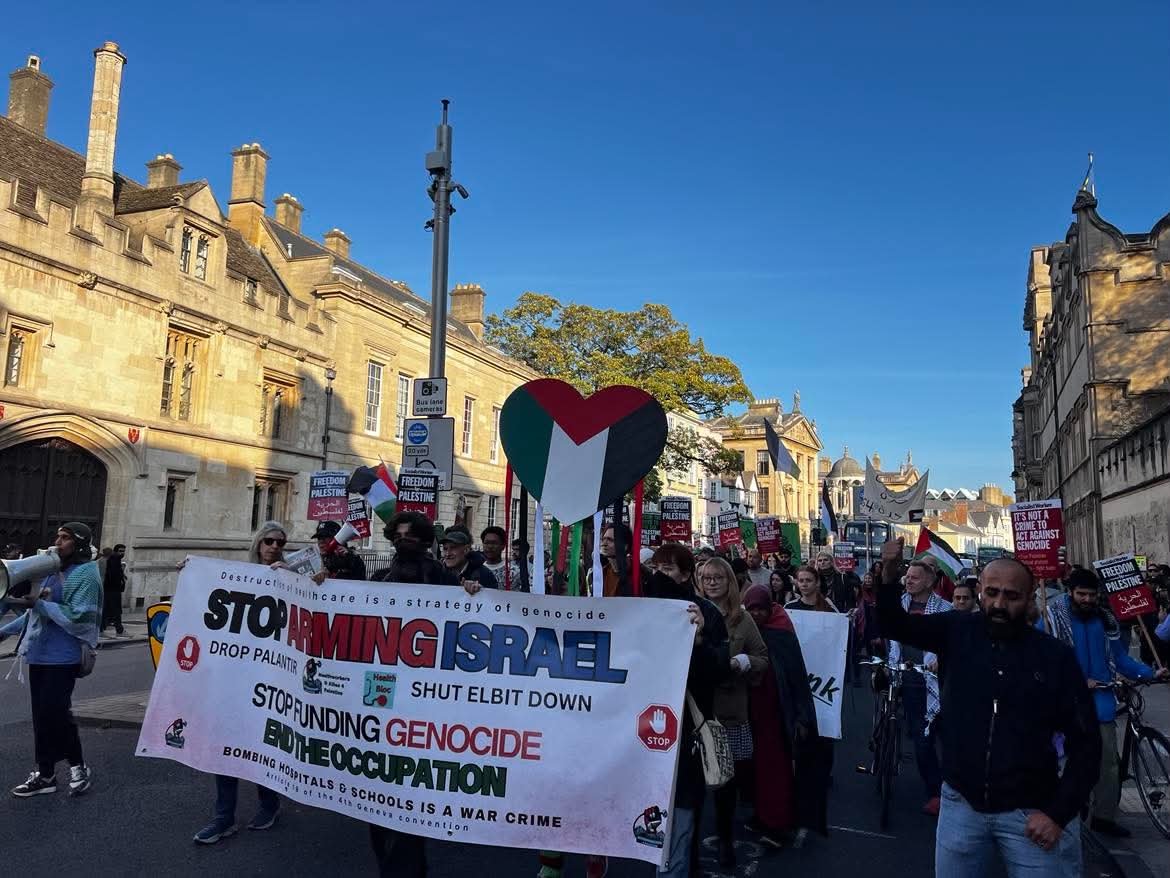
Pro-Palestine protesters marched from Cowley to the Weston Library on Saturday 31st October, demanding Oxford University’s divestment from Israel.
Around 120 people attended the protest, including groups such as Oxford Students for Palestine (formerly Oxford Schools for Palestine), Oxford Action for Palestine, Oxford City Green Party and Health Workers & Allies for Palestine.
The protest started with a speech about Oxford-educated administrators’ role in the creation of Israel, notably through the Balfour Declaration.
Green councillor Ahalya Bala also commented on the current situation in Palestine: “This is not a war. This is annihilation… The atrocities are still happening. It is just the pace that changes.”
“In the West Bank, forced displacement, seizures, neighbourhoods levelled to the ground, military raids, arbitrary detentions, torture, rape, executions, and land theft for Israeli expansionism and the cruel racial segregation and domination of Palestinians.”
A large banner at the centre of the gathering read: “Israel bombed 36 hospitals in Gaza and murdered more than 1700 healthcare workers. Targeting healthcare is a war crime. Arms embargo & Sanctions now!”
As protesters moved through Oxford, they chanted “blood money on your hands, show us your divestment plans”, “arms embargo right now”, and “Oxford University pick a side, justice or genocide”.
Two march attendees, Lisa and John, have been protesting for Palestine daily outside Carfax Tower. They spoke to Cherwell about the current state of the student movement for Palestine. Lisa, a current graduate student said that: “For students the consciousness is there and the willingness is there but people are afraid.” John added that Oxford’s prestige meant “there is a lot of power and opportunities to speak up concentrated here”.
Outside the Weston Library, protesters heard speeches from Nick Maynard, an Oxford alumnus and surgeon who has worked extensively in Gaza, and Haya Adams, an activist from the SOAS-liberated zone. Maynard, who went to Exeter College, said in his speech: “There are moments in history when silence becomes a form of complicity… More than 22,000 children have been killed in Gaza in the last three years.” He told the audience about individual patients he had seen in hospitals in Gaza, explaining that, on one occasion, his colleagues were stripped of critical supplies of baby formula by the Israeli military upon entering the strip.
Regarding the international treatment of Palestine, Maynard later told Cherwell: “We know it’s been failed by our governments, we know it’s been failed by our media, but it’s also being failed by our academic institutions… They have not given students a sufficient platform to talk about the genocide. Students have been fantastic. The university needs to give a much bigger platform to its students.”
Oxford Students for Palestine, one of the groups organising the protest, told Cherwell: “We wish to remind the University and others that Oxford city is extremely pro-Palestine, that we call for the end of the genocide and apartheid, and we call for every Palestinian to be liberated and have the right to return. We are twinned with Ramallah for a reason.”
The group added that “we’re calling on Oxford University and its colleges to disclose and fully divest from any Israeli investments, products, or banks like Barclays”. They also criticised the Oxford University Endowment Fund (OUEM) as “fundamentally resistant to disclosure and divestment”.
Adams, from the SOAS-liberated zone, told Cherwell: “The most basic and bare minimum thing that Oxford University can do is cut ties with genocide through their investments, through their partnerships. There really are ethical alternatives… Oxford University can also protect the right to free speech by allowing students to speak up for Palestine with no disciplinary action. They need to be held accountable for the arrests that happened during the time of the encampments.”
In response to a right of reply, Oxford University said: “Oxford is steadfast in its commitment to freedom of expression and to the right to peaceful protest within the law. At the same time, we have a legal and moral duty to uphold the rights, dignity and safety of every member of our community. When behaviour, including protest, causes serious disruption, harassment or safeguarding concerns, we will act in accordance with the law and our own established procedures.”
OUEM did not respond to our request for comment.
As the march ended, Oxford Students for Palestine reflected on how it fit with the global student movement. They told Cherwell: “The last thing we will say is that the students united will never be defeated, as we’ve seen across the world.”
Additional reporting by Stanley Arlidge and Freya Robson.
How could the outcome of the US midterm elections ever affect an Oxford student? Well, the elections might affect the cost of your next Tesco or Sainsbury’s visit. This month, diesel prices surpassed £2 per litre. British grocery inflation also just ticked up to 2.5% from 2.3%. The two are not unrelated. Many attribute Britain’s inflation to the ongoing conflict between Iran and the United States in the Middle East. On top of this, the Trump administration has threatened a 100% tariff on UK goods if the country does not abandon its digital services tax.
For better or worse, US government policy can affect the world, and with President Trump’s party holding slim majorities in both legislative chambers, current US policy may be challenged or forced to change. While, strictly speaking, the midterm elections only involve voting for representatives and senators, many view them as a vote of confidence in the president. Historically, the election has generally reflected a lack of confidence in the president, at least within the House of Representatives. Since 1946, regardless of party, the incumbent president’s party has gained seats in just two midterm elections: 1998 and 2002. These elections stand out because 1998 was the year President Clinton was impeached and 2002 was the election following 9/11.
Making sense of the midterms
Let’s say you agree with the notion that the outcome of the midterms may affect your grocery spend or your travel spend between or after term time; how on Earth do you make sense of the US election? Why do some politicians appear up for election and others do not? How do you know if power has shifted and a debate will occur on issues that affect an Oxford student?
In the US, Congress consists of two elected legislative bodies: the House and the Senate. Every two years, the entire House and one-third of the Senate stand for election.
A representative serves a two-year term in the House. This means the entire House stands for election on a two-year cycle, which includes the presidential election and the midterms in between. Currently, the Republican Party holds a slim majority in the House, and the Democratic Party would need a net gain of 3 seats to take control.
A senator, on the other hand, serves a six-year term, and there are 100 Senators. Further, the Senate is divided into three classes, with about 33 Senators per class. Senate elections are staggered so that one-third of the Senate stands for election every two years. Like in the House, the Republicans hold a majority in the Senate, and the Democrats would need a net gain of 4 seats to take control.
What Congress can do
Now that we understand how the election works, how would a change of power in Congress affect an Oxford student’s daily life?
Congress was designed as a restraint on the presidency. Congress possesses extensive power in budgeting, defence, foreign policy, trade, and other matters which can be used to counter the president. If the opposition party, the Democrats, wins control of either or both chambers, then expect attempts to foil President Trump. This matters to students from the UK and abroad. As mentioned before, US global policy might increase our food bill, but even more, as petrol prices rise, so will prices for all travel and, in particular, air travel back home for international students.
The Iran war
So, what can Congress do? Congress has a variety of options to influence the Iran war, one of which is the War Powers Resolution. Under this law, Congress could force an end to hostilities by voting to instruct the president to begin withdrawing the US military from hostilities within 60 days. However, this would require a supermajority of Congress because the president would likely veto a War Powers Resolution on the Iran war.
Alternatively, Congress can take other steps to impede the war. This includes restricting the military’s budget, rejecting or not voting on nominees, holding hearings, forcing Department of Defense officials to testify, and more. If the Senate doesn’t confirm a nominee, the president is limited in whom he may select, and the ‘acting’ official tends to hold little political power. All of this pressure would go a distance in bringing an end to a conflict that has increased petrol in the UK by 16-30% on average and increased airline jet fuel globally by 20%.
Tariffs and the power of the purse
On tariffs, Congress could pass legislation to terminate specific tariffs or rescind the president’s authority more broadly. Much of the same congressional options that applied to the Iran war also apply to tariffs. The key difference is that if both chambers of Congress switch to the Democrats, there is a good chance legislation curtailing the President’s tariffs could override a presidential veto.
The congressional power of the purse should also not be underestimated. In 2019, former Speaker of the House Nancy Pelosi refused to allow appropriations legislation to pass over a dispute to fund a border wall on the US-Mexico border, leading to a government shutdown. This can hurt the American public, as the lack of funding ceases or slows essential operations and functions like airports, issuance of small business loans, court proceedings, and heavily used public venues like national parks. Traditionally, this stalemate places great pressure on the party that appears unwilling to compromise and in 2019, President Trump found himself in that position. All of this puts the President’s 10% tariff on UK goods in jeopardy and diminishes the risks of new tariff threats.
The bottom line
So, today, take note of these facts if you attend a University of Oxford watch party. The election taking place 3,000 miles away may affect you more than you imagine, as it may affect the cost of what you eat, the cost of travel around Oxford, the cost of a flight home following term time, or even more; it may affect the global economy every Oxford student wishes to work in. Don’t stay up too late, but hopefully, if you watch the election, you will appreciate its significance, and it will also provide some entertainment.
Two forms of identification will be required to vote at the Oxford Union following consecutive instances of electoral fraud involving impersonation. Voters will now need to provide their membership card and one additional form of identification, after the Standing Committee accepted a rule change earlier this week.
Union President Gareth Lim told Cherwell that the change aims to protect the accuracy and integrity of the electoral process, especially to avoid the impact of counterfeit and illicitly obtained membership cards. The proposal to the Standing Committee described the previous system as “open to abuse” and added that the new rules are written under the principle that “the election system should be fully defensible against attempted fraud”.
Impersonation and false membership cards disrupted the two most recent Union elections.
In Trinity Term 2026, the election count was suspended after a Returning Officer identified evidence of substantial interference before boxes were opened. CCTV showed individuals attempting to cast votes using membership cards which were not their own.
Similar electoral fraud occurred during elections in Hilary, as President-Elect Catherine Xu was removed after a separate Tribunal found she had distributed membership cards belonging to other people for voting.
After both elections, membership cards were seized, and those found guilty have been suspended from the Union.
Lim proposed the new double-identification system over the summer. The Standing Committee recommended the changes, and they were affirmed by the Union’s ‘house’ on Thursday.
When asked why these measures have only come under consideration after the second instance of attempted fraud, the President told Cherwell the rules follow suspected large-scale counterfeit voting in June, whereas the Hilary election was suspected to be the scheme of one individual at the time.
Guidance on what will be accepted as secondary identification has not yet been confirmed. Cherwell understands that student identification, including Bodleian cards, will be sufficient.
In addition to the changes to voter identification, the Union is also changing the process through which candidates are selected for standing committee. Starting from the elections in Hilary term 2027, candidates for Secretary’s Committee will require three unique nominators who are not candidates themselves to stand. The change is being introduced to “help reduce the unfair and unnecessary burden placed on electoral officials by the frivolous nomination of candidates with no interest or support in winning”.
A mock election to trial the new system will be conducted by the Returning Officers during the Union’s US Midterm Election event this evening. Attendees have been directed to bring both their government ID and Union card. The new rules will take effect for the next election on 27th November.



-
 Oxford united FC4 weeks ago
LIVE: Exeter City vs Oxford United – Jersey Mike's Trophy group stage
-

 Oxford united FC4 weeks ago
Oxford United lose to Exeter City on penalties in Jersey Mike’s Trophy
-
 Student Life4 weeks ago
Rhodes scholarships cut amid financial difficulties
-

 Student Life3 weeks ago
From Oxford to Cambridge: The 204-mile punt for Alzheimer’s
-

 Oxford united FC4 weeks ago
Chris Gunter details Oxford United tactical adjustments
-

 Oxford united FC4 weeks ago
Oxford United youngster opens up on ‘surreal’ Aaron Ramsey influence
-

 Oxford united FC4 weeks ago
Oxford United win 2-1 at Notts County in League One return
-
 Oxford united FC4 weeks ago
LIVE: Exeter City 2-1 Oxford United – Grecians lead after Bradney debut goal