
Oxford University
Empowering higher education students with AI


We’ve launched our AI Study Assistant on Business, Politics, and Science Trove, following the successful launch of the tool on Law Trove in October 2025.
This means that all our Trove platforms now offer students enhanced functionality through AI to increase their efficiency when studying by helping them to find and engage with relevant content.
Troves—in business, law, politics, and science—offer discipline-specific collections of higher education textbooks from across our market-leading lists. Rolling out the AI Study Assistant more widely means that students from these disciplines can generate accurate summaries, authoritative answers, and targeted quizzes to support understanding, revision, and exam preparation. Moreover, responses and quizzes generated by the assistant only draw from our trusted textbook content, guaranteeing that students are accessing reliable source material.
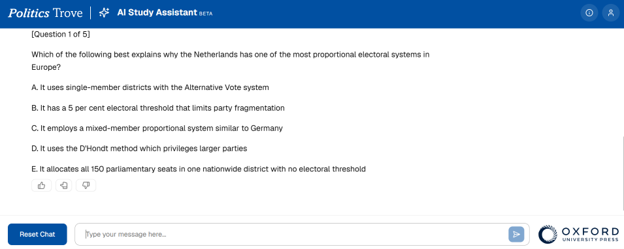
Building on the Law Trove AI Study Assistant
To expand the tool across our other Trove platforms, we further developed the assistant to meet user needs for Science Trove.
As with Law Trove, we have taken a conscientious approach to embedding AI into Business, Politics, and Science Trove by empowering users to develop the skills they need to apply critical thinking to their use of AI not just academically, but for their future careers through the specialized module on AI literacy. The module is available for all Trove users and covers generative AI fundamentals, academic integrity, critical thinking, and effective prompting, so users can use the AI Study Assistant responsibly and with confidence.
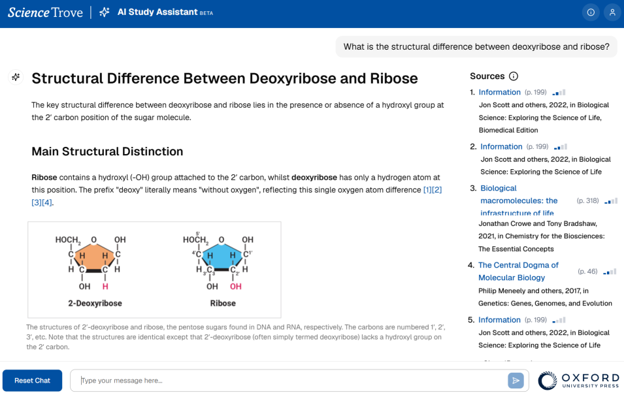
Shaped through user testing with lecturers and students, the tool has been designed with real teaching and learning needs at its heart, ensuring that Trove stands at the forefront of combining innovative technology with high-quality educative resources for higher education institutions and students.
We look forward to hearing how students interact with the tool across Trove in the new academic year and beyond. You can learn more about the development of the AI Study Assistant and the positive reception it has had on Law Trove here.

We are working with three universities to securely connect their ChatGPT Edu accounts to our academic content. Running from October to December 2026, the pilot will enable students and researchers to access our trusted content directly within their AI-assisted research journeys. Participating institutions include Harvard Library, the Wharton School of the University of Pennsylvania, and University of Oxford.
While researchers are increasingly integrating AI into their research journeys, a recent survey we conducted shows their trust in AI outputs remains low. This pilot aims to ensure high-quality, trusted content remains discoverable and responds to changing habits brought on by AI, such as the rise in zero-click search journeys.
How the pilot works
The pilot uses a Model Context Protocol (MCP) server developed with our platform provider, Silverchair, which acts as a bridge between an AI assistant, such as ChatGPT Edu, and an organization’s content. In response to a user’s query, the MCP searches and retrieves the most relevant sources from the content, using them to formulate a response for the user.
Throughout the pilot, select researchers and students at the three institutions will be able to use ChatGPT Edu to query peer-reviewed content their institution has purchased or subscribed to. This means those AI outputs are grounded in trusted, cited scholarship with links to content hosted on the Oxford Academic platform.
What the pilot will inform
With participating institutions, we will use both quantitative and qualitative data from the pilot to gain insight into researchers’ behaviours within AI research tools, including:
- Whether researchers are motivated to use an MCP to connect to trusted sources
- How access to trusted sources influences the quality of the LLM’s outputs
- Whether the presence of citations from a trusted publisher affects the process of verifying resources.
Usage data will be monitored and analysed to assess the desirability and sustainability of publisher MCP connectors. This data, combined with qualitative feedback from faculty and students, will be used by each institution to inform the role MCPs will play in their future AI-powered research journeys.
Richard Ovenden, Bodley’s Librarian and the Helen Hamlyn Director of the University Libraries at the University of Oxford, said: “As people increasingly look to AI technologies to support their academic research, it is important that libraries and publishers work together to make their studies and research as reliable and trustworthy as possible. We are therefore constantly exploring new ways to improve access to the resources we make available to students and researchers. This collaboration will allow us to review how readers use AI technology in their studies and to help develop approaches to ensure that students and researchers can confidently rely on the information they discover.”

John Campbell
Product Strategy Director, Academic
“This pilot is part of a programme of initiatives and partnerships to understand how the dissemination of high-quality research adapts to new technologies and continues to drive impact. By integrating carefully-managed AI tools across our products, we’re putting researchers’ needs at the heart of our work, helping them harness the power of this evolving technology in a secure and reliable way.”

Tanya Laplante
Director of Product Platforms, Academic
“At a time of rapid technological change, it’s difficult to see through the hype to identify what will actually benefit researchers in their day-to-day work. We’ve undertaken this pilot to lear n what real-world use of publisher MCPs looks like and what benefits it drives. This insight will help OUP and participating institutions determine where we go from here.”

Nearly two-thirds of higher education instructors in the social sciences use instructional videos in the classroom. But as AI-generated videos increase in volume, those instructors and their students require assurance that the videos they learn from are reliable.
We are responding to this challenge by launching Oxford Explains—a new video-based product developed to provide introductions to complex topics.
Oxford Explains connects learners directly with leading subject matter experts through concise, accessible videos developed specifically for higher education and research audiences. The content is original, curated, and structured to provide a clear, guided introduction to each topic by exploring the key concepts, debates, and its historical context, supporting deeper understanding and further research.

The first subject available on Oxford Explains is Politics, which will cover political systems and leadership, regional politics, global challenges, key issues, and much more. Initial collections include the US Presidency, Local and Urban Politics, and Public Policy, with more collections to follow later this year and in 2027. As the resource grows, researchers can gain access to a wider range of perspectives and expertise, with new voices contributing to and shaping the conversation.

Ada Brunstein
Editorial Director for Reference
“The videos offer a trustworthy introduction to each topic, with all content written, recorded, and vetted by leading scholars from across the globe—ensuring they’re not only original but reliable. As online video becomes increasingly automated and AI-generated, OUP’s focus remains on academic rigor, transparency, and trusted expertise. A reliable antidote to misinformation, Oxford Explains offers a foundational orientation to new topics, curated around key concepts, debates, and historical context.”
Oxford Explains is designed for those with different learning preferences, with accessibility supported through captions and full transcripts, allowing researchers to watch, listen, read, or revisit content in the format that works best for them. As researchers and scholars are increasingly using video for learning, outreach, and communicating research, Oxford Explains meets their changing needs and preferences for engaging with topics while maintaining the trusted, high-quality content they expect.

James Benefield
Product Manager for Oxford Explains
“Trusted content has never been so important to the academic community—but neither has its accessibility. Oxford Explains, our first video-led product for universities, is available exclusively on Oxford Academic, a platform that’s built for the research journey. Access to knowledge is not just about availability of course, but about ensuring people can engage with content in the way that works best for them. With Oxford Explains and beyond, we continue to invest in enhancements to Oxford Academic that strengthen accessibility so more people can engage with trusted research.”
Find out more about Oxford Explains here.

Chair of the Global Prize Committee and Professor of International History and Politics at the Geneva Graduate Institute
“This year’s pool of submissions was remarkably strong. A large number of manuscripts made genuine contributions to their respective fields and were worthy of serious consideration. The judging process was accordingly tough and energizing. I, for one, learned an enormous deal about themes as diverse as Caribbean environments, Vietnamese cities, and Latin American rivers.
“The ECR First Book Prize is invaluable. It doesn’t just recognize excellent books, but helps launch them.”



-

 Oxford united FC4 weeks ago
LIVE: Exeter City vs Oxford United – Jersey Mike's Trophy group stage
-

 Oxford united FC4 weeks ago
Oxford United lose to Exeter City on penalties in Jersey Mike’s Trophy
-

 Student Life4 weeks ago
Rhodes scholarships cut amid financial difficulties
-

 Student Life3 weeks ago
From Oxford to Cambridge: The 204-mile punt for Alzheimer’s
-

 Oxford united FC4 weeks ago
Chris Gunter details Oxford United tactical adjustments
-

 Oxford united FC4 weeks ago
Oxford United youngster opens up on ‘surreal’ Aaron Ramsey influence
-

 Oxford united FC4 weeks ago
Oxford United win 2-1 at Notts County in League One return
-

 Oxford united FC4 weeks ago
LIVE: Exeter City 2-1 Oxford United – Grecians lead after Bradney debut goal