
Student Life
Tanjil Rashid on diversity and the future of journalism

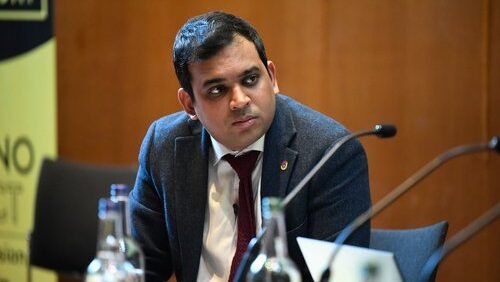
Tanjil Rashid is currently the Culture Editor of the New Statesman, although he has worked previously as a bookshop assistant and a civil servant and even, unfortunately, endured torrents of abuse as a comprehensive-school supply teacher. Having grown up in Ilford in East London, he now lives marginally to the north in Walthamstow. “I haven’t moved very far in life,” he jokes. In fact, he has been on quite a journey.
Rashid was born in 1990. “My parents had quite modest lives and I grew up in an immigrant Muslim Bengali family. My father immigrated to Britain to provide labour in the post-war economy, working up north in factories and then worked as a waiter and eventually getting an office job. My mother has been a housewife all her life. But they stressed education, as families like mine tend to; I went to a grammar school and became interested in literature and the arts. Public libraries were very good back then, they had lots of old books that you don’t find there anymore.”
He got into Cambridge and had a very good start in journalism at the Financial Times. After that he ended up landing in television, which he didn’t enjoy, and remained a freelance writer for many years until he was chosen to become the Culture editor of the New Statesman. He is doubtful, however, that people from backgrounds like his would in the future end up with such a prestigious position in the literary world.
“I grew up in a world that was changing and was still pretty analogue. The first fifteen years of my life were pretty much internet-free. Children from families like mine probably don’t have much exposure to print culture anymore. Children in intelligentsia families, the kind where they get the London Review of Books in the mail, probably still do. When I was growing up, my father was a great reader of newspapers, he’d sit there reading the paper while my mother was doing the shopping, and she also enjoyed reading Bengali newspapers.”
It was the early exposure to print culture which, though not a unique experience, turned Rashid towards the world of letters. “There are two kinds of people who go into journalism: one, people who really love news and current affairs; the other, people who like the written word. I’m someone who loves words, likes reading and writing. It’s hard to say why I specifically became interested in culture, art, fiction – I just for some reason got interested in that.” He pauses. “In some way literary journalism is a strange career to have. It’s not really a real career. It’s really too fun to be taken too seriously.”
Rashid, who has been a journalist for over a decade, is ruminative about the state of his chosen profession. “Fifty or a hundred years ago, it was in book reviewing and literary journalism that the great journalists were to be discovered.” Indeed, his predecessors as literary – now Culture – editors of the New Statesmen include V.S. Pritchett, Claire Tomalin, and Martin Amis.
While he does not agree the literary world is in the crisis some make it out to be in, he accepts changes are afoot. “The novel, like the epic poem, is no longer as central to the culture as it was. It’s impossible to know what new literary forms will take the place of the novel. The old ways of writing and understanding the world are changing. Critics must respond to this in a critically intelligent way. The people who are just being born or will be born in ten years’ time will express themselves as humans always do, but perhaps not writing novels. We recently did a piece, for instance, on how AI is reshaping the opera.” He stresses, however, that continuities remain. “Even now there are brilliant writers coming through in journalism. That supply of literary talent is proliferating. I’m constantly being amazed by youngsters who want to write about literature, and are remarkably well-read and write impressively.”
Identity is a recurring theme in Rashid’s writing. When I ask him about this, he reflects that this is not a conscious choice. “It happens to be the case that I am Muslim, I am British, and I am many other things, and these things inevitably shape what I write. These things are probably just noticed more because I have an – unusual identity. There aren’t many Bengali journalists in the media. There are so few of us that we often get mistaken for each other. For instance, I’m always getting mistaken for Faisal Islam, for some reason.” He laughs. “There are probably only two or three British Muslims in literary journalism. So, if you read my writings you’ll probably notice I have a slightly different identity, different perspective because of it. My identity doesn’t completely determine my perspective, but it certainly informs it.”
Earlier this year, Rashid interviewed Salman Rushdie. “Certainly, when it comes to a writer like Rushdie, a British Asian of Muslim heritage, there will be a way that I relate to his work and his life in a way that others don’t, because we share something of the world. There has been a lot of talk about diversity in the last decade or so but actually I don’t see the literary world becoming any less parochial. Things probably were better in decades past. In the decades after decolonisation you had Commonwealth writers such as VS Naipaul and Salman Rushdie being widely read and acclaimed, but today, even though we like to think of ourselves as more modern and contemporary and open, a novel such as Midnight’s Children would not be understood or read as widely.”
Identity certainly informs the multicultural Britain depicted in Rashid’s fiction. (As well as literary essays, articles, interviews, he has turned his hand to short stories, too.) “The Fanatic”, is particularly funny in the way it turns tropes and stereotypes on their head: it is the story of an imam who is expelled from his mosque for being a dangerous fanatic, but the fanaticism of which he stands accused is an inflexible, irrational love of Manchester United. “It was a wonderful thing to have short stories published in magazines and that sort of thing,” Rashid admits, “but it’s not a living.”
I ask him about his future ambitions. He pauses and looks down at the magazine – guess which one – that lies on the table. “My ambition, really, is to keep producing good literary coverage, good writing by the famous and brilliant writers I’m already publishing as well as finding new ones. The New Statesman has always been a venerable institution but since Tom McTague became editor the magazine has become absolutely essential to the national conversation – see the coverage of the Labour leadership contest, for instance. I would like to keep the literary pages of the New Statesman among the best in the world.” On the question of whether he might follow up his short stories with a novel, the reply, hesitantly given, is, “No comment.”
Many Cherwell readers – and certainly most Cherwell editors – are mulling over the prospect of a journalistic career, and will be seeking tips as to how to thrive in the profession. Rashid advises: “Have a day job: at this point in history, writing is an amateur sport, not a career. More importantly: Read. Read everything. Don’t just read what’s fashionable. Read science writing, travel writing, the Bible, read all kinds of words. Go back in time and read Shakespeare and Dickens. If you want to be a writer you have to understand language in all its subtleties, and to do that you have to read omnivorously.”
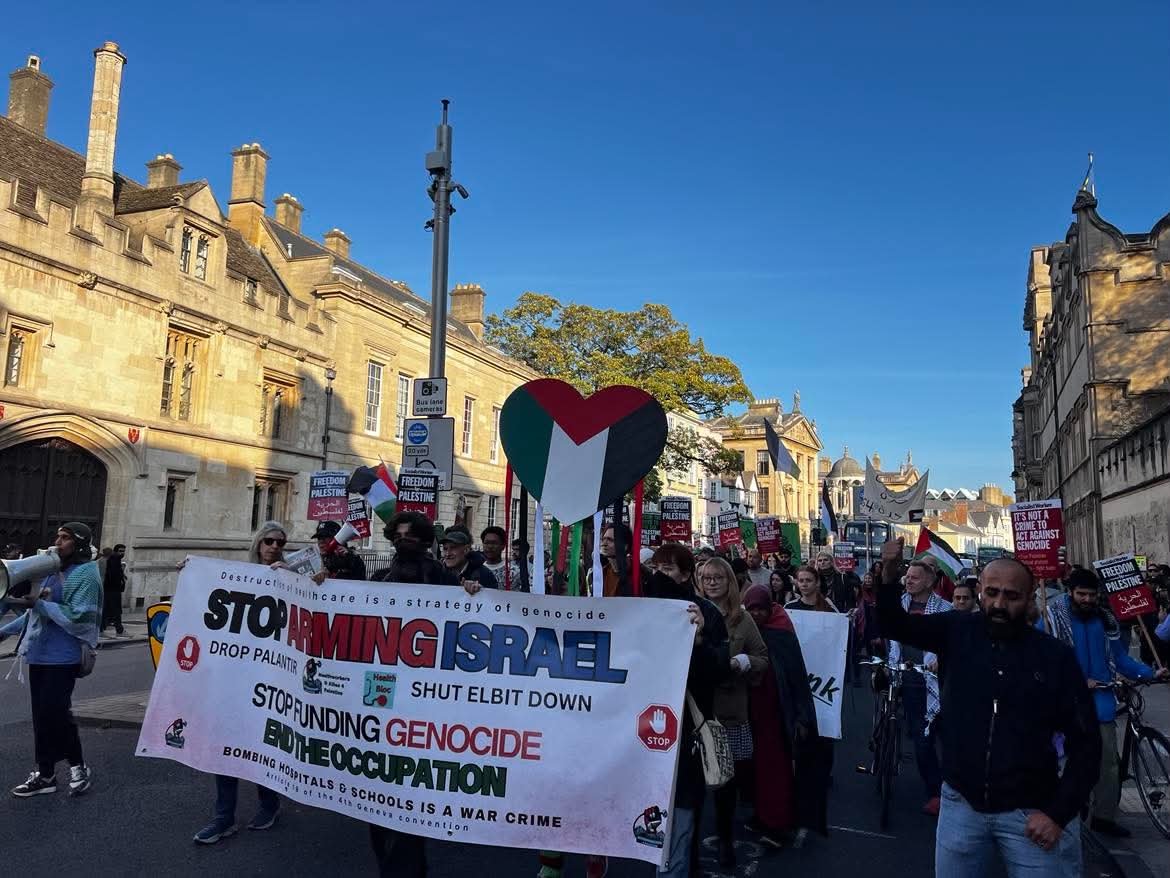
Pro-Palestine protesters marched from Cowley to the Weston Library on Saturday 31st October, demanding Oxford University’s divestment from Israel.
Around 120 people attended the protest, including groups such as Oxford Students for Palestine (formerly Oxford Schools for Palestine), Oxford Action for Palestine, Oxford City Green Party and Health Workers & Allies for Palestine.
The protest started with a speech about Oxford-educated administrators’ role in the creation of Israel, notably through the Balfour Declaration.
Green councillor Ahalya Bala also commented on the current situation in Palestine: “This is not a war. This is annihilation… The atrocities are still happening. It is just the pace that changes.”
“In the West Bank, forced displacement, seizures, neighbourhoods levelled to the ground, military raids, arbitrary detentions, torture, rape, executions, and land theft for Israeli expansionism and the cruel racial segregation and domination of Palestinians.”
A large banner at the centre of the gathering read: “Israel bombed 36 hospitals in Gaza and murdered more than 1700 healthcare workers. Targeting healthcare is a war crime. Arms embargo & Sanctions now!”
As protesters moved through Oxford, they chanted “blood money on your hands, show us your divestment plans”, “arms embargo right now”, and “Oxford University pick a side, justice or genocide”.
Two march attendees, Lisa and John, have been protesting for Palestine daily outside Carfax Tower. They spoke to Cherwell about the current state of the student movement for Palestine. Lisa, a current graduate student said that: “For students the consciousness is there and the willingness is there but people are afraid.” John added that Oxford’s prestige meant “there is a lot of power and opportunities to speak up concentrated here”.
Outside the Weston Library, protesters heard speeches from Nick Maynard, an Oxford alumnus and surgeon who has worked extensively in Gaza, and Haya Adams, an activist from the SOAS-liberated zone. Maynard, who went to Exeter College, said in his speech: “There are moments in history when silence becomes a form of complicity… More than 22,000 children have been killed in Gaza in the last three years.” He told the audience about individual patients he had seen in hospitals in Gaza, explaining that, on one occasion, his colleagues were stripped of critical supplies of baby formula by the Israeli military upon entering the strip.
Regarding the international treatment of Palestine, Maynard later told Cherwell: “We know it’s been failed by our governments, we know it’s been failed by our media, but it’s also being failed by our academic institutions… They have not given students a sufficient platform to talk about the genocide. Students have been fantastic. The university needs to give a much bigger platform to its students.”
Oxford Students for Palestine, one of the groups organising the protest, told Cherwell: “We wish to remind the University and others that Oxford city is extremely pro-Palestine, that we call for the end of the genocide and apartheid, and we call for every Palestinian to be liberated and have the right to return. We are twinned with Ramallah for a reason.”
The group added that “we’re calling on Oxford University and its colleges to disclose and fully divest from any Israeli investments, products, or banks like Barclays”. They also criticised the Oxford University Endowment Fund (OUEM) as “fundamentally resistant to disclosure and divestment”.
Adams, from the SOAS-liberated zone, told Cherwell: “The most basic and bare minimum thing that Oxford University can do is cut ties with genocide through their investments, through their partnerships. There really are ethical alternatives… Oxford University can also protect the right to free speech by allowing students to speak up for Palestine with no disciplinary action. They need to be held accountable for the arrests that happened during the time of the encampments.”
In response to a right of reply, Oxford University said: “Oxford is steadfast in its commitment to freedom of expression and to the right to peaceful protest within the law. At the same time, we have a legal and moral duty to uphold the rights, dignity and safety of every member of our community. When behaviour, including protest, causes serious disruption, harassment or safeguarding concerns, we will act in accordance with the law and our own established procedures.”
OUEM did not respond to our request for comment.
As the march ended, Oxford Students for Palestine reflected on how it fit with the global student movement. They told Cherwell: “The last thing we will say is that the students united will never be defeated, as we’ve seen across the world.”
Additional reporting by Stanley Arlidge and Freya Robson.
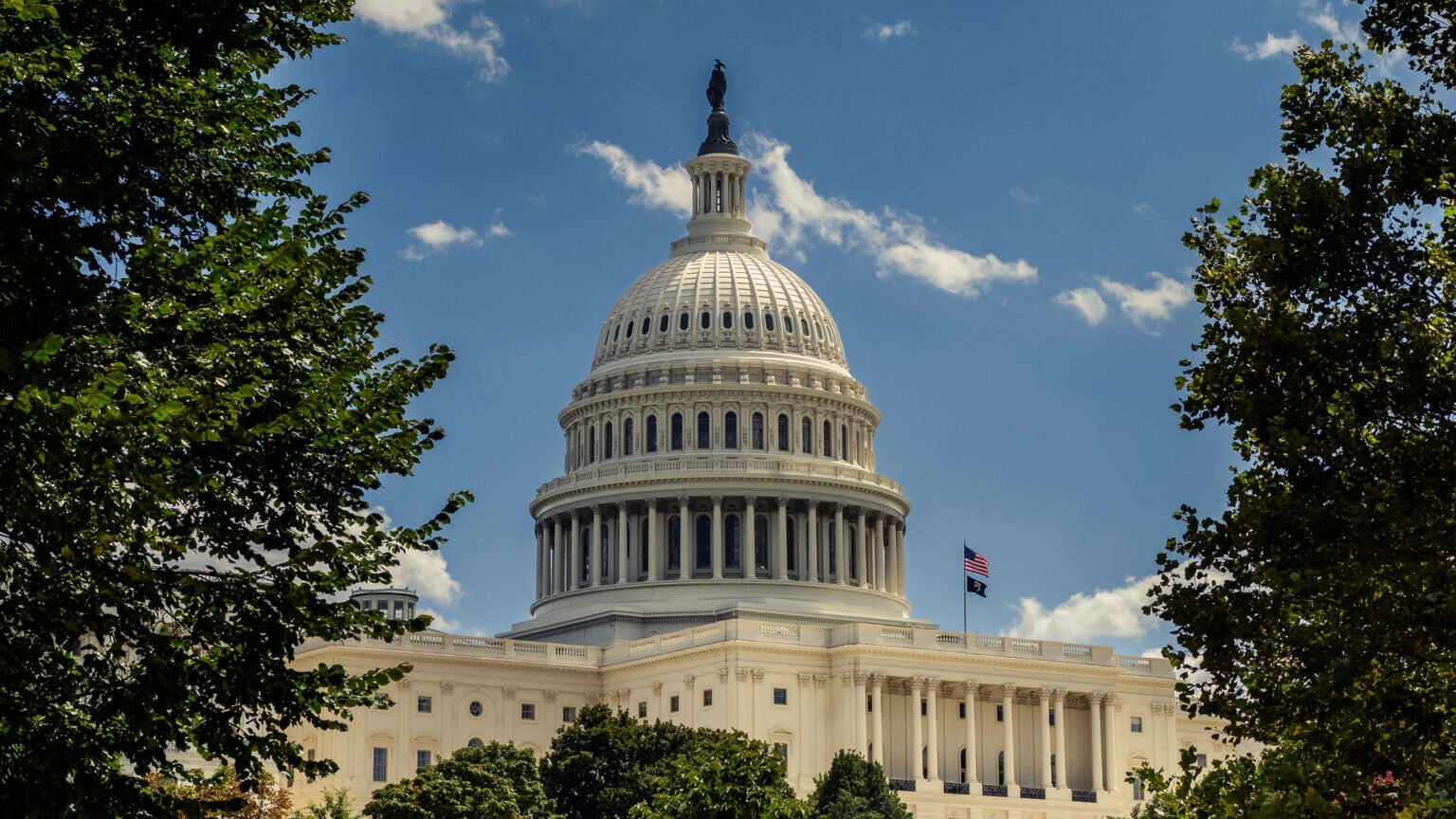
How could the outcome of the US midterm elections ever affect an Oxford student? Well, the elections might affect the cost of your next Tesco or Sainsbury’s visit. This month, diesel prices surpassed £2 per litre. British grocery inflation also just ticked up to 2.5% from 2.3%. The two are not unrelated. Many attribute Britain’s inflation to the ongoing conflict between Iran and the United States in the Middle East. On top of this, the Trump administration has threatened a 100% tariff on UK goods if the country does not abandon its digital services tax.
For better or worse, US government policy can affect the world, and with President Trump’s party holding slim majorities in both legislative chambers, current US policy may be challenged or forced to change. While, strictly speaking, the midterm elections only involve voting for representatives and senators, many view them as a vote of confidence in the president. Historically, the election has generally reflected a lack of confidence in the president, at least within the House of Representatives. Since 1946, regardless of party, the incumbent president’s party has gained seats in just two midterm elections: 1998 and 2002. These elections stand out because 1998 was the year President Clinton was impeached and 2002 was the election following 9/11.
Making sense of the midterms
Let’s say you agree with the notion that the outcome of the midterms may affect your grocery spend or your travel spend between or after term time; how on Earth do you make sense of the US election? Why do some politicians appear up for election and others do not? How do you know if power has shifted and a debate will occur on issues that affect an Oxford student?
In the US, Congress consists of two elected legislative bodies: the House and the Senate. Every two years, the entire House and one-third of the Senate stand for election.
A representative serves a two-year term in the House. This means the entire House stands for election on a two-year cycle, which includes the presidential election and the midterms in between. Currently, the Republican Party holds a slim majority in the House, and the Democratic Party would need a net gain of 3 seats to take control.
A senator, on the other hand, serves a six-year term, and there are 100 Senators. Further, the Senate is divided into three classes, with about 33 Senators per class. Senate elections are staggered so that one-third of the Senate stands for election every two years. Like in the House, the Republicans hold a majority in the Senate, and the Democrats would need a net gain of 4 seats to take control.
What Congress can do
Now that we understand how the election works, how would a change of power in Congress affect an Oxford student’s daily life?
Congress was designed as a restraint on the presidency. Congress possesses extensive power in budgeting, defence, foreign policy, trade, and other matters which can be used to counter the president. If the opposition party, the Democrats, wins control of either or both chambers, then expect attempts to foil President Trump. This matters to students from the UK and abroad. As mentioned before, US global policy might increase our food bill, but even more, as petrol prices rise, so will prices for all travel and, in particular, air travel back home for international students.
The Iran war
So, what can Congress do? Congress has a variety of options to influence the Iran war, one of which is the War Powers Resolution. Under this law, Congress could force an end to hostilities by voting to instruct the president to begin withdrawing the US military from hostilities within 60 days. However, this would require a supermajority of Congress because the president would likely veto a War Powers Resolution on the Iran war.
Alternatively, Congress can take other steps to impede the war. This includes restricting the military’s budget, rejecting or not voting on nominees, holding hearings, forcing Department of Defense officials to testify, and more. If the Senate doesn’t confirm a nominee, the president is limited in whom he may select, and the ‘acting’ official tends to hold little political power. All of this pressure would go a distance in bringing an end to a conflict that has increased petrol in the UK by 16-30% on average and increased airline jet fuel globally by 20%.
Tariffs and the power of the purse
On tariffs, Congress could pass legislation to terminate specific tariffs or rescind the president’s authority more broadly. Much of the same congressional options that applied to the Iran war also apply to tariffs. The key difference is that if both chambers of Congress switch to the Democrats, there is a good chance legislation curtailing the President’s tariffs could override a presidential veto.
The congressional power of the purse should also not be underestimated. In 2019, former Speaker of the House Nancy Pelosi refused to allow appropriations legislation to pass over a dispute to fund a border wall on the US-Mexico border, leading to a government shutdown. This can hurt the American public, as the lack of funding ceases or slows essential operations and functions like airports, issuance of small business loans, court proceedings, and heavily used public venues like national parks. Traditionally, this stalemate places great pressure on the party that appears unwilling to compromise and in 2019, President Trump found himself in that position. All of this puts the President’s 10% tariff on UK goods in jeopardy and diminishes the risks of new tariff threats.
The bottom line
So, today, take note of these facts if you attend a University of Oxford watch party. The election taking place 3,000 miles away may affect you more than you imagine, as it may affect the cost of what you eat, the cost of travel around Oxford, the cost of a flight home following term time, or even more; it may affect the global economy every Oxford student wishes to work in. Don’t stay up too late, but hopefully, if you watch the election, you will appreciate its significance, and it will also provide some entertainment.
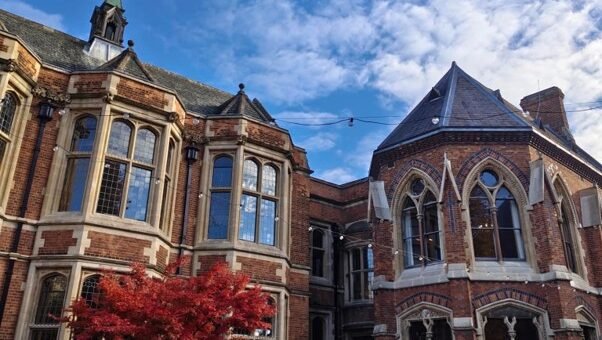
Two forms of identification will be required to vote at the Oxford Union following consecutive instances of electoral fraud involving impersonation. Voters will now need to provide their membership card and one additional form of identification, after the Standing Committee accepted a rule change earlier this week.
Union President Gareth Lim told Cherwell that the change aims to protect the accuracy and integrity of the electoral process, especially to avoid the impact of counterfeit and illicitly obtained membership cards. The proposal to the Standing Committee described the previous system as “open to abuse” and added that the new rules are written under the principle that “the election system should be fully defensible against attempted fraud”.
Impersonation and false membership cards disrupted the two most recent Union elections.
In Trinity Term 2026, the election count was suspended after a Returning Officer identified evidence of substantial interference before boxes were opened. CCTV showed individuals attempting to cast votes using membership cards which were not their own.
Similar electoral fraud occurred during elections in Hilary, as President-Elect Catherine Xu was removed after a separate Tribunal found she had distributed membership cards belonging to other people for voting.
After both elections, membership cards were seized, and those found guilty have been suspended from the Union.
Lim proposed the new double-identification system over the summer. The Standing Committee recommended the changes, and they were affirmed by the Union’s ‘house’ on Thursday.
When asked why these measures have only come under consideration after the second instance of attempted fraud, the President told Cherwell the rules follow suspected large-scale counterfeit voting in June, whereas the Hilary election was suspected to be the scheme of one individual at the time.
Guidance on what will be accepted as secondary identification has not yet been confirmed. Cherwell understands that student identification, including Bodleian cards, will be sufficient.
In addition to the changes to voter identification, the Union is also changing the process through which candidates are selected for standing committee. Starting from the elections in Hilary term 2027, candidates for Secretary’s Committee will require three unique nominators who are not candidates themselves to stand. The change is being introduced to “help reduce the unfair and unnecessary burden placed on electoral officials by the frivolous nomination of candidates with no interest or support in winning”.
A mock election to trial the new system will be conducted by the Returning Officers during the Union’s US Midterm Election event this evening. Attendees have been directed to bring both their government ID and Union card. The new rules will take effect for the next election on 27th November.



-
 Student Life4 weeks ago
Rhodes scholarships cut amid financial difficulties
-

 Student Life4 weeks ago
From Oxford to Cambridge: The 204-mile punt for Alzheimer’s
-

 Oxford united FC4 weeks ago
Chris Gunter details Oxford United tactical adjustments
-

 Oxford united FC4 weeks ago
Oxford United youngster opens up on ‘surreal’ Aaron Ramsey influence
-

 Oxford united FC4 weeks ago
Oxford United win 2-1 at Notts County in League One return
-

 Student Life4 weeks ago
Exeter College to fund data centre in Oxford
-
 Student Life3 weeks ago
Hidden in plain sight: the bakery behind Oxford’s café counters
-

 Property & Housing4 weeks ago
Plans developed for 12 affordable Blackbird Leys homes