
Student Life
The Oxford students who can’t read books


In 2024, an essay in The Atlantic by Rose Horowitch tapped into anxieties already circulating across elite higher education with its provocative title: “The Elite College Students Who Can’t Read Books.” The article alleged, among other claims, that students at Ivy League and other elite universities increasingly struggled to complete full books. Professors at Princeton, Georgetown, and Columbia described undergraduates overwhelmed by reading lists that once would have seemed unremarkable. One professor reported students “bewildered by the thought of finishing multiple books a semester”. Another observed that students struggled to sustain attention through even a 14-line sonnet.
At Oxford, the premise initially sounds absurd. It is difficult to think of a university more entangled with the idea of reading. The institution remains organised around libraries, primary texts, and tutorial reading lists that have become semi-mythological in undergraduate culture. Even maths students do not simply study maths; according to their Bod cards, they “read for” a degree. Entire pedagogies here rest on assumptions that students will disappear into novels, criticism, and archives before resurfacing with an essay and an original argument.
Yet, the real concern underlying Horowitch’s article was never simply whether students still technically read books. The students she described were perfectly capable readers in the conventional sense. They could decode texts, absorb information, and write essays. The anxiety centred instead on reading stamina: the capacity to sustain concentration through long arguments, difficult prose, ambiguity, and slow accumulation of meaning. Reading, in this account, had become increasingly fragmented – broken into excerpts, summaries, strategically selected passages, and material skimmed for argumentative utility rather than experienced in full.
At the same time, complaints about declining student reading stretch back generations. Every academic era seems convinced that the current cohort reads less attentively than the last. Horowitch’s article occasionally drifts toward a familiar genre of civilisational panic disguised as pedagogy. The issue, then, may be less about whether students still want to read deeply than whether universities structurally permit it.
There is reason to think these concerns extend beyond anecdotes. Research on reading habits suggests that long-form reading has declined over the past two decades, with a study finding that about 55% of surveyed professors said they had cut reading assignments (often because students weren’t completing them). Scholars studying university reading habits increasingly describe students becoming more selective and strategic: reading not necessarily to dwell on a text but to extract enough material to survive assessment.
The explanation offered by many educators is not that students have become less intelligent or less motivated. Rather, educational structures themselves have changed. School curricula increasingly favour shorter informational texts. Universities compress enormous quantities of material into tightly scheduled semesters. Students balance multiple classes simultaneously alongside internships, networking, and extracurriculars.
This is particularly visible when talking to visiting students at Oxford from elite American universities. Natasha Wipfler-Kim, a third-year visiting student from Princeton University studying English at Worcester College, described Princeton reading as broad but scattered. “Everything’s kind of distributed a lot more”, she said. Princeton’s Humanities Sequence (HUM), which assigns enormous quantities of reading across a single semester. A sample reading list for a twelve-week term contains roughly 30 books. Natasha described being expected to read multiple books a week, including Plato’s Republic, in a day. “The expectation”, she said, “was that it just wasn’t really possible”.
That impossibility changes how students read. When confronted with several books a week alongside work for four or five other classes, the goal becomes coverage rather than immersion. Students cannot afford to remain inside every text equally. Skimming becomes less a failure than a structural necessity. Describing how she dislikes skimming because it forces students into constant calculations about what can be abandoned, Natasha said: “I hate the point at which you’re reading, and then you have to decide that it’s time to skim.”
Horowitch’s article occasionally blurred two related but separate phenomena: students reading less deeply and universities assigning reading in ways that all but guarantee superficial engagement.
This is where Oxford becomes interesting.
Unlike most American universities, Oxford does not primarily organise learning around lectures, seminars, and continuous classroom participation. The tutorial system places extraordinary weight on solitary reading and independent interpretation. Students are expected to encounter texts alone first, formulate arguments independently, and then defend those ideas in the unnervingly personal setting of a tutorial. In contrast to large seminars at American universities, there is little room to disappear into anonymity.
As Clara Shapiro, a third-year visiting student from Harvard University, also studying English at Worcester, put it: “Since it’s a one-on-one system, if you haven’t read [the text] closely, your tutor will definitely notice that.” At Harvard, she explained, there are reading checks and classroom discussion, but also a tacit recognition that enormous quantities of reading will inevitably “slip through the cracks”. Oxford, by contrast, still largely assumes that students will at least thoroughly read the primary text, even if certain secondary criticism is strategically abandoned. Oxford, therefore, occupies an unusual position on the spectrum between close reading and strategic extraction. Tutorials demand immersion and detailed engagement with core texts; at the same time, the sheer scale of many reading lists makes selective reading unavoidable. Students are often expected to read deeply and strategically at once.
Oxford’s workload can also be brutal, but its brutality operates differently. As opposed to taking five or six classes, students often study only one or two papers at a time. The reading remains immense. One undergraduate syllabus requires students to read Anne Brontë’s Tenant of Wildfell Hall and Wilkie Collins’s The Woman in White (plus a chapter from John Stuart Mill) in a week. But, the structure more plausibly permits immersion.
“There’s just a lot more time [at Oxford]”, Natasha observed. “The day is, for the most part, quite open, so you can kind of make it happen”. Oxford therefore preserves institutional conditions in which deep reading remains possible more successfully than many universities do. But possibility is not the same thing as guarantee.
The mythology surrounding Oxford reading culture can obscure how tactical students become. Undergraduates quickly learn that no human being can read every item on every reading list with equal care. The result is not necessarily a rejection of close reading but a division of labour within reading itself: some texts receive sustained attention because tutorials require it, while others are approached strategically for arguments, context, or scholarly positioning.
Thomas Bainbridge, an English student and JCR President at Somerville College, described the difficulty of sustaining uninterrupted concentration alongside administrative responsibilities. As JCR President, he balances committee meetings, conversations with college staff, and student welfare responsibilities alongside degree work. Reflecting on his ability to sit with a book, he said: “You just don’t have a lot of time to sit for hours without being disturbed. You will get something that you need to do, like responding to an email or attending a meeting.” He continued: “You don’t have time to get immersed in something, which I do think matters quite a lot.”
Nor are these pressures uniquely American anymore. Oxford humanities students increasingly face the same imperative to convert a non-vocational degree into employability through internships, networking, committee positions, and extracurricular distinction. Thomas highlights how the amount of work required to pivot into other industries can be enormous. Increased time spent outside the library is therefore more a natural response to economic pressure and career anxiety, rather than evidence of intellectual decline.
Strategic reading, then, is not unique to Oxford, nor is it necessarily evidence of cultural collapse. In many ways, it represents a rational adaptation to reading lists that are designed to be impossible to complete. One can simultaneously believe that deep reading matters and acknowledge that no student consistently reads every assigned text in full. Oxford reading culture often depends precisely on holding two positions simultaneously: that certain texts demand close, immersive reading, and that no student can realistically approach every assigned work that way.
More interesting is the extent to which Oxford still pressures students towards close engagement despite these evasions. Tutorials have a peculiar way of exposing intellectual shortcuts. An undergraduate can survive a lecture or seminar having skimmed the novel. Defending an interpretation in front of a tutor who has taught the text for 20 years is different.
Clara described finding herself annotating far more at Oxford than at Harvard because the tutorial system demands not merely comprehension but independent thought. “You need to really hone in on what you find interesting personally”, she explained. “Sometimes that requires talking to the text”.
That phrase – talking to the text – captures something central about Oxford’s conception of reading. The Faculty itself increasingly seems aware that reading now exists within altered conditions of attention. Alongside traditional forms of literary study, recent initiatives have experimented with shorter, curated encounters with texts. Projects such as LitHits and The Ten Minute Book Club present expertly selected but unabridged excerpts intended to encourage engagement with literature through more concentrated forms of reading. Similarly, Professor Marion Turner’s project “Why We Read Fiction” forms part of a broader conversation within the Faculty about what reading means under contemporary conditions. These projects do not abandon deep reading so much as ask how it might be sustained. Further, undergraduates are repeatedly told to “put themselves in conversation with the text”, while mark schemes place heavy emphasis on independence of thought. The institution imagines reading not as passive absorption but as dialogue: a sustained argument between reader and author brought to life in tutorials. The ideal Oxford student generates new ideas, rather than simply regurgitating old ones.
This expectation can feel simultaneously liberating and disorienting. First years, in particular, often struggle to know exactly what they should read or what intellectual direction they ought to pursue. Clara described the unusual freedom one tutor gave her to construct an entire syllabus herself for a paper on Celtic myth and folklore. “Nobody’s ever asked me that before”, she recalled thinking. Rather than receiving a rigid programme, she found herself building one through curiosity, association, and “hyperlink hopping”, tracing connections between Seamus Heaney, ley lines, Irish folklore, and ethnographic collections of myths.
Thomas similarly described how reading lists at Somerville are often extremely expansive. Tutors, he explained, “value giving you the opportunity to read what you’re interested in and develop academic interests or niches”. This freedom allows students to pursue highly individual intellectual paths, but it also demands initiative.
American humanities education, by contrast, was repeatedly described by both Natasha and Clara as more collectively interpretive and more explicitly guided. At Harvard, Clara explained, students spend considerable time discussing texts together before writing essays. Lectures often provide strong interpretive frameworks and can occasionally resemble “performance art”. She recalled one Harvard lecture on Bartleby, the Scrivener delivered almost entirely in silence because Bartleby himself refuses to speak for much of the text.
Oxford tutorials can therefore feel comparatively austere. Students arrive having prepared essays alone and are then forced to defend or revise their thinking in real time. Tutors frequently withhold definitive readings. “It’s still a mystery to me what exactly my [tutor] thinks of a book”, Clara admitted. The effect can be disorienting but also intellectually productive. “Oxford really prepares you to generate thoughts about a book on your own”.
Yet, this raises a more complicated question. Oxford clearly preserves the conditions for deep reading more successfully than many universities do. But does it actually teach students how to read closely, or does it simply assume they will acquire those skills through immersion?
Thomas suggested many skills develop through immersion rather than explicit instruction. That assumption itself reflects a distinctly Oxford conception of literary study – that sustained exposure to difficult texts will organically produce better readers.
Historically, other institutions approached the problem more directly. Modern English as an academic discipline was shaped significantly by the tradition of practical criticism associated with I. A. Richards at the University of Cambridge. Cambridge’s English course developed forms of close textual analysis explicitly designed to train students how to extract meaning from dense passages of writing. First-year Cambridge students still sit papers intended specifically to cultivate those interpretive skills. Oxford’s closest equivalents – Old English and Chaucer set texts – often approach literature more through linguistic or sociological lenses, rather than through formal critical method itself.
This distinction matters because immersion alone does not necessarily safeguard against bad reading. Recent warnings from Oxford itself complicate any optimistic account of tutorials as a defence against intellectual shortcuts. Katherine Rundell recently argued that AI enables a “vast counterfeiting of knowledge”, warning that students can now plausibly produce sophisticated humanities essays without having meaningfully encountered the texts themselves. Yet Rundell’s diagnosis risks overstating technological novelty. Students have always improvised, strategically avoided reading, and performed understanding they did not possess. What’s more, her claim that students “could soon get degrees without reading a book” is still completely unfounded in Oxford, where students sit exams that are designed to test recall and understanding when faced with completely new questions.
Oxford’s tutorial system may cultivate deep reading less through direct instruction than through pressure, repetition, and institutional expectation. Its strength is the freedom it grants students. That freedom, however, becomes its weakness as students aren’t guided on how to read. The system can struggle to distinguish between genuinely attentive reading and sophisticated forms of academic improvisation.
That ambiguity complicates any attempt to cast Oxford straightforwardly as a holdout against cultural decline. The University benefits enormously from selection effects. Students admitted to Oxford humanities courses are already disproportionately likely to possess unusually strong reading habits. English applicants, for example, must take A-Level English Literature or an equivalent qualification, which still generally requires engagement with complete texts rather than excerpts alone.
Even here, however, things are changing. Thomas noted that longer poetic works, such as The Canterbury Tales and Paradise Lost, are increasingly taught through selected sections rather than in full. The broader educational culture surrounding universities has shifted long before students arrive at Oxford itself. This echoes Horowitch’s findings about prep schools in the U.S. She notes that educators have shifted emphasis toward shorter informational texts and exam skills in recent decades, citing data that only 17% of teachers primarily teach whole texts in middle and high school.
And some behaviours now treated as symptoms of decline may simply reflect changing academic incentives. Discussing the emphasis on secondary criticism and “scholarly conversation”, Natasha described a culture in which students increasingly engage with criticism strategically, mining arguments for useful frameworks rather than lingering over prose itself. “You go in, pull out what’s useful to you, and then just kind of leave”, she said. This does not necessarily eliminate appreciation for literature. It reflects the structure of contemporary academic work. Still, she worried something might be lost. Deep reading is not merely the ability to finish books. It involves a willingness to remain inside uncertainty long enough for meaning to emerge.
That may be the real issue underlying Horowitch’s article. The question is not whether elite students can still technically read books. It is whether universities still defend forms of attention incompatible with acceleration culture.
Oxford remains unusual not because students there never skim or optimise – they do – but because its pedagogical structure still allocates time for and comes to expect sustained interpretation. Tutorials force students into direct confrontation with texts in ways many university systems no longer do. Yet Oxford also reveals the limits of immersion as a pedagogical philosophy.
Perhaps the University’s real achievement is more modest. Oxford does not entirely resist the pressures transforming reading elsewhere. Its students optimise, skim, network, and strategically abandon material just like students at Princeton or Harvard. But the institution still creates spaces in which slow reading remains imaginable – where spending hours inside a difficult poem or novel continues to appear serious rather than inefficient.
Deep reading is becoming rare, but that’s not the real issue. The real problem isn’t that reading is disappearing altogether. It’s that our institutions are abandoning the idea that deep attention is a skill worth protecting in the first place.

Approximately 300 demonstrators joined the ‘Oxford Unites Against the Far Right’ unity march Saturday afternoon, amid matriculation ceremonies. More than 23 local organisations took part in the peaceful march from Cowley Road to the Sheldonian Theatre, challenging the far right’s rise across the UK.
Oxford Stand Up To Racism organised the march, which included representatives from political parties and matriculating students at the University of Oxford.
A representative from Stand Up to Racism, Monique, opened the rally: “We are going to show the love of Oxford today. We’ve got to find our humanity – it feels like this country has forgotten that.” Speaking to Cherwell, she added: “The message is simple: everyone should be welcome. That is the way England has always been, giving refuge to those who need it.”
In her speech, Labour Councillor for Blackbird Leys Lubna Arshad referenced the City Council’s commitment to make Oxford an anti-racist city. “We must turn those commitments into action,” she told the crowd. “The far right does not speak for Oxford. The far right will not divide us.”
A small group within the crowd booed the councillor’s speech, shouting “F*ck the Labour Party” and “Labour is a racist Party”. The crowd hushed them, and Stand Up To Racism said: “Today is for unity. The far right wants to divide us. We are all speaking the same message.” At the end of the event, Ian McKendrich, a representative for Oxfordshire Stand Up To Racism, said: “We need unity irrespective of our differences on other issues.”
Crowds of newly matriculated students in sub fusc cheered as the march approached the Sheldonian Theatre, some joining in to sing ‘Bella ciao’ down the High Street. One matriculant told Cherwell: “I wanted to show there’s no place in Oxford for the far right, as much as Ghislaine Maxwell and Boris Johnson have come from here.”
Emma Jones, speaking on behalf of the Coalition to Keep Campsfield Closed, called the detention centre “one of the biggest symbols of division in Oxford”. Since its reopening in December 2025, the centre has drawn regular protests. “Immigration detention is racist,” she told the crowd, “for more than 30 years, people in Oxfordshire have refused to accept Campsfield. The biggest danger of a thing like Campsfield is that we become accustomed to it.” Plans from the government to more than double Campsfield’s capacity are currently undergoing a public inquiry.
The demonstrators held placards including “Make Nazis afraid again”, and banners which called for the protection of Oxford as a city of sanctuary. Seth, the former Co-Chair of Oxford Labour Club, told Cherwell: “These marches show the people to whom the far right poses a genuine, tangible threat that they are not the only ones who have a voice, that there are people everywhere in the community that care and that will stand up with them.”
“It achieves genuine things,” he added. “Look at Shabana Mahmood – she has changed her policy on immigration rules that she imposed last November because of these constant protests.”
This is the second consecutive year that Stand Up To Racism has led the march in Oxford. Reflecting on last year’s demonstration, a drummer from Extinction Rebellion told Cherwell: “I think it was appreciated by people who can feel under attack at the moment. People come out of their houses clapping and thanking [us] – it is in solidarity with those people too.”
Oxford is one of eight cities to hold unity marches this Saturday. Speaking with Cherwell, Ines Wilhelm, the newly elected Chair for the Oxfordshire Green Party, said that “this is a happy protest. Lots of people are coming out, having a good time, and showing that they care about each other.”
Additional reporting by Mair Andrews, Stanley Arlidge, and Freya Robson.

As Michaelmas rolls around once again, I open my phone to the unmistakable signs of a new academic year at Oxford. Society committee pleas, ads for upcoming club nights, and emails welcoming a new wave of freshers fill my inbox and feed. But this year, scrolling through those familiar notifications leaves me with a feeling I did not expect.
Now in my third year, the time has finally come for the long-anticipated, even longer-in-the-making ‘year abroad’. While friends return to Oxford, I find myself watching the new academic year unfold from a distance – no collections to revise for, no frantic search for a last-minute BOP costume, and no Plush Thursday to inevitably mark the weekend drawing near.
As I sit writing this from Buenos Aires, Argentina, I feel deeply conflicted. Of course, there is a certain melancholy in watching friends slip so effortlessly back into the rhythms of university life. It can be oddly unsettling to see a place that has played such a significant part in my adult life carry on as though I had never left.
Yet simultaneously, I am glad not to be there. The concept of lining up for hall food, pulling an all-nighter in the library, or squeezing into the queue at Bully is significantly less appealing from 7,000 miles away. For all the nostalgia that comes with watching Oxford from afar, distance has also given me something I didn’t realise was needed: perspective.
And no, this is not going to be a long rambling of how I ‘found myself on my gap yah’. Although, somewhere between getting on the wrong bus to work and confidently preparing mate in entirely the wrong way, I have started to wonder why an experience this valuable should be reserved for students studying certain subjects.
There is something liberating about being somewhere where nobody knows your name, your college, or your subject. While abroad, I am no longer simply an Oxford student navigating the same routines of term-time life; I am an outsider, and, most importantly, a beginner again. The world suddenly feels much bigger than the few square miles I had grown accustomed to calling home.
It would be easy to romanticise this feeling. I am not Anthony Bourdain, travelling the world with a camera crew filming an episode of Parts Unknown. I am, instead, entirely reliant on a far less glamorous student loan, a questionably downloaded eSIM, and what appears to be a complete inability to read Google Maps.
Indeed, it can at times be overwhelming to think just how much I have left behind. Over two years’ worth of friendships, routines and rituals do not simply disappear because you board a flight. Friends are still there, returning to university for their final year, before graduating and stepping into the increasingly structured world of work. From a distance, it can feel as though everyone else is moving forward along a path that I have temporarily stepped away from.
For my friends back in Oxford, that step is becoming increasingly difficult to ignore. With 78% of graduates reportedly worried about finding employment, and 71.9% already in professional-level roles within just 15 months of graduating, it is hardly surprising that the job market can feel overwhelmingly competitive. Talks of internships now dominate a FaceTime catch-up, and for many, there is little choice but to climb to the first rung of the corporate ladder as soon as possible. The opportunity to travel, experiment, and explore a different way of living (both personally and professionally) can all too easily be pushed aside in favour of getting on with the ‘more serious’ route of starting a career.
That is precisely what makes the time away so valuable. It is a rare opportunity to step away from the well-trodden path for a while, without having to abandon it altogether. As more UK universities begin to offer years abroad across a wider range of subjects, it seems worth asking why Oxford should be any different.
The benefits are far from merely personal. I am now working at an Argentine news network, using a language I have spent years studying, but in an environment where getting the grammar right is rather less theoretical than it is in a classroom. Language students are fortunate in this respect: learning a language inevitably means learning something about the people and culture that speak it. But what about everyone else?
At its core, it is an exercise in empathy and human connection. A PPE student can encounter political and economic ideas outside the British context; a historian can experience another country’s relationship with its past; a scientist can apply their technical skills in a professional environment shaped by an entirely different set of assumptions. With funding available to make these experiences more accessible, there is little reason for the year abroad to remain the preserve of language students. Studying something is one thing; being forced to apply it somewhere unfamiliar is another.
With this may come the feeling of being out of one’s depth. But, certainly for me, that is the most important part. At a time when immigration, integration, and national identity occupy so much of British political debate, there is value in experiencing what it actually feels like to enter a society in which you do not automatically understand the language, the customs, or the unwritten rules.
Here, I am a newcomer trying to work out how things are done. More than once, I have forgotten to kiss the cheek of a superior at work, or have asked for completely the wrong thing at a supermarket. With that comes a certain humility, as you become constantly more aware that integration is not simply a matter of arriving somewhere and expecting to feel at home – an all-too common attitude of ‘Brits abroad’.
And perhaps that is the greatest argument for going abroad. Not because everyone needs to spend a Bourdain-esque year in South America, or because life in Oxford is somehow too small. It is because it is surprisingly easy to mistake the familiar for the universal. Living somewhere else forces you to question assumptions you did not even realise you had – about work, education, politics and culture, or even something as simple as whether a greeting calls for a firm handshake or a warm embrace and kiss on the cheek.
Eventually, I will return to Oxford, and life will presumably slip back into its familiar rhythms. But I hope to return with a little more perspective on the bubble I have spent two years inhabiting – less convinced that Oxford is the centre of the world, and considerably more curious about everything beyond it.
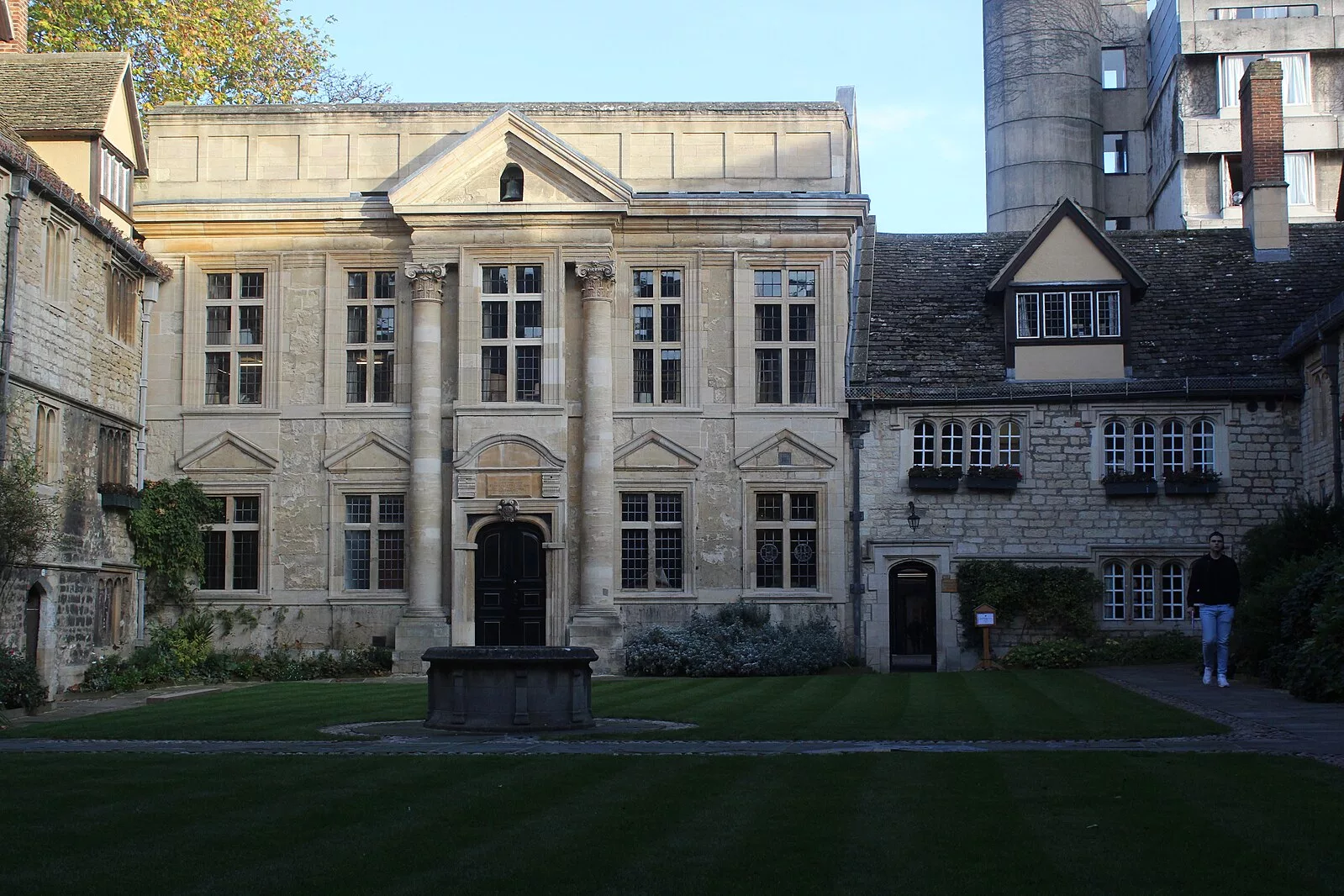
St Edmund Hall has opened new, sustainability-focused accommodation in Norham Gardens, one of Oxford’s most affluent neighbourhoods.
The College describes the buildings, which took three years to construct, as an “exemplar” of sustainability. Designed by architects Wright & Wright LLP, they are certified with a Passivhaus standard, widely regarded as the industry benchmark for energy efficiency, and were built using “sustainably sourced and low-embodied carbon materials”. According to a press release on the Teddy Hall website, the buildings will use 70% less energy than the typical modern building.
It contains 127 en-suite study rooms, split across three new buildings: Willis House, Ashton House, and Elliott House, on the nearly 50-year-old Norham St Edmund site. The buildings, which back onto University Parks, are powered at least in part by solar panels and are heated by air-source heat pumps.
The rooms include heated towel racks, big double beds, and dimmable lights. Despite the luxury, the College kept the nightly rate in line with the rest of its Norham housing. The College told Cherwell that it “recognises the need to keep rents as low as possible” and that its accommodation costs are “below the median of all Oxford colleges”. By that standard, tenants are expected to pay around £30 a night.
Rooms on the site will be reserved for Teddy Hall returning undergraduates. They will not be available to postgraduates and, by extension, not be offered through the Oxford University Collegiate Accommodation System, now in its second year of opening college rooms to students from other colleges. The accommodation will allow Teddy Hall to accommodate all undergraduates for their whole degree.
The development’s outdoor spaces are boasted as climate-resilient and biodiverse, with landscaped gardens and lawns. For budding geographers and biologists, the most intriguing feature may be an ecology pond.
Chancellor William Hague said in a press release: “Norham St Edmund is a world-leading blueprint for future student accommodation projects and sustainable building design, both in Oxford and beyond. I look forward to seeing it serve a thriving college community for generations to come.



-

 Oxford united FC4 weeks ago
Chris Gunter steps away Wales role to focus on Oxford United
-

 Oxford University3 weeks ago
New to the Oxford English Dictionary this September
-

 Oxford united FC2 weeks ago
LIVE: Exeter City vs Oxford United – Jersey Mike's Trophy group stage
-

 Student Life3 weeks ago
Oxford partnership allows OpenAI to use rare Bodleian texts to train ChatGPT
-

 Traffic & Transport2 weeks ago
Why should I have to pay more for buses if I don’t use a smartphone? | Bus fares
-

 Traffic & Transport2 weeks ago
How poor public transport policy is putting the brake on cities | Road transport
-

 Oxford united FC3 weeks ago
Northern Ireland fans laud Oxford United defender Ciaron Brown
-

 Oxford united FC2 weeks ago
Oxford United lose to Exeter City on penalties in Jersey Mike’s Trophy