
Traffic & Transport
When is an ebike not an ebike? When it has a powerful, illegal engine. Get this menace off our roads | Peter Walker

One of the curiosities of debates about cycling in the UK is that almost all of them centre on the place with the greatest concentration of not only bikes but also politicians and journalists: inner London. Inevitably this is just a small part of the story.
Much of the current focus is on so-called share bikes operated by companies such as Lime and Forest – nippy electric-assist machines that can be picked up and left on pavements. On Saturday, a Guardian investigation revealed that councils in the capital have so far this year seized 3,393 dangerously parked or abandoned ebikes, a number 23% higher than the total for the whole of last year.
Depending on your view, ebikes are either a gamechanging boon to short-distance urban transport or, if we heed the testimonies of those who have been menaced or injured, a dangerous and lawless scourge.
But even this misses the point. Outside the handful of urban areas where Lime and their competitors operate, the ebikes that exist are privately owned. And many of these are not, at least under the law, ebikes at all.
This can sound complex, but bear with me. To be classed as an ebike, a machine must have a powered speed limit of 15.5mph and a motor that only kicks in when you pedal, not via a throttle.
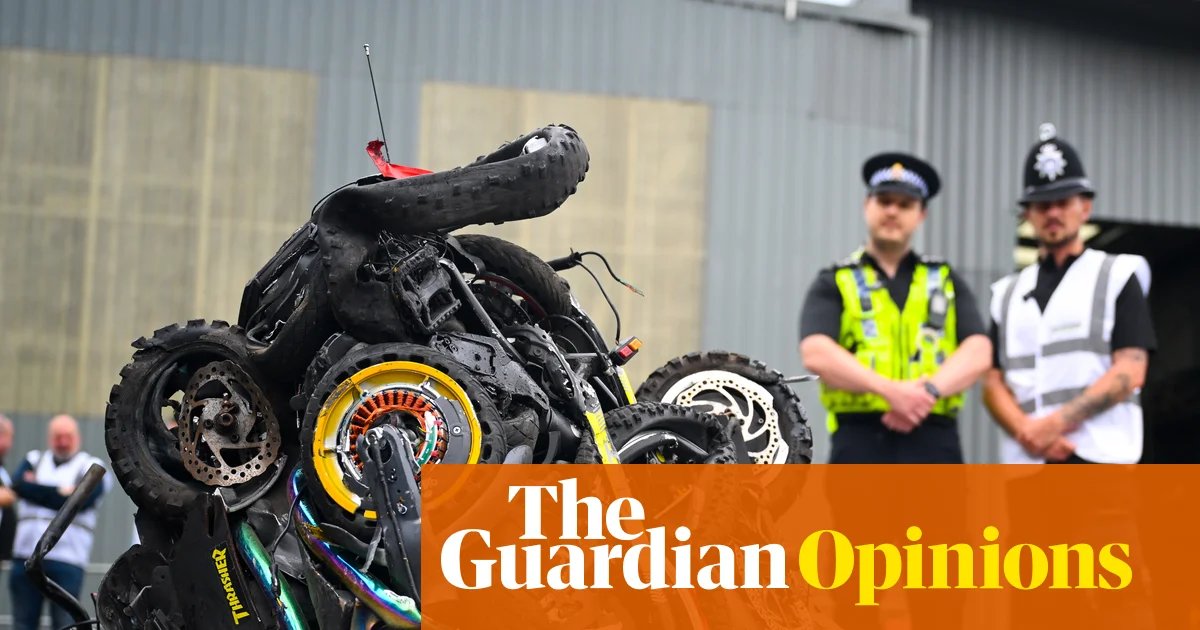
Wander around pretty much any UK town or city for long enough and you will see contraptions that very much do not meet these criteria. They might look broadly like a bike, with pedals and a chain. But they are often throttle-powered and can travel much, much faster than 15mph.
These are not ebikes. They are illegal electric motorbikes. This is a vital distinction to make before you start discussing ebikes, and whether they are, indeed, a brand new peril on our streets.
Now that we know where we are, how much, if at all, of the media scare stories about ebikes or their illegal cousins have a basis in fact? Again, it’s slightly more complex than it might seem.
If you hang around central London, it won’t take too long to see someone on a Lime bike sail serenely through a red light, sometimes weaving awkwardly through gaggles of pedestrians.
This is, of course, illegal, and for all that some cyclists try to justify such behaviour on self-preservation grounds, I’d also argue that it is selfish and intimidating. People should be able to cross the road at a green pedestrian signal without having to first scan the horizon for a beefy twentysomething called Josh on a Lime bike who is running late for his post-work five-a-side game.
But is there any need to panic? Not really. Cyclists are no different from drivers in that quite a few break the law if they think they can get away with it. One issue for cycling PR is that two-wheeled offences are often just more visible.
Government statistics show that when the traffic is flowing freely, fully three-quarters of drivers speed in 20mph zones. This is harder to spot, but the difference is that this sort of behaviour has a realistic chance of killing someone.
Very serious or fatal pedestrian casualties with legal bikes and ebikes do happen, but they are vanishingly rare, unlike incidents with motor vehicles. This is not a matter of morals, just physics – more specifically the way kinetic energy increases so rapidly as the inputs of mass and velocity change.
Some argue that riders of Lime-type bikes are disproportionately likely to flout the rules, in part because they are paying for the transport by the minute. I’m not sure that’s the case.
after newsletter promotion
Either way, it’s undeniable that, overall, share ebikes – in fact all legal ebikes – are a good thing. They make cycling available to demographics that would not normally consider using a bike, especially people without anywhere safe to store their own machine. Despite the occasional annoyance of the Josh contingent, I welcome them to the bike lanes.
It is a very different case for the illegal variants. These are often heavier – some are designed to look like motorbikes – and can go at significant speed. It’s not uncommon for me to be overtaken by a silent, moped-weight gizmo doing 30mph or more. I am, it is fair to say, not a fan of this.
This is, however, not a cycling problem. It’s a law-enforcement problem. It’s therefore also a political problem, not least whether or not any ministers are willing to crack down on a food-delivery industry heavily reliant on riders using illegal bikes.
But the repeated conflation of these two issues has ramifications for cycling. In part it is a call for restrictions on cycling because of offences by those speeding on illegal machines. And because illegal bikes often have vast, poorly made batteries with a tendency to catch fire, some rail companies are pondering bans on all ebikes.
The cycling world is changing quickly. And it is perfectly OK to be annoyed with the Lime bike buffoons. But do remember – they’re not the problem here.
Traffic & Transport
Rail passengers get automatic right to switch operators for free when trains are cancelled | Rail industry
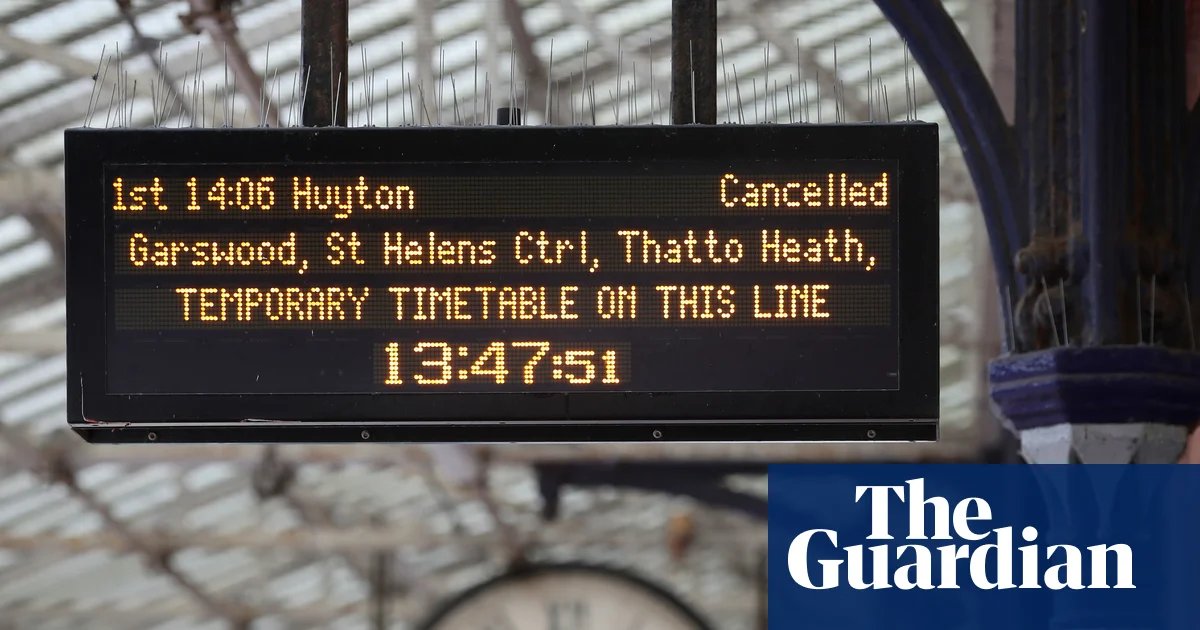
Rail passengers whose trains are cancelled will have the immediate right to travel on other operators’ services to finish their journey without further charge, ministers have announced.
The “commonsense change” will take effect from Sunday 20 September, ending the confusion in Britain where many pre-booked tickets are not valid on other firms’ trains.
While passengers are frequently allowed to travel with different operators in times of severe disruption, travellers can be left to wait for a formal agreement that another firm’s tickets can be accepted, or sometimes buy an expensive new ticket and apply for a refund for the first.
The Department for Transport said passengers had until now been “paying the price for a system which prioritises shareholders when trains are cancelled”.
From 20 September, customers holding a valid ticket will be able to travel on another operator’s train two hours before or after the original cancelled service, on a reasonable alternative route.
The rail minister, Lord Hendy, said: “This is a simple, commonsense change that puts passengers first. No one should be left stranded because of a fragmented railway when their journey is disrupted. From this weekend, if your train is cancelled, you can get on another operator’s service and carry on your journey without paying again.”
He said the government was making the railway “simpler, fairer and easier to use, as we move towards Great British Railways and put public service back at the heart of our railways”.
Automatic cross-operator ticket acceptance has been brought in already across firms returned to public ownership, but now CrossCountry, GWR, Avanti West Coast and Chiltern Railways, running important intercity routes, will be included.
The remaining passenger train operations are scheduled to come into public ownership next year under a Great British Railways banner, bar a handful of open-access services, which will remain separate.
after newsletter promotion
East Midlands Railway, which has been beset with problems while introducing malfunctioning Hitachi bi-mode trains, will also not be immediately included due to its ongoing mass cancellations and shortages of seats.
Alex Robertson, the chief executive of the independent watchdog Transport Focus said it was “a welcome change that we have long called for”, adding: “The key now is making sure passengers get clear information about their options whenever disruption occurs.”
Traffic & Transport
London Underground workers exposed to asbestos without protective masks, documents reveal | Asbestos

Hundreds of London Underground workers could have been exposed to asbestos for almost 20 years without protection required under safety regulations, according to documents seen by the Guardian.
Under 2002 rules on controlling asbestos and other hazardous materials, employers are required to take a series of precautions, including ensuring exposed workers are given individually fitted face masks to prevent inhalation of toxic dust.
Emails and minutes of meetings reveal that London Underground managers admitted that face-fitted masks were not issued to staff until as late as 2020.
The documents suggest Transport for London (TfL), the public body responsible for London Underground, is at risk of more expensive legal claims after already paying out more than £7m in asbestos-related compensation and legal fees.
The documents were disclosed as part of an employment tribunal hearing brought by a former London Underground cleaner, Micky Steeds, who successfully claimed he was unfairly dismissed after raising concerns about exposure to asbestos and other toxic dust.
In one set of minutes, a manager said he had no recollection or record of face-fitted masks being issued in 2018 to the team responsible for cleaning dust from vents, which included asbestos-sheathed cables. He said such masks were not introduced to London Underground’s civils teams, responsible for all the tube buildings, until late 2020.
In December 2020, another manager who was head of lifts and escalators said: “A lot of people aren’t face-fitted,” adding: “Staff shouldn’t have worked without face fit, but it has happened.”
He blamed the failure on a lack of training.
In 2019, an email from a third manager said allowing Steeds to carry on working without a face-fitted mask was oversight that would be rectified in future. In a 2023 email, a fourth manager admitted that asbestos dust fibre sampling, which is also required under the law, was not conducted.
TfL has recorded more than 20,000 asbestos-containing materials across its network, according to data released under freedom of information to Confront Power – an investigative newsletter on industrial harms.
TfL insists it has controls in place to manage the risk of asbestos exposure to its staff and the public. In an email in December 2022, a senior engineer responsible for hazardous materials said test results showed levels were “below the relevant workplace exposure limits for both respirable and inhalable dust”. But he said dust being cleaned contained “traces of asbestos fibre occasionally”.
But Steeds and one of his former colleagues point out that tests were not conducted while the asbestos was being cleaned and disturbed.
And minutes of meetings between staff and a manager also revealed issues with damaged asbestos, which is more dangerous. One experienced cleaner said he encountered asbestos on cables 90% of the time and sometimes: “Broken chunks of asbestos or cable shearing.”
Asked what he did when he found asbestos, he said: “We would just carry on and use common sense … don’t bash cables and do what you can.”
Catriona Ratcliffe, a solicitor from the personal injury team at LeighDay, said: “Where the asbestos materials are damaged or in poor condition, the risk of exposure is higher because there is more opportunity for the fibres to be released into the atmosphere.”
Earlier this year Ratcliffe secured a six-figure settlement from TfL for a former inspector who was diagnosed with sarcomatoid mesothelioma 27 years after supervising the removal of asbestos from the Northern Line.
She said the documents in Steeds’ case could result in more injury claims. She added: “If someone is exposed to asbestos over many years, even at low levels, that is going to put that person at risk. And if the employer had knowledge of the risk of exposure, that could result in a legal claim if they have not taken the precautions required under regulations.
“Under the control of asbestos regulations [if exposure to asbestos is unavoidable] employers should be giving workers full protection including face-fitted respiratory masks to reduce that risk as far as possible.”
Steeds, who was not fitted with a proper mask for 15 months, said: “Over the years, TfL must have put the health of hundreds of workers at risk by failing in their legal duty to provide fitted masks. It makes me so angry that even when I told them about it, they ignored my concerns and tried to cover it up. The incompetent managers who allowed this to happen now have serious questions to answer.”
Rob Donnan, a former LU cleaner who is appealing against an employment tribunal’s rejection of his claim for unfair dismissal, said he worked without a fitted mask for three years. He estimated that up to 80 cleaners in the vents department alone were not fitted with masks between 2002 and 2020 and that a further 300 staff in the escalator department were similarly unprotected.
A TfL spokesperson said: “We have strict controls in place, in line with the government’s control of asbestos regulations, which ensure customers and staff are not at risk from exposure to asbestos when travelling or working on the tube network. Our specialist teams monitor and manage locations where asbestos has been found to ensure the safety of everyone travelling or working on the network.”
They added that, as TfL was appealing against Steeds’ successful tribunal ruling, it was unable to comment further.
Traffic & Transport
Thousands of ebikes seized by London councils as anger rises over blocked paths | Cycle hire schemes
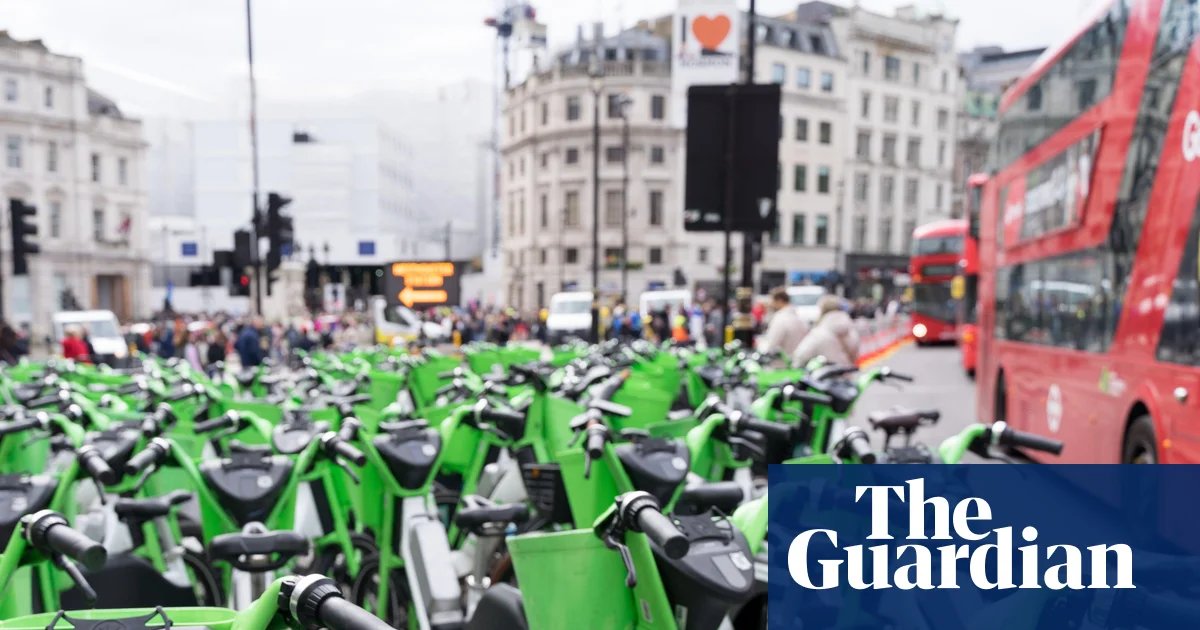
London boroughs have seized at least 3,000 ebikes this year, a Guardian investigation has found, as hire companies face growing calls to stop bicycles littering streets and blocking pavements.
Local authorities across the capital have seized 3,393 hazardously parked or abandoned ebikes so far this year, 23% higher than the number seized during all of 2025.
Lime, the California-based bike rental company, accounted for more than 2,000 of the seizures this year, according to figures provided by 19 reporting authorities under a freedom of information request. The rival bike company Forest ranked second, at 978 seizures overall, followed by Voi at 103.
Dockless ebikes have surged in popularity in recent years as a cheaper and greener alternative to other modes of transport. One in 10 of the 1.5m daily cycle journeys in the city are made using dockless ebikes, according to estimates by Transport for London (TfL).
However, campaigners are calling on providers to do more to prevent buildups of their bikes on pavements and roads.
“Irresponsibly parked ebikes cause a lot of problems,” said Zak Viney, of the campaign group Living Streets. “It prevents people from walking and wheeling on the street safely.”
Erik Matthies, policy lead at the Royal National Institute of Blind People, said the rise in abandoned ebikes was overwhelming blind and partially sighted people, as well as elderly people and wheelchair users.
“People are having collisions and injuries due to bikes left on the pavement, and the problem is getting worse,” he said. “There are blind people who tell us they do not go out on their own any more and they do not make journeys that they used to.”
The Guardian sent freedom of information requests to all the 21 boroughs across London that have dockless bike contracts, as well as the City of London, the authority that manages the financial district in the centre of the capital. Of these, nine said they did not seize or fine any bike operators, and three either did not reply within the deadline or said they did not hold the information.
James Slater, a councillor in Camden, said ebikes had been left in resident parking bays and had obstructed traffic on roads. “During the solar eclipse we had swarms of ebikes around Primrose Hill and Hampstead Heath,” he said. “The operators have a responsibility to make sure the bikes are not causing a public nuisance.”
Bike operators argue councils are not investing sufficiently in building more parking bays, which could prevent the buildup of poorly parked bikes on pavement.
Meanwhile, councils have bemoaned a lack of centralised regulation across London, which they argue would make planning easier.
Slater said the regulation across London was like a “jigsaw puzzle”.
“We need to have a London-wide approach,” he said. “It’s very difficult for 32 councils in London to all have slightly different policies, and in some cases different operators on borough boundaries.”
after newsletter promotion
The English devolution bill, passed in April, gives local authorities in England fresh powers to license rental ebike operators and set requirements around parking, safety and accessibility standards.
In London, the new licensing powers go to TfL, which is expected to create a single capital-wide regulatory framework for dockless ebike operators. The mayor of London’s office said it was working closely with TfL and the Department for Transport on the secondary legislation required to implement “much-needed controls as quickly as possible”.
A spokesperson said: “It’s vital that safety improvements sit at the heart of any future regulation to ensure the industry can continue to thrive. The mayor continues to urge all dockless operators to fully engage with London boroughs and TfL to ensure their services work well for all Londoners.”
Lime said the fact it was the biggest ebike operator in London should be taken into account when considering the number of its bikes seized, adding that these incidents mostly occurred at overcrowded parking bays.
“The vast majority of our riders end their trips responsibly, and a very small proportion of total rides result in seizures and fines by councils,” a spokesperson said.
“We recognise that parking is a challenge across the industry largely due to ebike parking not keeping pace with growing demand for rental ebike services.”
Forest also said the number of designated parking bays had not kept pace with demand, adding that it was “working close with boroughs to encourage responsible parking and ensure our service works for everyone”.
A Voi spokesperson said: “Voi vehicles should never be parked in a way that blocks access routes, lift areas, pavements, entrances or emergency routes. We recognise the particular impact poor parking can have on disabled people, parents with pushchairs and people using mobility aids, and we take reports of obstruction seriously.”


When is an ebike not an ebike? When it has a powerful, illegal engine. Get this menace off our roads | Peter Walker

Oxford United stars receive UEFA Nations League squad selection

Oxford United transfer chief explains EFL embargo and contract dilemma
-

 Oxford News3 weeks ago
Richard Hammond takes control of classic car company
-

 Business & Technology4 weeks ago
Apprentices say AI is reshaping tech skills demand
-
 Oxford News4 weeks ago
Royal Mail customer notice to anyone writing addresses by hand
-

 Business & Technology4 weeks ago
UK flight school collapsed into liquidation
-

 Oxford Events3 weeks ago
Stage Watch: Now You See Me, Comedy About Spies, Standard Of Living, Every Woman & Silence of Lambs
-

 Oxford Events3 weeks ago
What’s on in Oxfordshire this September
-

 Oxford Events3 weeks ago
Supercar invasion: Salon Privé 2026 to bring a slew of UK automotive debuts
-

 Oxford News3 weeks ago
King Charles applauded as Dragons’ Den star among 26 to lose MBE