
UK News
What will the Southport Inquiry tell us and what are next steps?

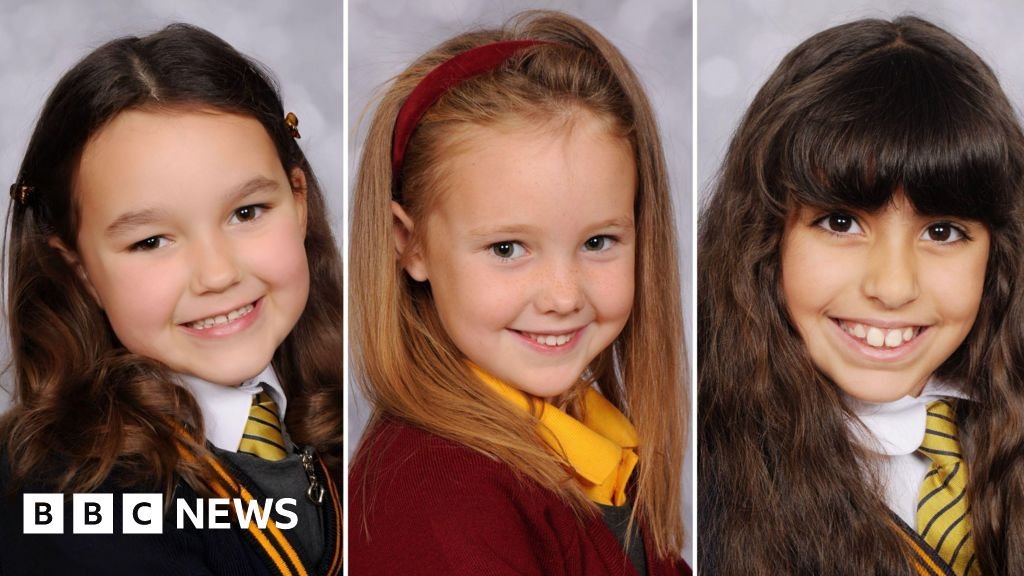
The public inquiry was set up following a knife attack which led to the deaths of three young girls.
Source link
UK News
Oil price tops $100 a barrel again after Trump announces strait of Hormuz blockade – business live | Business
Key events
FTSE 100 drops
London’s stock market has opened with a bump, as traders react to the lack of progress in the US-Iran peace talks.
The FTSE 100 index of blue-chip shares has lost 0.6% at the start of trading, falling by 67 points to 10,533 points.
AB Foods (the grocery, sugar, agriculture, ingredients and retail group) are the top faller, down 2.7%, with airlines, miners, banks and housebuilders all lower.
Energy companies are rallying, though; BP and Shell are both up more than 1%.
Energy shock to wipe out growth in UK living standards
The surge in energy costs from the Iran war will cost a typical UK household almost £500, new research from the Resolution Foundation shows.
The Resolution Foundation have esimated that rising energy prices are likely to tip living standards growth into negative territory this year.
That’s because the increased cost of energy bills and petrol at the pump will almost certainly be passed onto households.
The typical household is now set to see its income fall by 0.6% – a difference of £480 – over the course of the current financial year, they say, Before the conflict, they were on track for 0.9% growth.
Average income growth for the poorest fifth this year is now set to be just 1.2%, down from 2.8% before the conflict.
James Smith, chief economist at the Resolution Foundation, says:
“Despite hopes for a sustained peace, the path of this conflict remains uncertain and energy prices remain well above pre-war levels, meaning many households face a decline in their purchasing power this year.
“This squeeze will run right through the income distribution. Lower-income households will still see some income growth thanks to a long-awaited rise in real benefit levels, but inflation will likely knock more than a percentage point off what they stood to gain. For those in the middle and towards the top of the income distribution, even the thin growth they had been expecting has tipped into negative territory.
“Deescalation is certainly welcome, but damage to household finances this year is to a large degree already done. The Government should act now to prepare a social tariff that reaches households falling through the cracks this winter.”
Heathrow Airport has warned that the outlook for the next few months is uncertain, due to the ongoing conflict in the Middle East.
In its latest traffic commentary, Heathrow says it is supporting airlines and passengers as they adapt to airspace closures, adding:
The knock-on impacts to global supply chains, including fuel, have not affected airport operations. Heathrow will monitor the situation and liaise with Government and airlines to protect passengers’ journeys.
The US dollar is rallying as a sharp risk-off move ripples across markets.
The dollar index, which tracks the greenback against a basket of other currencies, has gained 0.35% this morning.
The pound is down half a cent, to just above $1.34.
UK gas price jumps
The price of wholesale gas has also risen this morning.
The month-ahead US gas contract is up 9% to 119.50 a therm, its highest level since last Tuesday (before Donald Trump announced the two-week ceasefire with Iran).
Before the conflict began at the end of February, gas was trading below 80p a therm, before hitting 180p/therm in mid-March.
Analyst: oil remains vulnerable to geopolitical triggers.
Every barrel of risk added to oil markets carries an inflation price tag for the global economy, warns Priyanka Sachdeva, analyst at brokerage Phillip Nova:
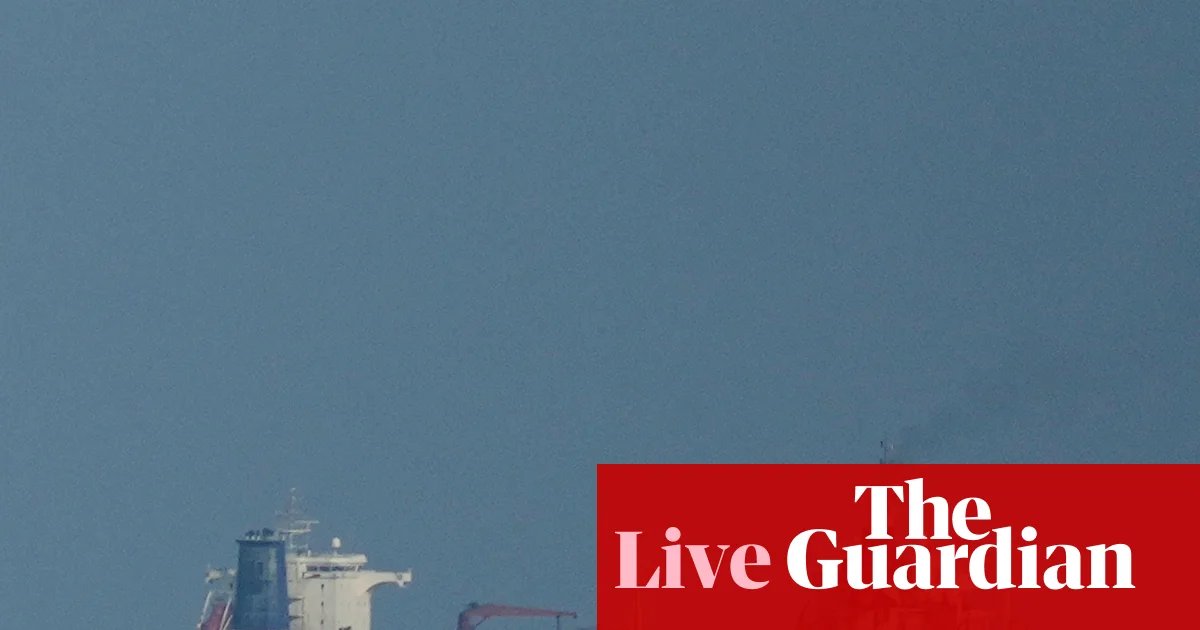
Oil markets have decisively re-entered geopolitical mode, with prices vaulting back above the psychological $100 per barrel threshold as the United States moved to impose a naval blockade targeting Iranian shipping through the strait of Hormuz.
Both benchmarks, WTI and Brent, opened gap-up and currently hover with almost 8% gains. The market reaction underscores a simple but powerful reality: Hormuz risk is not theoretical; it is structural, and it is real.
The latest catalyst came after talks mediated by Pakistan failed to produce a durable agreement, prompting the U.S. to announce enforcement of maritime restrictions on vessels moving to and from Iranian ports. The mere threat of enforcement alone has been sufficient to re-price risk, demonstrating how vulnerable oil remains to geopolitical triggers.
Only mild losses in Asia-Pacific markets after peace talks break down
The breakdown of US-Iran peace talks last weekend has only led to modest losses in Asia-Pacific markets.
Japan’s Nikkei index is down 0.75%, while Hong Kong’s Hang Seng index and the South Korean KOSPI have both dropped by 1.15%.
Michael Brown, senior research strategist at brokerage Pepperstone, says:
While crude has advanced, and stocks slipped a touch, the overall market reaction to the weekend news of a US Navy blockade of the strait of Hormuz has been relatively contained, as participants view the move largely as a negotiating gambit from President Trump.
While it’s clearly a risk-averse start to the trading week, amid President Trump’s announcement of a Navy blockade in the strait of Hormuz, the general market reaction can be summed up as ‘could be worse’.
The US blockade of the strait of Hormuz is a blow to the 20,000 seafarers who have been trapped in the Gulf for the last six weeks.
One told us last week:
“I gave my notice exactly one month ago. I’ve informed the master, I’m not willing to sail through the strait. It’s about safety, it’s all about safety.”
Introduction: US blockage threat puts oil back over $100
Good morning, and welcome to our rolling coverage of business, the financial markets and the world economy.
We start a new week, again, with an escalating conflict in the Middle East, after the collapse of US-Iran peace talks last weekend.
Donald Trump’s threat to impose a blockade on the strait of Hormuz has driven the oil price back over $100 a barrel again this morning, as hopes of an end to the conflict soon take another knock.
Brent crude, the international benchmark, has jumped by 7% to $101.88 a barrel, while US crude is up over 8% to $104.69 a barrel – back towards the highs of almost $120 set early in the conflict.
The US president also said he had asked the US Navy to “interdict” any ship that had paid a toll to Iran for passage through the strait, in an attempt to choke off the flow of Iranian oil.
Tony Sycamore, market analyst at IG, says:
By doing so, the US aims to force Tehran’s allies and customers to put pressure on Iran to reopen the vital chokepoint, potentially resolving the impasse without committing ground forces to another protracted conflict.
This approach will undoubtedly strain Iran’s relationship with its largest customer, China. Having already lost Venezuelan supply earlier this year, Beijing now faces the potential loss of another roughly 2m barrels a day.
The war has already driven confidence across Britain’s biggest companies down to a six-year low.
Deloitte’s quarterly survey of chief financial officers has found that concerns around energy prices, inflation and interest rates surging after the Middle East conflict, to its lowest level since early in the Covid-19 pandemic in 2020.
The agenda
UK News
The incredible life of the ‘bird man’ refugee who brought tweets, chirps and trills to British radio | Documentary films
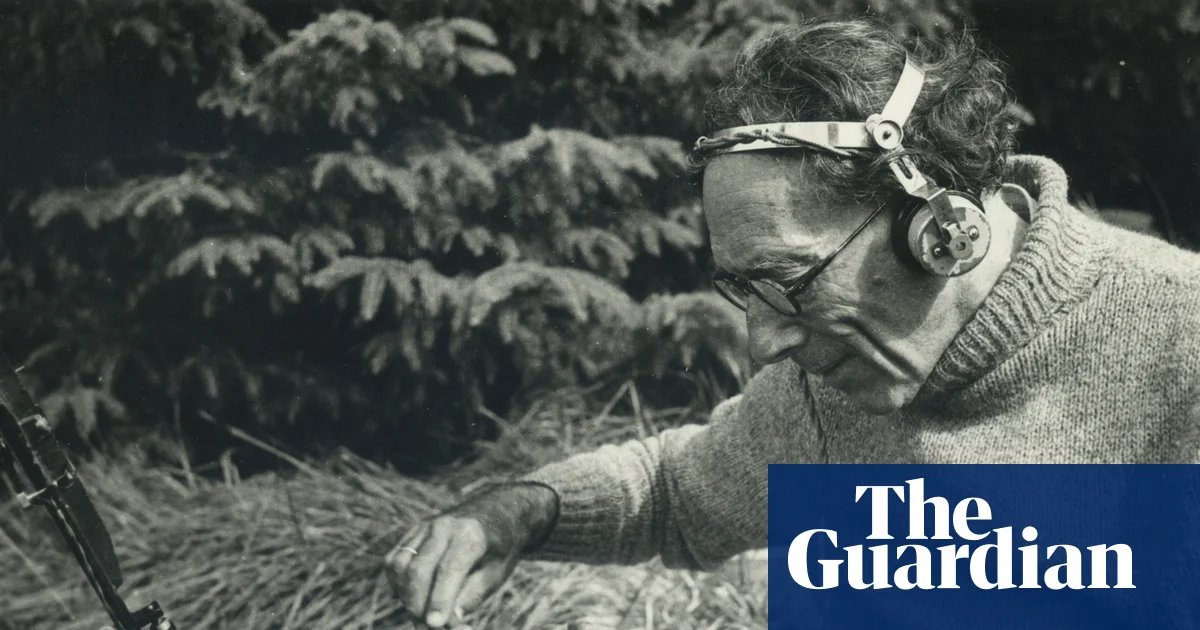
In his lifetime, pioneering German sound recordist Ludwig Koch’s heavily accented voice was as familiar to British audiences as David Attenborough’s is today. His tireless passion for capturing birdsong and bringing it first into German and, after his exile from Nazi Germany, British homes via sound books and BBC radio, made him a household name from the late 1930s onwards.
He was celebrated beyond his life, parodied by Peter Sellers (playing Koch observing life at a Glasgow traffic junction) and immortalised in Penelope Fitzgerald’s 1980 novel Human Voices, about the wartime BBC, which depicts Koch’s assiduous approach to capturing natural sounds and indirectly highlights how the organisation benefited from new voices like his.
Yet to his film-maker granddaughter Anthea Kennedy, Koch was a somewhat aloof presence. “I don’t remember ever having a conversation with him,” Kennedy says. Instead, he preferred singing to her, vividly daydreaming of the brief career as a tenor opera singer he had had to give up in Germany because of the first world war. “He’d squeeze my hand tightly, which I hated, and sing classical opera, then ask me what he’d been singing. It didn’t seem to matter to him that I didn’t have a clue.”
Given their relationship, it’s all the more surprising that Kennedy, with fellow film-maker and partner, Ian Wiblin, has created a loving tribute to Koch. Their film, Alarm Notes, interlaces images and sounds from modern Berlin and other places he visited as a naturalist with many of Koch’s own recordings, from the warm whistle of the golden oriole in Spandau, to sneezing seals on Skomer island, and his personal performances of Schubert lieder in old age. It’s a haunting and jarring intertwining of past and present, and acts like the dialogue between the granddaughter and grandfather that didn’t happen in life.
“I wanted to explore what had really happened to him in Berlin,” Kennedy says. “Neither he nor my grandmother ever talked to a soul about anything in their past.”
Before the Nazi takeover, Koch had enjoyed a thriving career as head of the culture department at one of Germany’s leading record companies (Carl Lindström), making bestselling sound books of birds and the natural world, as well as of urban landscapes. As part of this, he turned the idea of going on location – sometimes trailing cables for miles through undergrowth in the dead of night to obtain closeup sounds – into a professional craft. His 1889 recording of his pet shama bird, made in his animal-filled childhood home in Frankfurt when he was just eight years old, is believed to be the very first recording of a bird.
Kennedy recounts how Koch and his wife, Nelly, came to be entangled in the Gestapo investigation into the Reichstag fire of 1933, which the Nazis used as a pretext to turn Germany into a dictatorship.
The Kochs had – unwittingly – rented a room in their Berlin house to one of the accused arson attack plotters. Known to them as Dr Steiner, he was in fact Georgi Dimitrov, the communist revolutionary who went on to become Bulgaria’s first communist leader.
After Dimitrov’s arrest, they were also taken for interrogation by the secret police. Suspecting a further arrest, they wrote suicide notes, took barbiturates and turned on the gas taps in their kitchen, before being discovered by their maid and resuscitated. Their attempt to take their own lives was mentioned at Dimitrov’s trial at Germany’s highest court in Leipzig, prompting the Bulgarian to apologise.
Kennedy pieced together the story from archive documents and Dimitrov’s diaries. As far as she knows, her grandparents never mentioned their attempt at suicide, and spoke very little of their time under the Nazi cudgel.
While his “non-Aryan” identity had excluded Koch from the Reich Association for the Protection of Birds, the Nazis initially chose to ignore his Jewish heritage because they valued his skills as a sound recordist. In August 1933, he even suggested making a sound book of the armed forces for propaganda purposes. Entitled Im Gleichen Schritt und Tritt (Stepping and Striding Together), it is a frightening but impressive audio collection of everything from machine gun rounds to the flickering campfire of a soldiers’ night-time gathering.
Yet on a work trip to Switzerland in January 1936, after the assassination of the Nazi who had accompanied Koch to monitor him, he was warned by a Swiss government official his life was in danger. “The air in Switzerland is better than in Germany,” he was told.
Fleeing to Britain, he found a refuge among fellow naturalists and bio-acoustic enthusiasts and became a darling of radio listeners, in particular as a regular on the BBC’s Children’s Hour.
Koch, who died aged 92 in 1974, did not take Kennedy with him on any of his recording odysseys. The only brush she can recall with her grandpa in his guise as the “bird man”, was a “quite creepy” trip to London zoo when she was seven years old. Behind the scenes they were shown myna birds, which can imitate human speech and were banned from public display because of their inclination to pick up swear words. She recoils as she describes being made to go into a bird cage on her own, with other children looking on, as a toucan “rolled a grape down its beak into my mouth, then took it out again, rolling it back up its beak, my grandpa looking on”.
Yet making Alarm Notes has changed her view of her grandfather. Reading his letters held in the broadcaster’s archives, she recognised his lengthy struggles to be taken seriously by his British colleagues and to make a living. “I can’t help but think they made a caricature out of him, but that he decided, OK, I’ll fit into that, if that’s what it takes,” she says.
“It’s made me understand his suffering, and how incredibly difficult his life was. I admire his patience and desire, and it’s made me finally like listening to birds.”
Rose looked like a man on a mission on the front nine, but faltering on the par-four 11th – pushing his second shot right and then three-putting – stalled his momentum.
A duffed chip from the sticky fringe at the back of the green on the iconic par-three 12th was followed by another three-putt from an eagle opportunity on the scoreable par-five 13th.
Unable to recover, a frustrated Rose finished on 10 under and was denied the fourth Masters runners-up finish of his career.
“It is another little stinger,” said 2016 Olympic champion Rose, whose sole major win came at the 2013 US Open.
“I was by no means free and clear, and nowhere close to having the job done, but I was right in position.”
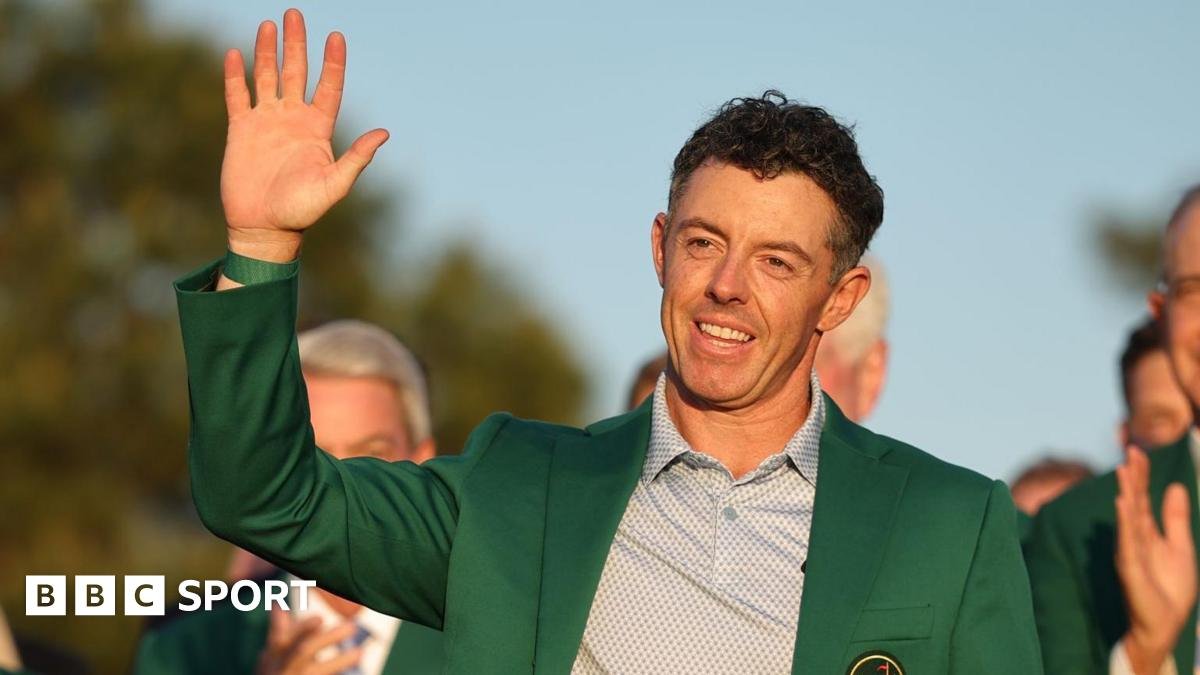
Instead it was two-time champion Scheffler who finished as McIlroy’s nearest challenger after carving his own piece of history.
The 29-year-old American, who won in 2022 and 2024, became the first player since 1942 to card a bogey-free weekend on his way to a fourth successive top-10 finish.
Ultimately he paid the price for making a slow start, which has been a common theme for him in recent months.
“I knew I was going to have to do something special if I wanted to catch [McIlroy] or [Young]. I was close but it was just a few shots here or there,” said Scheffler.
Rose was joined in joint third by England’s Tyrrell Hatton, plus American pair Russell Henley and Cameron Young.
Hatton’s final-day 66 concluded a weekend where he seems to have made peace with the Masters.
The 34-year-old’s relationship with Augusta National had been a volatile one, having regularly squabbled with the course’s unrelenting undulations and even going as far as labelling it “unfair” in 2022.
“This is my 10th Masters, so I’ve been fortunate to be here a lot and my results the last three years have definitely improved,” Hatton said.


Goring resident creates Goring Slot Racing Circuit

Oil price tops $100 a barrel again after Trump announces strait of Hormuz blockade – business live | Business

Sole traders turn to AI for tax advice as rules change
-
 Crime & Safety4 weeks ago
Police race to crash on Oxfordshire A34 with severe traffic building
-
 Oxford News4 weeks ago
Schwarzman Centre to open doors to public with major celebration
-
 Oxford News4 weeks ago
Gary Lineker’s nephew-in-law death inquest to be next week
-

 Business & Technology3 days ago
Aqilla launches AI invoice tool to speed accounts payable
-

 Crime & Safety1 week ago
American Akita and a French Bulldog seized after dog killed
-

 Crime & Safety4 weeks ago
Wiltshire 12-year-old girl with Oxfordshire links missing
-
 Oxford Events4 weeks ago
Michelin Guide Oxfordshire Restaurants – The Oxford Magazine
-

 Oxford News4 weeks ago
Statins do not cause the majority of side effects listed in package leaflets