
Business & Technology
UK home improvement retailer to close 15 stores in 6 months

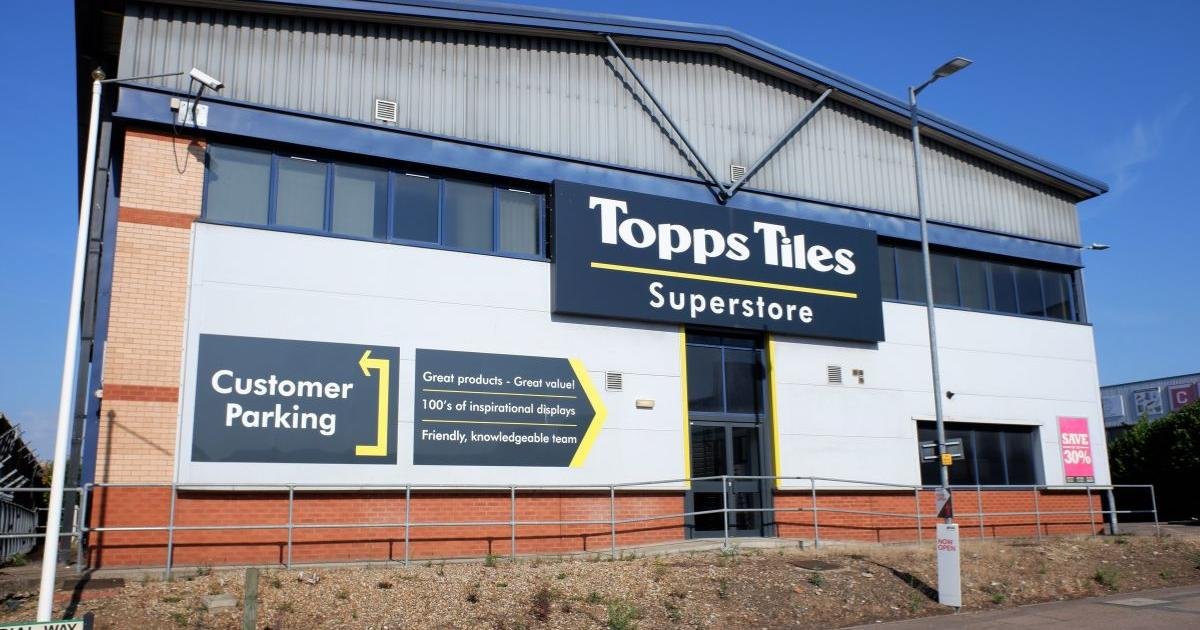
Topps Tiles has said the closures, which results in 7% of its 319-strong estate, will help slash costs as part of “significant self-help measures” in the face of a tougher home improvement market.
The Leicestershire-based tile chain added that this also includes savings being made at its head office.
It’s thought the move will “provide a stronger financial platform for 2027 and beyond”.
Topps said the stores are under-performing, with eight already closed since last September and the remainder being shut over the next six months.
However, it did not disclose what impact the moves would have on its workforce.
Topps Tiles chief executive Alex Jensen, who took over as chief executive on December 8 after former longstanding boss Rob Parker retired, commented: “In light of subdued consumer sentiment and geopolitical uncertainty as well as the cumulative impact of cost inflation, the management team is implementing a targeted programme of self-help measures weighted towards the second half.
“These actions are designed to support year on year profit growth and provide a stronger financial platform for 2027 and beyond.”
The tile company said sales fell 0.1% to £142.7 million in the six months to March 28, though it said revenues were impacted by a “lengthy” competition process and disposal programme required to appease competition concerns after it bought CTD out of administration in 2024.
With the CTD business stripped out, sales rose 2.1%, though it said growth slowed sharply to 0.6% in the second quarter.
It said it performed better than the wider DIY and home improvement market.
The cost savings efforts are set to impact sales, but boost profitability, Topps Tiles said.
Topps saw its deal to buy CTD out of administration probed by the Competition and Markets Authority (CMA), which required it to sell off a number of CTD stores to appease concerns.
The firm was left with 22 CTD stores, down from an initial 31.
In December, it also bought the brand of collapsed rival Fired Earth in a £3 million rescue deal after the Oxfordshire-based competitor tumbled into administration in October, resulting in the closure of its 20 UK showrooms and 133 job cuts.
Topps said the group is on track to return the CTD arm to profit in 2025-26, having notched up like-for-like sales growth of 1% across the division in the first half to March 28.
The firm reported a statutory pre-tax profit of £8.3 million in the year to September, swinging from a £16.2 million pre-tax loss a year earlier.
It will report half-year figures on May 19.
UK businesses that have entered administration in 2026
Topps Tiles isn’t the only major UK business affected by rising costs in 2026, which has already seen several retailers entering administration and others announcing widespread store closures.
Fashion brand LK Bennett collapsed into administration in January and launched a closing-down sale at its stores.
John Noon and Mark Firmin of Alvarez & Marsal Europe LLP were appointed joint administrators.
Following this, the LK Bennett brand and related intellectual property were sold to US firm Gordon Brothers, which also owns Laura Ashley and Poundland.
Alongside this, major high street retailers, including River Island, Primark, and Poundland, have been forced to close stores, while Revolution and BrewDog have shut the doors to 21 and 38 pubs, respectively.
UK construction company Onespace Group, which is based in Knutsford near Manchester and specialises in the creation of commercial office spaces, entered administration recently too.
Recommended reading:
UK beauty firm Beauty Bay filed for administration this month but was saved.
A French-owned company called AA Investments Group bought it for an undisclosed amount, saving stores and people’s jobs.
Russell & Bromley, Moores, Claire’s and The Original Factory Shop, Quiz, Denby, and National Car Parks (NCP) have also fallen into administration recently.
Which shops have recently closed near you that you miss? Let us know in the comments below.

Cloud2Me has published survey findings showing widespread use of artificial intelligence among finance and accountancy professionals, alongside growing concern about compliance and data security risks.
The survey found that 74% of respondents use AI at least a few times a week, while 60% use it daily. ChatGPT and Microsoft Copilot were the most commonly used tools, accounting for 55% of reported usage between them. Many professionals said they used more than one platform for different tasks.
Frequent exposure to AI appears to have made many accountants and finance workers more adept at identifying machine-written material. Respondents pointed to recurring signs such as unusual formatting, generic language, and excessive structure or punctuation.
Some said they noticed a mismatch between the language in AI-produced content and the known style of clients or candidates. Others cited factual errors, including cases where AI-generated material did not align with UK accounting rules or contained obvious mistakes.
One respondent highlighted an incident in which a chief executive officer used a diagram showing eight days in a week. Another said AI was being used in reverse to check whether job candidates had relied on it to prepare interview answers.
Adoption Gap
The findings also pointed to a gap between adoption and internal controls. Four in 10 respondents said they chose AI tools mainly because they were convenient or recommended by others, rather than for accuracy or compliance reasons.
That may draw attention in a sector that handles sensitive financial information and operates under strict regulatory obligations. The survey also recorded concerns about where uploaded data is stored and how client information is handled once entered into consumer AI tools.
Several respondents said unsafe AI use had already led to internal disciplinary action. This suggests some firms are dealing with governance issues after adoption rather than before it.
Helen Brooks, Head of Commercial at Cloud2Me, said: “These findings reflect a profession that is maturing in its relationship with AI – but maturing unevenly. Finance and accountancy professionals are sharp enough to spot AI-generated content, yet many are still selecting tools based on convenience rather than compliance credentials.
“In a sector where accuracy and data security are non-negotiable, that gap is a real risk. The GDPR concerns raised here are not hypothetical; they are already resulting in disciplinary action. The question for practices now is not whether to use AI, but whether they have the governance in place to use it responsibly.”
Detection Skills
The responses offered a detailed picture of how finance professionals say they recognise AI-written material. One participant wrote, “M dashes, underscored, conversational speak. It’s a red flag,” while another said, “The big dashes in the answers.”
These comments reflect growing familiarity with the stylistic patterns associated with widely used generative AI tools. Respondents also complained about polished but generic phrasing, saying it often failed to match the communication habits of the person it purported to represent.
One participant described that contrast directly: “You know your clients, and the vocabulary doesn’t correlate to the individual.”
Sector Pressure
The accountancy profession has been under pressure to assess how AI fits into daily work without undermining rules on privacy, record-keeping, and accuracy. Firms are increasingly weighing productivity gains against the risk that models may generate false information or process data in ways that create legal and reputational exposure.
Cloud2Me supports more than 500 accountancy practices across the UK. It provides hosted desktop and managed cloud services for accountants, bookkeepers, and finance teams.
The survey suggests AI use is no longer experimental for many professionals in the sector. The sharper question raised by the responses is whether firms can match that routine use with controls strong enough to prevent errors, misuse, and breaches involving client data.
As one respondent put it: “Several staff members had to have disciplinaries over unsafe AI practice. Where is the data we upload going? Where is it stored? Big GDPR problem.”

Keyloop has completed the acquisition of Motortech.ai, bringing Motortech.ai’s AIME product into its Fusion automotive retail platform.
The deal adds an AI-based customer communications tool for car retailers’ sales and service operations. AIME will be integrated across core parts of Fusion, including Vehicle Hub, Acquisition Hub and Sales Hub.
Motortech.ai is a UK-based developer of automotive retail software. Its main product, AIME, is designed to handle online customer conversations that would otherwise go through website forms or sales staff.
According to Keyloop, the software can respond to customers at any time of day, search vehicle stock, provide finance quotations, value part exchanges, capture test-drive preferences and book appointments. The system is intended to reduce lost leads caused by slow response times and limited out-of-hours support.
AIME also screens customer interactions before passing higher-intent leads to sales teams. By the time a lead reaches staff, the software may already have checked stock, produced finance quotes and valued a part exchange, reducing the time employees spend on each potential sale.
Tom Kilroy, chief executive officer of Keyloop, set the acquisition within the group’s wider use of artificial intelligence in dealership software.
“The acquisition of Motortech.ai and integration of AIME across Fusion is a significant milestone in our AI strategy. By embedding purpose-built conversational AI directly into our platform, we’re giving retailers an always-on capability that engages customers and frees sales teams to focus on what they do best – building relationships and closing deals,” said Kilroy.
Dealer Results
Keyloop cited early results from one dealer already using AIME on its website. The retailer deployed the system as part of an effort to improve customer satisfaction and reduce the number of separate IT tools in use.
Over a three-month period, the dealer’s web conversion rate rose fourfold to 14.5%, according to figures supplied by Keyloop. Sales also increased by 101% over the same period.
Keyloop said the retailer generated GBP £18 in profit for every GBP £1 invested in the software. The business also saved the equivalent of 19 full working days, allowing sales staff to spend more time on customer interactions.
Platform Push
The move expands Keyloop’s presence in AI tools for automotive retail, an area where software providers are trying to help dealers automate more of the customer journey while preserving human involvement in higher-value conversations. By placing AIME inside Fusion rather than offering it as a separate product, Keyloop is seeking to integrate customer communications with the wider systems that manage stock, websites and sales processes.
The acquisition follows an initial agreement to buy Motortech.ai reached earlier this year.

Logiq has acquired Savient, expanding its presence in south-west England.
Both companies serve clients in regulated sectors, including government, defence and other security-sensitive areas. Savient specialises in software consultancy, development and technical services for organisations involved in science, engineering and next-generation technology programmes operating under strict assurance and operational requirements.
Founded in 2018, Bristol-based cyber security consultancy Logiq said the deal brings Savient’s specialist team into the business. It now has more than 175 specialists working on security assurance, system delivery and secure solutions for organisations running systems in tightly controlled environments.
The acquisition also strengthens Logiq’s regional footprint in an area closely tied to the UK’s cyber security and national security market. Bristol and the wider south-west have become an important base for suppliers serving defence, government and critical national infrastructure, particularly as security-cleared staff remain in short supply.
The move comes amid sustained demand for cybersecurity services across the public sector and defence. Companies in these markets face mounting pressure to find specialists with experience delivering in restricted and high-assurance settings as departments and contractors update systems while meeting security and compliance requirements.
According to transaction details, Savient brings established customer relationships and delivery experience in programmes with stringent controls. Logiq said these strengths complement its existing work and broaden the combined group’s reach across secure government and regulated sectors.
James Morgan, chief executive officer of Logiq, described the acquisition as an extension of the company’s growth strategy.
“Logiq has continued to deliver sustained organic growth and, whilst we’ve been deliberate about how we scale, this is a strategic acquisition that reinforces what we already do well. Savient have an exceptional reputation across Government, and we are excited to work alongside a highly capable team with deep experience of delivering in secure environments. Their trusted client relationships align closely with our own. Our capabilities are highly complementary, and we’re excited to expand our presence within the UK’s Cyber Security capital,” Morgan said.
Savient will be integrated into Logiq rather than operate as a separate business. Existing clients will continue to receive service during the transition, with both teams working together to maintain delivery standards and customer relationships.
Sector Focus
The deal highlights continued consolidation in specialist technology and cybersecurity services linked to government and defence. Smaller consultancies with niche expertise in data, software and secure delivery have become attractive targets for firms looking to deepen client access and add cleared personnel without relying solely on recruitment in a constrained labour market.
For Logiq, the acquisition adds a business with practical delivery experience in programmes where systems must operate under strict operational rules. Savient has built its business around customers in complex, high-assurance environments, closely matching Logiq’s focus on secure and resilient system delivery.
Andrew Alhadeff, managing director of Savient, said the fit between the two businesses was clear.
“We’ve built Savient around supporting clients in complex, high-assurance environments, where delivery has to work in practice, not just in theory. Savient’s technical solutions transform business not only for clients but also change the experience of their employees and customers. There is a very clear and very strong alignment with Logiq’s approach and becoming part of Logiq allows us to scale that capability while continuing to support our clients with the same focus and expertise,” Alhadeff said.
The combined organisation said it would support a broader range of programmes across secure government and regulated sectors, with greater depth and capacity to deliver in complex environments.



-

 Crime & Safety2 weeks ago
Oxford: ‘Next generation’ LimeBikes in city from today
-

 Jobs & Careers2 weeks ago
Why Join Oxford | Oxford University Jobs
-

 Jobs & Careers2 weeks ago
Explore our Careers
-

 Oxford Events2 weeks ago
Oxford News and Events, What’s on in Oxford, Exhibitions
-

 Jobs & Careers2 weeks ago
Internal Job Board for University vacancies
-

 Student Life2 weeks ago
The independent cinema battling Oriel College to stay open
-

 Oxford Events3 weeks ago
Michelin Guide Oxfordshire Restaurants – The Oxford Magazine
-

 Crime & Safety2 weeks ago
Crash partially blocks A40 and causes severe Oxfordshire traffic