
UK News
UK hit by record rise in fuel prices as Iran war bites; Trump sends European stock markets sliding – business live | Business

European stock markets fall as investors price in ‘economic catastrophe’
Stock markets are falling across Europe, as investors react to Donald Trump’s special address last night, in which he vowed to send Iran “back to the stone ages”.
Frankfurt’s stock market has started the day with a bump; Germany’s DAX share index is down 1.5%.
France’s CAC 40 has dropped by 1.35%, and Italy’s FTSE Mib is down 1.2%.
London’s FTSE 100 index is showing a smaller fall – now down 0.6%, as oil company shares rally.
Chris Beauchamp, chief analyst at IG, says markets are now anticipating longer delays to oil supplies from the Gulf, as Trump didn’t provide guidance for how the conflict may end.
“In what might be the most dramatic April Fools’ of recent years, Donald Trump did nothing of what was expected in his speech. Instead of ‘no more war’, we got ‘no, more war!’, with heavier strikes expected and a fresh warning of attacks on power plants.
This leaves markets back where they were last week, and now we have to price in hundreds of millions of barrels of oil that aren’t coming out any time soon. The gloomy predictions of last week would have been perhaps misplaced if Trump had signalled a quick end, but now markets are back to pricing in economic catastrophe.”
Key events
UK gas prices rise too
UK gas prices have risen this morning, as traders anticipate further disruption to supplies from the Middle East.
The month-ahead UK wholesale gas contract is up 3.5% at 124.6p a therm.
Before the Iran war began, this contract was trading around 77p a therm. However, it’s still below its recent peak of above 150p set last month.
Susannah Streeter, chief investment strategist at Wealth Club, says:
“High hopes have been replaced by fresh frissons of fear about the duration of the war with Iran after President Trump’s bellicose speech, which gave no indication the conflict was very close to ending. Instead, the military looks set to intensify attacks, which is likely to provoke retaliatory strikes by Iran and risks destabilising the region further.
The big concern will be about further damage to energy facilities across the Gulf. The repair work is already likely to take years, and further destruction is likely to keep oil and gas prices elevated for even longer. A barrel of Brent crude has jumped sharply, reflecting these worries, and is trading back up at $107 a barrel. European and UK gas futures have also jumped by more than 5% and are set to stay highly volatile. Around a fifth of global LNG supplies are usually transported through the Strait of Hormuz, but it remains largely impassable, and it’s becoming clear that there is going to be no easy exit from this war, with a lack of planning increasingly evident.
IEA, IMF and World Bank team up to tackle crisis
Overnight, three major institutions have warned that the Middle East crisis is hitting global supply chains, causing market volatility and threatening growth.
In a joint statement, the heads of the International Energy Agency, the International Monetary Fund, and World Bank Group said the impact of the war would be ‘substantial, global and highly asymmetric, disproportionately affecting energy importers’.
The IEA, IMF and World Bank are now going to create a coordination group to “navigate this crisis”.
This group will assess the severity of impacts across countries and regions, coordinate a response mechanism, and mobilize relevant stakeholders.
They warn:
The Middle East war has caused major disruptions to lives and livelihoods in the region and triggered one of the largest supply shortages in global energy market history.
The impact is substantial, global, and highly asymmetric, disproportionately affecting energy importers, in particular low-income countries. It is already transmitted through higher oil, gas and fertilizers prices, and is triggering concerns about food prices as well. Global supply chains—including of helium, phosphate, aluminum, and other commodities—are affected, as is tourism due to flight disruptions at key Gulf hubs.
The resulting market volatility, weakening of currencies in emerging economies, and concerns about inflation expectations raise the prospect of tighter monetary stances and weaker growth.
This chart from estate agency Knight Frank shows how the markets are broadly pricing in two rate rises from the Bank of England this year.
They add:
For now, the outlook in the Middle East remains confused. Financial markets this week were tentatively factoring in a US withdrawal from the region, irrespective of whether it has re-opened the Strait of Hormuz.
Donald Trump’s television address on Wednesday didn’t confirm the withdrawal to the extent some had expected, but neither did he say anything particularly new.
City investors are now fully pricing in two increases in UK interest rates by December, due to the Middle East crisis.
The money markets are now indicating UK Bank rate will have risen to over 4.25% by the end of the year, implying two quarter-point increases in rates, up from 3.75% at present.
Yesterday the markets had only priced in around 44 basis points of increases, meaning two rises weren’t fully priced in.
UK gilt yields rise
UK government borrowing costs are on the rise again, amid the disappointment over Trump’s speech last night.
With bond prices falling, the yield (or interest rate) on UK gilts is going up again.
Ten-year gilt yields are up 4 basis points (0.04 percentage points) back to 4.886%.
Thirty-year gilt yields are up 3bps.
And two-year bond yields have risen by more – gaining 6bps to 4.36%, reflecting increased fears of an inflation spike from higher energy costs.
Trump speech had “opposite effect” to what investors hoped for
Global markets have taken a step backwards overnight after Donald Trump’s live address, with the mood shifting sharply from the cautious optimism that had been building in recent days.
So explains Matt Britzman, senior equity analyst at Hargreaves Lansdown, who adds:
From a market perspective at least, the speech appeared to have the opposite effect investors were hoping for, with oil pushing higher, bond yields climbing, and equity markets falling back. Rather than offering any fresh clues on a path toward de-escalation, Trump largely repeated a familiar set of talking points that traders have already digested across social media in recent weeks.
The result is a classic risk-off move across asset classes as hopes for further progress toward de-escalation gave way to renewed uncertainty. The FTSE 100 has opened lower, US futures suggest an unwind of yesterday’s optimism, and rate hike expectations are back on the rise. For investors, this is another reminder of how sentiment can shift quickly, and of how hard it is to time entry and exit points. Being diversified and sticking to a longer-term plan is a much more sensible strategy.
Oil markets are higher once more, with Brent and [US] crude now back above $100, as traders began pricing in the growing risk of disruption to energy infrastructure across the Gulf, amid lingering uncertainty around key shipping routes like the Strait of Hormuz. Comments suggesting military operations in the region could extend for several more weeks have dampened hopes of a near-term resolution, adding a fresh geopolitical risk premium to oil prices. That’s come despite a sizeable 5.5 million barrel build in US crude inventories last week, which would typically have weighed on prices but has instead been brushed aside in the current environment.
European stock markets fall as investors price in ‘economic catastrophe’
Stock markets are falling across Europe, as investors react to Donald Trump’s special address last night, in which he vowed to send Iran “back to the stone ages”.
Frankfurt’s stock market has started the day with a bump; Germany’s DAX share index is down 1.5%.
France’s CAC 40 has dropped by 1.35%, and Italy’s FTSE Mib is down 1.2%.
London’s FTSE 100 index is showing a smaller fall – now down 0.6%, as oil company shares rally.
Chris Beauchamp, chief analyst at IG, says markets are now anticipating longer delays to oil supplies from the Gulf, as Trump didn’t provide guidance for how the conflict may end.
“In what might be the most dramatic April Fools’ of recent years, Donald Trump did nothing of what was expected in his speech. Instead of ‘no more war’, we got ‘no, more war!’, with heavier strikes expected and a fresh warning of attacks on power plants.
This leaves markets back where they were last week, and now we have to price in hundreds of millions of barrels of oil that aren’t coming out any time soon. The gloomy predictions of last week would have been perhaps misplaced if Trump had signalled a quick end, but now markets are back to pricing in economic catastrophe.”
Oil company shares rise
The UK stock market is being propped up by oil producers.
BP (+2.9%) and Shell (+2%) are leading the risers on the FTSE 100 share index, following the 6% jump in Brent crude prices this morning.
FTSE 100 falls as global sell-off reaches London
The London stock market has joined the global sell-off, as hopes of a quick end to the Middle East conflict fade.
The FTSE 100 index of blue-chip shares has dropped by 0.68%, or 70 points, at the open to trade around 10,297 points.
Yesterday, the ‘Footsie’ had jumped by 188 points, its best day in almost a year, but the optimism that pushed stocks higher has retreated after Donald Trump vowed to hit Iran ‘extremely hard’.
Precious metal miners Fresnillo (-5.7%) and Endeavour (-5.3%) are the top fallers on the FTSE 100, as traders react to a 3% drop in the gold price today.
They’re followed by housebuilder Barratt Redrow (-3.8%) and copper producer Antofagasta (-3.6%), who would both suffer weaker demand if the Iran conflict keeps interest rates high, hurting borrowers and global economic growth.
Jim Reid, market strategist at Deutsche Bank, says Trump’s primetime address has dented market optimism:
After rallying sharply over the previous two sessions, market sentiment has deteriorated overnight after Trump’s much anticipated address last night delivered little to nothing new on potential timelines or conditions for ending hostilities against Iran. The US President claimed that the operation against Iran was “very close” to completion but also said the US “will hit Iran extremely hard over the next 2-3 weeks”. Trump again raised the threat to hit Iran’s power plants if there is no negotiated deal and reiterated the view that shipping via the Strait of Hormuz was other countries’ problem. So while Trump sounded flexible on remaining war aims, for instance claiming that Iran is “no longer a threat”, there was no signal of the US seeking an imminent offramp out of the war.
In response, markets have reversed the continued positive momentum they’d seen yesterday amid rising hopes that an end to the conflict might be coming into view.
Oven Pride household goods group McBride raising prices to recover Iran war costs
UK cleaning products maker McBride is putting up its prices, to pass on increased costs from the Iran war.
McBride, which makes the Oven Pride, Clean n Fresh and Actiff cleaning ranges, told the City this morning it is implementing “temporary” price hikes to cover increased costs from the conflict.
McBride explained that its chemical and packaging suppliers have begin raising their prices to recover the cost of more expensive raw materials, and higher energy costs.
The first signs of possible shortages in supply chains around the world are beginning to emerge, it warns, adding:
As a result, the Group will see elevated input costs in April and expects further increases in the near future. Consequently, the Group has already informed all customers about temporary price adjustments, or surcharges to current pricing, to recover these higher, beyond our control, cost impacts from the Middle East conflict.
Clampdown on ‘subscription traps’ could help in cost of living squeeze
With mortgage rates and fuel costs climbing, Britons don’t also need to be wasting cash on unwanted subscriptions.
And new government plans, which aim to better protect consumers from “subscription traps”, could help.
The rules, which could come into force early next year, will ensure consumers receive reminders before their free or discounted trials end, or when contracts of 12 months or more automatically renew.
The changes will also make it easier to cancel subscriptions, and create a a new 14-day cooling-off period for when a free or discounted trial concludes, or when a contract renews for a year or longer.
Business minister Kate Dearden has said that the Government’s new rules for subscriptions will give consumers “more control of their hard-earned cash”.
Speaking to Times Radio, she said:
“I’ve heard from so many people the impacts that unwanted subscriptions or subscriptions that you weren’t aware of, the impact that can have on their finances.
“So we’re making sure that people have more control of their hard-earned cash, that you are more aware of the subscriptions that you signed up to.
“These new rules that we’re announcing today make sure that businesses have to inform you about when a free trial might come to an end.
“That’s right at any point, but especially during a cost of living crisis, when people might want to re-look at their subscriptions.”
Nervous investors are, again, taking shelter in the US dollar.
The dollar, a classic safe-haven asset, has gained almost 0.5% against a basket of major currencies today.
This move has pushed the pound down by almost a cent to $1.321, reversing yesterday’s gains.
Brent crude jumps 6% after Trump speech
Oil is pushing higher too.
Brent crude, the international benchmark, has leapt by over 6% this morning to $107.63 a barrel – yesterday, hopes of de-escalation in the Middle East had pushed it below the $100/barrel mark.
Our Middle East crisis blog is covering all the key events that may move the oil price further today:
Asia-Pacific markets fall after Trump speech
Asia-Pacific stock markets are a sea of red after Donald Trump dented hopes of an early end to the Iran war.
All the major stock markets in the region have fallen, after the US president used his primetime address overnight to vow to hit Iran “extremely hard” over the coming weeks.
Hopes of an imminent end to the conflict are fading today, as Trump declared:
“We’re going to hit them extremely hard over the next two to three weeks. We’re going to bring them back to the Stone Ages where they belong.”
Japan’s Nikkei index has fallen by 2.4%, while China’s CSI 300 index is 1.36% lower. South Korea’s KOSPI (which has been particularly sensitive to the crisis) has tumbled by 4.8%.
After a couple of days where markets have struck a decidedly more positive tone, a degree of caution has once again crept into proceedings overnight, says Michael Brown, senior research strategist at brokerage Pepperstone, adding:
President Trump’s ‘address to the nation’ hasn’t helped on this front, with market participants having wanted to hear a bit more than the President provided.
While Trump did note that the US is ‘nearing completion’ of its strategic objectives, and reiterated that those countries reliant on crude flows through Hormuz should be the ones to re-open it, Trump failed to give a definitive timeframe for ending the conflict, while also nothing that Iran will be hit ‘very hard’ over the next couple of weeks.
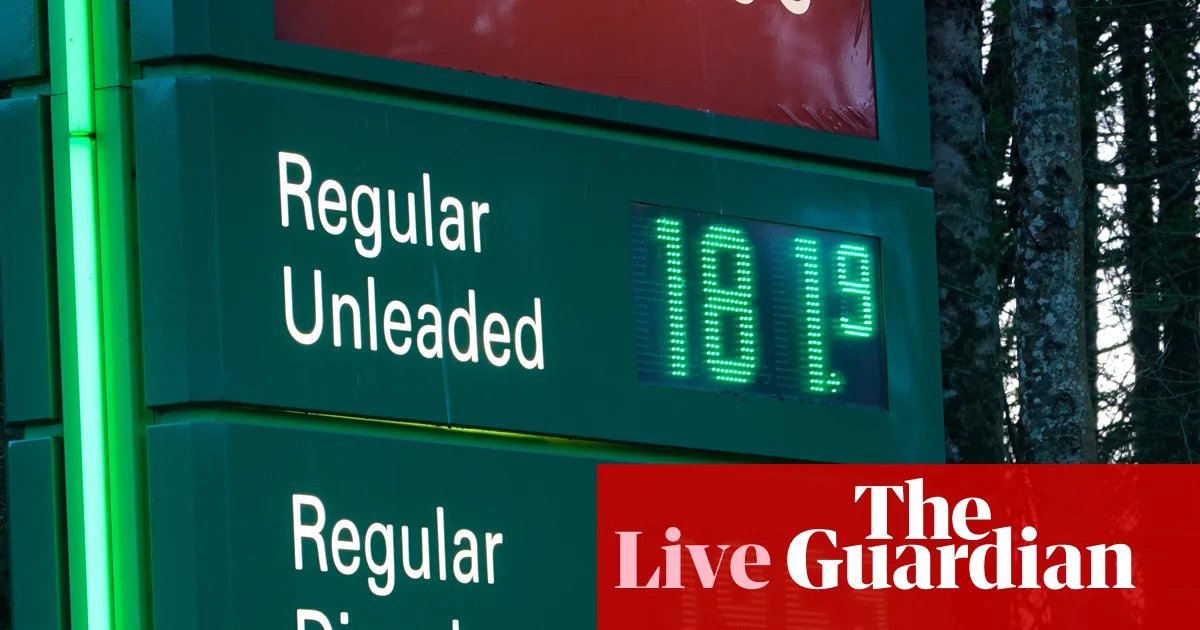
Record monthly petrol and diesel price increases in March
It’s not just mortgages that are going up, either.
UK petrol and diesel prices jumped by a record amount in March, as the oil supply shock caused by the Iran war quickly rippled to forecourts.
New data from the RAC shows that the average price of a litre of unleaded petrol rose by 20p from 132.83p on 1 March to 152.83p by the end of the month. That surpasses the previous all-time biggest monthly jump of 16.6p recorded in June 2022, following Russia’s invasion of Ukraine.
Diesel prices have risen even more sharply – up 40p in March to an average of 182.77p from 142.38p. That’s almost twice as large as the previous record rise of 22p recorded in March 2022.
RAC head of policy Simon Williams says March’s price rises were ‘unprecedented’, adding:
“The increases drivers have had to endure in March 2026 far exceed those seen in the early days of the war in Ukraine.
“While the monthly rise in a litre of petrol is bad enough, the jump in the cost of diesel is even harder to swallow at 40p a litre.
“With long-term RAC research showing eight-in-10 people are dependent on their vehicles, these costs must really be taking their toll on households as well as businesses.”
However, these record increases are in nominal terms; in real terms, prices rose by more during the oil shock of 1973, the RAC point out.
And despite these price rises, average fuel prices are still below the all-time highs of summer 2022 when petrol peaked at 191.5p per litre and diesel at 199.0p per litre.
Introduction: Iran war brings ‘biggest shock to the UK mortgage market since the mini-Budget’
Good morning, and welcome to our rolling coverage of business, the financial markets and the world economy.
The UK is reeling from the biggest shock to its mortgage market since Liz Truss’s mini-budget in 2022, after the Iran war drove up borrowing costs.
New research from data provider Moneyfacts shows how the cost of fixed-rate mortgages has surged over the last month, making it harder for new borrowers to get onto the housing ladder – and meaning those remortgaging face a surge in repayments.
Here’s the details of how the lending environment has changed since the start of March:
-
Mortgage deals rapidly repriced. Average two-year fixed rates jumped +100 bps in a month (4.84% to 5.84%), with five-year fixes up +79bps (4.96% to 5.75%), marking the sharpest rise since autumn 2022.
-
Product choice contracted. Mortgage availability has fallen by a net 1,283 products (17% of the market) in one month, the steepest contraction by market share since the mini-Budget disruption.
-
Shock for remortgage borrowers. Those rolling off older five-year deals are hardest hit, with rates up 300+ bps and repayments rising by £417–£444 per month (£5k+ annually).
-
Affordability deteriorated quickly. Typical borrowers now face £150 extra per month (+£1,777 annually) on a £250k loan compared to costs at the start of the conflict, with higher LTV borrowers seeing increases of up to £167 per month.
-
Lowest rates moved sharply higher. The cheapest 60% LTV two-year fixed rate has risen +109bps (3.51% to 4.60%), as the most competitive deals have been quickly repriced in response to rising funding costs.
Adam French, head of consumer finance at Moneyfacts, says it adds up too the biggest shock since the aftermath of the mini-Budget three and a half years ago.
French explains:
“Average mortgage rates have risen at pace, with two-year fixes increasing by 100 basis points from 4.84% to 5.84% in just one month and five-year fixes up by nearly 80 basis points, from 4.96% to 5.75%. The cheapest deals available to borrowers have moved dramatically too, the lowest two-year fixed rate at 60% LTV has increased by over 100 basis points from 3.51% to 4.60%. While this falls short of the extreme jumps seen in the aftermath of the mini-Budget, it is still a sharp and sudden shift that has materially worsened affordability in a very short space of time.
“For many borrowers, the cost could be significant. Someone taking out a typical two-year fix will find it costs £150 more per month on average compared to just a few weeks ago. However, the real payment shock will be felt by those coming off older five-year deals, where rates have more than doubled, pushing up repayments by many hundreds of pounds per month.
“The combination of rising rates, reduced choice and heightened volatility means borrowers and brokers are operating in a market where timing is critical and the window to secure competitive deals can be very short-lived. Unfortunately, anyone looking to buy or remortgage this year needs to prepare for substantially higher borrowing costs than expected before this conflict began.”
The City money markets had been reducing their forecasts for how many times the Bank of England might raise interest rates this year to cool inflation, from three hikes to less than two, as of last night.
But, Donald Trump has now disappointed markets by declaring the month-long war in Iran a success which is “nearing completion”, but gave little clarity on how he planned to wind down the conflict over the next “two to three weeks”.
That has knocked Asia-Pacific markets, and pushed up the dollar and the oil price, as hopes of an early end to the conflict fade.
The agenda
The family of Shaun Burton, say they are “devastated” by the loss.
Source link

Key events
In the opening half an hour against Cape Verde, Mikel Oyarzabal, the centre-forward, did not get a single touch.
Kyle Green gets in touch: “Your highlighting of Lalas and his absurdity is something that has prevented me from wanting to watch the coverage on Fox. While every channel has its pros and cons I just can’t.
“I’m 45 and probably the youngest of anyone who remembers him as a player instead of an opinionated insert insult here. As for the match this could be more competitive than it looks on paper Spain need a win the pressure is on them. Saudi Arabia could hold out for a draw and see what happens in their last match. “
News from the England camp, and it seems to be good news on Declan Rice.
“I’m ready and fit, raring to go. I was feeling a little bit of neural pain in my hamstring, which I was managing from after Christmas with Arsenal for a very long time. Obviously, not a lot of people would have known that. It was all behind-the-scenes stuff but it was a smart decision.
“In the end, that last 20 minutes is probably where you pick up the most, and it’s where you play a 70-minute match. But that last 20 is where you really feel your body going for it. And I think it was a smart decision because the last few days I felt really, really good.”
Alex Reid has penned today’s weekend special Football Daily.
Portugal v Uzbekistan on Tuesday enticingly pits the incredibly nice, incredibly 41-year-old-superstar-tolerant Roberto Martínez against Fabio Cannavaro, who’s won a Ballon d’Or as a player and the Chinese Super League as a coach. While the fixture following that game really does see the dream of Thomas Tuchel – in his first international job with England – taking on Queiroz, who is in charge of his ninth national side with Ghana.
The expected formations are 4-2-3-1 for Spain, and 5-3-2 for the Saudi Arabians.
The Saudi team features two Donis changes: Ali Lajami, a defender, and Nasser Al Dawsari, a midfielder, are preferred to Mohammed Abu Al Shamat and Mohamed Kanno. You may recall Salem Al Dawsari, the Saudi captain, as the man who scored the winner against Argentina.
An entertaining read, even for those of us who have just seen the clips.
In a conversation where his co-panelist is casually reminiscing about his days playing alongside Messi or exchanging shirts with Ronaldo Nazário at the World Cup, what exactly is Lalas going to talk about – coming on as a second-half substitute for Earnie Stewart in a friendly against Scotland in 1998? Helping the Kansas City Wizards finish last in the 1999 MLS Western Conference? Did Lalas enjoy an elite playing career? No. But does he do the background reading that could compensate for his relative lack of standing in a conversation with titans like Henry and Zlatan? Also no. But is he charming or funny or charismatic or otherwise magnetic on screen? Eh, no.
For the record, I once interviewed Alexi Lalas on the challenge of playing against Romario in the 1994 World Cup. He had this to say:
“He could kill you in so many different ways. If you remember from that World Cup, he scored so many types of goals. That ranged from solo adventures to an outside-of-the-right-foot half-volley off a corner kick. Romario was both the most difficult to play against and the best that I have faced.
“Roberto Baggio was doing his thing, but in terms of consistency and living up to the hype, he [Romario] was the best. As with all stars, there was a moment when the fans sit up in their seats, and that was a feeling I got with Romario. When it got close to him and the potential for his involvement in a play was there, everybody sat up in their seat. They knew that something spectacular would be happening.”
Saturday’s match reports here.
The Saudi Arabia coach, and Blackburn legend, Georgios Donis, spoke about the challenges facing his team: “Spain is not the same team when Yamal or Williams are on the bench.
“While they still have plenty of possession, they lack the individual one-on-one penetration when these two are missing. I’m not saying it’s a problem for Spain, but when those players are missing, they play in a different way. We saw this very clearly against Cape Verde.
“We are playing against one of the best teams in the world, and it’s very important that when you play against these kinds of teams, you should enjoy the experience and respect the opponent, but not too much.
“It is very hard for any team playing against Spain to have any time in possession. So what we must do is to be more in control of our movement and compact, and when the ball goes through the lines, be able to defend dynamically.
“It’s nice to see miracles in football, and we’ve seen favourites losing against underdogs. Of course, it’s great for Saudi football to have a great memory of the result against Argentina, but we aren’t drawing anything from that.
“I think we’ll feel more pressure in that [Cape Verde] game than we will against Spain.”
The Spain coach, Luis De La Fuente had this to say in his Saturday press conference: “This generation of footballers is highly competitive and really fired up… It’s going to be a completely different story,” he said at his pre-match press conference on Saturday. There is no drama or crisis. The bottom line is simply that we need to win tomorrow.”
Four changes for Spain: Lamine Yamal, Pedro Porro, Dani Olmo and Alex Baena also come into the side with Marcos Llorente, Fabian Ruiz, Ferran Torres and Gavi dropping out.
The teams – Lamine Yamal starts
Spain: Simon, Porro, Cubarsi, Laporte, Cucurella, Gonzalez, Rodri, Yamal, Olmo, Baena, Oyarzabal. Subs: Raya, Joan Garcia, Pubill, Grimaldo, Eric Garcia, Llorente, Merino, Torres, Fabian, Gavi, Pino, Williams, Zubimendi, Munoz, Iglesias.
Saudi Arabia: Al Owais, Abdulhamid, Tambakti, Lajami, Al Amri, Al Harbi, Nasser Al Dawsari, Al Khaibari, Al Juwayr, Al Buraikan, Salem Al Dawsari. Subs: Al Aqidi, Al Kassar, Majrashi, Yahya, Al Shehri, Al Boushal, Kadesh, Al Johani, Al Ghannam, Al Hajji, Al Hamdan, Mandash, Kanno, Thakri, Abu Al Shamat.
Referee: Raphael Claus (Brazil)
Perhaps one of the Saudi -players can write themselves into this high-grade selection?
Perhaps it can be their goalkeeper.
Madrid screening of Spain v Saudi Arabia cancelled due to heat
The public screening of Spain’s World Cup match against Saudi Arabia in Madrid on Sunday has been cancelled because of extreme heat forecast for the Spanish capital, officials said.
The match, due to kick off at 6pm local time on Sunday, had been scheduled to be shown on a giant screen installed by the Spanish football federation (RFEF) at a fan zone in Plaza de Colón in central Madrid.
Madrid city council and the federation decided to cancel the screening after national weather agency AEMET issued an orange heat warning – the second-highest level – for the Madrid region, with temperatures forecast to reach 40C.
“The decision has been taken with the aim of protecting the health of attendees, event staff and support services involved in the event,” Madrid city hall said in a statement, apologising for any inconvenience.
Officials urged supporters to watch the match indoors in air-conditioned spaces and avoid prolonged exposure to the heat.
Large parts of Spain are experiencing unusually high temperatures for June as a mass of hot air from North Africa moves across the Iberian Peninsula.
A total of 13 of Spain’s 17 regions are on orange alert for heat on Sunday, while the northern Basque Country bordering France is on red alert, the highest level.
Authorities advised residents and visitors to take precautions during the heatwave, including drinking water regularly, staying in cool environments, limiting outdoor physical activity during the hottest hours of the day and taking extra care of vulnerable people. AFP
Can Saudi Arabia repeat the magic of 2022?
Argentina arrived in Qatar on a 36-game unbeaten run. When Lionel Messi opened the scoring from the penalty spot after 10 minutes, a comfortable afternoon seemed in the offing. Saleh al-Shehri and Salem al-Dawsari had other ideas, Argentina had three goals disallowed for offside in the space of 13 minutes and the greatest comeback in Saudi Arabia football history was made. Argentina went on to lift the trophy, while defeats to Poland and Mexico meant the Saudis did not reach the knock-out stage.
Unai Simon over David Raya is a controversial choice for De la Fuentes. The Arsenal keeper could lay claim to being Europe’s best this season.
“Those at the Champions League final had a few more days, so I got there on the Wednesday night,” Raya says. “I arrived a bit before Fabián [Ruiz]. I was saying hello to some of the others in reception when he arrived. I went to say congratulations; that was almost the first thing I did. I couldn’t really talk [to him] after the final; I just didn’t have it in me. The next day we talked about the game properly. Just two mates chatting … I was happy for him that he could lift the trophy for a second time.”
A high pressure game for the European champions, as Sid Lowe reports.
“If we had scored one, the game would have changed,” Martín Zubimendi said. Immediately after the game, De la Fuente had offered a simple analysis: when the ball doesn’t want to go in it doesn’t want to go in, he insisted. Spain had racked up 27 shots, after all. Ferran Torres had hit the bar and seen another clear opportunity saved. Vozinha, the 40-year-old goalkeeper who stopped that, saved six more and was named the man of the match. “There’s nothing to reproach the team for,” Rodri said. “We generated chances but couldn’t put it away; the good thing is they created almost nothing.”
We wait to see what role Lamine Yamal will play today. His coach would surely like to be able to use him.
The worst mistake we could make would be to compare him to anyone. He is the midst of a process. He has exceptional footballing maturity and lives it all with total naturalness. He has great serenity and strength. We have to let him follow his path but those players who have something different are ready for that. They’re geniuses, like Dalí [who] can paint a picture, or Michelangelo. They’re different. What is exceptional to us, isn’t to them. In those extremes, they feel comfortable. Why? Because they are different. What we think is exceptional, they consider normal.
Preamble
Spain’s campaign did not get off to a flying start, and Luis de la Fuentes may wake up in the night to visions of Cape Verde’s Vozinha. He will have Georgia on his mind ever since Monday. Saudi Arabia are no pushovers and gave Uruguay a scare in their opening match. Memories of downing Argentina four years ago still abound, and so Spain might beware. They can ill afford to go into the final game with Uruguay at a disadvantage. All eyes on Lamine Yamal, whose fitness situation remains opaque, though Spain need their other forwards to come to the party.
Kick-off 5pm UK, 1pm ET, 2am AEST. Join me.

A topless man can be seen driving erratically in Edinburgh before abandoning his car and attacking a black man and a delivery rider.
Source link



-

 Oxford University4 weeks ago
New to the Oxford English Dictionary this September
-

 Oxford united FC4 weeks ago
Chris Gunter steps away Wales role to focus on Oxford United
-

 Oxford united FC2 weeks ago
LIVE: Exeter City vs Oxford United – Jersey Mike's Trophy group stage
-
 Student Life3 weeks ago
Oxford partnership allows OpenAI to use rare Bodleian texts to train ChatGPT
-

 Traffic & Transport2 weeks ago
Why should I have to pay more for buses if I don’t use a smartphone? | Bus fares
-

 Traffic & Transport2 weeks ago
How poor public transport policy is putting the brake on cities | Road transport
-

 Oxford united FC3 weeks ago
Northern Ireland fans laud Oxford United defender Ciaron Brown
-

 Oxford united FC2 weeks ago
Oxford United lose to Exeter City on penalties in Jersey Mike’s Trophy