
UK News
UK forces face operational cuts without more cash, defence chief warns

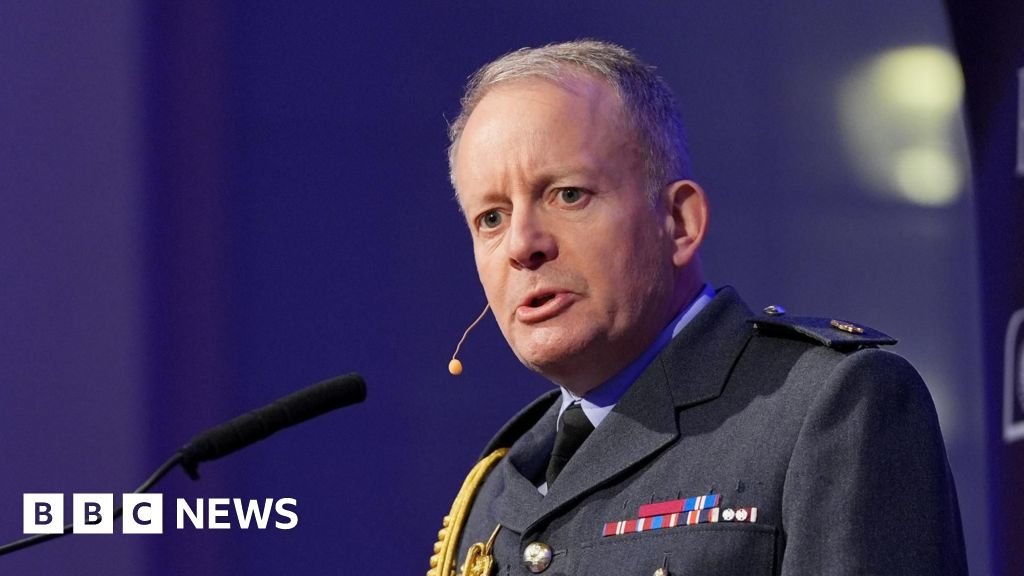
Sir Richard Knighton backs ex-defence secretary John Healey’s claim the government is not providing adequate funds.
Source link
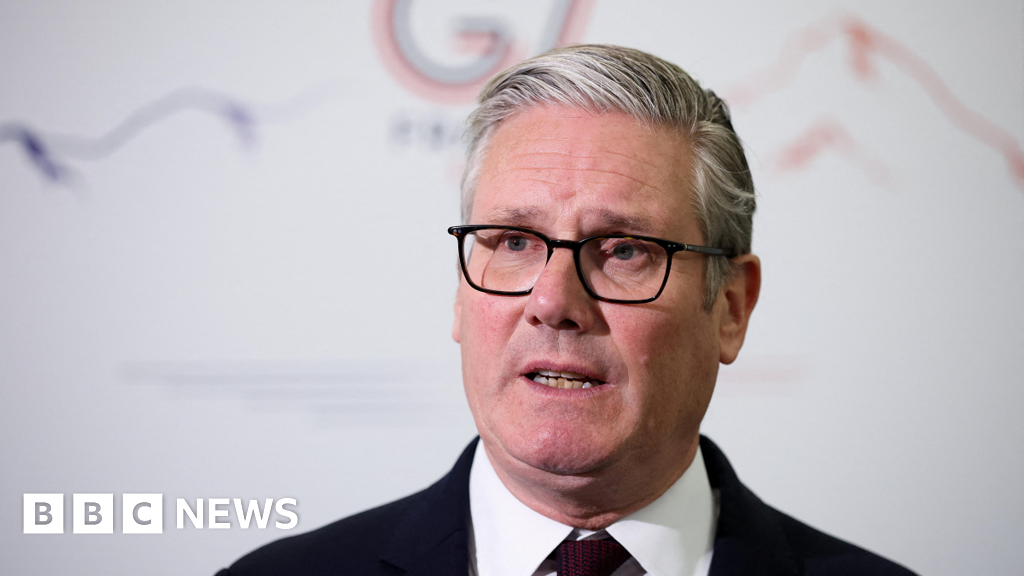
The prime minister says the UK is working with other countries on a plan to protect vessels in the key waterway.
Source link
UK News
Trump says Iran ‘will never have a nuclear weapon’ under new deal and warns Israel over Lebanon – Middle East crisis live | Iran
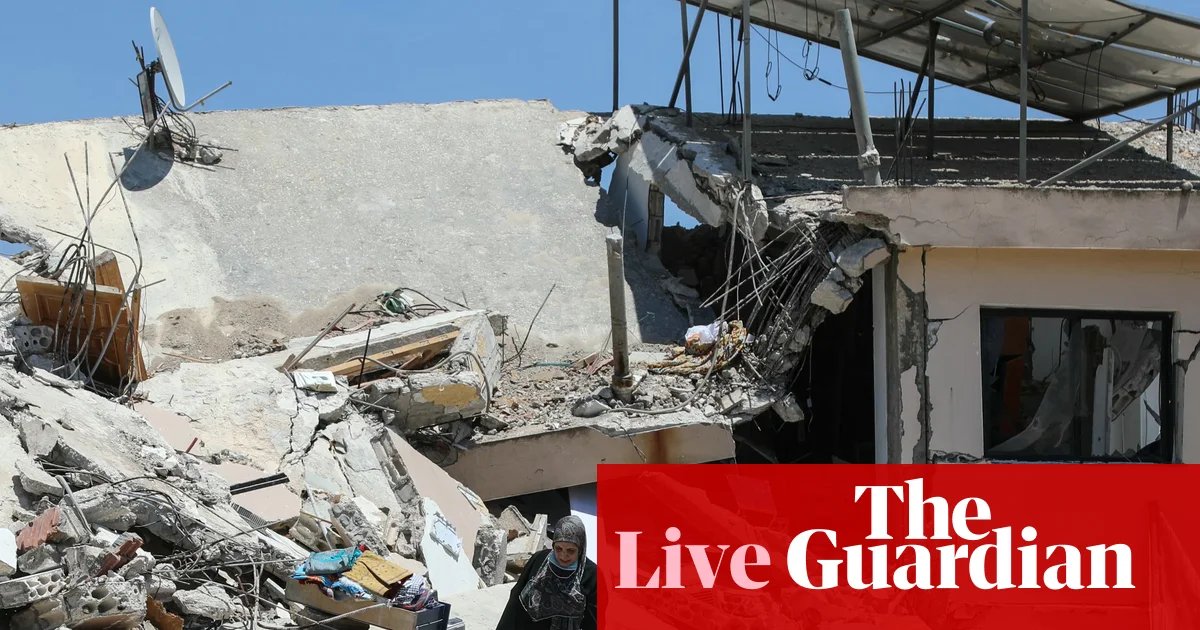
Donald Trump claims the strait of Hormuz will be open by Friday
Speaking at the G7, US president Donald Trump has said the strait of Hormuz will be open by Friday and that the full text of the peace deal will be released in a “formal setting”.
Trump also said he expects the “second stage” of the deal “to go quickly”.
He added that the main outcome from the MOU is that Iran will “never have a nucelar weapon” and that he will go over the deal with the media “in a couple of days”.
He earlier told reporters this morning that he had a “great relationship” with Israeli prime minister, Benjamin Netanyahu, but said he “has to be more responsible with respect to Lebanon”.
“Without me there would be no Israel, because no other president was willing to do what I did,” he told reporters.
Key events
China’s top diplomat told his Pakistani counterpart on Tuesday that the next phase of negotiations between the United States and Iran – which Pakistan has helped mediate – will be “more difficult”.
In a phone conversation ahead of the planned signing on Friday of a US-Iran memorandum of understanding to end their war, Chinese foreign minister Wang Yi told Pakistan’s Ishaq Dar that “it is foreseeable that, compared with the first stage, the second stage of negotiations will be more difficult”.
Wang added that the United Nations Security Council “should also play a greater role” in supporting these talks, according to a statement from Beijing’s foreign ministry.
“The current consensus is far from the final destination, rather it is a new starting point,” Wang said.
“Achieving lasting peace in the Middle East and Gulf region still requires unremitting efforts from all parties,” Wang said, adding that China was willing to work with Pakistan to promote peace.
US-Iran deal to be signed in Burgenstock, Switzerland on Friday
A US-Iran deal aimed at ending the Middle East war will be signed at Switzerland’s mountainside Burgenstock resort on Friday, the Swiss foreign ministry confirmed to AFP.
The site, located near Lucerne in central Switzerland, is difficult to access and therefore easily secured. It “was proposed by the Pakistani and Qatari mediators, as well as by the US and Iran”, Switzerland’s foreign ministry said.
It had previously been reported that the signing would take place in Geneva.
An Iranian deputy foreign minister on Tuesday said the two-month US naval blockade on Iranian ports had been lifted ahead of the planned formal signing of a deal ending the war.
“The lifting of the blockade was something we had emphasised from the outset. It has now begun, and the blockade has been lifted prior to the formal signing” scheduled for Friday, said Iranian deputy foreign minister Majid Takht-Ravanchi, according to the government’s website.
Lucy Campbell
Yesterday’s bilateral talks between Donald Trump and French president Emmanuel Macron were “a bit tense”, a European Union official has told NBC News.
“Trump is being his usual self, nice sometimes and not so nice sometimes,” the official said, adding that the US president was dismissive of EU support following the Iran framework agreement – saying he didn’t need Europe’s help.
Trump and Macron are due to dine tomorrow at the Palace of Versailles. This was the “‘shiny’ object he needed to come to France”, the EU official said of Trump, but “whether this will keep him happy remains to be seen”.
Iran won’t sign final nuclear deal if Israel doesn’t withdraw from Lebanon, Hezbollah says
Hezbollah, the Iranian backed Lebanese militant group and political party, said it has received assurances from Iran that Tehran will not sign a final nuclear deal with the US unless Israel withdraws from Lebanon, Hezbollah’s media relations office has told the Reuters news agency.
Trump says he’d send Iran deal to Congress for review
Trump said that he would send the deal with Iran to the US Congress for a review. “I like the idea, send it to Congress please,” he said at the start of a meeting with the UAE president Sheikh Mohammed bin Zayed Al Nahyan on the sidelines of the G7 summit. “I mean who wouldn’t approve it.”
The absence of the details of the memorandum of understanding with Iran has led to bipartisan scrutiny on Capitol Hill about what the agreement might contain and how favourable the terms are to the US.
Republicans on Capitol Hill say they want Trump to provide more information, with some expressing skepticism that the deal can deter Iran from pursuing a nuclear weapon. James Lankford, a Republican senator, said: “If you want a deal to last, it can’t be an executive agreement.” “We’ve got to have a vote of Congress to be able to solidify (it) long term.”
“I think it’s going to go pretty quickly,” Trump told reporters about the next phase of negotiations with Iran, stipulated with a 60-day deadline.
“Iran wants to get it done. They have to get back to business, and the relationship is now normalised, so I think it’s going to go pretty quickly,” Trump told reporters during his meeting with Mohamed bin Zayed Al Nahyan, the president of the United Arab Emirates, on the sidelines of the G7.
“Could go faster, could take longer too, but it could go fast.“
Donald Trump claims the strait of Hormuz will be open by Friday
Speaking at the G7, US president Donald Trump has said the strait of Hormuz will be open by Friday and that the full text of the peace deal will be released in a “formal setting”.
Trump also said he expects the “second stage” of the deal “to go quickly”.
He added that the main outcome from the MOU is that Iran will “never have a nucelar weapon” and that he will go over the deal with the media “in a couple of days”.
He earlier told reporters this morning that he had a “great relationship” with Israeli prime minister, Benjamin Netanyahu, but said he “has to be more responsible with respect to Lebanon”.
“Without me there would be no Israel, because no other president was willing to do what I did,” he told reporters.
Iran state media says Iranian oil tankers resumed shipping after US deal
Iranian state television said that Iranian oil tankers and other vessels had resumed shipping following a deal with Washington, in what appeared to be an easing of a US naval blockade.
“Three Iranian oil tankers are currently sailing in the northern Indian Ocean, and two others carrying essential goods and livestock feed are en route and sailing towards southern ports,” said a state television reporter from a site in the strait of Hormuz.
He added that “the operation to lift the naval blockade has been implemented”, in reference to the US measure in place since April.
Here are some of the latest images being sent to us over the newswires from Lebanon, where some people displaced by the Israeli assault on the country are cautiously making their way home after news of the initial US-Iran deal:
Qatar, a key mediator between the US and Iran, said it believed the framework peace agreement could deliver security to the Middle East.
“We are cautiously optimistic that the signing of the memorandum of understanding will lead to the next phase of regional security through the talks that will take place on the nuclear programme and on other issues,” foreign ministry spokesperson Majed Al Ansari told reporters in Doha, as he praised Pakistan’s mediation efforts.
“We are on the right track now towards regional security. Obviously, there are a lot of challenges coming ahead, but let’s take this as a moment to enjoy some optimism,” he said.
“We are talking about various issues: the strait of Hormuz, regional security and non-aggression, and good neighbourly relations between this region and Iran,” he added.
“We’re talking about, of course, the nuclear program but also other issues regarding proxies and missiles and other issues that have played prominent in the region for decades. These will not be resolved in mere days.”
According to Lebanon’s state-run National News Agency (NNA), Lebanon’s president, Joseph Aoun, and the country’s prime minister, Nawaf Salam, stressed the need for a permanent ceasefire in Lebanon, the full withdrawal of Israeli troops from territory in the south, the return of Lebanese prisoners and the deployment of the Lebanese army to “internationally recognised borders”.
Aoun and Salam described the US–Iran memorandum of understanding as a “positive step” toward de-escalation across the region.
Their meeting, at Baabda Palace, also focused on “preparations” for the next round of talks between Israel and Lebanon due to take place in Washington next week, according to the NNA. Hezbollah is not party to these negotiations.
The militant group, which has been funded and supported by Iran for decades, has welcomed the US-Iran agreement but warned that it would not accept any attacks that violated Lebanon’s sovereignty or targeted its people.
Trump says that Iran has “rational” leadership now because of the US-Israeli attacks on the country that killed senior Iranian figures. This is untrue because Iran’s powerful hardliners are now energised by a three-month confrontation they feel Tehran has won.
Despite his obvious irritation with Netanyahu, Trump said his relationship with the Israeli leader is a “very effective” one. He said their relationship is “unbelievable” – but made a point of saying that Israel would not exist without his support.
The US president said Lebanon has been “treated the worst” out of “all countries” as they “can’t defend themselves” and they are having to deal with Hezbollah, which he said is a “problem for them”.
Trump told reporters:
No, I am not happy with the way Israel has handled themselves with Lebanon and with Hezbollah. They should have been able to do the job faster. It just goes on forever and when that happens it throws a negative light on the big deal – and that is the deal with Iran.
Trump thinks Syria will do a ‘better job’ of ‘taking care of Hezbollah’ than Israel
In unusually frank remarks, Trump seems to acknowledge the fact that Israel has been killing many civilians in its attacks on Lebanon that it claims are only targeting Hezbollah. He told reporters:
Israel’s fighting Hezbollah too long and too many people are being killed. And you don’t have to knock down an apartment house every time you are looking for somebody, because there are a lot of people in those apartment houses and they are not all Hezbollah, that I can tell you.
And I suggested to Israel to let Syria take care of Hezbollah because to be honest with you I think they will do a better job of doing it.
Trump said he didn’t “like” that Israel attacked the Lebanese capital of Beirut – not the “southern side” – shortly before the deal with Iran was signed. “I let them know that. I didn’t like it – not at all,” Trump said.
“If Israel can’t do the job, without killing everyone else, he’ll do the job, Syria will do the job,’ Trump said, referring to Syrian president, Ahmed al Sharaa, whom he has good relations with.
During Syria’s civil war that broke out in 2011, Hezbollah sent thousands of fighters to help Bashar al-Assad stay in power. They remained until Sharaa’s Islamist rebel forces toppled the longtime ruler in December 2024. Sharaa is the former leader of Hayat Tahrir al-Sham (HTS), the rebel group that led the military operation to topple Assad.
Trump said Sharaa “is very good with Hezbollah” and “does not like them”. “He’s been very good for me. He’s protected everything that I have asked for,” he said, referring to Sharaa.
Netanyahu has to be ‘more responsible with respect to Lebanon’, Trump says
Trump also said he had a “great relationship” with Israeli prime minister, Benjamin Netanyahu, but said he “has to be more responsible with respect to Lebanon”.
“Without me there would be no Israel, because no other president was willing to do what I did,” he told reporters.
Trump says he considers Israel’s war in Lebanon a ‘minor’ one
Donald Trump also said he considers Israel’s war on Lebanon a “minor” one and believes his deal with Iran can survive even if Israeli attacks continue.
“I consider that the minor war,” Trump said. “Iran’s the big one, but we have that little pinprick out there that constantly rears its head and that’s Hezbollah”.
Iran does not agree with Trump’s assessment as it is increasingly asserting that continued Israeli attacks in Lebanon will violate its agreement with the US, and has sought to characterise the US and Israel as one entity in this respect.
Iran ‘will never have a nuclear weapon’ and ‘all hell will rain down’ if it tries to get them, Trump says
In his comments to reporters, Donald Trump also warned that “all hell will rain down” on Iran if it tries to get a nuclear weapon.
“The only thing that really matters to me is Iran will never have a nuclear weapon, and it says it loud and clear,” he said, referring to the agreement with Tehran.
As my colleague Graham Russell notes in this useful explainer, Iran has long maintained its nuclear program is peaceful and has not publicly committed to giving up the enriched uranium, which is believed to be buried under three nuclear sites that were badly damaged by US strikes last year.
Trump faces significant political pressure to secure a better deal on this issue than the one he scuppered during his first term. He withdrew the US from a 2015 multilateral Iran deal, negotiated by Barack Obama, that lifted sanctions on Tehran in exchange for limits on its nuclear program, including international inspections.
Iran responded by ramping up its enrichment of uranium, producing more than 400kg of material at close to bomb-grade purity. The eventual fate of that uranium is likely to be a key negotiating point during the upcoming broader talks.
Trump says US-Iran deal going to a ‘second stage’
We have some comments from Donald Trump who has been speaking to reporters at the G7 summit.
According to the Reuters news agency, the US president said the deal with Iran was going to a “second stage” and said Washington was not investing any money in Iran as part of the agreement.
“We have our deal done with Iran, and it should be successful, it goes to a second stage, which I think would be actually easier,” he told journalists.
UK News
UK defence spending plan ‘well short of what’s required’ and harder choices needed, says John Healey – UK politics live | Politics
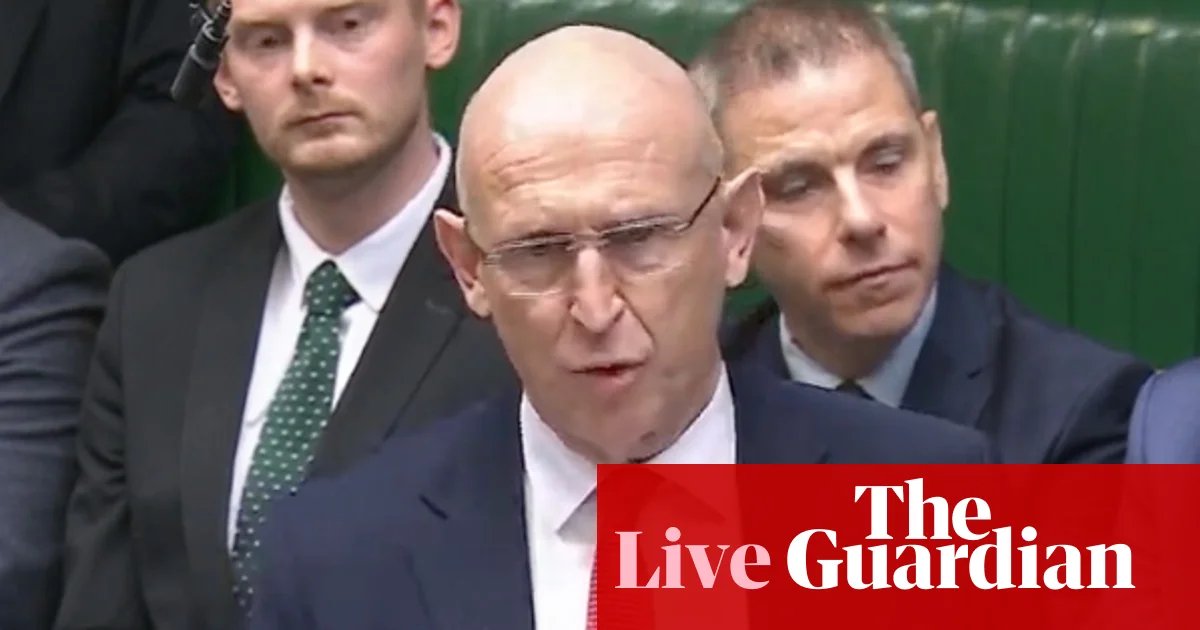
Healey says defence needs more than ‘incremental change’
Healey says the government has been working 12 months on the defence investment plan.
Since the SDR [strategic defence review] we’ve seen the world changing still faster, with threats increasing and demands on defence, rising conflict in the Middle East, new Nato missions in the High North, the US moving forces away from Europe, intensifying attacks in Ukraine and increasing Russian aggression towards the UK.
Nato has now said we must prepare for war with Russia within the next five years.
This is the age of hard power and rising threat. This is not the moment for calibration or incremental change.
This means bigger politics, bolder priorities, harder choices.
Key events
-
Healey says UK needs ‘bigger view of national security’
-
Healey says DIP ‘well short of what’s required’, and UK’s enemies ‘don’t follow timetable set by Treasury’
-
Healey says defence needs more than ‘incremental change’
-
Healey says he thinks his resignation will ‘in time’ help ensure defence gets more funding
-
John Healey delivers statement on his resignation to MPs
-
710 migrants arrived in small boats on Monday, figures show – but overall arrivals down 40% on same point in 2025
-
UK will have to ‘dial back’ military plans without more funding, says chief of defence staff
-
Having Burnham, not Starmer, as leader would give Labour 4-point boost against Reform UK, poll suggests
-
Greens condemn Streeting’s call for Rosebank and Jackdaw drilling as ‘environmentally reckless’
-
Burnham’s approval ratings down since he launched byelection campaign, but still far better than his rivals’, polls show
-
Starmer should set out timetable for his departure if Burnham wins byelection, Streeting says
-
Starmer says Dan Jarvis, new defence secretary, being consulted on DIP ahead of final version being published
-
Starmer says arson attacks on property linked to him should be seen in ‘broader context’ of Russian threat
-
Streeting warns against ‘expensive’ pledges in leadership contest, and defends bond markets, in dig at Burnham
-
Streeting says UK capitalism ‘suffers from lack of competition’ as he makes case for ‘progressive capitalism’
-
Thames Water nationalisation moves closer as government ‘objects to rescue deal’
-
Elon Musk claims social media ban for under-16s shows UK ‘police state’
-
UK ministers lobby Trump to avert backlash against social media ban
-
Starmer vows new sanctions on Russia and nuclear energy support for Ukraine
-
Anti-Burnham fake news on Makerfield Facebook accounts has surged, report finds
Healey says UK needs ‘bigger view of national security’
Healey said he was grateful to cabinet colleagues who agreed to cuts to fund higher defence spending.
He went on:
There are credible ways of meeting the mid-term funding challenges, working multinationally and as other nations in Europe are doing.
They could allow us to protect the ability to deliver our Labour missions across government.
Healey also calls for a different approach to defence.
We need a bigger view of national security. It’s not just the job for defence or the agencies. Every department has a part to play in national security and national resilience.
From energy to transport to health, security must run through the government like letters through a stick of rock.
And security must be felt in the communities right across Britain, reversing long term decline and bringing new jobs and new hope.
At the start of his speech Healey said that, now he was no longer defence secretary, he was glad he did not have to sleep with three phones by his bed. He ended with a joke about his personal love for HP sauce.
For now, Jackie [Healey’s wife] is just grateful I no longer carry three phones in my bag, although I do still have my bottle of HP sauce.
Healey says DIP ‘well short of what’s required’, and UK’s enemies ‘don’t follow timetable set by Treasury’
Healey said Keir Starmer knows what is needed.
The prime minister knows what the country needs for defence. He spelled out the threat this month when he said it is our intelligence assessment and the assessment of other countries in NATO that there could be an attack by Russia on Nato as soon as 2030.
So Britain must set the head mark of spending 3% on defence in 2030, and a clear path to 3.5% in 2035.
The commitment all Nato nations have made to each other and to their people … commands wide cross-party support.
Our predecessors in this house experienced what happens when deterrence fails. Our predecessors in this House entrusted us with institutions like Nato that they created to keep us safe.
We don’t choose the circumstances in which we serve or the responsibilities that fall upon us, either in this house or in government.
And it’s the duty of our political generation now to ready Britain for the uncertainties of the years to come. The decisions that we make in the months ahead will be judged by those who follow us.
At this dangerous time. I see the current defence investment plans falling well short of what is required, a rise of 0.08% from next year to 2030.
No date for reaching 3%, no path to 3.5% by 2030.
Well over half of Nato members will be spending 3% or more. And when allies are looking for British leadership, we must not fall behind.
When NATO needs European nations to step up, we must not fall short.
Our adversaries don’t follow timetable set by the Treasury.
Healey says defence needs more than ‘incremental change’
Healey says the government has been working 12 months on the defence investment plan.
Since the SDR [strategic defence review] we’ve seen the world changing still faster, with threats increasing and demands on defence, rising conflict in the Middle East, new Nato missions in the High North, the US moving forces away from Europe, intensifying attacks in Ukraine and increasing Russian aggression towards the UK.
Nato has now said we must prepare for war with Russia within the next five years.
This is the age of hard power and rising threat. This is not the moment for calibration or incremental change.
This means bigger politics, bolder priorities, harder choices.
Healey says he it was a privilege to serve as defence secretary.
And he stresses his commitment to Labour.
I’ve been a Labour MP for nearly 30 years, a Labour team member for 45 years, a trade unionist for longer still.
It is my family, literally. Jackie, my wife worked for Labour HQ. We met at a union conference. Two weeks later we were engaged.
He says he only wanted a successful Labour government.
He says he is proud of the party’s record on defence.
I’m proud of what we’ve done in less than two years as a Labour government.
We stepped up into national leadership for Ukraine. We’ve raised defence investment three years earlier than anyone expected, won record defence export deals, given the armed forces their biggest pay rise for 20 years, brought 36,000 forces family homes back into public ownership, and we’ve signed major defence agreements with Germany, Norway, France and the European Union delivering for defence, delivering for Britain.
Healey says he thinks his resignation will ‘in time’ help ensure defence gets more funding
Healey says he thinks his resignation will help get the MoD more funding.
I took the decision to resign with the very greatest regret and reluctance. I continue to be certain about this decision.
In time I believe it will be seen as necessary in securing the future of our armed forces and of our alliances.
John Healey delivers statement on his resignation to MPs
John Healey is delivering a personal statement to MPs on his resignation last week as defence secretary.
He starts:
Many in the media have pressed me to say more since Thursday, but I’m a proud parliamentarian.
I wanted first to speak in this house as I take my seat, as I take my seat on the backbenches for the first time for more than 10 years.
710 migrants arrived in small boats on Monday, figures show – but overall arrivals down 40% on same point in 2025
Some 710 migrants arrived in the UK on Monday after crossing the Channel, the highest number on a single day so far this year, the Press Association reports. PA says:
It follows a spell without crossings, with no migrants having made the journey between 1 June and 14 June.
The cumulative number of arrivals by small boats in 2026 now stands at 9,852, according to provisional figures from the Home Office.
This is down 40% on the equivalent point last year, when the total stood at 16,317.
It is also 14% below this point in 2024, when the total was 11,431.
There were 11 boats that arrived on Monday, which suggests an average of around 65 people per boat.
UK will have to ‘dial back’ military plans without more funding, says chief of defence staff
Britain will have to “dial back” on military operations and exercises in the next few years if the Ministry of Defence (MoD) does not receive extra funding from Downing Street and the Treasury, Rich Knighton, the chief of the defence staff, has told peers. Dan Sabbagh has the story.
Having Burnham, not Starmer, as leader would give Labour 4-point boost against Reform UK, poll suggests
The new polling from Ipsos released today also shows how people say they would vote given a choice between a Reform UK party led by Nigel Farage and a Labour party led by either Keir Starmer or Andy Burnham.
While Burnham is considerably more popular with voters than Starmer, these figures suggest that, were Burnham to become leader, there would be a significant, but not huge, rise in the number of people inclined to vote Labour.
The figures show a Starmer-led Labour party 9 points ahead of Reform, and a Burnham-led Labour party 13-points ahead.
Polling like this is particularly speculative, and ultimately it is very had to know how voters would react to a Burnham-led government because we don’t know what it would do. We don’t even know who the chancellor would be. But these figures imply that, while having Burnham as leader would help Labour electorally, his impact might be more incremental than transformative.
Greens condemn Streeting’s call for Rosebank and Jackdaw drilling as ‘environmentally reckless’
The Green party has criticised Wes Streeting for his call for new drilling to be allowed from the Rosebank and Jackdaw oil and gas fields in the North Sea. (See 10.44am.) Commenting on Streeting’s speech, Rachel Millward, the Greens’ co-deputy leader, said:
Wes Streeting has ceased to be relevant, but his so-called ‘progressive capitalism’ shows the degree to which fossil fuel corporations have their grubby hands all over Labour policy.
His call to open up new drilling in the North Sea is environmentally reckless and economically illiterate.
Rosebank alone contains enough fossil fuel to produce over 200 million tonnes of CO2 if burned – more than the combined annual emissions of 28 low-income countries.
Opening up these oilfields will do nothing to improve energy security or bring down bills either, because any oil and gas extracted will be sold at global prices on the world market.
Greenpeace UK also condemned the speech. Angharad Hopkinson, a Greenpeace campaigner, said:
Flogging more oil and gas from the North Sea to pay for cleaner energy sounds like a business scheme worthy of Del Boy. Any windfall from tax receipts would only be temporary because this basin is in terminal decline, not to mention the escalating costs in lives and money from more extreme weather. Streeting is backing the wrong horse several decades after it has bolted.
Burnham’s approval ratings down since he launched byelection campaign, but still far better than his rivals’, polls show
Andy Burnham has become less popular with British voters as a whole following his decision to stand as Labour’s candidate in the Markerfield byelection, according to two separate polls published today.
Burnham is still more popular than other Labour politicians. But the polling suggests some voters have become more negative about him as a result of his decision to put himself forward as a byelection candidate in the clear hope off being able to replace Keir Starmer.
Here are the figures from YouGov.
YouGov says:
In earlier polls in this series, Andy Burnham achieved a positive net favourability rating (+9 at its peak). However, his popularity declined starting from the middle of May – the period that encompassed the Labour party revolt against Keir Starmer that included Wes Streeting’s resignation and Josh Simons stepping down in Makerfield, triggering the by-election that Andy Burnham is likely to win.
As a result, Burnham now takes a net favourability rating of -11 in our latest poll: 30% of Britons like the would-be PM, versus 41% who dislike him.
The YouGov report also says Wes Streeting’s unfavourability ratings have risen since he resigned as health secretary with the intention of challenging Starmer for his job, and Ipsos in its report says it has picked up on the same trend.
According to Ipsos, Burnham’s ratings have fallen in particular with people over the age of 55, people who voted Conservative in 2024, people who think Labour is doing a bad job in government and people from Scotland.
However, the Ipsos report also shows that, of the 17 leading politicians it polled, Burnham has the highest – or least negative – favourability rating.
Starmer should set out timetable for his departure if Burnham wins byelection, Streeting says

Peter Walker
Peter Walker is a Guardian senior political correspondent.
Keir Starmer should set a timetable for his departure if Andy Burnham wins the Makerfield byelection on Thursday rather than battle to stay in Downing Street, Wes Streeting has said.
Answering questions after his speech on the economy (see 10.44am and 11.32am), Streeting reaffirmed that he would fight in any leadership battle, and insisted he has the necessary support among Labour MPs, but refused to say whether he would trigger a contest.
He said:
I would hope that after Thursday’s byelection, when the results are in, and I very much hope Andy Burnham wins … I hope the prime minister will at that stage reflect on his own position and set out a timetable. I think that would be a better way forward for everyone and would enable that better culture that we aspire to.
When he resigned as health secretary last month, Streeting had been expected to trigger a leadership contest himself, and the fact he did not prompted opponents to assume he did not have the backing of the 80 other Labour MPs needed to trigger the process.
Asked if he did now, Streeting replied: “Yes, I have the support I need to be on the ballot.”
However, he refused to say whether he might seek to trigger it next week. He said:
I think I’ve been extremely clear about this. I think there should be a contest. I have every intention of standing in that contest, and I’ve not triggered a contest, because we’ve got a byelection under way where one of the inevitable candidates is on the ballot paper.
To have sought a contest before Burnham was potentially back in parliament would be to “pull a fast one”, Streeting argued.



-

 Crime & Safety4 weeks ago
What happens to Halifax customers if Lloyds makes changes?
-

 Oxford News4 weeks ago
Actor steps down from major role in new Harry Potter series
-
 Crime & Safety4 weeks ago
Oxfordshire bridge closure comes as management ‘weaknesses’ found
-
 UK News4 weeks ago
Burnham seeks to calm markets by committing to fiscal rules
-

 UK News4 weeks ago
Glass deposit scheme 'risks major problems' for retail industry
-
 UK News4 weeks ago
Ex-minister Shapps quits aerospace firm over rule concerns
-
 Crime & Safety4 weeks ago
Ryan Bridge speaks of London arrest after Oxford incident
-

 Crime & Safety4 weeks ago
Oxfordshire man accused of sexual offences 40 years ago