
UK News
The tortoise and the hare: will China beat the US in the race back to the moon? | Space

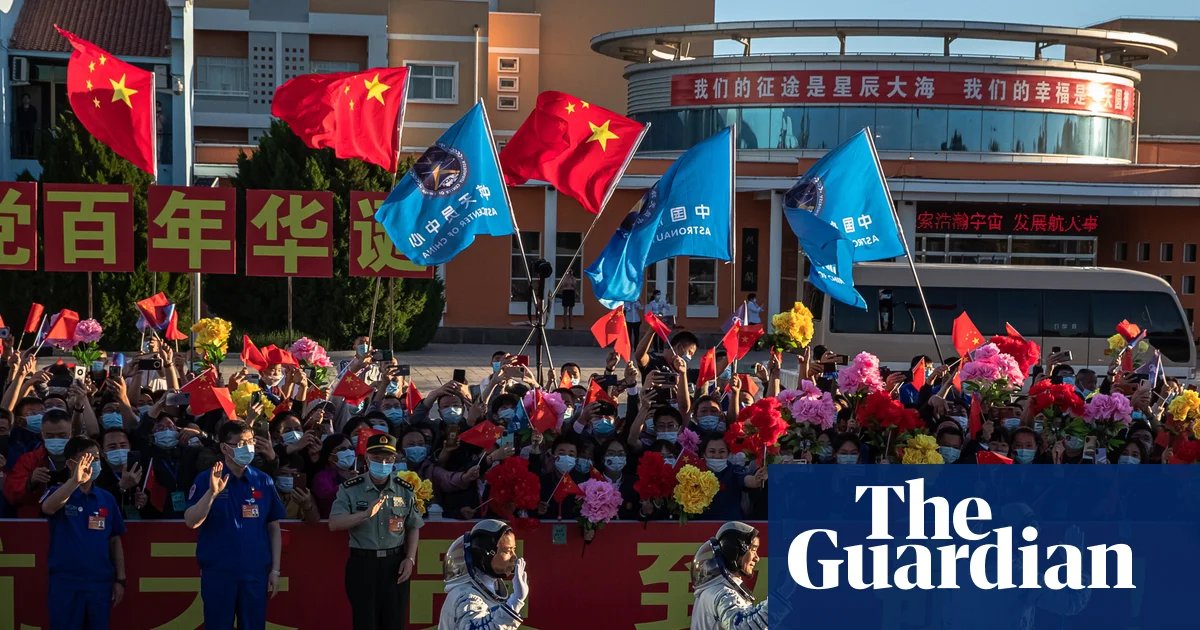
The world watched earlier this month as Nasa sent four astronauts around the moon – but to actually land on the surface the US is once again in a space race, this time with China. And China may well win.
Both countries plan to build inhabited lunar bases – the first settlement on another celestial body – as well as searching for rare resources and using the deep space environment to test technology for future crewed missions to Mars.
The well-funded China National Space Administration (CNSA) is pitted against the US’s National Aeronautics and Space Administration (Nasa).
And while Nasa has an advantage from institutional knowledge of having already landed on the moon as part of its Apollo programme, it is attempting to return with just a fraction of the share of the national budget it had in the 1960s.
The US space agency is also vulnerable to changes in government every four years, making it hard to stick to decade-long plans – something Chinese rocket engineers working in a one-party state are not affected by.
To move ahead at speed, Nasa has outsourced critical mission components to private firms, including billionaire-led ventures aiming to capitalise on the burgeoning space economy. Elon Musk’s SpaceX and Jeff Bezos’s Blue Origin are both rushing to design and build lunar landers in time for test flights next year.
Unlike the race to the moon between the Soviet Union and the US, the 21st-century competition is shaping up to be more like a marathon, with a gargantuan effort to launch multiple missions over many years.
“What this is really illustrating is that it doesn’t matter who gets to the moon next. It matters who gets to the moon the next 10 times,” said Scott Manley, a Scottish astrophysicist and expert on rocket engineering. “The nation that keeps going is going to be the one that actually starts to win; starts to actually claim space. That’s critical.”
With space being an area with opaque legal consensus, the first country to establish a presence on the resource-rich lunar surface will probably have a head start in defining the rules.
Still, the first return crewed mission will no doubt be a major symbolic win, both domestically and as an expression of power overseas. This competitive element is regularly played up by Nasa, which has an interest in creating a sense of urgency to encourage Congress to fund it. The Nasa chief, Jared Isaacman, said this week that there was a global power competition for the “high ground of space”, adding: “When you do have a competition, you do not want to lose.”
It is a tight race: Nasa plans to land in 2028, although it will possibly be delayed, and Beijing plans to land by 2030, but that could arrive sooner. “The difference between winning and losing will be measured in months not years,” said Isaacman.
China’s human spaceflight programme was established in the 1990s but in the past 25 years it has accelerated, and also partners with the military and local business. While China has never sent a taikonaut beyond low Earth orbit, Beijing already has its own space station, and, unlike Nasa, has an impressive record of adhering to its own timeline.
“When they put a flag in the sand, they tend to be pretty good at hitting that date,” said Manley, who is based in the US. Having “eclipsed Russia in almost every single way in terms of their space capabilities”, he said China is now running a “very deliberate, but not necessarily that fast, space programme”.
A decade ago, James Lewis, a former US diplomat, testified to a committee in Congress that the US, having won the race to the moon against the USSR had “largely lost interest in space”, while China was ramping up its programme. “What we don’t want is a tortoise and hare scenario where a slow-moving China passes the United States,” he said.
Over the past 10 years, Nasa has reinvigorated its crewed space programme, which is called Artemis after the Greek goddess of the moon who is the twin sister of Apollo. That culminated this month in the first crewed mission to the vicinity of moon since 1972.
At the same time, China – which calls its lunar exploration missions Chang’e after the Chinese goddess of the moon – has made formidable progress in catching up, and has broken other records. In 2024, China became the first nation to retrieve samples from the lunar far side with the Chang’e-6 probe. Chang’e-7 is scheduled for late 2026 to hunt for water ice at the south pole, a vital component for a sustained human presence.
“Overall, progress appears to be proceeding smoothly,” said Xie Gengxin, a professor at Chongqing University and a prominent Chinese scientist who has led key experiments in Beijing’s space programme, including the groundbreaking test in 2019 in which a green leaf was grown on the moon for the first time. In another of his experiments a butterfly hatched in space.
Beijing is regularly testing its equipment for crewed missions, which will use a Long March-10 rocket to launch the Mengzhou, or “dream boat”, space capsule with three astronauts. A nine-metre lunar lander called Lanyue, meaning “embracing the moon”, will then take two down to the surface, where they will hop around in a new Chinese spacesuit. The Wangyu suit (“gazing into the cosmos”) has been designed for more flexibility, allowing astronauts to bend down to the rugged terrain.
In the US, SpaceX and Blue Origin are racing to finish their landers in time for Nasa to test their docking capabilities next year. Blue Origin plans a test flight for an iteration of its Blue Moon lander later in 2026, while few details have been released on SpaceX’s 52-metre tall lander, which dwarfs other models. Neither lander is complete, raising questions over Nasa’s ambitious moon-landing timeline.
Within the scientific community, the hope is that the moon will encourage cooperation for the benefit of all, perhaps replicating a situation like Antarctica, which operates as a neutral, science-focused territory under the 1959 treaty that prohibits military activity, mineral mining or new territorial claims.
Yet this is a time of fierce rivalry between Washington and Beijing. Nasa was in effect banned under US law in 2011 from collaborating with China’s space agency, and relations have only soured since then.
In China, their space mission is not framed so much as a race with the US, but instead focuses on achieving domestic aims. “We are not setting a goal of comprehensively overtaking the US,” said Xie. “That would neither be realistic nor necessary.” But he added, landing humans on the moon “will undoubtedly inspire a strong sense of national pride and fulfilment”.
While the US has banned cooperation with China, the European Space Agency (Esa) and individual governments have not. Italy, France and Sweden sent payloads aboard China’s latest lunar probe, the Chang’e-6 mission.
Pierre-Yves Meslin, a researcher at France’s Institut de Recherche en Astrophysique et Planétologie, worked as the scientific manager of the Dorn experiment, which analysed the moon’s very thin atmosphere and was carried onboard the Chinese Chang’e 6 lander.
“As Europeans, we don’t have the tools to go to the moon ourselves … So we rely on international partners to deliver our instruments,” he said. “Mostly the US. But now China is definitely another very serious partner.”
Working with China has given him insight into their space programme. “They have a very clear and very logical step-by-step programme to go to the moon,” he said.
The impact of massive domestic investment from China in the space sector is being felt worldwide, he said. Two decades ago, Meslin did not see so many Chinese people at space science conferences but their halls are now filled with young Chinese scientists.
What has been critical from a researcher perspective, said Meslin, is a reliable partner to take experiments into space, something he said China has proved it can be. “When they decide something, it’s decided and it will be done.”

At the end of 2011, party season was under way but I was in no mood for festivities. Two years into fertility treatment, my body was pumped full of synthetic hormones and felt like a pin cushion, while my head was filled with both the fragile hope of having a baby, and the exhaustion of failed clinical attempts to do so.
I was in my late 20s. I met my husband when I was 22; we got married when I was 25. “I want to have kids young,” I’d told him. It was a feeling I’d harboured since my teenage years. But I’d also had the nagging sense that it might not come easily to me. As it turned out, my intuition was right. Approaching 28, I was a regular on the infertility merry-go-round.
I was recovering from my second miscarriage that year when I heard Sia’s raspy voice on the car radio belting out words that sounded emotionally weighty for an electronic dance number – her David Guetta collaboration, Titanium.
It’s not a song I would have necessarily rated or listened to again – I’m more likely to play 00s R&B and hip-hop – but it came at the perfect time in my life. I had forgotten how days felt before fertility drugs and the diarised cycles of administering them. I’d been constantly wearing a brave face and cramming in hospital appointments before and after work, going about my job through a fog of longing and hormones. It had left me in a “cry on the bedroom floor” kind of a heap. I needed something to drag the hope back into me.
I turned the radio up and listened to the lyrics: “I’m bulletproof, nothing to lose / Fire away, fire away.” It felt as if it was talking to and about me, issuing a riposte to all those shots of disappointment that had been fired our way. As Sia’s vocals ascended through the chorus with Guetta’s soaring synths – “Ricochet, you take your aim” – I cried, but I felt myself gaining power with her, too. “You shoot me down, but I won’t fall / I am titanium.” Those were the words I needed to hear.
I felt like a puppet pulled upright again. I streamed it on repeat in the days that followed. I might not have been able to face the work Christmas party but I wasn’t going to languish on the bedroom floor any more.
Over the next months, I spent a lot of time in my car, travelling to work and to fertility appointments to get my blood tested, hormones measured or insides scanned. Listening to Titanium became routine. Each time, its cinematic surge had the same empowering effect and I’d turn up the volume, wind down the windows and defiantly sing along in my terrible voice so it could wash over me.
The following May, when my husband and I headed to the clinic for another IVF embryo transfer, I let it motivate me; when we drove back from scans confirming we were six weeks, then 12 weeks pregnant, I celebrated with it. As I nervously made my way through my pregnancy, I turned to it when I needed the boost.
In January 2013, our first son was born. Today, he is the eldest of three: his brother arrived 15 months later, via IVF too (the last of our fertilised embryos) and four years later, another brother, without fertility treatment. We consider ourselves unspeakably lucky; for many, the outcome is not the same.
In our family, everyone knows Titanium is my fight song. It’s the only big commercial dance hit on my playlists, and a marker of something I overcame.
My kids call me in whenever it streams or plays on TV. When I made my husband a playlist for our 15th wedding anniversary, it’s the song that represented our 2011. And the other week, when he was out with friends, he sent me a voice note from the bar: he’d recorded it playing in the background.
There’s something all-consuming about fertility treatment: you view life only through the filter of your efforts to get pregnant. If you’re lucky, the filter lifts. It did for me, but the fight song remained. So, now, elsewhere in life, when I need a shot of strength and find myself alone in the car, down goes the window and on it goes.

Amy Gibney says she is one of eight families at her child’s school to find out that they don’t have a place for next year.
Source link
UK News
Edinburgh airport reopens after security alert but passengers warned of ‘knock on’ effect | Scotland

Edinburgh airport reopened on Saturday morning after parts of the terminal building were evacuated on Friday night because of a security alert.
An explosive ordnance disposal team was sent to the airport to investigate what Police Scotland described as a “potentially suspicious package” discovered at about 6.50pm on Friday.
An evacuation was ordered and a police cordon was set up, with roads closed.
Passengers faced disruption as result of the operation and the airport warned that schedules would continue to be affected on Saturday.
In a statement at about 3am on Saturday, the airport confirmed it had reopened and would work to restore normal services as quickly as possible.
“Following investigations by specialist teams, the airport has now reopened.
“This incident will have knock-on impacts throughout today and staff are working hard to address these and support passengers.
“Operational teams are continuing to work to restore normal services as quickly as possible.
“Please check with your airline for the latest information on your flight.”
The statement did not provide an update about the examination of the suspicious package.



-

 Oxford News3 weeks ago
Oxfordshire families invited to free day of fun in Bicester
-

 Crime & Safety4 weeks ago
New video call system to help domestic abuse victims
-
 Crime & Safety3 weeks ago
Photos as 1979 Pontiac Firebird ‘bursts in flames’ at Tesco
-

 Business & Technology3 weeks ago
New ‘high-quality’ mushroom business launched in Oxford
-

 Business & Technology4 weeks ago
NHS IT outages disrupt 274,620 patient interactions
-

 Student Life3 weeks ago
Transgender rights protest in central Oxford following updated EHRC guidance
-

 Crime & Safety4 weeks ago
Co-op incident in Oxfordshire town leads to police charge
-

 Business & Technology3 weeks ago
Oxford firm wins major backing for fin-based tidal power