
UK News
The Masters 2026: final round – live | The Masters

Key events
The leaders are out
The final group takes to the tee … and both Cameron Young and Rory McIlroy take 3-woods for safety. The way Rory has been driving all week, this could be a tactic we’ll see more than once. Time will tell. It’s not as though he’s giving up too much distance, and he’s just wedging in from 155 yards. He very nearly slam-dunks it, too, a couple of feet to the left. He’ll have a good look at birdie from 11 feet. That’ll hopefully put him on an even keel: remember he bogeyed Tea Olive yesterday, and infamously doubled it on Sunday last year. That, it is fair to say, is a marked improvement. Young, having found the fairway bunker on the right, finds the heart of the green and will have a putt from 20 feet or so.
An opening birdie for Sam Burns in the penultimate group. A lovely downhill putt from 30 feet, and he joins the leaders at -11. His playing partner Shane Lowry however takes a heavy-handed chip from the front of 1, and bogey takes him the other way. No birdie for Scheffler on 2, meanwhile, but Tyrrell Hatton follows up his spectacular eagle on 7 with birdie at 8.
-11: Burns (1), Young, McIlroy
-9: Rose (1)
-8: Scheffler (2), Day (1), Lowry (1)
-7: Hatton (8), Cantlay (3), Henley (3), Li (2)
Scottie takes putter from the back of 2. He only just gets his putt through the fringe, though the margins are small, and it still dribbles down to six feet. But he’s not 100 percent happy with that. A thin-lipped smile as he considers his birdie putt. Meanwhile a bogey for Viktor Hovland on 18, and he ends the week with a 67 at -4. That round promised more. He’s the new clubhouse leader, though.
Justin Rose isn’t wasting time either! He chips in from the swale to the right of Tea Olive, and the three-time runner-up moves to within a couple of the lead at -9. The gallery, who wouldn’t say no to the genial Rose getting his flowers at last, erupt in delight. Meanwhile over on 2, Scottie Scheffler fires his second into the green, but over the back. Still a decent opportunity to get up and down from close-ish range, though. A sense that this Masters is about to catch fire, and the leaders aren’t even out yet. Fingers crossed for an all-time classic. Another all-time classic. Two in two years too much to ask?
You’ll have noticed Tyrrell Hatton popping up at the bottom of that updated Leader Board at -6. That’s because he’s just holed out for eagle on 7 from 131 yards, landing his ball 15 feet over the flag and spinning it back into the cup! Earlier on today, Aaron Rai did the exact same thing, from 137 yards, so it’s been a good day on Pampas for the English. Rai ended his week at +5 after a round of 70.
Scottie Scheffler isn’t wasting time. A high cut around the branches from the pine straw down the left of 1 into the heart of the green. A mirror-image version of the wedge Bubba Watson played from the trees at 10 to win the play-off in 2012. He’s seven feet away. In goes the birdie putt, and if the leaders weren’t already worried†, they are now††. Bogey for his playing-partner Haotong Li, though, the cost of leaving his approach short.
-11: Young, McIlroy
-10: Burns
-9: Lowry
-8: Scheffler (1), Day, Rose
-7: Knapp (4), Henley (1)
-6: Åberg (7), Hatton (7), Schauffele (5), Reed (2), Cantlay (1), Li (1)
†: They were
††: They already were
Jake Knapp doesn’t have much of a record in the majors. A tie for 55th at the 2024 Masters, a couple of missed cuts at the PGA, another missed cut at the US Open. But the 31-year-old Californian did tie for 12th at the Players last year, and is poised to build on that here. An opening round of 73 followed by a pair of 69s, and with birdies at 1 and 3 he’s moved up the standings to -7.
Viktor Hovland responds magnificently to that double-bogey blow on 15. The pin on the famous par-three 16th is in its traditional Sunday position, front left, very accessible thanks to the downward camber of the green. Hovland finds the sweet spot that gathers his ball to six feet, then tidies up for birdie. He’s back to -5, and that’s the eighth birdie at 16 this afternoon already, with only 14 players having gone through so far.
Scottie Scheffler isn’t the only player looming large in the leaders’ rear-view mirrors. But you can bet your last shiny cent that Cameron Young and Rory McIlroy will consider him the most dangerous one. A world number-one ranking and two Green Jackets kind of add to the aura. Starting the day four behind at -7, it’ll take some effort from Scheffler, but if anyone can, Scottie’s the man. So having teed him up thus, he sends his opening drive wide of the bunker on the right-hand side of the fairway. He might have to punch under some branches from there. We’ll see. He’s going around today with Haotong Li, who he played with on the final day of last year’s Open at Portrush. A good omen for the big man? We’ll see about that as well. Li launches long down the left-hand side of the track.
Turns out Viktor Hovland’s momentum-saving efforts on 14 were all for nought. Hitting his second into 15, he air-mails the green, sending an absurdly overhit iron onto the bank behind and into the pond near the 16th. He can’t find the green with his chip back up, and that’s a double-bogey seven. Again, he isn’t the first, he won’t be the last, and it’s a reminder that the carpet can be whipped from underneath your feet at Augusta National in an instant. He’s -4.
Marco Penge was making a good fist of his Masters debut. Especially as the 27-year-old from Crawley, the reigning Spanish Open champion, took a triple-bogey eight at the 2nd on Thursday. Not the most auspicious start to his Augusta National career, but he limited the first-round damage to 76, then shot 69 and 71. Sadly his final round isn’t going so well, and he’s just dumped two balls in the water at the iconic par-three 12th, the first spinning back off the bank, the second from the dropzone not even getting over to dry land before dunking into the drink. A quadruple-bogey seven. He isn’t the first, he won’t be the last, and things could have gotten a whole lot worse, just ask the Towering Inferno …
Bogey at the last for Jon Rahm. A diminuendo end to a fine round of 68. You have to wonder how much buyer’s remorse Rahmbo has for joining the LIV tour: the 2021 US Open champion and 2023 Masters winner has never been the same player since. Still, his recovery this week from an opening round of 78 will give him a little succour. He ends his week at +1, one shy of the current clubhouse leader Gary Woodland.
We’re in that little major-championship sweet spot, the brief period of calm before the whipping up of a Sunday storm. So while we’re waiting for the leading players to take to the course, there’s time to indulge in a wee spot of Masters nostalgia. This episode of This Golfing Life, a wonderful new golf podcast hosted by the award-winning journalist and author Dan Davies, dives deep into the career of the 1980 and 1983 champion, the legendary Seve Ballesteros, and comes much recommended. (Fans of Paddington and Maurice Flitcroft may enjoy this episode too.) Get on it!
… so it’s probably time to update the Leader Board for the first time today. This is where we’re at for the moment. Meanwhile Viktor Hovland whips his second at 14 over the trees and into the heart of the green, and despite knocking his 25-foot birdie putt six past, tidies up to maintain his upward momentum. Quite a few of these lads, The Hov included, will be rueing their slow starts this week.
-11: Young, McIlroy
-10: Burns
-9: Lowry
-8: Day, Rose
-7: Scheffler, Li
-6: Hovland (14), Åberg (4), Knapp (1), Cantlay, Henley, Reed
Gary Woodland shoots 66
The chasing pack will be very much buoyed by the work of the early starters. Because is there a score out there? Oh yes, there’s a score out there. With the huge caveat that the fairways and greens will dry out and harden up as the afternoon sun beats down – Augusta National getting fast, fast, fast – the signs are very promising. Consider:
-
Ludvig Åberg has started out with three straight birdies; he’s -6 overall
-
Jon Rahm, who started the week with a LIV-shaming 78, is five under for his round today through 17; he’s level par
-
Gary Woodland has just got back to the clubhouse with a 66; he’s the early clubhouse leader at level par
-
Viktor Hovland is seven under through 13, though he’s just Roryed his drive into the trees at 14; he’s -6 for the Tournament
Is a low score on? Oh, it’s on. It’s already been on.
Garcia given code of conduct warning
Today’s weather bulletin: clear, dry and the hottest it’s been all week, with temperatures climbing into the mid-80s. Wind picking up a little during the day, but not in any intrusive manner. Meanwhile in other temperature-related news, the 2017 champion Sergio Garcia has been getting very hot under the collar, reacting to an errant drive on 2 by battering his driver into the ground a couple of times, before whacking it across a nearby cooler, snapping it in two. He’s been given an official code of conduct warning by Augusta National officials, while the tanty registers C++ on the Guardian’s Official Masters Meltdown-o-Meter™, which older and more jaded readers may remember from hole-by-hole reports passim.

Welcome, patrons, it’s time to clamber aboard the rollercoaster. Now then, if the wild and wonderful scenes of Moving Day are anything to go by, many things are possible today. The most likely is that either Rory McIlroy or Cameron Young will win: that’s because the last nine winners have come from the final pairing on Sunday. But there is precedent of a win from as far as eight shots back after 54 holes: Jack Burke Jr. pulled off that particular trick in 1956. Admittedly he only had three players ahead of him on the Leader Board, and it was blowing a field-scattering hoolie, but an eight-stroke comeback is an eight-stroke comeback, whichever way you spin it. Therefore anyone starting the day as low as -3 is technically in with a chance. At least according to the historical data. Even if they have 17 more players ahead of them than Burke did. And today’s conditions are benign. So let’s be realistic. But those are the facts, flat on the page.
Preamble
Exactly 30 years ago, give or take two days, this happened …
… so the loss of a six-shot lead at the Masters isn’t exactly a new thing. And hey, unlike the poor old Great White Shark, at least Rory has 18 more holes still to play, and with them an opportunity to do something about it.
Here’s how the top of the Leader Board looked when dawn broke in Georgia …
-11: Cameron Young, Rory McIlroy
-10: Sam Burns
-9: Shane Lowry
-8: Jason Day, Justin Rose
-7: Scottie Scheffler, Haotong Li
-6: Patrick Cantlay, Russell Henley, Patrick Reed
-5: Collin Morikawa, Jake Knapp, Ben Griffin
-4: Ryan Gerard, Xander Schauffele, Brooks Koepka, Wyndham Clark, Tyrrell Hatton, Tonny Fleetwood
-3: Ludvig Åberg, Brian Campbell, Nick Taylor, Matthew Fitzpatrick, Michael Brennan, Max Homa, Chris Gotterup, Kristoffer Reitan
… and here are today’s tee times (USA unless stated, all times BST).
1406 Aaron Rai (Eng), Charl Schwartzel (SA)
1417 Gary Woodland, Kurt Kitayama
1428 Jon Rahm (Spa), Sergio Garcia (Spa)
1439 Si Woo Kim (Kor), Rasmus Hojgaard (Den)
1450 Keegan Bradley, Dustin Johnson
1501 Matt McCarty, Corey Connors (Can)
1512 Viktor Hovland (Nor), Justin Thomas
1523 Alex Noren (Swe), Maverick McNealy
1545 Adam Scott (Aus), Marco Penge (Eng)
1556 Harris English, Samuel Stevens
1607 Brian Harman, Jordan Spieth
1618 Im Sung-jae (Kor), Hideki Matsuyama (Jpn)
1629 Sepp Straka (Aut), Jacob Bridgeman
1640 Chris Gotterup, Kristoffer Reitan (Nor)
1651 Michael Brennan, Max Homa
1713 Nick Taylor (Can), Matt Fitzpatrick (Eng)
1724 Ludvig Aberg (Swe), Brian Campbell
1735 Tyrrell Hatton (Eng), Tommy Fleetwood (Eng)
1746 Brooks Koepka, Wyndham Clark
1757 Ryan Gerard, Xander Schauffele
1808 Jake Knapp, Ben Griffin
1830 Patrick Reed, Collin Morikawa
1841 Patrick Cantlay, Russell Henley
1852 Scottie Scheffler, Li Haotong (Chn)
1903 Jason Day (Aus), Justin Rose (Eng)
1914 Sam Burns, Shane Lowry (Ire)
1925 Cameron Young, Rory McIlroy (NI)
This report will get going at 6pm BST. In the meantime, catch up with the dramatic action from round three by reading Ewan Murray’s report …
… here’s how Rory McIlroy felt after letting his six-shot lead slip …
… and here’s Andy Bull on how sensational Scottie Scheffler put himself in the mix for the Green Jacket.
It’s on!
The family of Shaun Burton, say they are “devastated” by the loss.
Source link
Key events
In the opening half an hour against Cape Verde, Mikel Oyarzabal, the centre-forward, did not get a single touch.
Kyle Green gets in touch: “Your highlighting of Lalas and his absurdity is something that has prevented me from wanting to watch the coverage on Fox. While every channel has its pros and cons I just can’t.
“I’m 45 and probably the youngest of anyone who remembers him as a player instead of an opinionated insert insult here. As for the match this could be more competitive than it looks on paper Spain need a win the pressure is on them. Saudi Arabia could hold out for a draw and see what happens in their last match. “
News from the England camp, and it seems to be good news on Declan Rice.
“I’m ready and fit, raring to go. I was feeling a little bit of neural pain in my hamstring, which I was managing from after Christmas with Arsenal for a very long time. Obviously, not a lot of people would have known that. It was all behind-the-scenes stuff but it was a smart decision.
“In the end, that last 20 minutes is probably where you pick up the most, and it’s where you play a 70-minute match. But that last 20 is where you really feel your body going for it. And I think it was a smart decision because the last few days I felt really, really good.”
Alex Reid has penned today’s weekend special Football Daily.
Portugal v Uzbekistan on Tuesday enticingly pits the incredibly nice, incredibly 41-year-old-superstar-tolerant Roberto Martínez against Fabio Cannavaro, who’s won a Ballon d’Or as a player and the Chinese Super League as a coach. While the fixture following that game really does see the dream of Thomas Tuchel – in his first international job with England – taking on Queiroz, who is in charge of his ninth national side with Ghana.
The expected formations are 4-2-3-1 for Spain, and 5-3-2 for the Saudi Arabians.
The Saudi team features two Donis changes: Ali Lajami, a defender, and Nasser Al Dawsari, a midfielder, are preferred to Mohammed Abu Al Shamat and Mohamed Kanno. You may recall Salem Al Dawsari, the Saudi captain, as the man who scored the winner against Argentina.
An entertaining read, even for those of us who have just seen the clips.
In a conversation where his co-panelist is casually reminiscing about his days playing alongside Messi or exchanging shirts with Ronaldo Nazário at the World Cup, what exactly is Lalas going to talk about – coming on as a second-half substitute for Earnie Stewart in a friendly against Scotland in 1998? Helping the Kansas City Wizards finish last in the 1999 MLS Western Conference? Did Lalas enjoy an elite playing career? No. But does he do the background reading that could compensate for his relative lack of standing in a conversation with titans like Henry and Zlatan? Also no. But is he charming or funny or charismatic or otherwise magnetic on screen? Eh, no.
For the record, I once interviewed Alexi Lalas on the challenge of playing against Romario in the 1994 World Cup. He had this to say:
“He could kill you in so many different ways. If you remember from that World Cup, he scored so many types of goals. That ranged from solo adventures to an outside-of-the-right-foot half-volley off a corner kick. Romario was both the most difficult to play against and the best that I have faced.
“Roberto Baggio was doing his thing, but in terms of consistency and living up to the hype, he [Romario] was the best. As with all stars, there was a moment when the fans sit up in their seats, and that was a feeling I got with Romario. When it got close to him and the potential for his involvement in a play was there, everybody sat up in their seat. They knew that something spectacular would be happening.”
Saturday’s match reports here.
The Saudi Arabia coach, and Blackburn legend, Georgios Donis, spoke about the challenges facing his team: “Spain is not the same team when Yamal or Williams are on the bench.
“While they still have plenty of possession, they lack the individual one-on-one penetration when these two are missing. I’m not saying it’s a problem for Spain, but when those players are missing, they play in a different way. We saw this very clearly against Cape Verde.
“We are playing against one of the best teams in the world, and it’s very important that when you play against these kinds of teams, you should enjoy the experience and respect the opponent, but not too much.
“It is very hard for any team playing against Spain to have any time in possession. So what we must do is to be more in control of our movement and compact, and when the ball goes through the lines, be able to defend dynamically.
“It’s nice to see miracles in football, and we’ve seen favourites losing against underdogs. Of course, it’s great for Saudi football to have a great memory of the result against Argentina, but we aren’t drawing anything from that.
“I think we’ll feel more pressure in that [Cape Verde] game than we will against Spain.”
The Spain coach, Luis De La Fuente had this to say in his Saturday press conference: “This generation of footballers is highly competitive and really fired up… It’s going to be a completely different story,” he said at his pre-match press conference on Saturday. There is no drama or crisis. The bottom line is simply that we need to win tomorrow.”
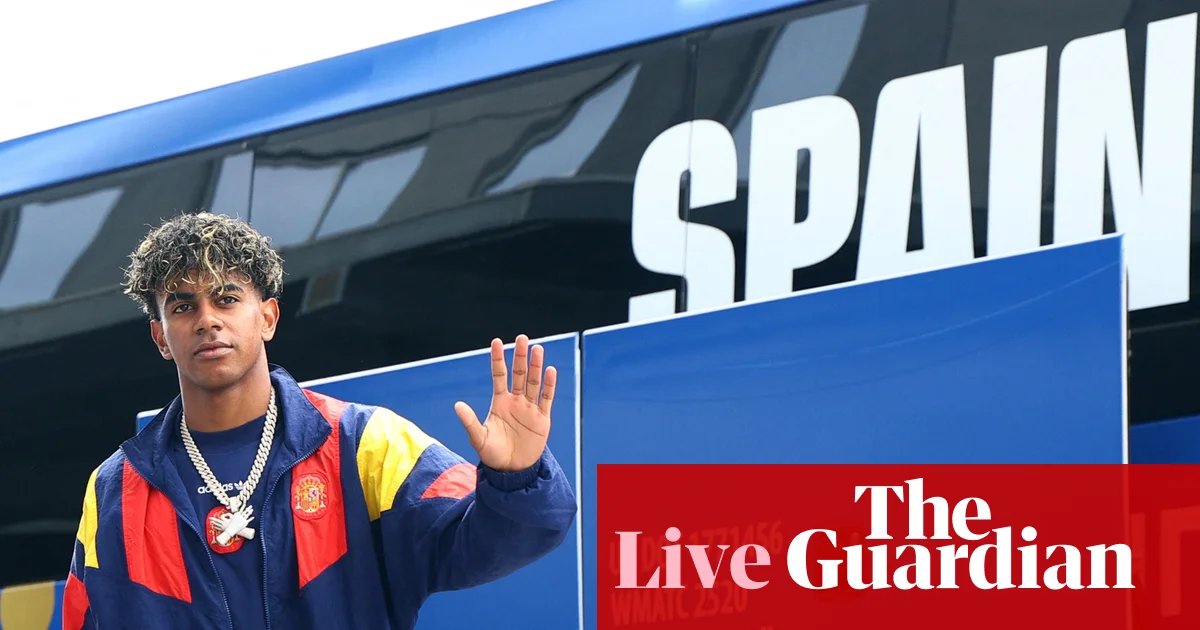
Four changes for Spain: Lamine Yamal, Pedro Porro, Dani Olmo and Alex Baena also come into the side with Marcos Llorente, Fabian Ruiz, Ferran Torres and Gavi dropping out.
The teams – Lamine Yamal starts
Spain: Simon, Porro, Cubarsi, Laporte, Cucurella, Gonzalez, Rodri, Yamal, Olmo, Baena, Oyarzabal. Subs: Raya, Joan Garcia, Pubill, Grimaldo, Eric Garcia, Llorente, Merino, Torres, Fabian, Gavi, Pino, Williams, Zubimendi, Munoz, Iglesias.
Saudi Arabia: Al Owais, Abdulhamid, Tambakti, Lajami, Al Amri, Al Harbi, Nasser Al Dawsari, Al Khaibari, Al Juwayr, Al Buraikan, Salem Al Dawsari. Subs: Al Aqidi, Al Kassar, Majrashi, Yahya, Al Shehri, Al Boushal, Kadesh, Al Johani, Al Ghannam, Al Hajji, Al Hamdan, Mandash, Kanno, Thakri, Abu Al Shamat.
Referee: Raphael Claus (Brazil)
Perhaps one of the Saudi -players can write themselves into this high-grade selection?
Perhaps it can be their goalkeeper.
Madrid screening of Spain v Saudi Arabia cancelled due to heat
The public screening of Spain’s World Cup match against Saudi Arabia in Madrid on Sunday has been cancelled because of extreme heat forecast for the Spanish capital, officials said.
The match, due to kick off at 6pm local time on Sunday, had been scheduled to be shown on a giant screen installed by the Spanish football federation (RFEF) at a fan zone in Plaza de Colón in central Madrid.
Madrid city council and the federation decided to cancel the screening after national weather agency AEMET issued an orange heat warning – the second-highest level – for the Madrid region, with temperatures forecast to reach 40C.
“The decision has been taken with the aim of protecting the health of attendees, event staff and support services involved in the event,” Madrid city hall said in a statement, apologising for any inconvenience.
Officials urged supporters to watch the match indoors in air-conditioned spaces and avoid prolonged exposure to the heat.
Large parts of Spain are experiencing unusually high temperatures for June as a mass of hot air from North Africa moves across the Iberian Peninsula.
A total of 13 of Spain’s 17 regions are on orange alert for heat on Sunday, while the northern Basque Country bordering France is on red alert, the highest level.
Authorities advised residents and visitors to take precautions during the heatwave, including drinking water regularly, staying in cool environments, limiting outdoor physical activity during the hottest hours of the day and taking extra care of vulnerable people. AFP
Can Saudi Arabia repeat the magic of 2022?
Argentina arrived in Qatar on a 36-game unbeaten run. When Lionel Messi opened the scoring from the penalty spot after 10 minutes, a comfortable afternoon seemed in the offing. Saleh al-Shehri and Salem al-Dawsari had other ideas, Argentina had three goals disallowed for offside in the space of 13 minutes and the greatest comeback in Saudi Arabia football history was made. Argentina went on to lift the trophy, while defeats to Poland and Mexico meant the Saudis did not reach the knock-out stage.
Unai Simon over David Raya is a controversial choice for De la Fuentes. The Arsenal keeper could lay claim to being Europe’s best this season.
“Those at the Champions League final had a few more days, so I got there on the Wednesday night,” Raya says. “I arrived a bit before Fabián [Ruiz]. I was saying hello to some of the others in reception when he arrived. I went to say congratulations; that was almost the first thing I did. I couldn’t really talk [to him] after the final; I just didn’t have it in me. The next day we talked about the game properly. Just two mates chatting … I was happy for him that he could lift the trophy for a second time.”
A high pressure game for the European champions, as Sid Lowe reports.
“If we had scored one, the game would have changed,” Martín Zubimendi said. Immediately after the game, De la Fuente had offered a simple analysis: when the ball doesn’t want to go in it doesn’t want to go in, he insisted. Spain had racked up 27 shots, after all. Ferran Torres had hit the bar and seen another clear opportunity saved. Vozinha, the 40-year-old goalkeeper who stopped that, saved six more and was named the man of the match. “There’s nothing to reproach the team for,” Rodri said. “We generated chances but couldn’t put it away; the good thing is they created almost nothing.”
We wait to see what role Lamine Yamal will play today. His coach would surely like to be able to use him.
The worst mistake we could make would be to compare him to anyone. He is the midst of a process. He has exceptional footballing maturity and lives it all with total naturalness. He has great serenity and strength. We have to let him follow his path but those players who have something different are ready for that. They’re geniuses, like Dalí [who] can paint a picture, or Michelangelo. They’re different. What is exceptional to us, isn’t to them. In those extremes, they feel comfortable. Why? Because they are different. What we think is exceptional, they consider normal.
Preamble
Spain’s campaign did not get off to a flying start, and Luis de la Fuentes may wake up in the night to visions of Cape Verde’s Vozinha. He will have Georgia on his mind ever since Monday. Saudi Arabia are no pushovers and gave Uruguay a scare in their opening match. Memories of downing Argentina four years ago still abound, and so Spain might beware. They can ill afford to go into the final game with Uruguay at a disadvantage. All eyes on Lamine Yamal, whose fitness situation remains opaque, though Spain need their other forwards to come to the party.
Kick-off 5pm UK, 1pm ET, 2am AEST. Join me.

A topless man can be seen driving erratically in Edinburgh before abandoning his car and attacking a black man and a delivery rider.
Source link



-
 Oxford University4 weeks ago
New to the Oxford English Dictionary this September
-
 Oxford united FC4 weeks ago
Chris Gunter steps away Wales role to focus on Oxford United
-

 Oxford united FC2 weeks ago
LIVE: Exeter City vs Oxford United – Jersey Mike's Trophy group stage
-

 Traffic & Transport2 weeks ago
Why should I have to pay more for buses if I don’t use a smartphone? | Bus fares
-

 Traffic & Transport3 weeks ago
How poor public transport policy is putting the brake on cities | Road transport
-

 Student Life3 weeks ago
Oxford partnership allows OpenAI to use rare Bodleian texts to train ChatGPT
-
 Oxford united FC2 weeks ago
Oxford United lose to Exeter City on penalties in Jersey Mike’s Trophy
-

 Oxford united FC3 weeks ago
Northern Ireland fans laud Oxford United defender Ciaron Brown