
Business & Technology
Oxfordshire museum reveals major refurb amid funding threat

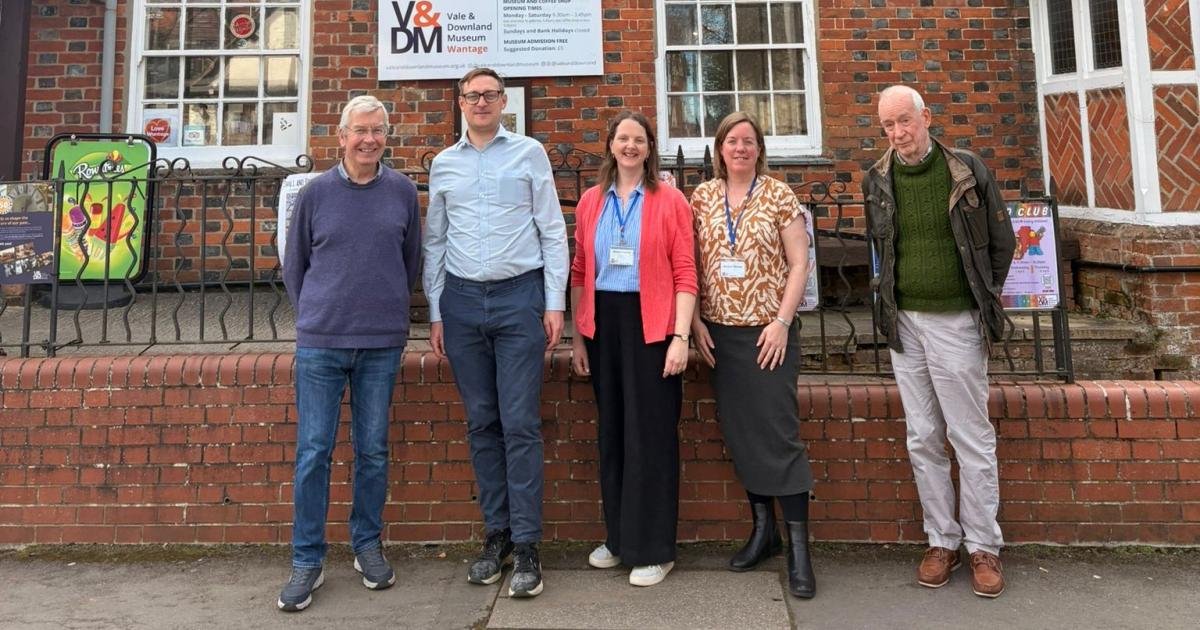
Olly Glover, MP for Didcot and Wantage, visited the Vale and Downland Museum on Church Street last week and heard about new proposals to redevelop the Barn Gallery.
This comes as the manager of the Wantage museum, Lisa Gale, said that without “an increase in consistent income” they will continue to face challenges meeting costs.
READ MORE: Frustration and worry in Oxford as Iran War sparks sharp rise in fuel costs
The project to renovate the gallery recently received a financial boost with funding secured from several sources, after the removal of a Formula 1 car from the area by Williams Racing two and a half years ago.
Those funding the works include Arts Council England, Vale of the White Horse District Council, FCC Communities Foundation, Persimmon Homes, and the Friends of the Vale and Downland Museum.
Ms Gale said: “We are thrilled to receive funding for projects across the museum, and it makes a real difference.”

The renovation is set to be phased with the first installation, scheduled for June, featuring a large-scale artwork by landscape artist Anna Dillon, depicting the distinctive scenery of the Vale and Downlands.
A second phase will focus on the physical refurbishment of the space, introducing interactive displays, hands-on activities, and previously unseen objects from the museum’s collection.
While the green light for this project was welcomed, the museum continued to stress that they were facing funding challenges, including to Mr Glover.
The local MP – who recently raised the issue in Parliament – said: “I had a good discussion with the team about the challenges they face in terms of fundraising and rising costs, following my recent oral question to culture ministers.

“I will continue to do all I can to support them.”
Ms Gale said: “Without an increase in consistent income—particularly as we do not benefit from the level of admissions income that many independent museums receive—we continue to face challenges in meeting our operational costs.
READ MORE: Almost 100-year-old Oxford pub listed for £700,000 sale
“We encourage local businesses to consider partnering with the museum.
“There are also opportunities for individuals to get involved, including joining our 100 Club or becoming a museum patron. Please get in touch if you’d like to find out more.”
Funding for cultural attractions such as museums is a topical issue in Oxfordshire after the River and Rowing Museum closed to the public last September.
Ms Gale has previously reported on signs of wear and tear at the Wantage destination.
Speaking in March, she said: “We have had leaks in certain places. Day to day dealing with an old building is a challenge.”

Seekr has partnered with Arcas to supply explainable artificial intelligence systems to mid-sized organisations in Europe, with a focus on customers in regulated and sovereign infrastructure environments.
Together, they will offer AI applications to European Union organisations that need audit trails, clear explanations for outputs, and control over where data and models are hosted. London-based Arcas specialises in secure, governed AI deployments for mid-market European clients, while Seekr develops AI software for regulated commercial and government settings.
The partnership comes as businesses in Europe prepare for stricter oversight under the EU AI Act. The rules are expected to require AI systems used in professional settings to explain automated decisions, increasing compliance demands in sectors such as finance, legal services, and other regulated industries.
Platform Focus
At the centre of the partnership is SeekrFlow, Seekr’s AI software platform. It is designed to handle data preparation, model training, deployment, monitoring, and governance, with particular emphasis on tracing outputs back to training data and keeping systems within a customer’s own infrastructure.
That approach is likely to appeal to European buyers seeking to keep data in private cloud, on-premises, or other sovereign environments. The software can run in managed cloud, private cloud, on-premises data centres, air-gapped systems, and edge locations.
Seekr says its software allows organisations to fine-tune models on their own data or use supported open-source models. It also includes tools to score confidence in outputs and inspect the training data that most influenced a result, features likely to matter for firms facing scrutiny from regulators or clients.
For Arcas, the partnership broadens its product offering for customers who want generative and agentic AI tools without sacrificing visibility into how those systems operate. For Seekr, the deal provides a route into a European market where companies are increasingly seeking AI products that can be examined and defended in audits or disputes.
Early Use Cases
The companies pointed to early customer work in Europe as evidence of demand. According to figures they provided, a legal publisher in Luxembourg reduced manual review time by 78% using automated database summaries.
A regulatory advisory firm serving European fund managers cut compliance research time by 65%. In that case, each response was linked to source documentation, and the system ran within the customer’s own infrastructure.
Those examples reflect a broader market pattern, with legal, compliance, and information-heavy industries emerging as early adopters of AI tools that can show the basis for an answer. In these sectors, speed gains alone are rarely enough; buyers also need systems that enable staff to verify results and document the rationale for a decision.
The emphasis on explainability also reflects a broader shift in AI procurement. European organisations, especially in regulated fields, are placing greater weight on governance, auditability, and data sovereignty as core procurement criteria rather than optional safeguards.
Regulatory Pressure
The EU AI Act is shaping many of those buying decisions. As enforcement is phased in, companies using AI in professional settings face pressure to document how systems behave, what data they rely on, and whether results can be challenged or reviewed.
That creates an opening for suppliers that offer built-in transparency rather than bolt-on controls. It also favours partners able to deploy within local infrastructure, an issue that has gained importance in Europe as customers and policymakers focus on sovereignty, confidentiality, and control over sensitive information.
Seekr has positioned itself around that argument, particularly for organisations handling critical decisions or sensitive data. Arcas brings access to mid-sized European firms that may want AI tools tailored to complex document workflows but lack the resources to build and govern such systems internally.
Rob Clark, President of Seekr, said the partnership addresses a growing compliance challenge for companies in Europe: “Simply put: there is no governance or ability to audit AI systems without true explainability and transparency. Seekr’s platform was built for environments where every decision demands an explanation; European firms facing the EU AI Act need those same capabilities, deployed within the security and confidentiality of their own sovereign AI datacenters.”
Clark added, “We are excited to partner with Arcas to bring explainable AI to their customers, allowing them to move faster with AI while providing all the guardrails they need.”
Chiara Buck, co-founder of Arcas Agentic, said customers in Europe are under immediate pressure to prove how AI-generated outputs are reached: “In Europe, the regulatory bar for AI is here. Firms have a relentless demand for AI, but scaling it effectively means being able to defend every output to regulators.”
Buck added, “Seekr’s technology has made that possible. We are proud to partner with Seekr to deliver explainable AI solutions to our customers and move at the pace they demand.”

Tracker and UK police recovered 55% more stolen vehicles in 2025, with the recovered vehicles valued at a combined £41.3 million.
The figures set a record for the vehicle recovery company and reflect a 72% year-on-year increase in the value of vehicles it helped police recover.
As a result of its recovery work, 200 stolen vehicles without Tracker devices were also recovered and returned to their owners. The company attributed the results to collaboration with police forces, car makers, dealer groups and insurers.
The data suggests vehicle crime is widening, with lower-value cars featuring prominently in recoveries. The largest share of stolen cars recovered last year were valued at between £10,000 and £20,000, while one in 10 were worth less than £10,000. Only 4% were valued at more than £50,000.
This contrasts with the public focus on prestige vehicle thefts and suggests organised criminal groups are targeting a broader range of models. Tracker said profits from stolen vehicles help fund other criminal activity and warned motorists that no vehicle should be considered safe from theft.
Recovery Rates
Tracker says it remains the only stolen vehicle recovery specialist formally supported by all 43 police forces in the UK. Most police patrol vehicles and all police helicopters carry its detection units, which identify stolen vehicles through a VHF signal.
It says this approach delivers a 95% recovery rate, with half of stolen vehicles found within four hours and 80% returned to owners within 24 hours.
The broader picture is mixed. Tracker cited DVLA data obtained through a Freedom of Information request showing an 11% year-on-year fall in vehicle theft across England and Wales in 2025. However, theft levels remain 48% higher than a decade earlier.
At the same time, recovery rates for vehicles without dedicated protection remain low. According to Tracker, police recovered only 13% of stolen vehicles between 2022 and 2025.
More than 90,000 vehicles were reported stolen in 2025, based on the DVLA figures it cited. Those thefts ranged from motorbikes and vans to prestige cars and agricultural machinery.
Models Targeted
The most stolen vehicle in the DVLA data for 2025 was the Yamaha NMAX scooter, followed by the Ford Transit 350. Other frequently stolen vehicles included the Toyota Hilux, Honda WW 125-A, Nissan Navara Tekna, Ford Fiesta Zetec and Mercedes-Benz Sprinter models.
Tracker’s own recoveries are heavily weighted towards premium marques, including BMW, Jaguar Land Rover, Mercedes-Benz, Lexus and Toyota.
Clive Wain, Tracker’s head of police liaison, outlined the mix of vehicles his team sees in recovery work.
“Our stolen vehicle recoveries are dominated by thefts of premium car brands, such as BMW, Jaguar Land Rover, Mercedes-Benz, Lexus and Toyota. However, the intelligence we gather from our partner network tells us that the Toyota RAV4, Ford Puma, Nissan Juke and BMW X5 are firm favourites amongst thieves,” Wain said.
Recoveries also peaked around the March and September registration plate changes. More than £4 million worth of vehicles were recovered around the spring plate change alone.
Crime Networks
Tracker linked vehicle theft to dismantling operations and the illegal sale of used parts. Working with police, it said it uncovered and shut 78 illegal chop shops last year, leading to 147 arrests.
“Vehicle theft can be financially and emotionally devastating for motorists. That’s why we continue to forge industry partnerships and work tirelessly with U.K. police to recover stolen vehicles to their owners,” Wain said. “Together, not only are we stopping motorists’ prized possessions from being sold on or shipped abroad, but we are also stopping them from being stripped for their parts. The illegal harvest and sale of quality second-hand parts have become a lucrative revenue stream for OCG’s operating on the black market. Last year, Tracker and the police uncovered and closed 78 illegal chop shops, resulting in 147 arrests, which was another record year.”
Mark Kameen, lead for the National Vehicle Crime Reduction Partnership, said the results reflected closer intelligence-sharing between law enforcement and private sector organisations.
“An overarching ambition when launching the National Vehicle Crime Strategy in 2024 was to enhance intelligence between law enforcement and the private sector to help tackle organised vehicle crime. And we are actively achieving our goal. The record number of stolen vehicle recoveries by Tracker and the U.K. police also underlines this. We will continue to build on this success by working closely with all of our partners and members, sharing expertise to ensure we all play a vital role in tackling vehicle crime across the country,” Kameen said.

Distology has signed a distribution agreement with Snyk covering the UK, DACH and Benelux markets.
The deal gives Distology’s resellers and partners access to Snyk’s AI Security Platform and Agent Security products, as demand rises for tools that address risks in software development and AI-assisted coding.
It also expands Snyk’s reach across Northern Europe through Distology’s channel relationships, with local support and regional coverage included in the agreement.
Security teams are facing a shift in how software is produced. As organisations use AI tools to generate code faster, they are also dealing with more application vulnerabilities and open-source risks that are harder to control if discovered late in the development cycle.
Snyk’s products are designed to move security earlier in the process by helping developers identify and fix issues while writing code, rather than waiting until software is closer to release.
For Distology, the agreement adds application and AI security to a portfolio focused on cyber suppliers and services. It plans to support partners with training, technical assistance and sales support, alongside enablement for services such as implementation, DevOps and consultancy.
Sarah Geary, Chief Commercial Officer at Distology, said the company is seeing stronger demand from organisations that want to embed security earlier in software development.
“We’re seeing growing demand from organisations that need to secure applications earlier in the development process.
“AI is accelerating software development, and customers need a security solution that can keep pace. By bringing Snyk into our portfolio, we’re giving our partners a way to step into that conversation. This isn’t a transactional sale. It’s about helping customers rethink how they build and secure applications from the outset, which opens the door to higher-value services,” said Geary.
Channel Focus
The partnership is part of Snyk’s channel strategy, centred on working with a smaller number of specialist partners that can provide technical and pre-sales support around its products.
Snyk serves more than 4,800 customers globally and has been building its position in application security as AI becomes more embedded in enterprise software development.
Tom Evetts, Vice President Sales and General Manager at Snyk, said many organisations are trying to balance faster software delivery with the need to maintain security oversight.
“Speed of development is important for organisations to maintain their competitive edge,” said Evetts.
“But they know it can’t happen at the expense of security, which is why demand in our space is so strong and why we wanted to appoint a partner we trust to support our channel in the right way.
“We’re very selective about who we partner with. For us, it’s about working with a company that understands the cybersecurity sector and can support partners with technical depth, strong presales and local-language capability,” he added.
Market Demand
The partnership reflects a broader shift in the security market as software supply chains become more complex and AI tools become standard across development teams. That has increased interest in products that help engineering teams address vulnerabilities during coding rather than relying only on later-stage testing.
Distributors and resellers are also looking for areas where they can attach services and consulting work, particularly in segments where customers need support to change internal development and security practices.
The agreement is intended to help partners build offerings around application and AI security rather than simply resell licences.
“This is about giving partners access to areas of the market where they can add real value,” said Geary.
“Application and AI security is clearly one of those.”



-

 Oxford Events4 weeks ago
Michelin Guide Oxfordshire Restaurants – The Oxford Magazine
-

 Crime & Safety3 weeks ago
Oxford: ‘Next generation’ LimeBikes in city from today
-

 Jobs & Careers3 weeks ago
Explore our Careers
-

 Student Life3 weeks ago
The Art of Personalised Jewellery: Why Engraved Bracelets Are the Ultimate Keepsake
-

 Oxford News3 weeks ago
Gary Lineker’s nephew-in-law death inquest to be next week
-

 Oxford News4 weeks ago
Schwarzman Centre to open doors to public with major celebration
-

 Jobs & Careers3 weeks ago
Why Join Oxford | Oxford University Jobs
-

 Oxford Events3 weeks ago
Oxford News and Events, What’s on in Oxford, Exhibitions