
UK News
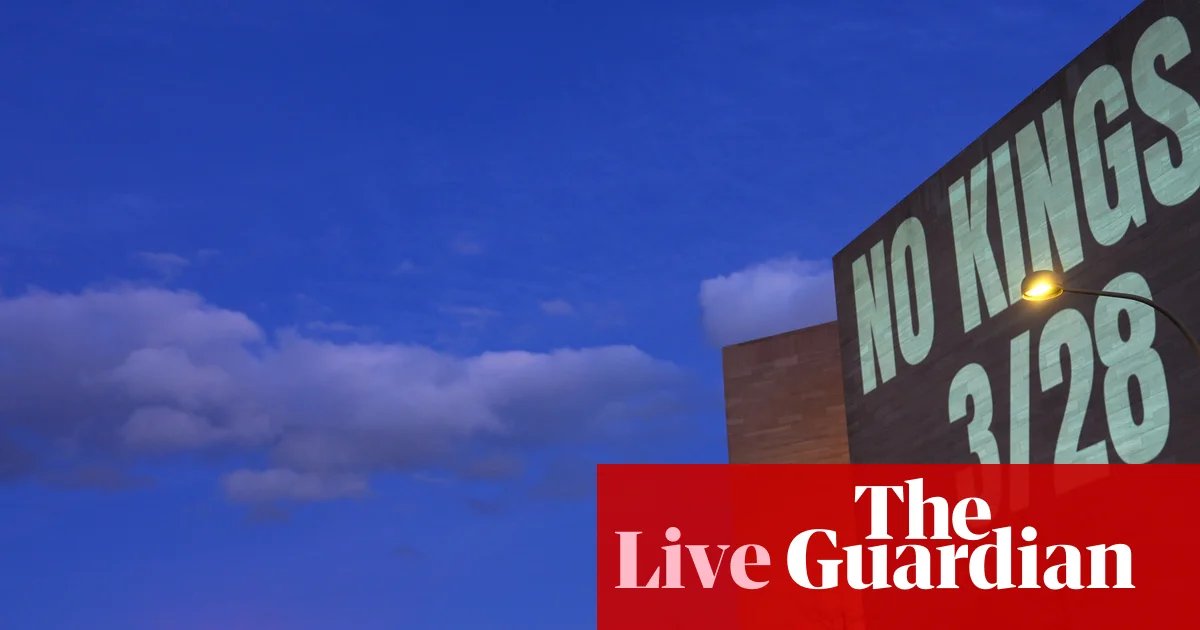
No Kings protests live updates: hundreds of thousands rally in cities around the world against Trump and his administration | Protest (US)

Key events
Fabiola Cineas
As one of DC’s No Kings marches wound down at the Southwest Waterfront, protesters said they want the country to remember that DC was the “guinea pig.”
“Donald Tump unleashed this on Washington DC first,” Ama’d, 27, said as a group of National Guard members stood a few feet away. “We need to rest of the country to know that we are being over-policed in our communities.
Ama’d, an activist and music artist, helped design protest music that he performed on a float. “No one man should have all that power! We need our rights back! We’re taking back ours,” one musician rapped as crowds of protesters chanted, “Free DC! Free DC!”
As protesters made their way to the Waterfront metro station, organizers distributed flyers for future protests, including a daily “Hands Off the Arts” protest to “keep the Kennedy Center open” and “save jobs,” organizers told the Guardian.
For a 1 May protest, activists are demanding a day of “No work. No School. No shopping,” another flyer states.
“Part of what we are trying to do is be in solidarity with other groups and movements that are being attacked and one of them is the labor unions and working people here in DC,” said Nachama Wilker, 64, a volunteer with Free DC, the local organization advocating for DC home rule and DC statehood. “The May action is in solidarity with all of these labor organizations as Trump guts union jobs in DC”.
Wilker added, “People come out to these big rallies, and they don’t know how to plug in after the rally. That’s a big reason why I am handing out these flyers”.
Rachel Leingang
Jane Fonda, Joan Baez and Maggie Rogers are closing out the day’s speakers in St. Paul.
“This is not the America I was told existed,” Fonda said. “I was told we are the people.”
Rogers praised Minnesotans for their resilience, saying it was inspiring. “So much love in the face of evil,” she said.
Baez praised Minnesota’a resistance, saying “thank you, Minneapolis”.
Then, Baez and Rogers ended the rally by singing “The Times They Are A-Changing.”
As No Kings protests begin to wrap up on the east coast, they’re just getting started in California.
Here’s a glimpse of the demonstrations under way in San Francisco and Los Angeles:
Lex McMenamin
The multiple No Kings contingents in Manhattan merged through Times Square, continuously flanked by photographers. Families carried LGBTQ pride flags and Palestinian flags, while older marchers held pun-heavy protest signs, and others handed out whistles. Across age groups and race — though the crowd did overall lean white and older, it was by no means homogenous — the consistent themes were anti-ICE, pro-LGBTQ, and, obviously, anti-Trump.
But perhaps the most consistent theme was anti-war. Multiple signs connected the Epstein files to the Trump administration’s decision to target Iran and spend immense amounts of funding on warfare. “This war has to stop,” said M.B., 55, who came in from Queens to protest. “American people do not want what this administration is doing. We don’t want it. We need healthcare, we need jobs. We need infrastructure.”
The front of the march reached the dispersal point at Madison Square Garden by 3:30 local time, and more than an hour later, protesters still streamed through the closed intersection. Leftist organizing groups and political parties set up shop to peel protesters off as they walked to the subway, flyering for future actions and ways to get involved in their work.
Rachel Leingang
Organizers in Minnesota estimate at least 200,000 are at the main march at the state capitol in St. Paul.
The crowd stretches back further than I can see in multiple directions.
“Fuck ICE” and “ICE OUT” signs and pins are a frequent site, an indicator of how much the federal government’s incursion into the state left a mark on its people.
Speakers on the stage talked about how they and their organizations responded on the ground to their neighbors’ needs during the surge.
Bernie Sanders riled up the crowd with remarks about the role of the ultra rich in politics.
My colleage Amy Qin is continuing to report live from Chicago, where a diverse slate of speakers, including faith leaders and legal advocates, have addressed a crowd gathered at Butler Field in Grant Park:
The loudest cheers came when two student protest leaders came on stage, including Leah Sophia Lopez, a student at Social Justice High School in Chicago’s Little Village neighborhood, a predominately Latino neighborhood that was a frequent target of Trump’s immigration enforcement campaign last fall.
“My fellow Americans: kids are being put into cages while our government funds war and genocides,” said Lopez, who led hundreds of students in a school walk out protesting ICE last year. “America is built off of protest, immigrants, slaves, we built this county.”
Illinois lieutenant governor Juliana Stratton closed out the rally to thunderous cheers from the crowd. “We came here to make it clear that we will never bow to a king,” she said. “Illinois will stand up and fight back like we always do.”
Fabiola Cineas
Thousands of protesters are rallying across the Washington, DC region as No Kings protests spread across the nation’s capital.
One protest group, made up of about a dozen Palestinian mothers, stood at the steps of the Lincoln Memorial and waved a massive 10-foot-tall Palestinian flag. One of the mothers, activist Hazami Barmada, 42, said she was protesting to draw attention to “Israel’s atrocities against the Palestinian people.”
“Most Americans don’t know that our tax dollars are being used to subsidize violence,” Barmada said. “This is happening while many Americans can’t afford housing, milk, school, or healthcare. Prices continue to go up as we are fighting Israel’s wars.”
Other protesters, led by local activist organizations including Free DC, gathered at the Frederick Douglass Bridge in southeast Washington, DC. The crowd marched across the bridge to Fort McNair in Southwest DC where White House senior advisor Stephen Miller resides. The protest’s organizers say Miller is “running the effort to take over DC.”
Protesters told the Guardian they wanted to draw attention to the occupation of Washington, DC. In August, President Trump issued an executive order that put the federal government in charge of the Washington, DC Metropolitan Police Department. Trump used an additional executive order to deployed more than 2,000 members of the National Guard to the nation’s capital. Trump said the Guard members were mobilized to fight crime, though violent crime in DC is at a 30-year low.
Bruce Springsteen headlines rally in Minnesota
Rachel Leingang
At the flagship protest in St Paul, Minnesota, many tens of thousands filled the streets around the state capitol to commiserate, mourn and speak out again the Trump administration.
Bruce Springsteen sang his song about the death and destruction brought by ICE to this state, Streets of Minneapolis, leading the crowd in chants of “ICE OUT NOW.”
Governor Tim Walz introduced Springsteen, saying it was clear America needed “no damn kings” but it needed The Boss.
Walz praised his state as the “freest” in the country and commended the state’s people for standing up for each other and for immigrants when Trump sent in thousands of federal agents, who killed two Minnesotans.
The names of Renee Nicole Good and Alex Pretti featured heavily in the No Kings protest and signs here in Minnesota.
“We will never forget what they did here,” Walz said of the Trump administration. “You’ll still be here when that orange clown is in the dustbin of history.”
Thousands of protesters are rallying at Butler Field in Grant Park, Chicago, where my colleage Amy Qin is reporting:
As they filed into the park, protesters chanted “ICE out” and “Trump must go now, facists gotta go now”.
Chicago mayor Brandon Johnson was the first to speak at the event, opening by addressing the size of the crowd: “Look around: Our movement is bigger, our resolve is bigger.”
“We’re sending a clear message: we’re gonna end these assaults against working people, against immigrants and end these endless wars,” Johnson said.
In the crowd, protesters held aloft signs reading “No country for orange men” and “Imagine hating immigrants more than pedophiles”. Others waved signs denouncing ICE, supporting voting rights and criticizing wars.
Later in the rally, Dian Palmer, president of SEIU Local 73, said, “Fascism is really just one thing: powerful people using force to keep everyone else down, and unions exist to push back against that.”
Also at the event, social worker and Chicago Therapy Collective executive director Iggy Ladden denounced the Trump administration’s attacks against transgender people.
“Trans people are a direct threat to fascism because depends on control telling people who they can and cannot be,” Ladden said. “When we build a world that protects trans people we build a world that’s better for everyone.”
As demonstrators gather across the United States, the White House and Republican leadership are denouncing the No Kings day events planned today as “Trump Derangement Therapy Sessions”.
In a statement, White House spokesperson Abigail Jackson said the demonstrations were created by “leftist funding networks” and that “only people who care about these Trump Derangement Therapy Sessions are the reporters who are paid to cover them.”
The National Republican Congressional Committee echoed the White House. “These Hate America Rallies are where the far-left’s most violent, deranged fantasies get a microphone,” spokesperson Maureen O’Toole told the Associated Press.
Protesters are gathering in Minnesota’s Twin Cities for a flagship No Kings rally in St Paul. Bruce Springsteen is expected to headline the event and perform Streets of Minneapolis, which he wrote following the deaths of Renee Nicole Good and Alex Pretti earlier this year.
Joan Baez, Jane Fonda and senator Bernie Sanders are also expected at the St Paul rally, which organizers believe could attract about 100,000 people.
Lex McMenamin
Well before the main New York City No Kings march was set to touch off near Central Park’s south-west edge, protesters milled through the frigid midtown streets with posters and banners, donning costumes, keffiyehs and parkas.
By 1.50pm, Letitia James, the state attorney general, Jumaane Williams, the city public advocate, Robert De Niro, Rev Al Sharpton and Padma Lakshmi filed into the front of the crowd behind hand painted banners reading: “WE PROTECT OUR DEMOCRACY – PEOPLE OVER BILLIONAIRES – WE PROTECT OUR NEIGHBORS.” They joined union members in AFT merch and protesters of all ages.
Press photographers swarming the celebrities slowed the progress of the march down 7th Avenue, making it difficult for them to take off. “From Palestine to Mexico, all the walls have got to go,” someone boomed into a small speaker, half a block ahead of the celebrities. “Racist ICE, you can’t hide, we charge you with genocide!” Hundreds more people awaited the march in Times Square, while another march proceeded parallel down Broadway to convene.
Protest against the far-right underway in UK
With No Kings protests under way in the United States, my colleagues across the pond are covering a massive, although unrelated, demonstration against the far-right in the United Kingdom.
Organizers believe about half a million people gathered in London today in what was expected to be the biggest multicultural march in UK history, organized by the Together Alliance.
“Together was formed in response to last September’s far-right ‘unite the kingdom’ demonstration, when violent groups went on the rampage. The overwhelming majority of people reject the racism, Islamophobia, division, hatred and violence promoted by Tommy Robinson and the far right,” Sabby Dhalu, of Stand Up to Racism, one of the members of the Together Alliance, told the Guardian.
As crowds continue to gather in Washington DC and Minnesota’s Twin Cities – where two of the largest protests of the day are planned – demonstrations are underway across the country.
Here are some more images from protests in Georgia, Kansas, Texas and elsewhere.
What is the 3.5% protest rule and what does it mean for the US?
The number is frequently cited in leftwing circles, serving as a rallying cry for people who oppose Donald Trump: if 3.5% of a population protests against a regime, the regime will fail.
Left-leaning content creators, activists and media have boosted the 3.5% rule as the anti-Trump resistance has grown. A Pod Save America episode in June was headlined The 3.5% Protest Rule That Could Bring Down Trump. Social media posts from protest groups broke down the rule and its limitations.
In the lead-up to mass days of protest, organizers have referred to the target as a goal. After the No Kings protests in June 2025, for instance, the progressive activist group Indivisible sent an email to its supporters noting how “3.5% is a historically important target – but not a magic number”. Another day of protests is set for Thursday [July 2025], dubbed “Good Trouble”, a reference to the late congressman John Lewis on the fifth anniversary of his death.
The figure stems from research of prior mass movements, though it’s often oversimplified. Still, the gist is accurate: sustained mass participation in a resistance movement can topple authoritarianism.
Hundreds of demonstrators have gathered outside the Capitolio de Puerto Rico in San Juan where my colleage Joseph Gedeon is reporting.
Here’s a scene of the crowds:
In an op-ed published today, California congressman Ro Khanna said, “The Epstein class thinks it runs America. Today, No Kings protesters send their response.”
“As more Americans are sent to fight abroad and the survivors of abuse are silenced at home, people increasingly feel dispensable,” the California congressman wrote in MS NOW. Khanna co-sponsored the Epstein Files Transparency Act. “For too long, Americans have seen our leaders fight harder for the Epstein class than for the working class. They have watched our system shield elites instead of delivering fundamentals such as affordable health care, housing and education.”
The family of Shaun Burton, say they are “devastated” by the loss.
Source link
Key events
In the opening half an hour against Cape Verde, Mikel Oyarzabal, the centre-forward, did not get a single touch.
Kyle Green gets in touch: “Your highlighting of Lalas and his absurdity is something that has prevented me from wanting to watch the coverage on Fox. While every channel has its pros and cons I just can’t.
“I’m 45 and probably the youngest of anyone who remembers him as a player instead of an opinionated insert insult here. As for the match this could be more competitive than it looks on paper Spain need a win the pressure is on them. Saudi Arabia could hold out for a draw and see what happens in their last match. “
News from the England camp, and it seems to be good news on Declan Rice.
“I’m ready and fit, raring to go. I was feeling a little bit of neural pain in my hamstring, which I was managing from after Christmas with Arsenal for a very long time. Obviously, not a lot of people would have known that. It was all behind-the-scenes stuff but it was a smart decision.
“In the end, that last 20 minutes is probably where you pick up the most, and it’s where you play a 70-minute match. But that last 20 is where you really feel your body going for it. And I think it was a smart decision because the last few days I felt really, really good.”
Alex Reid has penned today’s weekend special Football Daily.
Portugal v Uzbekistan on Tuesday enticingly pits the incredibly nice, incredibly 41-year-old-superstar-tolerant Roberto Martínez against Fabio Cannavaro, who’s won a Ballon d’Or as a player and the Chinese Super League as a coach. While the fixture following that game really does see the dream of Thomas Tuchel – in his first international job with England – taking on Queiroz, who is in charge of his ninth national side with Ghana.
The expected formations are 4-2-3-1 for Spain, and 5-3-2 for the Saudi Arabians.
The Saudi team features two Donis changes: Ali Lajami, a defender, and Nasser Al Dawsari, a midfielder, are preferred to Mohammed Abu Al Shamat and Mohamed Kanno. You may recall Salem Al Dawsari, the Saudi captain, as the man who scored the winner against Argentina.
An entertaining read, even for those of us who have just seen the clips.
In a conversation where his co-panelist is casually reminiscing about his days playing alongside Messi or exchanging shirts with Ronaldo Nazário at the World Cup, what exactly is Lalas going to talk about – coming on as a second-half substitute for Earnie Stewart in a friendly against Scotland in 1998? Helping the Kansas City Wizards finish last in the 1999 MLS Western Conference? Did Lalas enjoy an elite playing career? No. But does he do the background reading that could compensate for his relative lack of standing in a conversation with titans like Henry and Zlatan? Also no. But is he charming or funny or charismatic or otherwise magnetic on screen? Eh, no.
For the record, I once interviewed Alexi Lalas on the challenge of playing against Romario in the 1994 World Cup. He had this to say:
“He could kill you in so many different ways. If you remember from that World Cup, he scored so many types of goals. That ranged from solo adventures to an outside-of-the-right-foot half-volley off a corner kick. Romario was both the most difficult to play against and the best that I have faced.
“Roberto Baggio was doing his thing, but in terms of consistency and living up to the hype, he [Romario] was the best. As with all stars, there was a moment when the fans sit up in their seats, and that was a feeling I got with Romario. When it got close to him and the potential for his involvement in a play was there, everybody sat up in their seat. They knew that something spectacular would be happening.”
Saturday’s match reports here.
The Saudi Arabia coach, and Blackburn legend, Georgios Donis, spoke about the challenges facing his team: “Spain is not the same team when Yamal or Williams are on the bench.
“While they still have plenty of possession, they lack the individual one-on-one penetration when these two are missing. I’m not saying it’s a problem for Spain, but when those players are missing, they play in a different way. We saw this very clearly against Cape Verde.
“We are playing against one of the best teams in the world, and it’s very important that when you play against these kinds of teams, you should enjoy the experience and respect the opponent, but not too much.
“It is very hard for any team playing against Spain to have any time in possession. So what we must do is to be more in control of our movement and compact, and when the ball goes through the lines, be able to defend dynamically.
“It’s nice to see miracles in football, and we’ve seen favourites losing against underdogs. Of course, it’s great for Saudi football to have a great memory of the result against Argentina, but we aren’t drawing anything from that.
“I think we’ll feel more pressure in that [Cape Verde] game than we will against Spain.”
The Spain coach, Luis De La Fuente had this to say in his Saturday press conference: “This generation of footballers is highly competitive and really fired up… It’s going to be a completely different story,” he said at his pre-match press conference on Saturday. There is no drama or crisis. The bottom line is simply that we need to win tomorrow.”
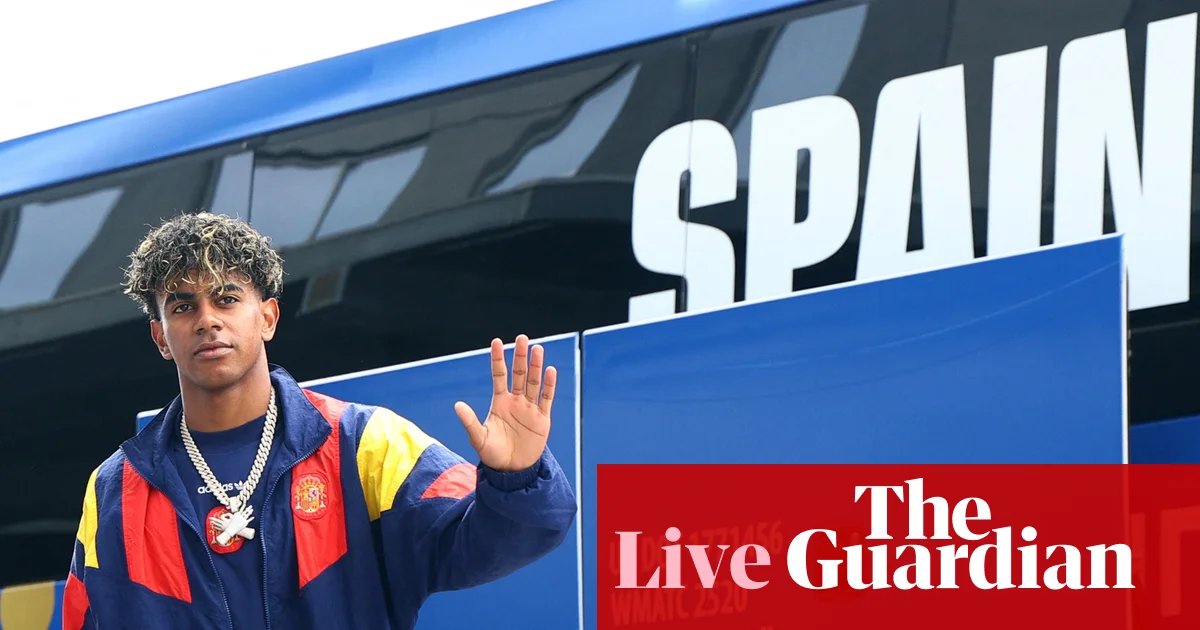
Four changes for Spain: Lamine Yamal, Pedro Porro, Dani Olmo and Alex Baena also come into the side with Marcos Llorente, Fabian Ruiz, Ferran Torres and Gavi dropping out.
The teams – Lamine Yamal starts
Spain: Simon, Porro, Cubarsi, Laporte, Cucurella, Gonzalez, Rodri, Yamal, Olmo, Baena, Oyarzabal. Subs: Raya, Joan Garcia, Pubill, Grimaldo, Eric Garcia, Llorente, Merino, Torres, Fabian, Gavi, Pino, Williams, Zubimendi, Munoz, Iglesias.
Saudi Arabia: Al Owais, Abdulhamid, Tambakti, Lajami, Al Amri, Al Harbi, Nasser Al Dawsari, Al Khaibari, Al Juwayr, Al Buraikan, Salem Al Dawsari. Subs: Al Aqidi, Al Kassar, Majrashi, Yahya, Al Shehri, Al Boushal, Kadesh, Al Johani, Al Ghannam, Al Hajji, Al Hamdan, Mandash, Kanno, Thakri, Abu Al Shamat.
Referee: Raphael Claus (Brazil)
Perhaps one of the Saudi -players can write themselves into this high-grade selection?
Perhaps it can be their goalkeeper.
Madrid screening of Spain v Saudi Arabia cancelled due to heat
The public screening of Spain’s World Cup match against Saudi Arabia in Madrid on Sunday has been cancelled because of extreme heat forecast for the Spanish capital, officials said.
The match, due to kick off at 6pm local time on Sunday, had been scheduled to be shown on a giant screen installed by the Spanish football federation (RFEF) at a fan zone in Plaza de Colón in central Madrid.
Madrid city council and the federation decided to cancel the screening after national weather agency AEMET issued an orange heat warning – the second-highest level – for the Madrid region, with temperatures forecast to reach 40C.
“The decision has been taken with the aim of protecting the health of attendees, event staff and support services involved in the event,” Madrid city hall said in a statement, apologising for any inconvenience.
Officials urged supporters to watch the match indoors in air-conditioned spaces and avoid prolonged exposure to the heat.
Large parts of Spain are experiencing unusually high temperatures for June as a mass of hot air from North Africa moves across the Iberian Peninsula.
A total of 13 of Spain’s 17 regions are on orange alert for heat on Sunday, while the northern Basque Country bordering France is on red alert, the highest level.
Authorities advised residents and visitors to take precautions during the heatwave, including drinking water regularly, staying in cool environments, limiting outdoor physical activity during the hottest hours of the day and taking extra care of vulnerable people. AFP
Can Saudi Arabia repeat the magic of 2022?
Argentina arrived in Qatar on a 36-game unbeaten run. When Lionel Messi opened the scoring from the penalty spot after 10 minutes, a comfortable afternoon seemed in the offing. Saleh al-Shehri and Salem al-Dawsari had other ideas, Argentina had three goals disallowed for offside in the space of 13 minutes and the greatest comeback in Saudi Arabia football history was made. Argentina went on to lift the trophy, while defeats to Poland and Mexico meant the Saudis did not reach the knock-out stage.
Unai Simon over David Raya is a controversial choice for De la Fuentes. The Arsenal keeper could lay claim to being Europe’s best this season.
“Those at the Champions League final had a few more days, so I got there on the Wednesday night,” Raya says. “I arrived a bit before Fabián [Ruiz]. I was saying hello to some of the others in reception when he arrived. I went to say congratulations; that was almost the first thing I did. I couldn’t really talk [to him] after the final; I just didn’t have it in me. The next day we talked about the game properly. Just two mates chatting … I was happy for him that he could lift the trophy for a second time.”
A high pressure game for the European champions, as Sid Lowe reports.
“If we had scored one, the game would have changed,” Martín Zubimendi said. Immediately after the game, De la Fuente had offered a simple analysis: when the ball doesn’t want to go in it doesn’t want to go in, he insisted. Spain had racked up 27 shots, after all. Ferran Torres had hit the bar and seen another clear opportunity saved. Vozinha, the 40-year-old goalkeeper who stopped that, saved six more and was named the man of the match. “There’s nothing to reproach the team for,” Rodri said. “We generated chances but couldn’t put it away; the good thing is they created almost nothing.”
We wait to see what role Lamine Yamal will play today. His coach would surely like to be able to use him.
The worst mistake we could make would be to compare him to anyone. He is the midst of a process. He has exceptional footballing maturity and lives it all with total naturalness. He has great serenity and strength. We have to let him follow his path but those players who have something different are ready for that. They’re geniuses, like Dalí [who] can paint a picture, or Michelangelo. They’re different. What is exceptional to us, isn’t to them. In those extremes, they feel comfortable. Why? Because they are different. What we think is exceptional, they consider normal.
Preamble
Spain’s campaign did not get off to a flying start, and Luis de la Fuentes may wake up in the night to visions of Cape Verde’s Vozinha. He will have Georgia on his mind ever since Monday. Saudi Arabia are no pushovers and gave Uruguay a scare in their opening match. Memories of downing Argentina four years ago still abound, and so Spain might beware. They can ill afford to go into the final game with Uruguay at a disadvantage. All eyes on Lamine Yamal, whose fitness situation remains opaque, though Spain need their other forwards to come to the party.
Kick-off 5pm UK, 1pm ET, 2am AEST. Join me.

A topless man can be seen driving erratically in Edinburgh before abandoning his car and attacking a black man and a delivery rider.
Source link


Oxford United player ratings in bizarre Mansfield Town draw

Number of cloned number plates on UK roads at record high, data shows | Transport

LIVE: Mansfield Town 1-1 Oxford United – Two red cards as U's down to nine men
-

 Oxford united FC4 weeks ago
Chris Gunter steps away Wales role to focus on Oxford United
-

 Oxford University3 weeks ago
New to the Oxford English Dictionary this September
-

 Oxford united FC1 week ago
LIVE: Exeter City vs Oxford United – Jersey Mike's Trophy group stage
-
 Traffic & Transport2 weeks ago
How poor public transport policy is putting the brake on cities | Road transport
-
 Student Life3 weeks ago
Oxford partnership allows OpenAI to use rare Bodleian texts to train ChatGPT
-

 Traffic & Transport2 weeks ago
Why should I have to pay more for buses if I don’t use a smartphone? | Bus fares
-

 Oxford united FC2 weeks ago
Northern Ireland fans laud Oxford United defender Ciaron Brown
-
 Oxford Events4 weeks ago
Four days of equestrian spectacle at 2026 Blenheim Palace International Horse Trials