
UK News
Middle East crisis live: US secretly plotting ground attack despite message of diplomacy, says Iran’s parliamentary speaker | US-Israel war on Iran

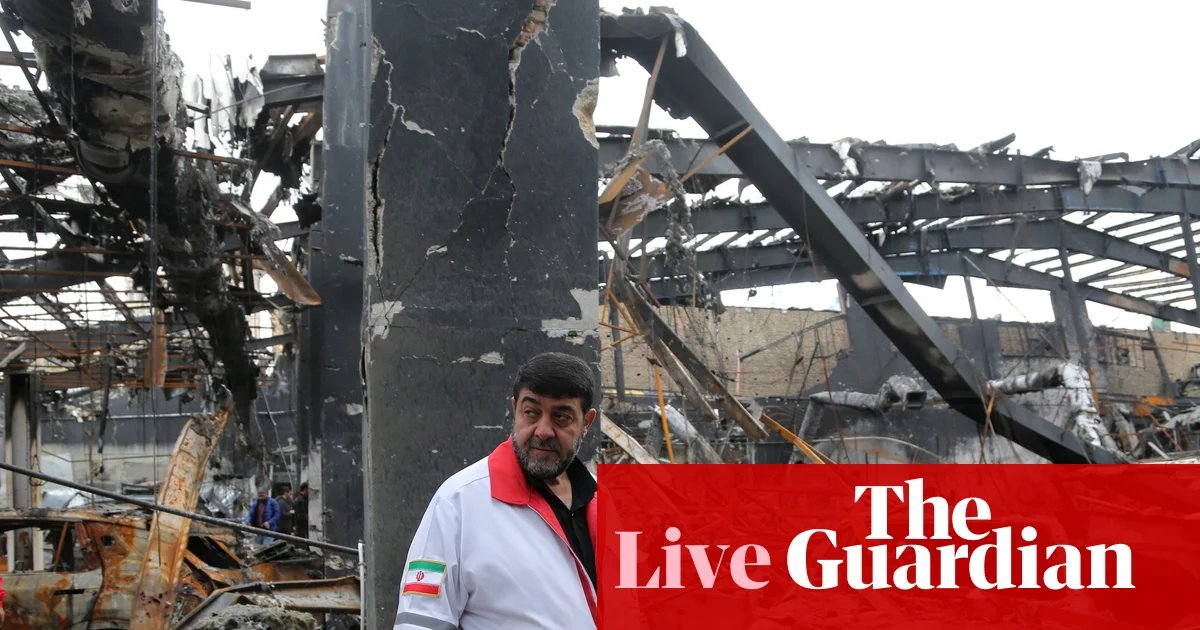
US secretly plotting ground attack despite message of diplomacy, Iran’s parliament speaker says
Iranian state media have published a message from Iranian parliament speaker Mohammad Bagher Ghalibaf marking 30 days since the start of the US-Israeli war.
“The enemy openly sends a message of negotiation and secretly plans a ground attack,” Ghalibaf, who has served as speaker of the parliament since 2020, wrote in his message carried by the Tasnim news agency.
“The United States expresses its desires with a list of 15 points and pursues what it did not achieve in the war.”
“We are in a major world war, and we must prepare ourselves for the tortuous and difficult path ahead of us until we reach the summit,” he added.
Ghalibaf was previously an Islamic Revolutionary Guard Corps (IRGC) commander, police chief and mayor of Tehran. Washington reportedly has thought of him as a potential partner and he is reported to be Donald Trump’s preferred choice for leader.

Photograph: Morteza Nikoubazl/NurPhoto/Getty Images
Key events
A report by Human Rights Activists in Iran (HRA), Airwars and the Center for Civilians in Conflict (CIVIC) that was issued on Friday lays out the civilian toll of the US-Israeli war on Iran. You can read it in full here:
-
Between 28 February and 23 March, HRA recorded at least 1,443 civilian deaths, including at least 217 children, resulting from US and Israeli airstrikes in Iran. These figures represent verified minimums and are expected to rise.
-
Drivers of civilian harm from US and Israeli operations identified by CIVIC, HRA, and Airwars include targeting errors and misidentification, including as a result of outdated or faulty intelligence; inadequate precautionary warnings for civilians; the use of explosive weapons in densely populated areas; and attacks on or impacting civilian and “dual-use” infrastructure, risking long-term reverberating impacts on civilians’ well-being.
-
As of 23 March, HRA found that 37% of confirmed attacks took place in Tehran’s urban environments. HRA has verified damage to 60 hospitals or medical centers, 44 schools, and 129 residential buildings, while government estimates indicate more than 16,000 homes were damaged. 543 strikes targeted “dual-use” infrastructure, including energy and transport systems essential to civilian life.
-
The humanitarian impact is significant, with approximately 3.2 million people reportedly displaced, according to United Nations figures.
-
Moreover, HRA has documented how Iranian civilians have faced intensified domestic repression since 28 February, including expanded arbitrary arrests (at least 1,830 as of 19 March), restrictive security controls, and inflammatory official rhetoric threatening arrest and even death to perceived opponents.
IDF says it has completed ‘another wave’ of airstrikes across Tehran
The IDF said this morning that it had completed “another wave” of airstrikes across the Iranian capital of Tehran.
Tehran was targeted with an intense wave of Israeli airstrikes yesterday that damaged residential neighbourhoods and reportedly struck a prestigious university.
US-Israeli airstrikes have repeatedly hit the densely populated city throughout the war. Many civilians have been killed in the attacks, despite them framed as only targeting the infrastructure of the Iranian state and targets linked to the regime.
Iran’s parliament speaker: the outsider seen by White House as possible partner

Patrick Wintour
Trying to appoint Mohammad Bagher Ghalibaf from Washington reveals either a misunderstanding of the Islamic Republic’s multilayered political system or a determination to upend it: power in Iran historically lies with the supreme leader, and Mojtaba Khamenei has been selected to that role by the Assembly of Experts.
While it is true that Khamenei has not been seen since his election and is believed to be seriously injured, Iran insists he is the functioning decision-maker…
As speaker of parliament, Ghalibaf has broadly followed the mainstream, supporting the 2015 nuclear deal but then, when Trump pulled out, arguing that Iran’s future lay in alliances with Russia and China. His critics claim that Ghalibaf supporters backed the attack on the Saudi embassy in Tehran in 2016 that led to the breaking off of diplomatic relations between the two countries.
From Trump’s perspective, little of this matters if he feels, in negotiating with Ghalibaf, he is negotiating with Iran’s true power brokers. Ghalibaf does have lines to the commander-in-chief of the IRGC, Ahmad Vahidi, and the commander of the Khatam al-Anbiya central headquarters, Ali Abdollahi Aliabadi.
Soon after it became known that Washington thought he was reliable, Ghalibaf issued a tweet saying: “Our people demand the complete and humiliating punishment of the aggressors. All officials stand firmly behind their Leader and people until this goal is achieved. No negotiations with America have taken place. Fake news is intended to manipulate financial and oil markets and to escape the quagmire in which America and Israel are trapped.”
Trump’s anointment may at least send the message to Israel that Ghalibaf is not to be killed, but it also piles pressure on him to show he will not betray his country.
US secretly plotting ground attack despite message of diplomacy, Iran’s parliament speaker says
Iranian state media have published a message from Iranian parliament speaker Mohammad Bagher Ghalibaf marking 30 days since the start of the US-Israeli war.
“The enemy openly sends a message of negotiation and secretly plans a ground attack,” Ghalibaf, who has served as speaker of the parliament since 2020, wrote in his message carried by the Tasnim news agency.
“The United States expresses its desires with a list of 15 points and pursues what it did not achieve in the war.”
“We are in a major world war, and we must prepare ourselves for the tortuous and difficult path ahead of us until we reach the summit,” he added.
Ghalibaf was previously an Islamic Revolutionary Guard Corps (IRGC) commander, police chief and mayor of Tehran. Washington reportedly has thought of him as a potential partner and he is reported to be Donald Trump’s preferred choice for leader.
Photograph: Morteza Nikoubazl/NurPhoto/Getty Images
How likely is it that Donald Trump will order a ground invasion of Iran?

Andrew Roth
Thousands of US marines aboard navy amphibious ships from the 31st and 11th expeditionary units have been deployed to the Middle East from Asia.
Another 2,000-odd paratroopers from the 82nd Airborne are also being sent to the theatre – they are tasked with deploying worldwide within 18 hours of notification and execute parachute assaults, including against a “defended airfield” to prepare for further ground operations.
The secretary of state, Marco Rubio, repeated on Friday that the US believes it will be able to achieve its goals without boots on the ground, but when marines are in position next week, Trump could order an assault to either provide leverage to reopen the strait of Hormuz or to degrade Iran’s ability to keep the waterway closed by force.
The lack of heavy armoured units, logistical depth and other elements needed for a protracted military conflict will limit the White House’s ability to escalate the conflict, however, potentially extending a stalemate that could be devastating to the international economy. Read the full piece here:
Saudi Arabia’s defence ministry said in a statement shared to social media about three hours ago that the country had intercepted and destroyed 10 drones in the previous few hours.
Qatari news channel Al Araby has said in a post on X that an Israeli missile had hit the building housing its office in the Iranian capital of Tehran, causing “extensive damage and halting live broadcasts”.
Iran’s foreign minister, Abbas Araghchi, has condemned Israel’s killing of three journalists in Lebanon on Saturday.
On his Telegram, Araghchi said the killings amounted to “targeted assassination” and “flagrant violation of international law”. He said they were a way of silencing “the voices of those who tell the truth”.
Ali Shoeib, from the Hezbollah-owned al-Manar television station, Fatima Ftouni and her brother and cameraman Mohammed Ftouni from the channel al-Mayadeen were killed in the Israeli airstrike targeting their car yesterday.
Israel claimed the attack shortly afterwards, saying the target was Shoeib, whom it accused of being a Hezbollah “terrorist”, without providing any evidence to support its claim. It did not comment on the killing of Fatima or Mohamed Ftouni.
Israel, which has killed more than 220 journalists since 2023, according to Reporters Without Borders, often claims the journalists it targets are linked to armed groups (like Hamas) without providing any evidence. International humanitarian law is meant to protect civilian journalists during armed conflict and Israel has been accused of clearly violating it, with effective impunity.
Kuwait has said its air defence systems intercepted four drones attacking the country this morning.
In a statement posted to social media earlier, the Kuwait army said that “any explosions that may be heard are the result of air defence systems intercepting hostile targets”, without specifying who was behind the attacks.
US base in Syria targeted by Iraq in repelled drone attack, assistant minister says
Syria’s assistant defence minister said Sunday that his country’s forces had repelled a drone attack from neighbouring Iraq targeting one of Syria’s last US military bases.
“Earlier today, the US base in Qasrak, located on our territory, was attacked by four drones launched from Iraqi territory,” Sipan Hamo said on X, adding that “the drones were shot down without casualties”.
“We hold Iraq responsible and call upon it to prevent the recurrence of attacks that threaten our stability.”
The attack came a day after Syria’s army said it repelled another drone attack from Iraq aimed at al-Tanf, a base in the southeast which used to house US forces.
Earlier this week, the Syrian military said another base in the north-east was also targeted by a missile attack from Iraq, with an Iraqi official saying a local armed group was behind it. Iraq has arrested four people in connection with that attack.
Iraq has been pulled into the war since it was sparked by US and Israeli strikes against Iran, with the conflict engulfing much of the Middle East.
Pro-Tehran Iraqi groups have claimed responsibility for attacks on US interests in Iraq and across the region, while strikes have also targeted these groups.
In recent months, American forces have withdrawn from the al-Tanf base, as well as Shadadi in the northeastern province of Hasakeh, and had begun withdrawing from the Qasrak base, also located in Hasakeh.
Oman’s foreign ministry condemns attacks on its territory
Oman’s foreign ministry said on Sunday that it condemns attacks on its territory, adding that no party has claimed responsibility.
It said authorities were investigating the attacks’ “sources and motives” without providing further details.
Oman said on Saturday that a worker was injured in a drone attack on the Gulf country’s Salalah port and Danish container shipping group Maersk said later that it temporarily halted its operations at the port after Saturday’s attack.
Five killed in US-Israeli strikes on Iran city near Hormuz strait, state media says
US-Israeli strikes hit a quay at an Iranian port city on Sunday near the strategic strait of Hormuz, killing five people, Iranian state media reported.
The official IRNA news agency reported the “enemy carried out a criminal attack at the quay of Bandar Khamir, killing five people and injuring four others”.
A series of loud explosions was also heard on Sunday across the Iranian capital, an AFP journalist said. The blasts were heard in northern Tehran and smoke was seen rising from impacted areas.
If you are just catching up on what it means that Yemen’s Houthi’s have joined the war, you can read a piece from the Guardian’s Julian Borger here.
IDF says it has hit Iranian command centres and weapons sites
The Israel Defense Forces (IDF) says it has temporary Iranian command centres and weapons production and storage sites in Terhan in a fresh wave of strikes.
In a post on X, the IDF said the sites targeted included “ballistic missile production and storage facilities, aerial defense systems, and observation posts of the Iranian regime”.
According to the IDF, Iran had moved some command centres to temporary sites. “Several temporary command centers were dismantled, including commanders who were operating within the HQ’s,” the IDF said in the post.
Iran Guards say strikes on Bahrain and UAE aluminium plants are retaliation for US-Israeli attacks
Iran’s Revolutionary Guards says it launched missile and drone strikes on aluminium plants in Bahrain and the UAE over the weekend in retaliation for a US-Israeli attack on Iranian industrial infrastructure launched from bases in Gulf states.
The IRGC said the strikes were targeting what they described as industries linked to the US military.
Since the Middle East war erupted at the end of February, Bahrain and other Gulf countries have regularly been targeted by Iranian missile and drone strikes in retaliation for the US-Israeli campaign.
In a statement carried by Iranian state broadcaster IRIB, the Guards said they hit an aluminium facility in the UAE and Aluminium Bahrain’s main plant, calling both sites “industries affiliated with and connected to the US military and aerospace sectors in the region”.
Aluminium Bahrain, one of the world’s largest aluminium producers, said two employees were wounded in an Iranian strike targeting its facility on Saturday.
The company, also known as Alba, said the workers suffered minor injuries.
Shipping helplines ring with alerts from seafarers trapped amid war
Seafarers’ helplines say they are overwhelmed with messages from crews stuck in the Gulf by the Middle East war, desperately seeking repatriation, compensation and onboard supplies.
“Writing to urgently inform you that our vessel is currently facing a critical situation regarding provisions and one crew health conditions,” read an email from one seafarer on 24 March to the International Transport Workers’ Federation (ITF)’s Seafarer Support team.
“Immediate supply of food, drinking water, basic necessities is required to sustain the crew,” said the message to the team’s helpline.
The ITF said it had received more than 1,000 emails and messages from seafarers stuck around the strait of Hormuz and the wider region since the war erupted with US-Israeli strikes on Iran on 28 February.
Opening summary
Hello and welcome to our live coverage of events in the Middle East as the war enters its second month.
The war only continues to escalate as Yemen’s Iran-backed Houthis confirmed a second wave of attacks on Israel since joining the conflict on Saturday. They have vowed to continue strikes in the coming days, posing a threat not just to worsening regional security but also global trade.
In Iran, two powerful explosions shook northern Tehran early on Sunday, an AFP journalist reported. The blasts occurred in the Iranian capital about 7.20am as air defences operated, but it was not yet clear what was targeted.
Meanwhile, the US is reportedly preparing plans for ground operations in Iran. The Trump administration has already deployed US Marines to the Middle East.
Here’s a quick recap of the latest:
-
In a televised speech, Houthi military spokesperson, Yahya Saree, said the Iran-backed group had launched a “barrage of cruise missiles and drones” in a second attack on Israel, targeting key military sites. He vowed the Houthis would continue military operations in the coming days until Israel “ceases its attacks and aggression”.
-
The entry of the Houthis, poses a direct threat to the Bab al-Mandab strait at the southern end of the Red Sea, a second major choke point in the supply chain of energy supplies and other trade in and out of the Middle East. With Iran’s near total closure of the strait of Hormuz, a shutdown of the Bab al-Mandab, located between Yemen and the Horn of Africa, would amplify the already grave impact of the war on the global economy, and could also reignite a Saudi-Yemen conflict.
-
The Pentagon is preparing plans for weeks of ground operations in Iran – potentially including raids on Kharg Island and coastal sites near the strait of Hormuz – though President Donald Trump has not yet approved any deployment, the Washington Post is reporting. Any ground operation would stop short of a full-scale invasion, instead involving raids by special operations forces and conventional infantry troops, the Post said, citing unnamed officials.
-
Exiled Iranian Crown Prince Reza Pahlavi has told one of the US’s biggest annual gatherings of conservatives that he is ready to lead a new Iranian government and would call on the country’s citizens to rise up when the “right moment arrives”, AP reports. Pahlavi is the son of the shah, a monarch deposed in 1979 when the Islamic theocracy came to power.
-
Iran’s Revolutionary Guard threatened to target US universities in the Middle East after saying US-Israeli strikes had deliberately targeted two Iranian universities. “If the US government wants its universities in the region to be free from retaliation… it must condemn the bombing of the universities in an official statement by 12 noon on Monday, March 30, Tehran time,” said the statement published by Iranian media.
-
Pakistan has said it would host a meeting of Middle Eastern powers on Monday in an effort to find a regional approach to ending the conflict. But the talks, which bring together the foreign ministers of Saudi Arabia, Turkey and Egypt, did not appear to include any of the warring parties, casting further doubt on persistent US claims of diplomatic progress.
-
Israeli attacks killed three journalists in a targeted strike on their car in southern Lebanon, which the Lebanese president condemned as a “blatant war crime”. The strike killed Ali Shoeib, from Hezbollah-owned al-Manar TV, Fatima Ftouni and her brother and cameraman Mohammed Ftouni from pro-Hezbollah outlet al-Mayadeen.
-
Tedros Adhanom Ghebreyesus, the director general of the World Health Organisation, called for an end to attacks on medical staff after nine paramedics were killed in southern Lebanon on Saturday.
-
The Israeli military bombarded Tehran with a “wide-scale wave of strikes”, damaging residential areas, civilian infrastructure, and research and educational buildings. The IDF also said it had hit Iran’s headquarters for naval weaponry.
-
Iran has allowed 20 oil tankers from Pakistan to pass through the strait of Hormuz. Ishaq Dar, Pakistan’s deputy prime minister, said two ships would cross per day. The country has been playing a key mediatory role in the conflict.
UK News
Manchester City v Liverpool kicks off FA Cup quarter-finals, Fernández latest and more – matchday live | FA Cup

Key events
Billy Munday caught the return of Roy Hodgson to Bristol City after 44 years of absence.
Football has changed in the two years since Hodgson left Crystal Palace, including “the cult of the long throw”, with Charlton’s Harry Clarke launching a ball into the box within moments of kick-off here. “I only came across that in the 80s when we played Wimbledon,” he said.
Per Reuters, it’s a big day in Miami for MLS club Inter Miami.
Inter Miami will open the home Lionel Messi helped build when they host Austin FC on Saturday night.
The match will be the first at the Herons’ permanent home, the 26,700-seat Nu Stadium, constructed slightly northwest of downtown Miami.
While approval for construction came before Messi joined Miami (3-1-1, 10 points) and MLS in the summer of 2023, it was always billed as a project meant to attract the game’s biggest stars. And now the man considered the game’s greatest living player will lead his team there.
“Honestly, it’s spectacular getting to see the new home,” Messi said this week in Spanish. “The new stadium turned out incredible, and it’s really special to be able to experience it. We’d been eager to play there, to make our debut, to finally be competing there. And now the moment has arrived.“
We didn’t see Harry Kane this week for England, but Barney Ronay has been keeping an eye on the great man.
The Premier League does feel a distance away, doesn’t it? Perhaps the FA Cup and European action in midweek can salve our thirst for now.
don’t recall a mid-season period like this with almost 3 full weeks between PL matches, and none over an easter weekend. This afternoon’s early match should be good, you’d guess that neither want to go to penalties, but whether as has been suggested the next 5 or so matches for Liverpool decide Scot’s future is debatable ie he’s either staying or going, nobody knows which just yet but if he goes then who is in the frame to replace him…and what does his replacement do if he ain’t comfortable with Liverpool’s set up re their new and rather expensive recent signings
said before the start of this season that I’d take top 4 and a decent domestic cup run, still holding to that but actually and given how they’re played, and how they’ve not played too often, this season maybe events 4 isn’t realistic…Liverpool can be expected to concede so yet again they may have to outscore their opponents and that issue, amongst a few, needs addressing before next season

The Women’s FA Cup is being played, too. Suzanne Wrack runs the rule over the ties.
-
Arsenal v Brighton, Sunday 1pm
-
Charlton v Liverpool, Sunday 2.30pm
-
Chelsea v Tottenham, Monday 1.30pm
-
Birmingham v Manchester City, Monday 5pm
Arsenal will come up against a goalkeeper on loan from Bayern Munich when they play Southampton in the cup later today. Ben Fisher spoke to Daniel Peretz.
Peretz was inspired by the Germany goalkeeper as a boy – he had a giant photo of the 2014 World Cup-winner on his bedroom wall – but in Bavaria Neuer, who turned 40 last week, morphed into a mentor. “[It went] from admiring the players, to them becoming my friends and my teammates.
“I watched every single save [Neuer] made and then he was with me day by day and he became a friend,” Peretz says, recalling the emotions of their first encounter. “I was sweating all over, so nervous that I could not speak. I had goosebumps, everything.”
More Liverpool, more Slot. More Salah.
Slot, however, insisted he would not have handled the situation with the club legend any differently. He explained: “Yes [he is happy with how he managed it]. I look back at this season thinking that I made a few decisions that could have been better, but I’m not talking about this specific thing with Mo. I don’t regret many things I did during our one-and-a-half years together, or just longer.
Ed Aarons takes up genealogy in this deep dive on the Arsenal family.
George Male was a key figure in Arsenal’s dominant side of the 1930s, helping them win five league titles in eight seasons. Known for his consistency and leadership in defence, he remains one of the club’s historic figures and is pictured in two places outside the Emirates Stadium. Male went on to become a long-serving youth-team coach and then a scout at Arsenal after retiring, and is remembered as the man who discovered Charlie George, who was part of the famous Double-winning team of 1970-71.
That Easter double-header got off to a great start for Frank Lampard’s Coventry. And: Millwall in the Premier League? It may well be happening.
Mikel Arteta wasn’t holding back in his press conference, either. This on the Carabao Cup.
During the first part, it’s like a ball of poison that you have in your tummy,” said Arteta when asked whether he had spent the international break stewing over the final.
“Take that out as quick as possible. How can I use that to make myself better, to make the team better? There is a part that I think has to be there and I think this is not going to go in the next 30 years. Because when you have the opportunity to win a final in Wembley, you have to get it done. So that has to stay there.
Talking of players linked with Madrid and City v Liverpool, Rodrí and Guardiola from Friday.
As mentioned in the preamble, today’s is a huge game for Liverpool. Andy Hunter has run the rule over the Arne Slot regime.
Let’s start with that Chelsea story. Ben Bloom was at the Liam Rosenior press conference while Jacob Steinberg has analysed the latest Cobham crisis.
Preamble
Good morning, football. Happy Easter, you happy eaters.
We’re up for the FA Cup, and it’s the last eight, with a huge game between Manchester City and Liverpool starting the weekend’s quartet of matches. Perhaps that’s not as amped up as it might have been, with both teams having tough seasons by contrast to previous successes but: City won the Carabao Cup in style and Liverpool look to rescue something from their season.
So, the games today are:
-
Manchester City v Liverpool, 12.45pm
-
Chelsea v Port Vale, 5.15pm
-
Southampton v Arsenal, 8pm
With the EFL being played on Good Friday and Easter Monday, there’s a lack of action in England’s 92. But: there’s action in Scotland and across Europe, and a series of stories to look at, including L’affaire Fernandez at Chelsea.
Join me.

It launched LimePrime at the end of February – a monthly subscription giving riders in Salford, Nottingham, London, Oxford and Milton Keynes a fixed price for the first 20 minutes of their journey. After that, riders are charged per minute at a discounted rate.
UK News
Claim sooner rather than later, experts urge, after £7.5bn car loan compensation scheme launched | Motor finance

Complain now to be at the front of the queue. That is the message from the City regulator and the consumer champion Martin Lewis as a scheme gets under way to pay out about £7.5bn in total to millions of motorists mis-sold car loans.
More information emerged this week about how much money the different categories of people might get and how it will all work after Monday’s announcement that an industry-wide compensation scheme for victims of the UK’s car finance scandal is definitely going ahead.
Here are five main takeaways:
Technically it’s two schemes. The plan was always for a single compensation scheme, but this week it emerged that the Financial Conduct Authority (FCA), has set up two.
Scheme 1 covers older motor finance agreements, those taken out between 6 April 2007 and 31 March 2014; scheme 2 is for more recent ones, those taken out between 1 April 2014 and 1 November 2024.
As they are broadly similar, the FCA is generally referring to them collectively as “the scheme”.
A very brief recap of the story so far: millions of people were treated unfairly when they took out motor finance to buy a new or secondhand vehicle and ended up paying more than they should have done.
It is lenders (typically banks) who are on the hook for the compensation.
The scheme, which will be free to use, covers motor finance taken out over a 17-year period during which commission was paid by the lender to whoever sold the loan – usually the dealer.
You will only get a payout if important information was not properly disclosed to you.
The vast majority of new cars and an increasing number of used vehicles are bought with motor finance – typically either a personal contract purchase (PCP) plan or a hire purchase agreement.
The average payout has gone up. The FCA said in October last year it expected eligible consumers to receive an average of £695 an agreement. But tweaks mean this has increased to £829.
Most people will receive the average of the estimated financial disadvantage and the commission paid, plus interest. The formula for calculating loss depends on which scheme you are in.
In scheme 1, the average for each agreement is £734; in scheme 2, it is £881.
How much those getting a payout will receive also depends on which type of case theirs is – there are three. By far the biggest category is deals that included a “discretionary commission arrangement” (DCA) – a now-banned type of finance which allowed the dealer or broker to adjust (ie, increase) the interest rate the customer would pay to get a higher commission.
There are two other main types of case. One is where there was an arrangement that gave a lender exclusivity or ‘first dibs’ when it came to providing the credit to the individual (these are known as “contractual tie” cases).
The other involves unfairly high commission (where it was at least 39% of the total cost of the credit and 10% of the amount borrowed).
FCA documents suggest that for the DCA people, the average payout will be £810. For the second category named above, it’s £807. For the third category, involving an unfairly high commission, it’s quite a bit higher: £1,203.
Interest will be paid on compensation, based on the annual average Bank of England base rate per year plus 1%. The minimum interest people will receive is 3% in any year.
The FCA says consumers should not be put into a better position financially than they would have been in had they been treated fairly. This means that in about one in three cases, compensation will be capped (details of the formula being used are available online).
Fewer people will get compensation. The FCA previously estimated 14.2m loan agreements would be considered unfair, but on Monday it cut this to 12.1m. “We have tightened eligibility so only those treated unfairly receive compensation,” says the regulator. For example, agreements involving “minimal” commission (less than £150 or less than £120 depending on the date) will be excluded from redress.
Also, where a lender can prove there were visible links between the finance and the car manufacturer/dealer, a contractual tie alone will not trigger compensation. In other words (this is a made-up example), if you used a Volkswagen dealer and the car loan you signed up for was branded something like “Volkswagen Finance”.
Payouts could begin immediately. In theory, at least. Nikhil Rathi, the chief executive of the FCA has said : “There’s nothing stopping lenders moving tomorrow now they’ve seen the rules.”
Technically, the scheme has launched, but there will now be a short “implementation period” so lenders can get their ducks in a row. This will be up to 30 June this year for loans taken out after 1 April 2014, and up to 31 August this year for the older agreements.
The FCA says millions of people will receive compensation this year, but the complexities of the scheme mean it is hard to say exactly how many will get their cash this year and how many will have to wait until next year or the very start of 2028.
Get your complaint in now. Lenders will have three months from the end of the relevant implementation period to let people who have complained know whether they are owed compensation and how much.
The FCA says: “People who have already complained, or who complain before the end of the relevant implementation period, will be compensated sooner.”
Lewis says: “The only way to know if you were mis-sold is to complain. To know if you’ve got a complaint, you have to complain.”
The FCA says there is no need to use a claims management company (CMC) or law firm as people can complain now for free using a template letter on its website.
Lewis’s MoneySavingExpert website also has a free complaint tool and template letter. “You just put your details in, it formulates an email for you and tells you where to send it. You check it and you press send,” he says.
If you are unsure about who your car finance provider was, the FCA website includes details of a few ways that you can check.
Meanwhile, while the credit reference agency Equifax’s myEquifax app includes a free car finance checker tool to help track down and access past loan records.
Lenders will only contact people who have not complained if they are likely to be owed money. They have six months from the end of the relevant period to do so.
Anyone not contacted has until 31 August 2027 to make a claim.


Manchester City v Liverpool kicks off FA Cup quarter-finals, Fernández latest and more – matchday live | FA Cup

Oxford United should have beaten Hull City, Bloomfield says

Didcot event shines spotlight on South Oxfordshire culture
-

 Crime & Safety2 weeks ago
Oxford: ‘Next generation’ LimeBikes in city from today
-

 Jobs & Careers3 weeks ago
Why Join Oxford | Oxford University Jobs
-

 Jobs & Careers3 weeks ago
Explore our Careers
-

 Oxford Events3 weeks ago
Oxford News and Events, What’s on in Oxford, Exhibitions
-

 Jobs & Careers3 weeks ago
Internal Job Board for University vacancies
-

 Student Life3 weeks ago
The independent cinema battling Oriel College to stay open
-

 Oxford Events3 weeks ago
Michelin Guide Oxfordshire Restaurants – The Oxford Magazine
-

 Crime & Safety3 weeks ago
Crash partially blocks A40 and causes severe Oxfordshire traffic