
UK News
Middle East crisis live: Trump says he is ‘not at all’ worried about possible war crimes as his deadline nears | US-Israel war on Iran

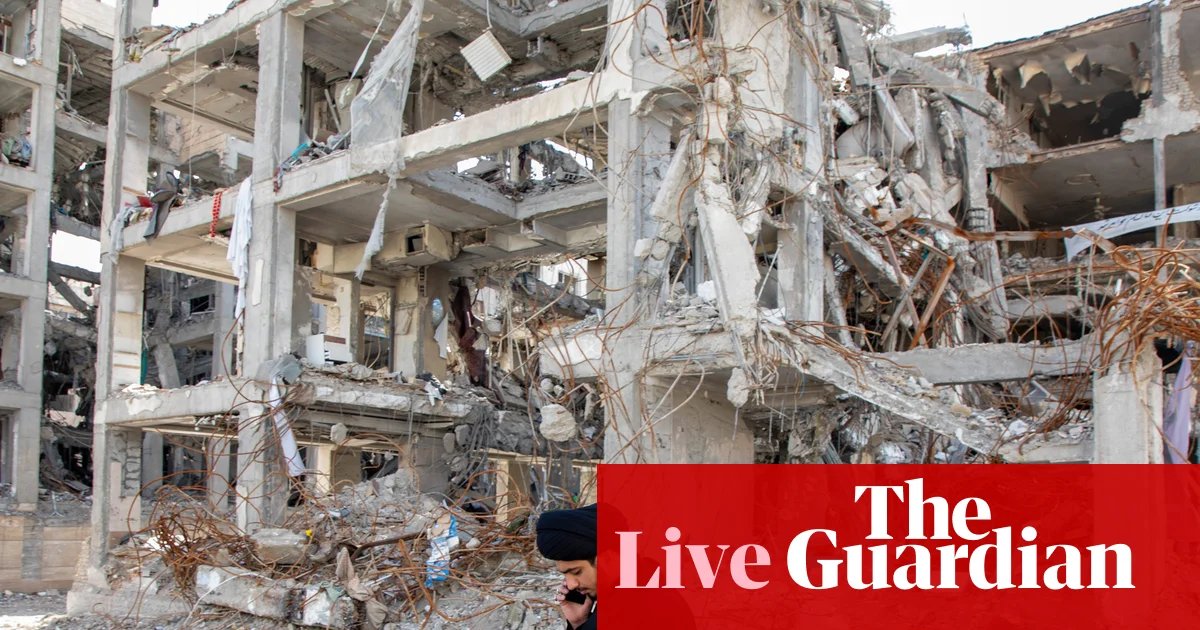
Opening summary
Hello and welcome to our continuing live coverage of the US-Israel war on Iran and its consequences for the region, the world and the global economy.
Donald Trump said he was “not at all” concerned about committing possible war crimes as he again threatened to destroy Iran’s bridges and power plants if Tehran does not meet his Tuesday 8pm ET deadline to reopen the strait of Hormuz.
“I’m not worried about it,” the US president said. “You know what’s a war crime? Having a nuclear weapon.”
Speaking at the White House, Trump refused to say whether any civilian targets would be off-limits. Iran on Monday rejected a 45-day ceasefire proposal and said it wanted a permanent end to the conflict.
“We only accept an end of the war with guarantees that we won’t be attacked again,” Mojtaba Ferdousi Pour, the head of the Iranian diplomatic mission in Cairo, told the Associated Press.
At a news conference, Trump said all of Iran could be “taken out” in one night “and that night might be tomorrow night”, referring to Tuesday. Without an agreement with Tehran, he said, “every bridge in Iran will be decimated” by midnight ET (0400 GMT) on Wednesday and “every power plant in Iran will be out of business, burning, exploding and never to be used again”.
Israel and the US carried out a wave of attacks on Iran on Monday, killing more than 25 people. Iran responded with missile fire on Israel and its Gulf Arab neighbours.

In other key developments:
-
The UN security council is expected to vote on Tuesday on a resolution to protect commercial shipping in the strait of Hormuz but in significantly watered-down form after veto-wielding China opposed authorising force, Reuters is reporting, citing diplomats.
-
The Israeli military said early on Tuesday it had completed an “air strike wave” aimed at damaging Iranian regime infrastructure in Tehran and additional areas across Iran. It said soon after that missiles were launched at Israel from Iran and defensive systems were operating to incept them.
-
Israel’s military also said it carried out strikes on three airports in Tehran, targeting several Iranian planes and helicopters.
-
The World Health Organisation suspended medical evacuations from Gaza to Egypt via the Rafah crossing after a contract worker for WHO was killed in Gaza on Monday. Separately, an Israeli airstrike killed at least 10 people outside a school housing displaced Palestinians in central Gaza, health officials said. Before the strikes some Palestinians had clashed with members of an Israeli-backed militia who they said attacked the school, Reuters cited medics and residents as saying.
-
Oil prices extended their rises on Tuesday amid Trump’s heightened rhetoric against Iran. The head of the IMF, meanwhile, said the war would lead to “higher inflation and slower global growth”.
-
The head of International Committee of the Red Cross said that “deliberate threats … against essential civilian infrastructure and nuclear facilities must not become the new norm in warfare”. Mirjana Spoljaric said, without singling out any country or leader: “Any war fought without limits is incompatible with the law.”
-
Israel said it struck Iran’s largest petrochemical complex on Monday. Israeli prime minister Benjamin Netanyahu said the facility had been “destroyed” and his country was “systematically eliminating the Revolutionary Guards’ money machine”.
-
The intelligence chief of Iran’s Revolutionary Guards, Maj Gen Majid Khademi, was killed in US-Israeli strikes at dawn on Monday, the Guards said.
-
Saudi Arabia intercepted seven ballistic missiles launched towards its eastern region and debris fell in the vicinity of energy facilities, the defence ministry of said on Tuesday.
-
Two blasts were reportedly heard near the Erbil airport – which hosts advisers from the US-led anti-jihadist coalition – in Iraq’s northern Kurdistan region, an Agence France-Presse journalist said.
Key events
Malaysia’s foreign ministry has said that one of seven Malaysian commercial vessels stranded in the strait of Hormuz has been allowed to pass and is now heading to its destination.
The ministry said this followed diplomatic talks with Iranian officials led by Malaysian prime minister Anwar Ibrahim. It didn’t give further details.
Malaysia reaffirmed its support for safe and open sea routes under international law and called for continued dialogue to maintain peace and stability in the region.
Iran has rejected a proposed ceasefire deal, state media has reported, confirming earlier reporting that diplomatic negotiations appeared to be faltering a day before Donald Trump’s deadline, in which he has threatened to destroy Iran’s bridges and attack its power plants.
“Iran has conveyed to Pakistan its response to the American proposal to end the war,” the news agency Irna said, without revealing its source or what the US offer contained.
Several countries have been acting as mediators to try to halt more than five weeks of fighting sparked by US-Israeli strikes on Iran.
“In this response – set out in ten points – Iran … has rejected a ceasefire and insists on the need for a definitive end to the conflict,” the Iranian state news agency added.
Irna also said Tehran’s demands included “an end to conflicts in the region, a protocol for safe passage through the Strait of Hormuz, reconstruction, and the lifting of sanctions”.
The New York Times, citing two unnamed senior Iranian officials, reported that Tehran was also seeking guarantees it would not face future attacks, and that Israeli strikes against its ally Hezbollah in southern Lebanon would cease.
Oil prices rose on Tuesday while equities were mixed as investors assessed Donald Trump’s latest deadline for Iran to reopen the strategic strait of Hormuz or be “decimated”.
The US president warned Tehran that its civilian infrastructure would be destroyed if it did not let ships through the waterway, through which a fifth of global crude and gas passes.
Both main oil contracts rose Tuesday, with West Texas Intermediate topping $115 – its highest in a month – and Brent sitting around $111.
Equity markets fluctuated, with Tokyo, Singapore, Manila and Jakarta down while Shanghai, Sydney, Seoul, Wellington and Taipei rose.
That followed a positive start to the week on Wall Street.
“Financial markets are oscillating in a narrow, uneasy range as traders sized up the countdown to Donald Trump’s Iran deadline,” wrote Stephen Innes at SPI Asset Management.
Tentative ceasefire optics [were] offering brief relief but never fully offsetting the lingering risk of escalation.
Opening summary
Hello and welcome to our continuing live coverage of the US-Israel war on Iran and its consequences for the region, the world and the global economy.
Donald Trump said he was “not at all” concerned about committing possible war crimes as he again threatened to destroy Iran’s bridges and power plants if Tehran does not meet his Tuesday 8pm ET deadline to reopen the strait of Hormuz.
“I’m not worried about it,” the US president said. “You know what’s a war crime? Having a nuclear weapon.”
Speaking at the White House, Trump refused to say whether any civilian targets would be off-limits. Iran on Monday rejected a 45-day ceasefire proposal and said it wanted a permanent end to the conflict.
“We only accept an end of the war with guarantees that we won’t be attacked again,” Mojtaba Ferdousi Pour, the head of the Iranian diplomatic mission in Cairo, told the Associated Press.
At a news conference, Trump said all of Iran could be “taken out” in one night “and that night might be tomorrow night”, referring to Tuesday. Without an agreement with Tehran, he said, “every bridge in Iran will be decimated” by midnight ET (0400 GMT) on Wednesday and “every power plant in Iran will be out of business, burning, exploding and never to be used again”.
Israel and the US carried out a wave of attacks on Iran on Monday, killing more than 25 people. Iran responded with missile fire on Israel and its Gulf Arab neighbours.
In other key developments:
-
The UN security council is expected to vote on Tuesday on a resolution to protect commercial shipping in the strait of Hormuz but in significantly watered-down form after veto-wielding China opposed authorising force, Reuters is reporting, citing diplomats.
-
The Israeli military said early on Tuesday it had completed an “air strike wave” aimed at damaging Iranian regime infrastructure in Tehran and additional areas across Iran. It said soon after that missiles were launched at Israel from Iran and defensive systems were operating to incept them.
-
Israel’s military also said it carried out strikes on three airports in Tehran, targeting several Iranian planes and helicopters.
-
The World Health Organisation suspended medical evacuations from Gaza to Egypt via the Rafah crossing after a contract worker for WHO was killed in Gaza on Monday. Separately, an Israeli airstrike killed at least 10 people outside a school housing displaced Palestinians in central Gaza, health officials said. Before the strikes some Palestinians had clashed with members of an Israeli-backed militia who they said attacked the school, Reuters cited medics and residents as saying.
-
Oil prices extended their rises on Tuesday amid Trump’s heightened rhetoric against Iran. The head of the IMF, meanwhile, said the war would lead to “higher inflation and slower global growth”.
-
The head of International Committee of the Red Cross said that “deliberate threats … against essential civilian infrastructure and nuclear facilities must not become the new norm in warfare”. Mirjana Spoljaric said, without singling out any country or leader: “Any war fought without limits is incompatible with the law.”
-
Israel said it struck Iran’s largest petrochemical complex on Monday. Israeli prime minister Benjamin Netanyahu said the facility had been “destroyed” and his country was “systematically eliminating the Revolutionary Guards’ money machine”.
-
The intelligence chief of Iran’s Revolutionary Guards, Maj Gen Majid Khademi, was killed in US-Israeli strikes at dawn on Monday, the Guards said.
-
Saudi Arabia intercepted seven ballistic missiles launched towards its eastern region and debris fell in the vicinity of energy facilities, the defence ministry of said on Tuesday.
-
Two blasts were reportedly heard near the Erbil airport – which hosts advisers from the US-led anti-jihadist coalition – in Iraq’s northern Kurdistan region, an Agence France-Presse journalist said.
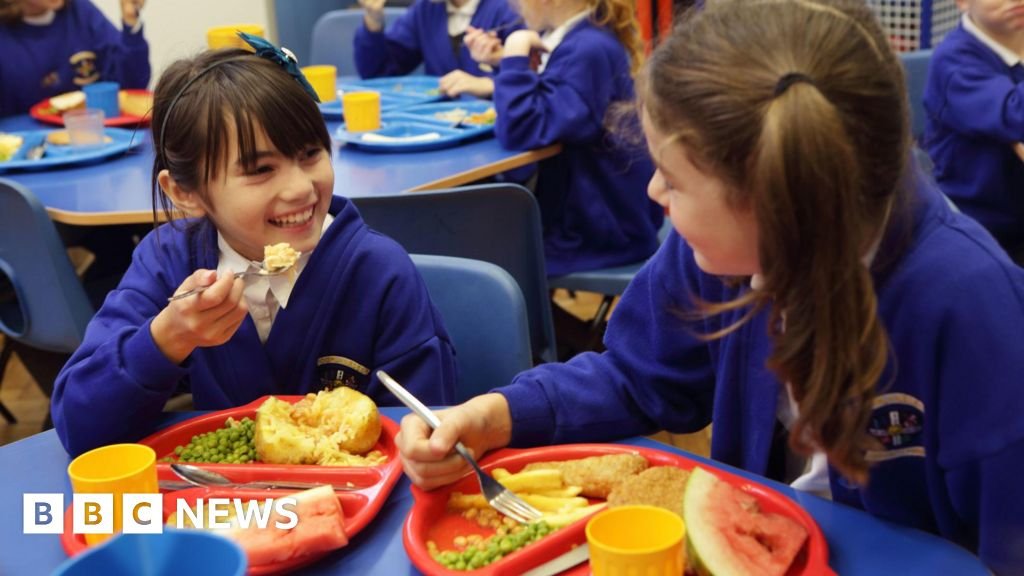
“From talking to parents, head teachers and school governors in my constituency, I know that many are worried about the rising cost of food, and in many cases the current funding just isn’t enough, forcing schools to provide smaller portion sizes and poorer quality food,” she said.
UK News
Oil price tops $100 a barrel again after Trump announces strait of Hormuz blockade – business live | Business
Key events
FTSE 100 drops
London’s stock market has opened with a bump, as traders react to the lack of progress in the US-Iran peace talks.
The FTSE 100 index of blue-chip shares has lost 0.6% at the start of trading, falling by 67 points to 10,533 points.
AB Foods (the grocery, sugar, agriculture, ingredients and retail group) are the top faller, down 2.7%, with airlines, miners, banks and housebuilders all lower.
Energy companies are rallying, though; BP and Shell are both up more than 1%.
Energy shock to wipe out growth in UK living standards
The surge in energy costs from the Iran war will cost a typical UK household almost £500, new research from the Resolution Foundation shows.
The Resolution Foundation have esimated that rising energy prices are likely to tip living standards growth into negative territory this year.
That’s because the increased cost of energy bills and petrol at the pump will almost certainly be passed onto households.
The typical household is now set to see its income fall by 0.6% – a difference of £480 – over the course of the current financial year, they say, Before the conflict, they were on track for 0.9% growth.
Average income growth for the poorest fifth this year is now set to be just 1.2%, down from 2.8% before the conflict.
James Smith, chief economist at the Resolution Foundation, says:
“Despite hopes for a sustained peace, the path of this conflict remains uncertain and energy prices remain well above pre-war levels, meaning many households face a decline in their purchasing power this year.
“This squeeze will run right through the income distribution. Lower-income households will still see some income growth thanks to a long-awaited rise in real benefit levels, but inflation will likely knock more than a percentage point off what they stood to gain. For those in the middle and towards the top of the income distribution, even the thin growth they had been expecting has tipped into negative territory.
“Deescalation is certainly welcome, but damage to household finances this year is to a large degree already done. The Government should act now to prepare a social tariff that reaches households falling through the cracks this winter.”
Heathrow Airport has warned that the outlook for the next few months is uncertain, due to the ongoing conflict in the Middle East.
In its latest traffic commentary, Heathrow says it is supporting airlines and passengers as they adapt to airspace closures, adding:
The knock-on impacts to global supply chains, including fuel, have not affected airport operations. Heathrow will monitor the situation and liaise with Government and airlines to protect passengers’ journeys.
The US dollar is rallying as a sharp risk-off move ripples across markets.
The dollar index, which tracks the greenback against a basket of other currencies, has gained 0.35% this morning.
The pound is down half a cent, to just above $1.34.
UK gas price jumps
The price of wholesale gas has also risen this morning.
The month-ahead US gas contract is up 9% to 119.50 a therm, its highest level since last Tuesday (before Donald Trump announced the two-week ceasefire with Iran).
Before the conflict began at the end of February, gas was trading below 80p a therm, before hitting 180p/therm in mid-March.
Analyst: oil remains vulnerable to geopolitical triggers.
Every barrel of risk added to oil markets carries an inflation price tag for the global economy, warns Priyanka Sachdeva, analyst at brokerage Phillip Nova:
Oil markets have decisively re-entered geopolitical mode, with prices vaulting back above the psychological $100 per barrel threshold as the United States moved to impose a naval blockade targeting Iranian shipping through the strait of Hormuz.
Both benchmarks, WTI and Brent, opened gap-up and currently hover with almost 8% gains. The market reaction underscores a simple but powerful reality: Hormuz risk is not theoretical; it is structural, and it is real.
The latest catalyst came after talks mediated by Pakistan failed to produce a durable agreement, prompting the U.S. to announce enforcement of maritime restrictions on vessels moving to and from Iranian ports. The mere threat of enforcement alone has been sufficient to re-price risk, demonstrating how vulnerable oil remains to geopolitical triggers.
Only mild losses in Asia-Pacific markets after peace talks break down
The breakdown of US-Iran peace talks last weekend has only led to modest losses in Asia-Pacific markets.
Japan’s Nikkei index is down 0.75%, while Hong Kong’s Hang Seng index and the South Korean KOSPI have both dropped by 1.15%.
Michael Brown, senior research strategist at brokerage Pepperstone, says:
While crude has advanced, and stocks slipped a touch, the overall market reaction to the weekend news of a US Navy blockade of the strait of Hormuz has been relatively contained, as participants view the move largely as a negotiating gambit from President Trump.
While it’s clearly a risk-averse start to the trading week, amid President Trump’s announcement of a Navy blockade in the strait of Hormuz, the general market reaction can be summed up as ‘could be worse’.
The US blockade of the strait of Hormuz is a blow to the 20,000 seafarers who have been trapped in the Gulf for the last six weeks.
One told us last week:
“I gave my notice exactly one month ago. I’ve informed the master, I’m not willing to sail through the strait. It’s about safety, it’s all about safety.”
Introduction: US blockage threat puts oil back over $100
Good morning, and welcome to our rolling coverage of business, the financial markets and the world economy.
We start a new week, again, with an escalating conflict in the Middle East, after the collapse of US-Iran peace talks last weekend.
Donald Trump’s threat to impose a blockade on the strait of Hormuz has driven the oil price back over $100 a barrel again this morning, as hopes of an end to the conflict soon take another knock.
Brent crude, the international benchmark, has jumped by 7% to $101.88 a barrel, while US crude is up over 8% to $104.69 a barrel – back towards the highs of almost $120 set early in the conflict.
The US president also said he had asked the US Navy to “interdict” any ship that had paid a toll to Iran for passage through the strait, in an attempt to choke off the flow of Iranian oil.
Tony Sycamore, market analyst at IG, says:
By doing so, the US aims to force Tehran’s allies and customers to put pressure on Iran to reopen the vital chokepoint, potentially resolving the impasse without committing ground forces to another protracted conflict.
This approach will undoubtedly strain Iran’s relationship with its largest customer, China. Having already lost Venezuelan supply earlier this year, Beijing now faces the potential loss of another roughly 2m barrels a day.
The war has already driven confidence across Britain’s biggest companies down to a six-year low.
Deloitte’s quarterly survey of chief financial officers has found that concerns around energy prices, inflation and interest rates surging after the Middle East conflict, to its lowest level since early in the Covid-19 pandemic in 2020.
The agenda

The public inquiry was set up following a knife attack which led to the deaths of three young girls.
Source link



-

 Crime & Safety4 weeks ago
Police race to crash on Oxfordshire A34 with severe traffic building
-

 Oxford News4 weeks ago
Schwarzman Centre to open doors to public with major celebration
-
 Oxford News4 weeks ago
Gary Lineker’s nephew-in-law death inquest to be next week
-

 Business & Technology3 days ago
Aqilla launches AI invoice tool to speed accounts payable
-

 Crime & Safety1 week ago
American Akita and a French Bulldog seized after dog killed
-

 Crime & Safety4 weeks ago
Wiltshire 12-year-old girl with Oxfordshire links missing
-

 Oxford Events4 weeks ago
Michelin Guide Oxfordshire Restaurants – The Oxford Magazine
-

 Oxford News4 weeks ago
Statins do not cause the majority of side effects listed in package leaflets