
UK News
Middle East crisis live: Tehran warns Trump over strait of Hormuz threat; Netanyahu suggests Israel helped rescue downed US crew member | US-Israel war on Iran

Opening summary
Welcome to the Guardian’s continuing coverage of the crisis in the Middle East.
Iran’s parliamentary speaker Mohammad Baqer Qalibaf has condemned Donald Trump’s threats to target energy and transport infrastructure, saying he was being misled by Israel’s prime minister Benjamin Netanyahu.
“Your reckless moves are dragging the United States into a living HELL for every single family, and our whole region is going to burn because you insist on following Netanyahu’s commands,” Qalibaf posted on X.
Late on Sunday, Netanyahu suggested Israel assisted the US with its rescue of the downed airman in Iran. The Israeli prime minister said he had spoken to Trump and “congratulated him on his bold decision and a perfectly executed American mission”. “The president expressed his appreciation for Israel’s help,” Netanyahu said.
On Sunday, the US president used expletive-laden language to call on Iran to let ships through the strait of Hormuz as he threatened to further attack Iranian energy and transport infrastructure. Writing on Truth Social, Trump said: “Open the Fuckin’ Strait, you crazy bastards, or you’ll be living in Hell.”
Showing it still had the ability to cause damage despite the US-Israeli pounding, Iran expanded attacks on Gulf energy infrastructure over the weekend, launching drone and missile strikes on petrochemical facilities in Kuwait, Bahrain and the United Arab Emirates.
The Revolutionary Guards also said they hit an Israeli-linked vessel at Dubai’s Jebel Ali port.

In other key developments:
-
Trump was sharply rebuked by US politicians, including Republican former ally Marjorie Taylor Greene, who called on the administration to “intervene in Trump’s madness”, adding the president “has gone insane, and all of you are complicit”. Top Senate Democrat Chuck Schumer wrote that “the President of the United States is ranting like an unhinged madman on social media”. Schumer added: “He’s threatening possible war crimes and alienating allies. This is who he is, but this is not who we are. Our country deserves so much better.”
-
Crude oil prices opened higher on Monday after Trump’s threats to Iran. West Texas Intermediate – the US benchmark – rose 1.86% to $113.62 a barrel while North Sea Brent crude was also higher at the week’s market opening, climbing 1.16% to $110.30 a barrel.
-
The second crew member of a downed F-15E fighter jet was rescued by the US overnight, ending a two-day search after the warplane crashed in south-west Iran. Trump said the crew member was “seriously wounded” but “safe and sound” after a mission that was reportedly made possible with the help of CIA subterfuge.
-
At least five people were reported to have been killed in US-Israeli attacks in south-west Iran during the rescue operations.
-
Israeli rescuers recovered the bodies of two people killed after an Iranian ballistic missile hit a residential building in the northern Israeli city of Haifa, Israeli media reported. Rescue efforts were continuing on Monday morning to reach two other missing.
-
On Sunday, Iran said it struck a petrochemicals complex in Bahrain. Video footage showed thick black smoke rising from the site.
-
The Kuwait Petroleum Corporation said a number of its facilities had been targeted by Iranian drone attacks, resulting in fires and “significant material losses”. Kuwait also reported that two power and water desalination plants sustained “significant material damage” after being attacked by Iranian drones.
-
Israeli attacks in Lebanon on Sunday killed at least 15 people, the country’s health ministry said, while Israel’s military chief visited troops in southern Lebanon and pledged to intensify strikes against Hezbollah. One of Israel’s strikes in Beirut on Sunday killed at least five people and wounded 52 in the Jnah neighbourhood, the Lebanese ministry said.
Key events
Iran executes man accused of trying to storm military site during protests
Iran has executed a man convicted over an attempt to storm a military facility and access an armoury during unrest in January, state media said on Monday, after the supreme court upheld his sentence.
The man was named as Ali Fahim, Reuters is reporting.
Iran has already executed three others linked to the incident, including Amirhossein Hatami earlier last week and Mohammadamin Biglari and Shahin Vahedparast on Sunday, the report said.
Another man linked to the same case is believed to face execution in the coming days, according to Amnesty International.
The rights group said in a statement last week it was unconscionable that even as Iranians reeled from the war, Iran continued to “weaponise the death penalty to eradicate dissenting voices and further terrify people”.
The nationwide anti-government protests in January were repressed in the biggest crackdown in the Islamic republic’s history, with some estimates suggesting more than 30,000 people were killed.
Authorities said the defendants had tried to seize weapons and military equipment during protests, describing them as “rioters” acting against national security.
Amnesty International said several defendants were facing execution over the unrest, adding in a recent report that detainees in such cases had been subjected to torture and “grossly unfair trials”.
The Israeli military has just said it identified missiles launched from Iran and that defensive systems are operating to intercept them.
The IDF’s message on Telegram also said alerts had been sent to people in relevant areas directing them to go to shelters and “remain there until further notice”.
More now on the Haifa attack: Israeli firefighters are searching for two missing people in the rubble of a residential building in the northern Israeli city after it was struck by an Iranian missile that killed two others, authorities said on Monday.
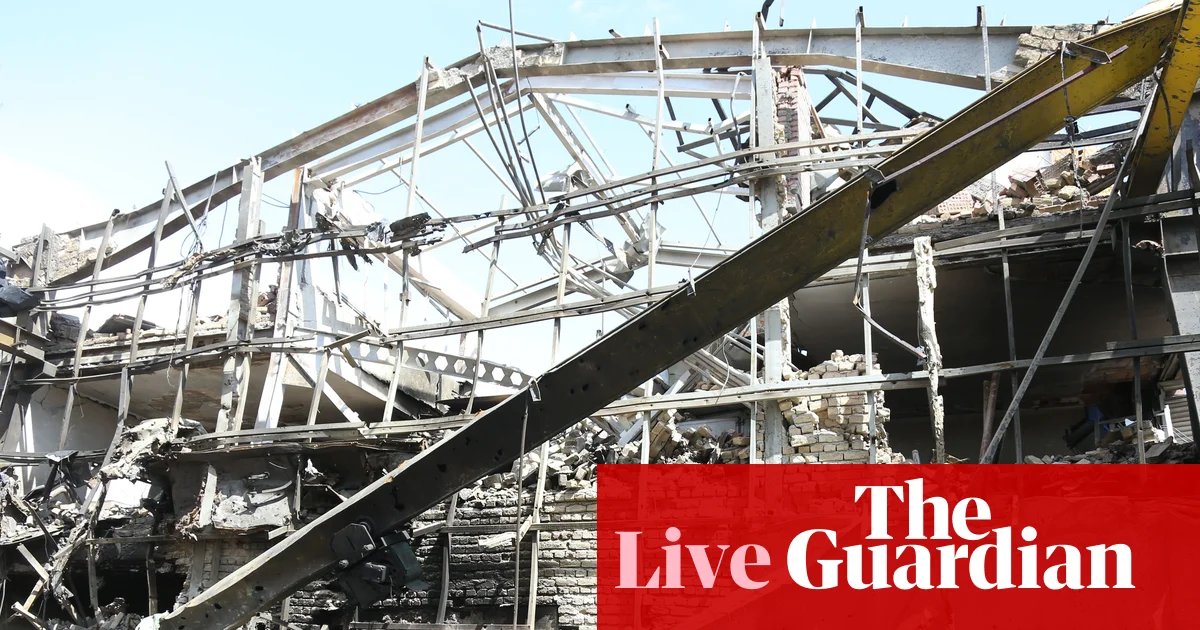
The direct hit on a seven-storey building tore through sections of the structure, which has partially collapsed, the military and rescue services said.
Footage from Agence France-Presse showed rescuers using flashlights to search through rubble and scattered concrete blocks.
The strike took place minutes after the military warned it had detected a new round of missiles fired from Iran about 15.00 GMT.
“We have a major destruction site,” said Elad Edri, chief of staff of Israel’s home front command.
Israel’s fire and rescue services said later that two of four people trapped under the rubble had been found dead.
The building was hit by a “direct impact of a missile”, a military spokesperson told AFP, confirming it was fired from Iran.
Israel’s Magen David Adom emergency service said four people were wounded in the strike, including a 10-month-old baby who suffered a head injury. An 82-year-old man was also in a serious condition, it said. A hospital later said he was stable.
On Monday the military detected fresh waves of missiles fired from Iran, and each time it said its “defensive systems are operating to intercept the threat”.
Israel’s military says it has completed a fresh wave of strikes against “regime targets” in Tehran.
The short statement – in a Monday post on Telegram – came after Iranian media reports of attacks on residential areas in the Iranian capital earlier in the day.
Japan’s prime minister, Sanae Takaichi, said on Monday her government was preparing to hold talks with Iran against the backdrop of the global energy crisis.
“We are preparing dialogues at the leadership level at an appropriate time,” she told a parliamentary committee.” She did not say with whom in Iran she planned to hold talks.
About 90% of Japan’s crude oil comes from the Middle East, making it particularly vulnerable to the closure of the waterway. Last month, the government approved the release of 15 days’ worth of oil from private-sector depots, the biggest-ever release of oil from its strategic reserves.
Iran threatens ‘devastating’ retaliation if civilian targets hit
Iran’s central military command has warned of “much more devastating” retaliation if the US hits civilian targets.
If attacks on civilian targets are repeated, the next stages of our offensive and retaliatory operations will be much more devastating and widespread.
The warning came after Donald Trump threatened to destroy Iran’s civilian infrastructure, demanding Tehran bow to his demands for a deal to reopen the Gulf to shipping.
Trump vowed on social media to hit Iran’s power plants and bridges and said the country would be “living in hell” if the strait of Hormuz – crucial for global trade – wasn’t opened. He ended with “Praise be to Allah”.
Opening summary
Welcome to the Guardian’s continuing coverage of the crisis in the Middle East.
Iran’s parliamentary speaker Mohammad Baqer Qalibaf has condemned Donald Trump’s threats to target energy and transport infrastructure, saying he was being misled by Israel’s prime minister Benjamin Netanyahu.
“Your reckless moves are dragging the United States into a living HELL for every single family, and our whole region is going to burn because you insist on following Netanyahu’s commands,” Qalibaf posted on X.
Late on Sunday, Netanyahu suggested Israel assisted the US with its rescue of the downed airman in Iran. The Israeli prime minister said he had spoken to Trump and “congratulated him on his bold decision and a perfectly executed American mission”. “The president expressed his appreciation for Israel’s help,” Netanyahu said.
On Sunday, the US president used expletive-laden language to call on Iran to let ships through the strait of Hormuz as he threatened to further attack Iranian energy and transport infrastructure. Writing on Truth Social, Trump said: “Open the Fuckin’ Strait, you crazy bastards, or you’ll be living in Hell.”
Showing it still had the ability to cause damage despite the US-Israeli pounding, Iran expanded attacks on Gulf energy infrastructure over the weekend, launching drone and missile strikes on petrochemical facilities in Kuwait, Bahrain and the United Arab Emirates.
The Revolutionary Guards also said they hit an Israeli-linked vessel at Dubai’s Jebel Ali port.
In other key developments:
-
Trump was sharply rebuked by US politicians, including Republican former ally Marjorie Taylor Greene, who called on the administration to “intervene in Trump’s madness”, adding the president “has gone insane, and all of you are complicit”. Top Senate Democrat Chuck Schumer wrote that “the President of the United States is ranting like an unhinged madman on social media”. Schumer added: “He’s threatening possible war crimes and alienating allies. This is who he is, but this is not who we are. Our country deserves so much better.”
-
Crude oil prices opened higher on Monday after Trump’s threats to Iran. West Texas Intermediate – the US benchmark – rose 1.86% to $113.62 a barrel while North Sea Brent crude was also higher at the week’s market opening, climbing 1.16% to $110.30 a barrel.
-
The second crew member of a downed F-15E fighter jet was rescued by the US overnight, ending a two-day search after the warplane crashed in south-west Iran. Trump said the crew member was “seriously wounded” but “safe and sound” after a mission that was reportedly made possible with the help of CIA subterfuge.
-
At least five people were reported to have been killed in US-Israeli attacks in south-west Iran during the rescue operations.
-
Israeli rescuers recovered the bodies of two people killed after an Iranian ballistic missile hit a residential building in the northern Israeli city of Haifa, Israeli media reported. Rescue efforts were continuing on Monday morning to reach two other missing.
-
On Sunday, Iran said it struck a petrochemicals complex in Bahrain. Video footage showed thick black smoke rising from the site.
-
The Kuwait Petroleum Corporation said a number of its facilities had been targeted by Iranian drone attacks, resulting in fires and “significant material losses”. Kuwait also reported that two power and water desalination plants sustained “significant material damage” after being attacked by Iranian drones.
-
Israeli attacks in Lebanon on Sunday killed at least 15 people, the country’s health ministry said, while Israel’s military chief visited troops in southern Lebanon and pledged to intensify strikes against Hezbollah. One of Israel’s strikes in Beirut on Sunday killed at least five people and wounded 52 in the Jnah neighbourhood, the Lebanese ministry said.
UK News
Why do some killer motorists get short prison sentences? UK road safety laws are letting them off the hook | Sally Kyd
In 2024, 1,602 people were killed on British roads. Only a small proportion of these resulted in a surviving driver being prosecuted. When we hear about the sentencing in such cases, the public reaction is often a mix of sorrow, anger and, increasingly, confusion. Why do some drivers who kill receive only short prison terms? Why are some charged with the lesser offence of “careless” rather than “dangerous” driving? After more than two decades researching this area of law, I believe our legal framework for prosecuting drivers needs to change.
Most of us rarely do anything that could easily kill another person – except when we drive. For many of us, passing our driving test is a rite of passage. It represents independence and adulthood in a car-centric society. When we first learn to drive, we are hyper-aware of the need to concentrate. But once we have passed, most of us never look at the Highway Code again, and the careful habits drilled into us by instructors fade away.
However, the law still assumes that we all understand – and consistently meet – the standard of a “competent and careful driver”. The reality is different.
Two cases heard in court on Friday 13 March highlighted the problem. At Birmingham crown court, Javonnie Tavener was sentenced for causing the death of four-year-old Mayar Yahia. Reports say he was on his phone, speeding in a 20mph zone, with cannabis in his system, and attempted to overtake near a junction. Dashcam footage showed him clipping another car, losing control, mounting the pavement and hitting Mayar’s family as they walked home. It is clear that his driving was appalling. Yet, inexplicably, the Crown Prosecution Service (CPS) categorised it as “careless”, and a jury was never given the opportunity to decide if it was in fact “dangerous”.
On the same day, I was at Lincoln crown court observing another sentencing hearing. Eighteen-year-old Madeleine Lonsdale had pleaded guilty to causing the deaths by careless driving of two peers in a crash last June, on the last day of their A-levels. She had been driving at 76mph in a 60mph limit and failed to brake before a bend. Her car left the road and hit a tree. Her passengers who died were students at my son’s school. Their mothers read their victim impact statements with extraordinary dignity.
When I described the court hearing to my son – who is learning to drive – he immediately asked why Lonsdale had not been charged with dangerous, rather than careless, driving. To him, choosing to drive at such a speed is obviously behaviour that falls “far below” the standard of a competent and careful driver. And that is precisely the legal definition of dangerous driving. Careless driving means falling below the standard; dangerous driving means falling far below it, and doing something that any competent driver would recognise as creating a risk of harm.
At the Lincoln hearing, no one suggested that dangerous driving might have been the right charge. But in Birmingham, after watching the dashcam footage, the judge, Peter Cooke, questioned why Tavener had not been charged with causing death by dangerous driving. It is unusual for a judge to say something like that in court. It casts doubt on the CPS’s claim that the evidence did not meet the test for a dangerous driving charge.
In both cases, the judges placed the offending in the highest category under the sentencing guidelines. Both defendants received a reduced sentence because they pleaded guilty, which is standard practice. Tavener received three years and 10 months in prison and a six-year driving ban. Lonsdale received 14 months in prison and a three-and-a-half-year ban. Judges always make clear that the prison term is not intended to reflect the value of the life lost. In the Birmingham case, though, the judge complained that his hands were tied because the charge limited his sentencing powers.
The problem goes deeper than individual decisions. Our entire legal framework for driving offences rests on a concept – the “competent and careful driver” – that does not have a shared meaning. Prosecutors, magistrates, jurors and police officers all interpret it differently. Even the Automated Vehicles Act 2024 uses the same standard to judge whether a self-driving car is safe enough for the roads. If humans cannot agree on what the standard means, how can we expect machines to meet it?
Meanwhile, driving standards appear to be falling. It was reported last month that more driving offences were committed in 2024 in England and Wales than ever before. Speeding is widespread. Handheld mobile phone use is endemic. Both of these are separate offences, yet also provide evidence of dangerous driving, according to CPS legal guidance. They are behaviours that have been criminalised because of the risk they pose to others. Creating separate offences does not, though, help with the messaging about what constitutes (un)acceptable driver behaviour. It is surely beyond question that reading WhatsApp messages on a mobile phone mounted to a dashboard while driving is unacceptable. Yet some assume that if it isn’t expressly banned, it must be fine.
Built-in screens to control GPS and music are now widespread and complicate things further. They can be distracting, and any lapse in attention could amount to careless driving, yet the temptation to allow our eyes to wander from the road is difficult to resist thanks to the marketing of car manufacturers. Even when drivers commit blatant breaches of the law, enforcement is patchy and inconsistent, thanks to roads policing having been cut to the bone. And every attempt to tighten the rules is met with cries of a “war on motorists”. This narrative must end.
In order to ensure that our criminal justice system can respond appropriately to road violence, we need to do three things. First, driving offences must be redefined. The distinction between careless and dangerous driving is poorly understood and too subjective. It leads to inconsistent charging decisions and undermines public confidence. We need a clearer framework – one that focuses on concrete behaviours, not abstract notions. It is disappointing that the government missed the opportunity to review these offences and resolve this ambiguity as part of its road safety strategy.
Second, the government must also reinvest in roads policing. Its new road safety strategy sets ambitious targets for reducing deaths and serious injuries – but without proper enforcement, these targets are unlikely to be met. Between 2012/13 and 2019/20, roads policing in England and Wales was cut in real terms by more than a third. Officers cannot deter dangerous behaviour and prevent deaths if they are not present on the roads.
Finally, there is work to do as a society to reframe how we think about driving. Many drivers see speed limits, cameras and enforcement as personal inconveniences. We must communicate the concept that driving is a responsibility, not an entitlement. This means better driver education and a public conversation that centres victims, rather than complaints about 20mph zones. Let’s ensure that the criminal justice system is used to reinforce the message that adherence to the Highway Code is not optional.

“Canada isn’t a feasible option, for some people it would be a great opportunity, but a lot of are mature students, some have mortgages, children, other careers they have put on hold, they can’t just pick up their lives and move half way across the world,” she said.

Charities say families are facing financial worries as changes to disability benefits come into effect.
Source link


Why do some killer motorists get short prison sentences? UK road safety laws are letting them off the hook | Sally Kyd

Oxford United boss on huge Portsmouth relegation clash

Care home celebrates a year of monthly friendship events
-

 Oxford Events3 weeks ago
Michelin Guide Oxfordshire Restaurants – The Oxford Magazine
-

 Crime & Safety3 weeks ago
Oxford: ‘Next generation’ LimeBikes in city from today
-

 Jobs & Careers3 weeks ago
Explore our Careers
-

 Jobs & Careers3 weeks ago
Why Join Oxford | Oxford University Jobs
-

 Oxford Events3 weeks ago
Oxford News and Events, What’s on in Oxford, Exhibitions
-

 Jobs & Careers3 weeks ago
Internal Job Board for University vacancies
-

 Student Life3 weeks ago
The independent cinema battling Oriel College to stay open
-

 Crime & Safety3 weeks ago
Crash partially blocks A40 and causes severe Oxfordshire traffic