
Crime & Safety
Highway Code warning as drivers risking speeding fines on motorways


Millions of us use the motorway everyday, but may be putting ourselves at risk of speeding fined due to an incorrect understanding of motorway cameras.
One motoring expert has warned drivers not to get caught out by an old tale that could leave them with a fine, points on their licence and even a driving ban.
Graham Conway, from leading vehicle leasing firm Select Car Leasing , explained that a surprisingly large number of drivers still believe smart motorway cameras are NOT in operation all of the time.
UK speed limits explained
That’s false – and gantry cameras can still snare speeders going above 70mph even when no variable limit is in place.
He said: “We hear this quite often, but it’s something that could potentially ruin your day if you get it wrong.
“It appears that many motorists think the speed cameras on smart motorways are only in operation when the matrix signs on the gantries show a variable speed limit, say 50mph or 60mph.
“They are aware that they need to slow down when they see this, but wrongly believe that at other times they won’t get clocked breaking the speed limit, as long as they don’t encounter the police.
“This simply is not right. Online motoring forums are full of accounts from drivers who’ve been caught out in such a manner.
“And the penalties for breaking the speed limit on a motorway can be severe. That’s as well as being dangerous and putting lives at risk, of course.”
Smart motorways have become a prominent feature of the UK’s road network, offering increased capacity and improved traffic flow.
Recommended Reading:
But these dynamic highways also come with unique safety considerations. They utilise variable speed limits to manage traffic flow and enhance safety – depending on traffic conditions, accidents or roadworks.
The smart motorway speed camera myth is one of many commonly-held misconceptions that can catch out drivers.
Another is that there is no speed limit on the M6 toll road, in the West Midlands, because it is run by a private company – which is also incorrect.
Mr Conway added: “The big message here is simple: Don’t speed. Road safety charity Brake! says speeding contributes to 105,000 road crashes and leads to more than 1,500 deaths every year.
“Good drivers are aware of the rules and abide by them, while also being conscious of the conditions on the day and what other road users are doing.
“It can be tempting at this time of year, when schedules are busy and you’re trying to get somewhere on time, to put your foot down.
“But it’s much better to get there slightly late and still in one piece than to not get there at all.”

Members of the public across the diocese contributed their views to help define the qualities needed in the next Bishop of Oxford.
This feedback has informed a Statement of Needs, a document outlining the role, context, and opportunities, and desired qualities for the next bishop, and the character of the Diocese of Oxford.
Rev Canon Geoff Bayliss, chair of the Vacancy-in-See Committee, said: “Our Statement of Needs is the result of a huge amount of work by very many people and gives a wonderful picture of the life of our diocese.
“It was informed by the consultation to which over 2,500 people very generously contributed.”
The document will guide the Crown Nominations Commission (CNC) in its search for potential candidates.
Following the completion of the Statement of Needs, the vacancy-in-see committee elected six representatives to serve on the CNC.
They will join six members from the wider Church of England to form the full commission, which is responsible for shortlisting candidates and recommending a nominee to the King and Downing Street.
The Diocese of Oxford covers Oxfordshire, Berkshire, and Buckinghamshire.
It has the largest number of churches of any diocese in the Church of England, with more than 800 churches in 609 parishes.

John Varley Roberts, one of Victorian England’s most celebrated choral trainers and organist of Magdalen College, Oxford, is the subject of a new book by music scholar Professor David Baker.
It shines a light on the musician’s impact on British church music, tracing a career that took Roberts from Halifax Parish Church in Yorkshire to national recognition.
Professor Baker, director of the Halifax Organ Academy and an accredited tutor with the Royal College of Organists, said: “Roberts’ influence was considerable and enduring at a time when church music was undergoing a significant transformation in Britain.
“He influenced generations of choristers, musicians, and choir directors, sitting alongside John Stainer and Walter Parratt as one of the greats of his generation.
“After becoming organist and choirmaster at Halifax Parish Church in 1868, he transformed music there.”
Roberts went on to become organist at Magdalen, where he served from 1883 to 1918.
During his tenure, the choir was regarded as the best in the country, and his compositions—40 anthems, four full services, organ solos, songs, part songs, and the cantata Jonah—were widely performed.
His anthem Seek ye the Lord remains popular internationally.
Professor Baker first learned of Roberts while studying at Cambridge University in 1968.
He said: “At the time I was organist at St Paul’s, Stanningley, Leeds.
“An elderly lady was a regular attender; she introduced herself as the niece of a famous choirmaster.
“I thought little of the encounter until 1972, when, for my dissertation, I was researching the music of Halifax Parish Church, discovering that Dr John Varley Roberts had been organist and choirmaster there, and the music had been second to none.
“I made the connection and sought out Edith Annie Roberts, the lady in question. As I walked into her front parlour, I saw a huge photograph hanging over the fireplace: Roberts in his Oxford DMus robes.”
Professor Baker said: “I was struck by how little remembered he was.
“Roberts was one of those forgotten Victorians who, in their day, had a considerable impact and influence on Victorian church music.”
Roberts’ music, aside from his most famous anthem, had fallen out of use—even at Magdalen College.
To mark the centenary of Roberts’ death in 2020, Professor Baker edited all of Roberts’ organ works for publication and encouraged his choirs to perform them.
He said: “They all enjoyed doing so, and it became clear that Roberts’ rise from an upper working-class background in mid-nineteenth-century Leeds deserved further study.”
The biography, John Varley Roberts and Religious Musical Life in Nineteenth-Century Britain, will be published by Taylor and Francis on April 21.
Professor Baker will host recitals and lectures to launch the book in both Halifax and Oxford later in the year.
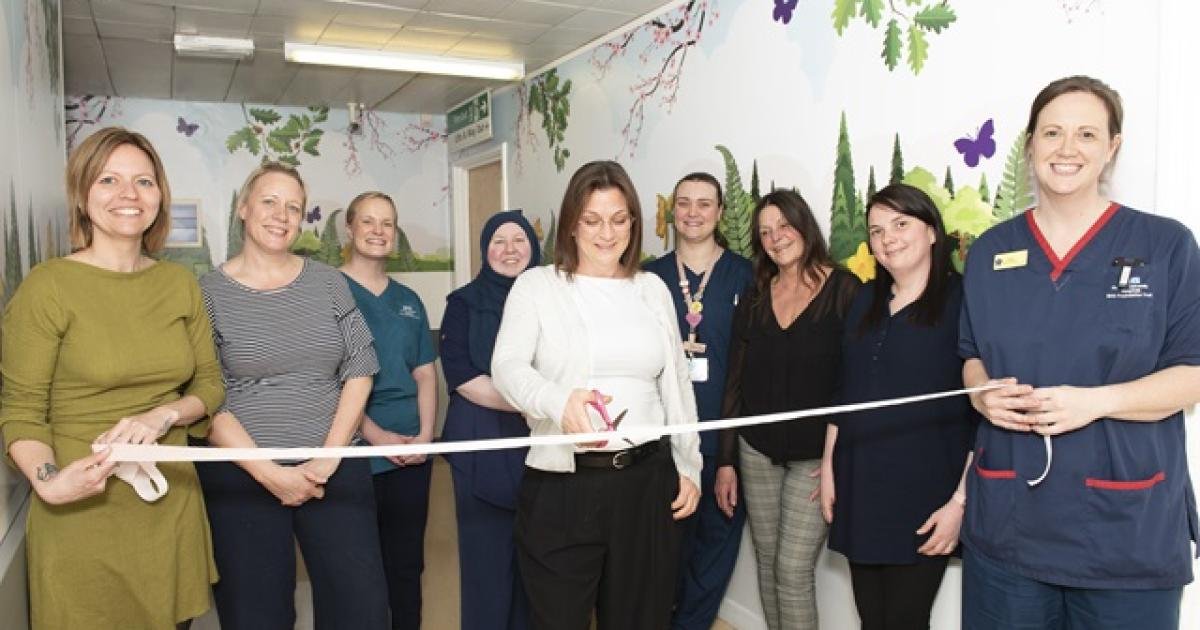
The nature-themed design now brightens the walkway to the Neonatal Unit at the John Radcliffe Hospital, with colourful imagery and meaningful details.
Funded by the charity SSNAP (Support for the Sick Newborn and their Parents), the artwork runs along the corridor connecting the Women’s Centre Maternity entrance to the Oxford Newborn Care Unit.
Emily Byrne, charity lead for SSNAP, said: “SSNAP is thrilled to be able to enhance the corridors leading to the Neonatal Unit and create a space that feels brighter, calmer and more welcoming.
“The transformation has made a real difference already, providing an uplifting environment for both families and staff.
“We are incredibly grateful that this work has been made possible through a generous legacy from a late donor.
“Their gift will help bring comfort and hope to parents walking this corridor for years to come.”
The vinyl mural features a calming meadow scene with acorns, blossom, and daffodils, with purple butterflies appearing throughout as a gentle tribute to babies from pregnancies with more than one baby who did not survive.
A parent said: “Walking through the doors of the Neonatal Unit can be very overwhelming, but the artwork helped me focus on something more positive.
“For me, it has a very special meaning as my son passed away and he was a twin.
“The purple butterfly immediately made me think of him – it makes me feel like he is with me as I visit his twin brother.
“It is a small detail, but it brings comfort during a difficult time. I really appreciate that something so thoughtful has been included in the space for families like ours.”
Another parent said: “It looks beautiful and makes the corridor so uplifting.
“It may seem like a small thing, but for parents like me who walk down the corridor every day and spend most of the day inside the unit, it is a lovely way to brighten your day and give you a small boost of positivity.”
A “graduation wall” has also been created, giving families a dedicated spot to take a photo before going home, marking their baby’s birth date, gestation, and weight.
Clare Morris, deputy matron for the Neonatal Unit at OUH, said: “The new corridor artwork has made a hugely positive difference to our Neonatal Unit, transforming what was once a plain corridor into one that feels bright, welcoming and calming.
“For families spending long and often emotional periods with us, it offers moments of comfort, while for staff it creates a more uplifting environment on their way to and from work.”



-

 Crime & Safety2 weeks ago
Oxford: ‘Next generation’ LimeBikes in city from today
-

 Jobs & Careers2 weeks ago
Why Join Oxford | Oxford University Jobs
-

 Jobs & Careers2 weeks ago
Explore our Careers
-

 Student Life2 weeks ago
The independent cinema battling Oriel College to stay open
-

 Oxford Events2 weeks ago
Michelin Guide Oxfordshire Restaurants – The Oxford Magazine
-

 Oxford Events2 weeks ago
Oxford News and Events, What’s on in Oxford, Exhibitions
-

 Jobs & Careers2 weeks ago
Internal Job Board for University vacancies
-

 Crime & Safety2 weeks ago
Crash partially blocks A40 and causes severe Oxfordshire traffic