
UK News
Hegseth right to mock Royal Navy, says ex-army chief as he backs claims over military underfunding – UK politics live | Politics

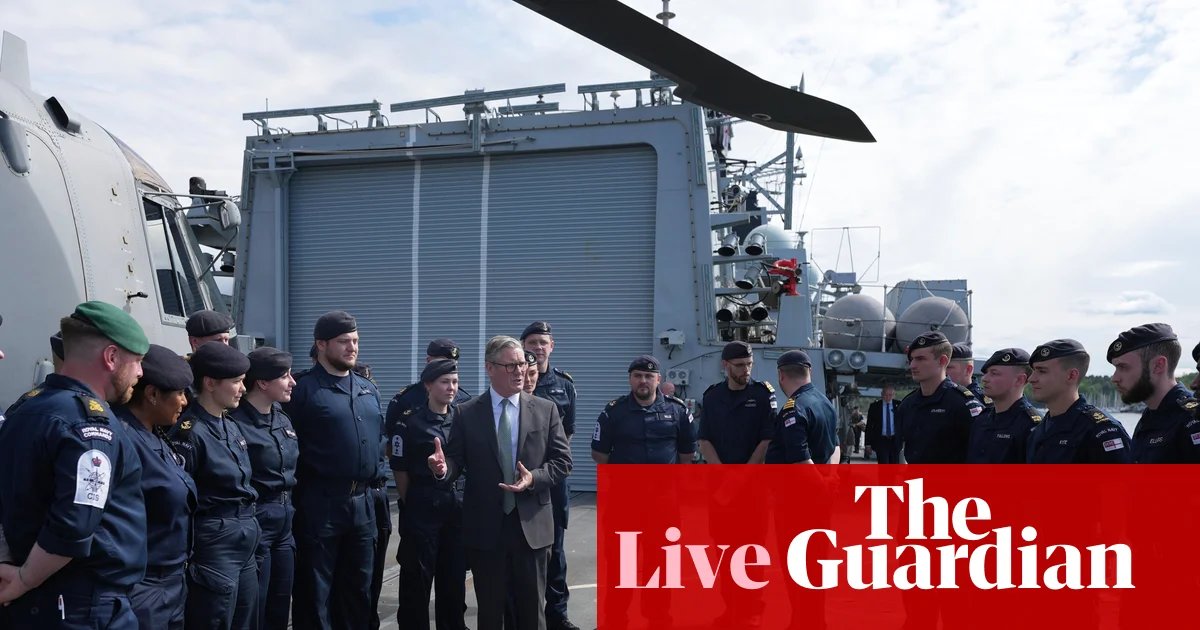
Hegseth right to mock Royal Navy, says ex-army chief as he backs claims over military underfunding
Good morning. When Keir Starmer gave evidence to the Commons liaison committee before the Easter recess, and when he made a statement to MPs yesterday on the first day after it was over, he was repeatedly asked when the government will publish its defence investment plan (DIP). On both occasions, he could not give a timetable and would just say it would be published as soon as it was ready.
His critics are furious because the DIP, a 10-year plan explaining how the government will fund its commitment to get defence spending up to 3% of GDP by the end of the next parliament, with total national security spending reaching 5% of GDP by 2035, was due to be published last autumn.
In particular, the DIP will explain how the government will be able to fulfil the goals set out in the strategic defence review it published last year. The review was led by the Labour peer George Robertson, a former defence secretary and former secretary general of Nato. And he seems to have finally lost patience with the government.
He is giving a speech in Salisbury tonight, but Lucy Fisher from the Financial Times has already written up some extracts and in them Robertson is withering about the Treasury. According to Fisher’s report, Robertson will accuse “non-military experts in the Treasury” of “vandalism”, adding: “We cannot defend Britain with an ever-expanding welfare budget.”
He will criticise Rachel Reeves, the chancellor, for devoting just 40 words to defence in her budget speech last year, and saying nothing about the topic at all in her spring statement last month. He will say:
There is a corrosive complacency today in Britain’s political leadership. Lip service is paid to the risks, the threats, the bright red signals of danger — but even a promised national conversation about defence can’t be started.
He will also say Britain is not safe.
We are underprepared. We are underinsured. We are under attack. We are not safe . . . Britain’s national security and safety is in peril.
Robertson is not a defence loudmouth. He is a quintessential establishment figure who for most of his career has avoided being provocative, or rocking the boat. If he feels minded to speak out like this, it must be serious.
Olivia Lee has a full write-up here.
This morning General Sir Richard Barrons, who along with Robertson was one of the three experts who wrote the defence review (the other was the former White House adviser and Russia expert Fiona Hill), gave an interview to the Today programme. Barrons, a former commander of Joint Forces Command, fully supported what Robertson will be saying in his speech. And he said that Britain’s armed forces are so diminished that he had to accept that Pete Hegseth, the US defence secretary, was right when he mocked the Royal Navy last month.
“Last time I checked, there was supposed to be a big, bad Royal Navy that could be prepared to do things like [clear the strait of Hormuz] as well,” Hegseth said.
Asked how he felt hearing that, Barrons said:
Like many others I hung my head in sorrow. But I couldn’t argue with him because although the Royal Navy and the Royal Air Force and the army are, in their bones, outstanding institutions, they are simply too small and too undernourished to deal with the world that we we now live in. And the review says this.
Here is the agenda for the day.
Morning: Keir Starmer chairs cabinet. There will be a political session, as well as the usual government meeting.
10am: South East Water executives give evidence to the environment, food and rural affairs committee, followed by Ofwat chief executive Chris Walters at 11am.
10am: Education experts give evidence to the Commons education committee about the proposed changes to Send (special educational needs and disabilities) provision.
10.30am: Executives from TikTok, Meta, Sky TV and Paramount TV executives give evidence to the culture committee about children’s TV and video content.
Morning: Kemi Badenoch is on a visit in south London.
11am: Ed Davey, the Lib Dem leader, holds a press conference focusing on health.
11.30am: Wes Streeting, the health secretary, takes questions in the Commons.
Noon: Downing Street holds a lobby briefing.
Afternoon: Starmer meets his Dutch counterpart, Rob Jetten, in Downing Street.
If you want to contact me, please post a message below the line when comments are open (between 10am and 3pm), or message me on social media. I can’t read all the messages BTL, but if you put “Andrew” in a message aimed at me, I am more likely to see it because I search for posts containing that word.
If you want to flag something up urgently, it is best to use social media. You can reach me on Bluesky at @andrewsparrowgdn.bsky.social. The Guardian has given up posting from its official accounts on X, but individual Guardian journalists are there, I still have my account, and if you message me there at @AndrewSparrow, I will see it and respond if necessary.
I find it very helpful when readers point out mistakes, even minor typos. No error is too small to correct. And I find your questions very interesting too. I can’t promise to reply to them all, but I will try to reply to as many as I can, either BTL or sometimes in the blog.
Key events
Reeves condemns Trump’s decision to launch war against Iran as ‘folly’
Rachel Reeves, the chancellor, has described Donald Trump’s decision to go to war against Iran as “folly”.
She used the comment in an interview with the Daily Mirror, ahead of her trip to Washington for IMF meetings where she will discuss the global impact of the war with her counterparts.
Reeves has already said publicly that she is “angry” about the war, but she was blunter speaking to the Mirror. She said:
This is a war that we did not start. It was a war that we did not want. I feel very frustrated and angry that the US went into this war without a clear exit plan, without a clear idea of what they were trying to achieve. And as a result the strait of Hormuz is now blocked.
Asked why she was so angry, she explained:
Because of the impact it’s having on families and businesses in our country. When I presented the spring statement at the beginning of March, it showed that inflation was coming down, interest rates were projected to fall further after having been cut six times since I became chancellor of the exchequer.
Borrowing and debt were falling and the economy was set to grow. It was already the fastest growing G7 economy in Europe last year, and that was projected to continue
Obviously no sensible person is a supporter of the Iranian regime, but to start a conflict without being clear what the objectives are and not being clear about how you are going to get out of it, I do think that is a folly and it is one that is affecting families here in the UK but also families in the US and around the world.
Sometimes politicians make the news when they say things that are unusual or controversial. This is an example of the opposite sort of news; a politician making a statement of the bleeding obvious, but one that is still unexpected because, for reasons of tact or diplomacy, most of her colleagues would never say it in public.
In private, “folly” may be one of the milder things being said by government ministers about Trump’s war. But Reeves’s comment is still stronger than anything anyone else in the government has said openly.
Keir Starmer and his team have spent much of their time in office trying to avoid saying anything at all critical of Trump, for fear of offending him. But increasingly Trump’s conduct, and domestic political considerations too, are making that policy impossible to sustain.
Core compensation paid to victims of infected blood scandal to be increased, MPs told
Nick Thomas-Symonds, the Cabinet Office minister, has told MPs that the government will increase the amount of “core compensation” available to victims of the infected blood scandal.
In a statement to the Commons giving the government’s response to a consultation on the compensation scheme, he said:
The community were clear that the scheme must do more to recognise people’s individual experiences and compensate them fairly in a way that minimises the administrative burden placed upon those who have been harmed, minimises the demand for evidence and maintains the delivery of tariff based compensation, and those requirements underpin the changes.
For infected people, the changes will increase the amount of core compensation available and increase the options available for supplementary compensation awards.
For affected people, additional core compensation will be available to those eligible.
Thomas-Symonds said the government would be making “substantive changes” in seven areas. He also said that as of April 7, 3,273 people have received an offer and more than £2 billion has been paid out.
The Cabinet Office has published full details of the changes here.
Sarwar accuses Swinney of encouraging ‘conspiracy theory’ about decision to block Chinese wind investment in Scotland
Anas Sarwar, the Scottish Labour leader, has accused John Swinney, Scotland’s SNP first minister, of encouraging a “conspiracy theory” about the UK government’s decision to ban a Chinese firm from building a wind turbine factory.
Last month the government announced that it would not allow MingYang, China’s biggest offshore wind company, to supply wind turbines for use in the North Sea. MingYang had been planning to build a factory to make them in the Highlands, creating up to 1,500 jobs.
At the time ministers said the investment was being blocked for reasons of national security. There are fears that the Chinese could somehow retain the capacity to switch off vital infrastracture in a crisis, but the government has not made this argument, or elaborated on what the national security concerns involved in this case were.
In a BBC election debate on Sunday night, Swinney suggested the move was motivated by anti-Scottish bias. He said:
My concern is that Scotland’s renewable industry is being undermined by the actions of a Labour government that’s just turned its back on £1.5 billion worth of investment.
It is welcoming Chinese investment into Hinkley power station south of the border. If that’s not an anti-Scottish move by a Labour government, I don’t know what is.
This morning, speaking to BBC Radio Scotland, Sarwar accused the first minister of peddling a “pretty strange conspiracy theory”. He said:
I can give you a cast-iron guarantee, I will not do crankery or conspiracy theory as first minister.
I will always accept national security advice, because our first duty as a government would be to protect the great citizens of this country.
Asked if it was strange that Chinese investment was allowed in other UK projects, Sarwar said:
All these projects will have national security briefings. A national security briefing was received that said there was a national security risk for investment.
Are we honestly saying that a first minister would reject national security advice? I can tell you quite categorically, if a national security briefing comes to me, I will not ignore it, because I will put the national interest before political interest.
He said the suggestion that the intelligence services would have taken a “deliberate do Scotland down approach” was the “height of conspiracy theory”.
But Swinney has defended his comment, saying he has not had an explanation from the UK government as to why the MingYang bid was blocked. He told the Press Assocation.
I have no more detailed understanding [of the decision] than that simple statement from the UK government.
And I think that is unacceptable because there is Chinese investment, Chinese development being embraced and welcomed in other parts of the United Kingdom – there’s a Chinese super embassy going to be built in the heart of the city of London.
Nandy clears takeover of Telegraph by German media group
Lisa Nandy, the culture secretary, has cleared Axel Springer’s £575m takeover of the Telegraph, paving the way for the end of almost three years of uncertainty over the ownership of the titles. Mark Sweney has the story.
Nandy made the announcement in a Commons written statement.
The Labour MP Samantha Niblett has said she wants to make 2026 the “summer of sex”. While this sounds like the most enticing of the election offers we’ve heard during the campaign so far, she used the phrase in an interview with PoliticsHome talking about her campaign for better, lifelong sex education. You can read the full interview, which includes Niblett saying she is negotiating with the parliamentary authorities about bringing sex toys into the Commons for an event she is planning to publicise her campaign, here.
Reform activist suspended over racist and antisemitic comments remains election agent
A Reform UK activist in the Gorton and Denton byelection who was suspended over racist and antisemitic comments has been named as the election agent for three of the party’s candidates in Manchester ahead of polls on 7 May, Ben Quinn and Rob Davies report.
Q: Do you understand why some people in your party are frustrated because they think you as a party should be doing much better?
Nationally, the Lib Dems are now polling well behind not just Reform UK, Labour, the Tories and the Greens.
Davey said oppostion was difficult. But he said “the fact that we keep winning is somethiing that should reassure people”. He said he thought the party would win “many more seats” at the next general election.
And the party was on course to become the second biggest party in local government because it “keeps winning”, he said. That would happen again in May, he said.
Lib Dems call for housing developers to be required to fund extra GP provision for people buying their homes
Ed Davey, the Lib Dem leader, was holding his press conference this morning to announce a proposal for housing developers to be required to fund new or expanded GP surgeries for the people who buy their new homes.
Explaining the plan in a news release, the Lib Dems say:
The party would require developers to fund or build new, or expand existing, GP surgeries in time for the arrival of new residents, with developer levies used to pay for them to be staffed while new residents are still moving in. This is part of the Liberal Democrats’ infrastructure-first approach to development, and supports their campaign to rescue General Practice and ensure everyone can get an appointment within 7 days, or 24 hours if urgent.
Developers would be required not only to fund new facilities but also to guarantee the GP surgery contract (or the cost of salaried GPs) while new residents are still moving in. This would ensure new residents don’t have to turn to over-stretched existing GPs, and new practices can be viable from the outset.
Delivery of health services has been found to be integral for public trust, with recent LSE research finding that where GP provision has declined and more surgeries have closed, support for the extreme right has risen.
At the press conference Davey was asked about claims by rival parties that, although the Lib Dems nationally back new housing, at a local level their councillors are adept at blocking developments.
Davey said “the reverse” was true. He claimed Lib Dem councils have a very good record building homes.
We’re the ones who actually build homes. I could take you to Eastleigh, who’ve been building homes over a number of years and have got a very good record. I could take you Cambridgeshire. I can take you to my own area, Kingston, where I have to declare a vested interest; my wife is the housing portfolio holder. She’s overseeing the largest council house building programme for 40 years. I could take you the Vale of White Horse in Oxfordshire. I could take you to South Lakeland. Across the country, actually the Liberal Democrats have a very, very proud record of building homes.
Davey renews call for South East Water CEO to resign after company tells MPs it failed in its duty to customers
Q: Do you think the chief executive of South East Water should resign? This morning he and colleagues told a committee that some of the problems that let to a water shortage in Tunbridge Wells last year were foreseeable?
Davey said that he has already called for the resignation of David Hinton, the South East Water CEO. He did so at the time of the Tunbridge Wells shortage, he said. He went on:
If he’s now admitting it was foreseeable and predictable, I’m surprised he is not offering his resignation already.
Here is the Press Association report of the evidence given by Hinton and others to the Commons environment committeee this morning.
The chairman of South East Water has admitted the company failed in its primary duty to supply customers with water after recent outages left thousands without drinking water.
Bosses of the company were grilled by the Commons environment, food and rural affairs committee this morning about their response to the multiple supply interruptions in Kent and Sussex.
Tunbridge Wells suffered a sustained outage in November and December, with around 24,000 properties in and around the Kent town left without drinkable water for almost two weeks.
Then thousands of properties in Kent and Sussex saw their supply disrupted for days in January, with South East Water (SEW) blaming the outage on Storm Goretti causing burst pipes and power cuts.
Customers were left with no tap water, unable to shower or bathe and could not flush their toilets, while a number of schools were forced to close.
Chairman Chris Train told MPs that the company “failed on the basic objective of delivering water to customers and therefore that is a failure and we recognise that failure”.
“We failed our customers,” he continued. “We worked very hard to rectify that situation, and since the events and independent review, we have undertaken a lot of actions to improve the resilience of the operations.”
Committee chairman Alistair Carmichael asked Train to score his team’s performance out of 10, arguing that customers deserve that degree of accountability from a non-executive director.
The chairman refused to do so, saying the situation is “complex” but added: “That degree of accountability is that we accept that we failed in our primary duty and we could have done better with all of the factors.”
Chief executive David Hinton was also asked to give a score out of 10 for the company’s response to the January outages after he previously marked it as eight out of 10 for the November incident.
Hinton also refused to do so but admitted that the performance was “disappointing” after many vulnerable customers were left without an alternative supply of water.
“My expectation is that we deliver to all priority service customers and that the bottled water stations are completely resourced the whole time, and customers can get access to alternative water at all times.
“So whenever we do not meet that particular yardstick, then I’m disappointed.”
Q: Do you think the Treasury should be looking for savings in other departments to fund higher defence spending?
Davey said of course the Treasury should be trying to find savings. But he claimed that his plan for defence bonds (see 11.36am) was the best idea put forward by any party to find the money for defence.
Davey claims Lib Dems will be ‘one of two biggest parties in local government’ by time of next general election
Q: Are you concerned that the Liberal Democrats are losing support given the rising popularity of the Green party?
Davey did not accept that. He replied:
We got, the best result for over a hundred years at the general election. But we’ve kept on winning since.
At the last May elections a year ago we beat the Conservatives and Labour for the first time ever. And it was our seventh year in a row of wins.
If you look at council by elections across the country, which party won the most in 2025? It was the Liberal Democrats.
And I make this prediction as we look at the council elections between now and the next election … By the time the next election will be one of the two biggest parties in local government. And with politics changing, that will be a massive change across our country.
According to Open Council Data UK, the Lib Dems are currently in third place, in total councillor numbers, in the UK.
Davey seems to be saying the Lib Dems will overtake the Tories, who are on course to lose around 1,000 seat in the local elections, according to at least one forecast. Labour are expected to lose even more, but they are starting from a higher base.
The family of Shaun Burton, say they are “devastated” by the loss.
Source link

Key events
In the opening half an hour against Cape Verde, Mikel Oyarzabal, the centre-forward, did not get a single touch.
Kyle Green gets in touch: “Your highlighting of Lalas and his absurdity is something that has prevented me from wanting to watch the coverage on Fox. While every channel has its pros and cons I just can’t.
“I’m 45 and probably the youngest of anyone who remembers him as a player instead of an opinionated insert insult here. As for the match this could be more competitive than it looks on paper Spain need a win the pressure is on them. Saudi Arabia could hold out for a draw and see what happens in their last match. “
News from the England camp, and it seems to be good news on Declan Rice.
“I’m ready and fit, raring to go. I was feeling a little bit of neural pain in my hamstring, which I was managing from after Christmas with Arsenal for a very long time. Obviously, not a lot of people would have known that. It was all behind-the-scenes stuff but it was a smart decision.
“In the end, that last 20 minutes is probably where you pick up the most, and it’s where you play a 70-minute match. But that last 20 is where you really feel your body going for it. And I think it was a smart decision because the last few days I felt really, really good.”
Alex Reid has penned today’s weekend special Football Daily.
Portugal v Uzbekistan on Tuesday enticingly pits the incredibly nice, incredibly 41-year-old-superstar-tolerant Roberto Martínez against Fabio Cannavaro, who’s won a Ballon d’Or as a player and the Chinese Super League as a coach. While the fixture following that game really does see the dream of Thomas Tuchel – in his first international job with England – taking on Queiroz, who is in charge of his ninth national side with Ghana.
The expected formations are 4-2-3-1 for Spain, and 5-3-2 for the Saudi Arabians.
The Saudi team features two Donis changes: Ali Lajami, a defender, and Nasser Al Dawsari, a midfielder, are preferred to Mohammed Abu Al Shamat and Mohamed Kanno. You may recall Salem Al Dawsari, the Saudi captain, as the man who scored the winner against Argentina.
An entertaining read, even for those of us who have just seen the clips.
In a conversation where his co-panelist is casually reminiscing about his days playing alongside Messi or exchanging shirts with Ronaldo Nazário at the World Cup, what exactly is Lalas going to talk about – coming on as a second-half substitute for Earnie Stewart in a friendly against Scotland in 1998? Helping the Kansas City Wizards finish last in the 1999 MLS Western Conference? Did Lalas enjoy an elite playing career? No. But does he do the background reading that could compensate for his relative lack of standing in a conversation with titans like Henry and Zlatan? Also no. But is he charming or funny or charismatic or otherwise magnetic on screen? Eh, no.
For the record, I once interviewed Alexi Lalas on the challenge of playing against Romario in the 1994 World Cup. He had this to say:
“He could kill you in so many different ways. If you remember from that World Cup, he scored so many types of goals. That ranged from solo adventures to an outside-of-the-right-foot half-volley off a corner kick. Romario was both the most difficult to play against and the best that I have faced.
“Roberto Baggio was doing his thing, but in terms of consistency and living up to the hype, he [Romario] was the best. As with all stars, there was a moment when the fans sit up in their seats, and that was a feeling I got with Romario. When it got close to him and the potential for his involvement in a play was there, everybody sat up in their seat. They knew that something spectacular would be happening.”
Saturday’s match reports here.
The Saudi Arabia coach, and Blackburn legend, Georgios Donis, spoke about the challenges facing his team: “Spain is not the same team when Yamal or Williams are on the bench.
“While they still have plenty of possession, they lack the individual one-on-one penetration when these two are missing. I’m not saying it’s a problem for Spain, but when those players are missing, they play in a different way. We saw this very clearly against Cape Verde.
“We are playing against one of the best teams in the world, and it’s very important that when you play against these kinds of teams, you should enjoy the experience and respect the opponent, but not too much.
“It is very hard for any team playing against Spain to have any time in possession. So what we must do is to be more in control of our movement and compact, and when the ball goes through the lines, be able to defend dynamically.
“It’s nice to see miracles in football, and we’ve seen favourites losing against underdogs. Of course, it’s great for Saudi football to have a great memory of the result against Argentina, but we aren’t drawing anything from that.
“I think we’ll feel more pressure in that [Cape Verde] game than we will against Spain.”
The Spain coach, Luis De La Fuente had this to say in his Saturday press conference: “This generation of footballers is highly competitive and really fired up… It’s going to be a completely different story,” he said at his pre-match press conference on Saturday. There is no drama or crisis. The bottom line is simply that we need to win tomorrow.”
Four changes for Spain: Lamine Yamal, Pedro Porro, Dani Olmo and Alex Baena also come into the side with Marcos Llorente, Fabian Ruiz, Ferran Torres and Gavi dropping out.
The teams – Lamine Yamal starts
Spain: Simon, Porro, Cubarsi, Laporte, Cucurella, Gonzalez, Rodri, Yamal, Olmo, Baena, Oyarzabal. Subs: Raya, Joan Garcia, Pubill, Grimaldo, Eric Garcia, Llorente, Merino, Torres, Fabian, Gavi, Pino, Williams, Zubimendi, Munoz, Iglesias.
Saudi Arabia: Al Owais, Abdulhamid, Tambakti, Lajami, Al Amri, Al Harbi, Nasser Al Dawsari, Al Khaibari, Al Juwayr, Al Buraikan, Salem Al Dawsari. Subs: Al Aqidi, Al Kassar, Majrashi, Yahya, Al Shehri, Al Boushal, Kadesh, Al Johani, Al Ghannam, Al Hajji, Al Hamdan, Mandash, Kanno, Thakri, Abu Al Shamat.
Referee: Raphael Claus (Brazil)
Perhaps one of the Saudi -players can write themselves into this high-grade selection?
Perhaps it can be their goalkeeper.
Madrid screening of Spain v Saudi Arabia cancelled due to heat
The public screening of Spain’s World Cup match against Saudi Arabia in Madrid on Sunday has been cancelled because of extreme heat forecast for the Spanish capital, officials said.
The match, due to kick off at 6pm local time on Sunday, had been scheduled to be shown on a giant screen installed by the Spanish football federation (RFEF) at a fan zone in Plaza de Colón in central Madrid.
Madrid city council and the federation decided to cancel the screening after national weather agency AEMET issued an orange heat warning – the second-highest level – for the Madrid region, with temperatures forecast to reach 40C.
“The decision has been taken with the aim of protecting the health of attendees, event staff and support services involved in the event,” Madrid city hall said in a statement, apologising for any inconvenience.
Officials urged supporters to watch the match indoors in air-conditioned spaces and avoid prolonged exposure to the heat.
Large parts of Spain are experiencing unusually high temperatures for June as a mass of hot air from North Africa moves across the Iberian Peninsula.
A total of 13 of Spain’s 17 regions are on orange alert for heat on Sunday, while the northern Basque Country bordering France is on red alert, the highest level.
Authorities advised residents and visitors to take precautions during the heatwave, including drinking water regularly, staying in cool environments, limiting outdoor physical activity during the hottest hours of the day and taking extra care of vulnerable people. AFP
Can Saudi Arabia repeat the magic of 2022?
Argentina arrived in Qatar on a 36-game unbeaten run. When Lionel Messi opened the scoring from the penalty spot after 10 minutes, a comfortable afternoon seemed in the offing. Saleh al-Shehri and Salem al-Dawsari had other ideas, Argentina had three goals disallowed for offside in the space of 13 minutes and the greatest comeback in Saudi Arabia football history was made. Argentina went on to lift the trophy, while defeats to Poland and Mexico meant the Saudis did not reach the knock-out stage.
Unai Simon over David Raya is a controversial choice for De la Fuentes. The Arsenal keeper could lay claim to being Europe’s best this season.
“Those at the Champions League final had a few more days, so I got there on the Wednesday night,” Raya says. “I arrived a bit before Fabián [Ruiz]. I was saying hello to some of the others in reception when he arrived. I went to say congratulations; that was almost the first thing I did. I couldn’t really talk [to him] after the final; I just didn’t have it in me. The next day we talked about the game properly. Just two mates chatting … I was happy for him that he could lift the trophy for a second time.”
A high pressure game for the European champions, as Sid Lowe reports.
“If we had scored one, the game would have changed,” Martín Zubimendi said. Immediately after the game, De la Fuente had offered a simple analysis: when the ball doesn’t want to go in it doesn’t want to go in, he insisted. Spain had racked up 27 shots, after all. Ferran Torres had hit the bar and seen another clear opportunity saved. Vozinha, the 40-year-old goalkeeper who stopped that, saved six more and was named the man of the match. “There’s nothing to reproach the team for,” Rodri said. “We generated chances but couldn’t put it away; the good thing is they created almost nothing.”
We wait to see what role Lamine Yamal will play today. His coach would surely like to be able to use him.
The worst mistake we could make would be to compare him to anyone. He is the midst of a process. He has exceptional footballing maturity and lives it all with total naturalness. He has great serenity and strength. We have to let him follow his path but those players who have something different are ready for that. They’re geniuses, like Dalí [who] can paint a picture, or Michelangelo. They’re different. What is exceptional to us, isn’t to them. In those extremes, they feel comfortable. Why? Because they are different. What we think is exceptional, they consider normal.
Preamble
Spain’s campaign did not get off to a flying start, and Luis de la Fuentes may wake up in the night to visions of Cape Verde’s Vozinha. He will have Georgia on his mind ever since Monday. Saudi Arabia are no pushovers and gave Uruguay a scare in their opening match. Memories of downing Argentina four years ago still abound, and so Spain might beware. They can ill afford to go into the final game with Uruguay at a disadvantage. All eyes on Lamine Yamal, whose fitness situation remains opaque, though Spain need their other forwards to come to the party.
Kick-off 5pm UK, 1pm ET, 2am AEST. Join me.

A topless man can be seen driving erratically in Edinburgh before abandoning his car and attacking a black man and a delivery rider.
Source link



-

 Oxford University4 weeks ago
New to the Oxford English Dictionary this September
-

 Oxford united FC4 weeks ago
Chris Gunter steps away Wales role to focus on Oxford United
-

 Oxford united FC2 weeks ago
LIVE: Exeter City vs Oxford United – Jersey Mike's Trophy group stage
-

 Traffic & Transport2 weeks ago
Why should I have to pay more for buses if I don’t use a smartphone? | Bus fares
-
 Traffic & Transport3 weeks ago
How poor public transport policy is putting the brake on cities | Road transport
-
 Student Life3 weeks ago
Oxford partnership allows OpenAI to use rare Bodleian texts to train ChatGPT
-

 Oxford united FC2 weeks ago
Oxford United lose to Exeter City on penalties in Jersey Mike’s Trophy
-

 Oxford united FC3 weeks ago
Northern Ireland fans laud Oxford United defender Ciaron Brown