UK News
French Open 2026: Osaka, Sabalenka and Gauff in action on day seven – live | French Open 2026
Key events
Meanwhile if you’re still digesting Novak Djokovic’s defeat last night at the hands of the 19-year-old with the nuclear forehand, Joao Fonseca, here’s Tumaini’s take on the match:
As Novak Djokovic limped back to his chair four hours into a tennis match that had descended into hell, the 24-times grand slam winner did not have much more to give. A two-set lead had unravelled and his 39-year-old body had hit a wall against a shining opponent 20 years his junior. Having reached the umpire’s chair, Djokovic vomited into the red dirt.
Still, nobody has mastered the art of finding victory from a miserable position quite like Djokovic, so everybody inside Court Philippe-Chatrier knew he could always conjure a path through.
It took the most courageous, headstrong performance from João Fonseca to refuse his legendary opponent a way back. The 19-year-old Brazilian held on for a career-defining victory, 4-6, 4-6, 6-3, 7-5, 7-5, after 4hr 53min.
While Fonseca is still a teenager this victory was a long time coming considering his talent and the attention that has been on him. Fonseca was asked about the self-belief that underscored the victory during his on-court interview. “I just played,” he said. “I just enjoyed being on court. What a pleasure it was.”
The plaudits were led by his opponent: “I think he, without a doubt, was the better player in important moments in those crucial fourth and fifth,” Djokovic said.
“Some amazing exchanges and points. Yeah, he just found incredible shots, lines. It was just amazing from his side. Obviously not great for me to be facing a player playing in such level, but yeah, I don’t think I’ve done too much wrong with my game. It’s just that he was better.”
This is just the second time Djokovic has lost from two sets up, the other occasion coming in a 2010 French Open quarter-final against Jürgen Melzer. One day earlier, Jannik Sinner’s astounding defeat by Juan Manuel Cerúndolo had transformed the tournament. All eyes turned to Djokovic, who had been waiting for this moment: a grand slam event without Sinner or Carlos Alcaraz.
But Djokovic was simply not in good enough shape to take advantage. He has been injured for much of this year since his epic run to the Australian Open final and although his level here was high for nearly five hours, it was not enough: “Considering I was injured for three months and trying to come back and then, going pretty much straight into a grand slam on this surface that is very demanding and, for me, takes more time to get used to, to find my groove,” he said. “Taking everything in consideration and all the circumstances, I think the level was really good.”
You can read the rest of Tumaini’s report here:
Meanwhile another rising American, Learner Tien, is getting plenty of advice from his coach, the 1989 Roland Garros champion Michael Chang, having been absolutely dominated in the first set against Flavio Cobolli, the Italian 10th seed who has far more experience on clay. Cobolli has charged into a 6-2, 2-0 lead.
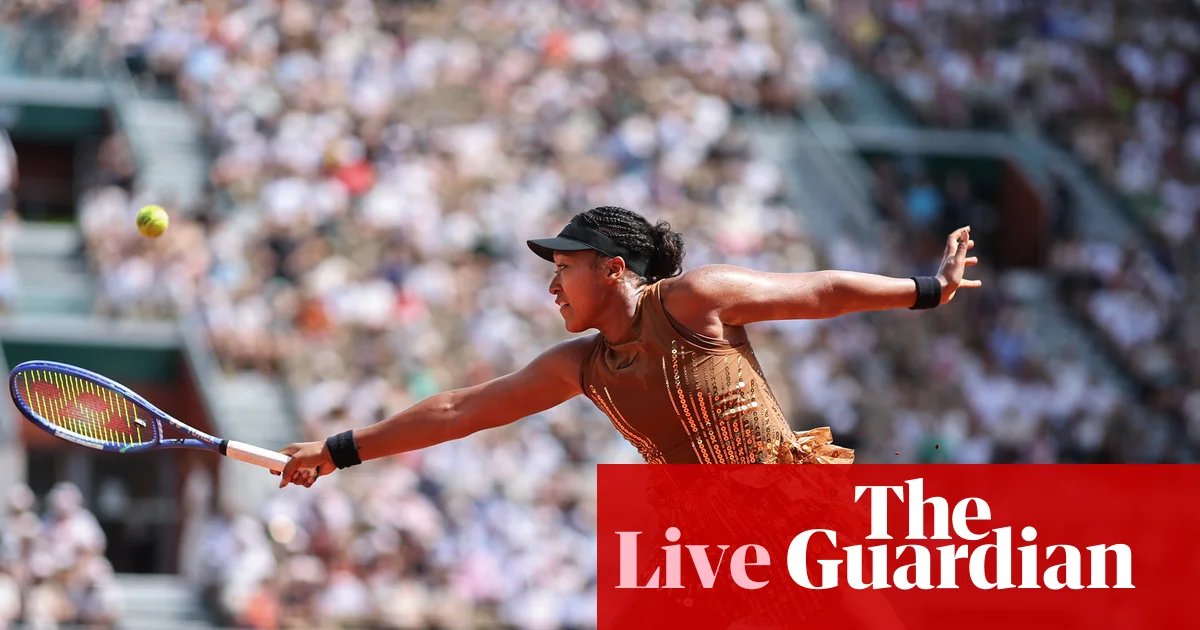
Jovic absolutely obliterated her fellow American and the former world No 8 Emma Navarro in the previous round, and rediscovers some of that form under extreme pressure here, reeling off seven points on the spin to cancel out Osaka’s early break in the second set. The 18-year-old holds with her first aces of the match and nudges ahead for 6-7, 3-2.
Today’s singles order of play
A quick rundown of the latest scores and what’s coming up on day seven:
COURT PHILIPPE CHATRIER
10-Flavio Cobolli (Italy) v 18-Learner Tien (US) 5-2
Diane Parry (France) v 6-Amanda Anisimova (US)
4-Coco Gauff (US) v 28-Anastasia Potapova (Austria)
4-Felix Auger-Aliassime (Canada) v 31-Brandon Nakashima (US)
COURT SUZANNE LENGLEN
17-Iva Jovic (US) v 16-Naomi Osaka (Japan) 6-7, 1-1
1-Aryna Sabalenka (Belarus) v Daria Kasatkina (Australia)
Moise Kouame (France) v Alejandro Tabilo (Chile)
Jaime Faria (Portugal) v 19-Frances Tiafoe (US)
COURT SIMONNE MATHIEU
Maria Sakkari (Greece) v Maja Chwalinska (Poland) 6-1, 3-6, 0-1
Matteo Berrettini (Italy) v Francisco Comesana (Argentina)
9-Victoria Mboko (Canada) v 19-Madison Keys (US)
COURT 14
25-Francisco Cerundolo (Argentina) v Zachary Svajda (US) 3-6, 4-6, 1-2
22-Anna Kalinskaya (Russia) v Camila Osorio (Colombia)
Matteo Arnaldi (Italy) v Raphael Collignon (Belgium)
COURT 7
25-Diana Shnaider (Russia) v Oleksandra Oliynykova (Ukraine) 2-4
Juan Manuel Cerundolo (Argentina) v Martin Landaluce (Spain)
Francisco Cerundolo was upstaged in the second round by his younger brother Juan Manuel, who of course took out an ailing Jannik Sinner, and he’s being totally upstaged by the 23-year-old Californian Zachary Svajda today, trailing now by two sets to love, 6-3, 6-4. Svajda’s dad died last autumn and he didn’t pick up a racket for a while after, but he’s found a way to channel his grief this year and, on his French Open debut, needs only one more set for a first appearance in the last 16 of a slam.
Osaka wins the first-set tie-break 7-5 against Jovic
… Jovic surrenders another point on serve to trail by a possibly insurmountable 5-2, which turns into 6-3 – so another three set points for Osaka, to add to the two she had in the previous game. Jovic saves the first in style, with a stinging serve out wide. The teenager thinks she’s nailed an ace down the T on the second SP, but it’s out. Osaka absolutely jumps on the second serve … but then thwacks into the net on her next shot. She still has one more SP though … and drills an inside-in forehand down the line! Osaka secures an absorbing first set and is a set away from what would remarkably be her first appearance in the French Open fourth round.
With a flurry of fans fluttering in the stands (the hand-held kind I should stress, not the people), with temperatures already hitting 30C at midday in Paris, Osaka takes the opening point of the breaker. The former world No 1 then grabs the first mini-break for 3-1, and backs it up with the quickest serve of the match for 4-1. They change ends at 4-2 …
One of the most intriguing questions going into today was how Osaka would deal with the precocious talents of the 18-year-old Jovic, and right now the answer is very well. Osaka brings up her first set point at 6-5 and advantage on Jovic’s serve … but a rare backhand error follows. A second set point soon arrives … this time Osaka’s forehand misfires. From there Jovic escapes with a hold. So it’s tie-break time!
Apologies for the sparse updates for the past hour – I’ve been having technical issues so Niall kindly added a couple of entries while spinning several other plates. So … what’s the state of play? Jovic is serving to stay in the first set against the Eiffel Tower sorry Osaka, trailing 6-5; Cerundolo is a set down, 6-3, but 3-2 up on serve in the second; and Sakkari is zooming through against Chwalinska, leading 6-1, 2-1.
Osaka breaks back to level the first set at 4-4, while Sakkari has wrapped up the first set against Chwalinska, winning it 6-1.
Elsewhere, another men’s seed in trouble as Francisco Cerundolo (No 25) trails US player Zachary Svajda by a set. Coming up shortly on Chatrier, it’s 10th seed Flavio Cobolli against Learner Tien.
Iva Jovic v Naomi Osaka is under way on Court Suzanne-Lenglen, and it’s the former with an early break, leading 3-2 in the first set. Maria Sakkari has also opened up an early lead; she’s 4-1 up on Poland’s Maja Chwalinska.
Preamble
Bonjour et bienvenue au jour sept de notre couverture de Roland Garros 2026!
After Novak Djokovic’s departure in the match of the tournament against the 19-year-old Brazilian sensation João Fonseca last night, opportunity knocks louder than ever before for the remaining men, with a first-time grand slam champion guaranteed next Sunday.
Today the players in the top half of the draw get the chance to underline their credentials, and with a huge Jannik Sinner-sized hole in that section, along with the exits of Ben Shelton, Daniil Medvedev and Alexander Bublik, the highest-ranked man in action is Félix Auger-Aliassime, and the fourth seed doesn’t play until tonight.
It means Sinner’s conqueror Juan Manuel Cerundolo gets another day in the sun, as does his brother Francisco, but a bigger buzz surrounds the 17-year-old overnight, hometown hero Moise Kouame, who will have Roland Garros rocking when he takes on Chile’s Alejandro Tabilo. The 10th seed Flavio Cobolli against the rising American Learner Tien could be tasty too, while Frances Tiafoe and the resurgent Matteo Berrettini are also in third-round action.
The leading names today are undoubtedly on the women’s side, which is still stacked with slam champions past and present: Coco Gauff continues her title defence, Aryna Sabalenka plays the former semi-finalist Daria Kasatkina, while Naomi Osaka and Madison Keys will be hoping to avoid the same fate as Djokovic when they take on the stupendously talented teens Iva Jovic and Victoria Mboko respectively. Amanda Anisimova plays too.
L’action commence: 11h à Paris/10am BST. Allons-y!
UK News
Farage exploiting Nowak’s murder against wishes of his family, says Starmer – UK politics live | Politics
Starmer condemns Farage at PMQs, condemning his ‘rage’ response to Nowak murder as ‘unforgivable’ snub to victim’s family
Nigel Farage, the Reform UK leader, also asked about the Nowak murder.
He said:
Following the horrendous circumstances of Henry Nowak’s death, can I urge the prime minister to consider this?
It is now clear to growing millions in this country that we are living under two tier policing.
The instructions that are given to police officers from police bosses are clear and written down in ink. It says you must treat different ethnic groups in different ways.
Farage suggested that was behind “the upset and the anger at the circumstances of his death, the anger that you saw spilling out in Southampton last night”.
Some MPs jeered at Farage, saying he should condemn the violence.
Farage went on:
If the public lose trust in being treated fairly by the police, can he take some action to end this divisive practice of two-tier policing and make sure that all British citizens are treated the same?
Starmer said: “I don’t believe there’s two-tier policing in this country.”
And he said that he was “really shocked” by Farage’s approach. He said Farage pretended to respect Nowak’s family. But he was acting like this.
Starmer went on:
The grieving family have asked us not to respond in the way that the leader of Reform has responded. They’ve asked us not to. They have lost their son in the most appalling circumstance. They make a simple plea of us as human beings to please not exploit that.
That is their plea to us. We all need to reflect on those words of Henry’s father.
My response – and the response of others, to be fair – has [been focused] on the lessons to be learned so we can deliver justice.
His response has been to appeal for rage.
That’s his response to a father who’s lost his son and asked for that not to happen.
Exploiting this tragedy to create grievance and division would be wrong in any circumstances, but to do it when the family are expressly saying please don’t is unforgivable. It shows who he is.
Key events
Ben Habib winds up his Advance UK party to create more space for Restore Britain to take on Reform UK

Ben Quinn
Ben Quinn is a Guardian political correspondent.
Advance UK, the hard-right outfit set up by former Reform UK deputy leader Ben Habib, has announced it is stepping aside to make way for Rupert Lowe’s Restore Britain to become the main force trying to emerge as a rival to Nigel Farage’s party.
Habib used a video message on X to announced that Advance UK would be de-registering as a political party and was “taking a step back” to prevent “confusion” on the party of voters looking for a right-wing alternative to Reform.
Advance UK has a few dozen councillors around England, mainly those who have defected from Reform and other places, while the far-right activist known as Tommy Robinson has identified himself as a supporter in the past.
The move now potentially opens up the potential for Robinson, whose real name is Stephen Yaxley-Lennon, to team up with Restore Britain, which was set up by the former Reform MP Rupert Lowe.
Lowe used X to praise Habib’s announcement, adding that his one-time Reform UK colleague and the Advance UK membership would be welcome in Restore Britain, but he added that it was a decision for them to make.
PMQs – snap verdict
In terms of the exchanges between the PM and the leader of the opposition, that was not quite a consensus PMQs. Kemi Badenoch asked about welfare, taunted the PM over his record, and came out with an OK jibe about Starmer being a “caretaker”. But it was all quite gentle, and Badenoch did not really score any hits. Her key decision was not politicise the central news of the day. In fact, Starmer even commended her for her stance on the Henry Nowak murder. (See 12.15pm – did he know in advance she was going to lead on welfare?) Badenoch’s choice of subject matter seems to have come as a disappointment to GB News (aka Reform UK TV), but it meant the Starmer/Badenoch exchanges felt more mature and sensible than they normally do.
One consequence of that was that the most important confrontation of the session came when Nigel Farage asked a question, and Starmer responded. (See 12.46pm.) In PMQs terms, this was a resounding win; Farage was knocked out of the park. But not because Starmer was particularly aggressive, or funny, or because he blindsided Farage with a clever argument; it was a victory of tone. Starmer got it right, and Farage got it wrong. (Unless you are a GB News viewer, perhaps.)
It is hard to imagine that Badenoch is particularly comfortable with being seen as constructive and non-partisan in her dealings with Starmer (particularly if, in doing so, she helped him grind down Farage). This is definitely not her default mode. No doubt normal service will resume next week.
Calvin Bailey (Lab) said that, as chair of the all-party parliamentary group on prostate cancer, he welcomed the news that more black men are being invited in for checks.
He said this was justified because black men have double the risk of getting prostate cancer. But, he said, Reform UK had responded to this news with “divisive weasel words and race baiting”.
Bailey was referring to this social media post from Zia Yusuf, the Reform UK home affairs spokesperson, last night.
On the day the whole political establishment claims we do not live in a two tier country, they announce this.
Note, the NHS makes NO drugs available exclusively to white people.
Starmer said the government was determined to improve cancer care.
Bob Blackman (Con) asked the government to proscribe the IRGC and to take action against Iran-backed charities operating in the UK.
Starmer said proscription-type powers were being introduced for state entities, and he said the government would announce “further steps in coming days”.
Starmer says Reform just offering ‘grievance and division’ in Makerfield byelection
Andrew Rosindell (Ref) asked about Havering, where Reform won the council in the local elections.
That gave Starmer a chance to have a go at the Reform UK candidate in Makerfield, Robert Kenyon. He said:
I have studied the candidate for Makerfield, the Reform candidate, since he brings up election. A self-professed sexist said women who get abortions do it for vanity purposes, encouraged people not to get the Covid vaccine, and said Russia was within its rights to invade Crimea.
Reform have got nothing to offer but grievance and division yet again.
Starmer criticises Farage for past comments opposing taxpayer-funded NHS
Tristan Osborne (Lab) asked Starmer about NHS treatments for memory loss.
He went on:
A very distressing case was recently brought to my attention by a constituent in a village in my constituency, of a man who could not remember his own words, even though he said it on television that the NHS should not be funded through general taxation.
What can we do to ensure my constituents to ecure clarity on future Kent and Medway NHS funding? And what can we do to help the leader of Reform UK [Nigel Farage – the person who claims not to remember previously proposing a different way of funding the NHS].
Starmer replied:
The Reform leader wants everyone to forget that he called for our NHS to be replaced with an insurance based system. You might want to jot it down to jog his memory.
And then he said that if people can pay, they should pay for NHS treatment. So we can help him by jolting his memory here.
You cannot trust Reform with our NHS. The only way to protect it is to vote Labour.
Liz Saville Roberts, the Plaid Cymru leader at Westminster, asked Starmer if he would give more powers to the Senedd.
Starmer said that he had spoken to Rhun ap Iorwerth, the new first minister, and that he would “work constructively, with the first minister and with the government in Wales, because that’s the right thing to do to deliver for Wales”.
Starmer condemns Farage at PMQs, condemning his ‘rage’ response to Nowak murder as ‘unforgivable’ snub to victim’s family
Nigel Farage, the Reform UK leader, also asked about the Nowak murder.
He said:
Following the horrendous circumstances of Henry Nowak’s death, can I urge the prime minister to consider this?
It is now clear to growing millions in this country that we are living under two tier policing.
The instructions that are given to police officers from police bosses are clear and written down in ink. It says you must treat different ethnic groups in different ways.
Farage suggested that was behind “the upset and the anger at the circumstances of his death, the anger that you saw spilling out in Southampton last night”.
Some MPs jeered at Farage, saying he should condemn the violence.
Farage went on:
If the public lose trust in being treated fairly by the police, can he take some action to end this divisive practice of two-tier policing and make sure that all British citizens are treated the same?
Starmer said: “I don’t believe there’s two-tier policing in this country.”
And he said that he was “really shocked” by Farage’s approach. He said Farage pretended to respect Nowak’s family. But he was acting like this.
Starmer went on:
The grieving family have asked us not to respond in the way that the leader of Reform has responded. They’ve asked us not to. They have lost their son in the most appalling circumstance. They make a simple plea of us as human beings to please not exploit that.
That is their plea to us. We all need to reflect on those words of Henry’s father.
My response – and the response of others, to be fair – has [been focused] on the lessons to be learned so we can deliver justice.
His response has been to appeal for rage.
That’s his response to a father who’s lost his son and asked for that not to happen.
Exploiting this tragedy to create grievance and division would be wrong in any circumstances, but to do it when the family are expressly saying please don’t is unforgivable. It shows who he is.
Noah Law (Lab) asked about the murder of Henry Nowak.
Starmer said he felt sick watching the video of Nowak being arrested.
He went on:
Henry’s father said this we do not want his death to be used to create further division, hatred or tension.
There are the words of a grieving father who’s lost his son.
We do not want his death to be used to create further division, hatred or tension.
I think those words have resonated with people across the country.
We must not allow this tragedy to be hijacked by anyone who seeks to divide us.
His final words seemed designed to set up the next MP to ask a question – Nigel Farage.
With his second question, Davey turned to Labour internal politics. And he delivered a very good joke.
With our armed forces overstretched, Labour now seems to be investing in a new weapon of war – the long-form essay.
It gives another meaning to the phrase drone warfare.
Davey went on:
Tony Blair says the UK should suck up to Donald Trump, kowtow to US tech barons and go slow on Europe.
The prime minister must be grateful for this rare endorsement of his agenda.
Blair also claims that the sensible people aren’t radical and the radical people aren’t sensible.
Is the prime minister concerned that unless he changes course, he will be remembered for being neither radical nor sensible?
Starmer said Davey spoilt what had been a good joke.
And he said he was suprised that Davey was not welcoming the tax cuts for theme parks.
Ed Davey, the Lib Dem leader, used his first question to ask about Henry Nowak.
The murder of Henry Nowak was an evil crime made much worse by the lies of the killer and the police response. The investigation must uncover all things that went wrong, and all police forces must act on its conclusions.
Outside court, Henry’s father made a powerful plea that his son’s murder should not be used to create further division, but should be used to treat knife crime as a national emergency.
Does the prime minister agree that the victims of knife crime and their families deserve a politics where we come together to solve these problems and not use them as a political football?
Starmer thanked Davey for his approach and said that it was the duty of politicians “to bring people together at a time like this, not seek to divide people”.
Badenoch says Starmer just ‘caretaker’ PM, ‘keeping seat warm’ for Burnham
Badenoch said Labour MPs were cheering for Starmer even though he released their text messages.
He is more than happy to release all their text messages while all of his have disappeared.
Disappearing messages from a disappearing PM.
There is a conservative solution benefits bill down, taxes down, growth up.
Badenoch said that Starmer was now just “a caretaker, keeping the seat warm for the mayor of Manchester”.
Starmer replied:
Forgive me if I don’t take too much notice of the leader of the opposition.
For 14 years they broke our welfare system, lost control of our borders, presided over the biggest fall in living standards on record, broke the economy, prisons, the NHS. I could go on and on.
No wonder she and they are totally irrelevant.
Starmer backs McFadden over his position on welfare reform
Badenoch said McFadden also said that in all meetings with Labour MPs, they wanted to raise taxes to pay benefits. She asks if Starmer will take the advice in Tony Blair’s essay and work with the Tories on welfare reform.
Starmer replied:
They introduced a system that’s broken and they put the bill through the roof. And now they want to give us advice on welfare. No thanks, no thanks.
The question should always be not what benefits people are entitled to, but what help we can give people to change their life.
That’s what the work and pensions secretary was arguing. And he’s right about that.
Referring to revelations in the Mandelson files, Badenoch asked Starmer if he agreed with Pat McFadden, the work and pensions secretary, that the failure of the welfare reform act last year was “the moment he lost his authority”.
Starmer said he was proud of his record.
Despite the war in the Middle East, the OECD forecast UK growth is up and inflation is down.
Net migration, which reached nearly one million under them, and the leader of the opposition was the cheerleader, down by a staggering 82%.
The asylum backlog down by 46%.
We’re delivering the fastest reduction in waiting times in the NHS in the history of the NHS. That’s on top of free school meals, free breakfast clubs and free childcare.
And of course, we’re lifting half a million children out of poverty.
I’m very proud of the work of this Labour government.
Badenoch said the welfare bill went up under the last government because of Covid.
She said Starmer had given up on welfare reform.
On Sunday, the welfare secretary was asked 12 times on national radio if he would make cuts to the benefits bill and 12 times he could not answer. So I will ask the prime minister, is he going to cut the benefits bill?
Starmer said Labour is reforming the system to get young people into work. The Tories left the system broken, he said.
Badenoch said the welfare bill had gone up by £20bn under Labour. She asked why there was no welfare bill in the king’s speech.
Starmer said the government was reforming the welfare system “so it no longer pushes people away from work”.
That’s what we’re doing. They voted against it.
Welfare reform is introducing a right to try, to incentivise people to take up opportunities. That’s what we’re doing. They voted against it.
Welfare reform is providing record funding on apprenticeships. That’s what we’re doing. Apprenticeship starts fell by 40% on their watch.
Under the Tories, welfare spending soared, Starmer said.
Starmer thanks Badenoch for ‘tone’ she has taken in relation to Nowak tragedy
Kemi Badenoch, after paying tribute to Alan Haselhurst, asked Starmer how much the welfare bill has gone up under Labour.
Starmer started by thanking Badenoch for her “approach and tone” in relation to the Henry Nowak tragedy.
On welfare, he said
We inherited a broken system from the party opposite. and we are now improving that system, delivering a youth guarantee, rolling out 300,000 work experience placements.
He said the benefits bill went up under the Tories – when the welfare secretary was Mel Stride, now shadow chancellor.
Roz Savage (Lib Dem) asked Starmer to impose a cap on political donations.
Starmer said the government has capped donations. He went on:
But the $5 million question, £5m question still remains. Why is the leader of Reform dodging questions about his donations? And why did he keep it secret in the first place?
UK News
Villagers cannot go home for two months during ground movement probe
Almost 100 properties in a former Clackmannanshire mining village were evacuated last week after reports of “unsafe structures”.
Source link
UK News
French Open 2026: Kalinskaya v Chwalinska; Sabalenka v Shnaider as quarter-finals continue – live | French Open 2026
Key events
Chwalinska has fine hands but her racket must feel as if it weighs about 100kg as she steps up to serve. She still moves to within two points of victory at 30-15, before Kalinskaya lets go of some of her frustrations with a brutal return winner. So will it become match point or break point? Break point, as Kalinskaya again comes out swinging. Chwalinska is still able to think clearly enough to confound Kalinskaya with a body serve. Deuce. Advantage Kalinskaya. And Chwalinska goes well long with a clunky forehand! A fourth successive break! Sacre bleu!
But here’s a sudden, jarring shift in momentum as Kalinskaya, hitting slightly freer now she has nothing to lose, tears through Chwalinska’s serve, 0-15, 15-all, 15-30, 15-40 … and Kalinskaya gets one of the breaks back with a fizzing forehand winner! But no sooner does she give herself a glimmer, she slumps 30-40 down on her own serve, and she balloons a backhand long! Yet another break – the 10th of the match – and now Chwalinska will serve for the match!
Kalinskaya’s face hardly ever betrays emotion but she is clearly rattled here, and is now arguing with her coach about tactics. With her focus gone, she slips 30-40 down, and is totally wrong-footed as Chwalinska clobbers a forehand winner beyond her! Chwalinska has the comfort of a double break (which she’ll be thankful for given the way the first set went) and she’s potentially two games away at 7-6, 4-1!
Chwalinska’s first serve is slower than Kalinskaya’s second serve, but she shows great variation to back up the break by holding to 30. The qualifier, with one grand slam match win to her name before this tournament, is now three games away (!) from the semi-final. Words not even Chwalinska would have thought possible a couple of weeks ago. Or possibly even half an hour ago when Kalinskaya was making her comeback.
After that wildly see-sawing opener, a couple of straightforward holds get the second set under way. Kalinskaya then finds herself under a bit of pressure on serve, at 30-all, before dealing with Chwalinska’s loopy ball with a perfectly executed drop shot. 40-30. But Chwalinska comes straight back at her for deuce and advantage and game, or more accurately Kalinskaya self combusts with three errors, to hand Chwalinska the break! The qualifier leads 7-6, 2-1.
Fancy some post-set entertainment? Sure you do:
Chwalinska wins the first-set tie-break 7-3
Kalinskaya concedes another point on serve to drop 4-3 behind. A high-quality clay-court rally complete with moon balls, net charges and lobs ends in Chwalinska’s favour for 5-3. And having waited so long for a point to be won on serve, two come along at once! It’s 6-3, three set points, to add to the two it feels like Chwalinska had yesterday. And this time, after all of Kalinskaya’s resistance, the Russian fires long! It’s been tortuous at times and very tense, but Chwalinska finally has the first set after 69 minutes.
The first five points of the breaker go against the server, make that six, as Chwalinska’s vicious slice stops dead on the clay, leaving Kalinskaya with little chance. So they change ends at 3-all …
Kalinskaya, perhaps panicked, rushes the opening points on her serve, losing the controlled aggression she has found as the set has progressed, and she slides 15-30 down. Credit to her for the way she comes back for 30-all, 40-30 and game. So much of the narrative here is on the Chwalinska, the qualifier, that it’s easy to forget this is only Kalinskaya’s second grand slam quarter-final and she’ll be feeling the nerves. This will be a tense, tense tie-break.
Kalinskaya looks to be the favourite from here, with her greater experience and power, though having said that the key to her comeback has been staying a bit more patient in the rallies and not trying to pull the trigger so quickly. At 30-all on Chwalinska’s serve, the Pole pushes Kalinskaya deep before sprinting to the net to finish off the point. Smart play. And Chwalinska takes the next point too to staunch the flow of games against her and nudge 6-5 ahead.
Kalinskaya is never a player to show much emotion, and with her game face on, she works her way to 40-15 with minimal fuss. Before crunching away a winner to settle matters. From 5-1 down, they’re back on serve at 5-5! So who will feel the pressure now? Chwalinska, having conceded such a commanding lead and missed those two set points, or Kalinskaya, now she has something to lose again?
Kalinskaya holds to 30 to further reduce her arrears, to 5-3. But Chwalinska will get another chance to serve this out … and comes out on top after a lung-busting 27-shot rally, finished off with a drop shot/lob combination, for 30-15! Even Kalinskaya is applauding. Chwalinska delves into her box of tricks again to bring up 40-30, so here’s another set point to add to the one the Pole had at at 5-1. Some big, brave hitting from Kalinskaya saves it. The wind is really ripping around Chatrier now, just to add to the drama. And this goes exactly the same way as game seven, as Kalinskaya breaks on a second BP! Remarkably, they’re back on serve.
So Chwalinska is serving for the set … and she’s playing as if this is her 34th grand slam quarter-final rather than her first. From 30-all, she advances to 40-30 … but Kalinskaya saves the best for last, fending off the set point with a backhand winner! Chwalinska, perhaps still thinking about that SP, makes a total hash of a smash at deuce, giving Kalinskaya the chance to break. And while the Russian doesn’t on the first break point, she does on the second. Could the comeback be on? Kalinskaya trails 5-2 but at least she’s starting to ask some questions of Chwalinska.
Make that four, although the Pole is make to work for the hold, saving a break point at 30-40. Chwalinska is giving Kalinskaya so little rhythm and the Russian is totally befuddled in the next game as Chwalinska zips 15-40 ahead. Now Kalinskaya is trying to get in on the drop-shot act … but it’s not her natural game, it doesn’t work and Chwalinska charges forward before dispatching a winner into the open court! It’s now 5-1. Phew.
The 5ft 5in left-hander Chwalinska, who makes up for her lack of height and power with intelligence, is drop-shotting and slicing Kalinskaya into submission here, and it gives her a break point at 30-40. Kalinskaya saves it with a big backhand – but soon enough it’s break point again and after a nine-shot rally Kalinskaya’s forehand drifts wide! Chwalinska breaks for 3-1 and that’s three games on the spin.
Now it’s Chwalinska’s turn to recover from 40-15 down on Kalinskaya’s serve to break … and then she rattles through four successive points on serve to hold! The world No 114 is on the board and leads 2-1. This interview with Chwalinska and Swiatek as 15-year-olds is a good watch, btw. How good is their English, given their age?!?!
Chwalinska looks anything but stressed as she swiftly moves 40-15 ahead on serve in the opening game. But Kalinskaya comes back at her for deuce. Despite this being only a second grand slam quarter-final for Kalinskaya, the 22nd seed knows this match is on her racket, and she’s trying to stamp her authority from the off. She has the greater firepower, which she demonstrates to get to her advantage. Chwalinska craftily works Kalinskaya around the court and saves the break point. But the next two points go Kalinskaya’s way and the Russian breaks in the opening game.
The qualifier Chwalinska (pronounced Hfa-leen-ska in case you were wondering) is having the time of her life in Paris, having won all but one of her seven matches in straight sets, upsetting Zheng Qinwen, Elise Mertens and Maria Sakkari along the way. Her solitary grand slam match victory before this tournament came at Wimbledon four years ago, after she’d taken a break from tennis because of depression. She has said she associated the sport with “pressure, stress and crying” but now has a more balanced approach: “The results don’t define me as much as they did before. I just couldn’t differentiate Maja and tennis player. I was just one.”

Tumaini Carayol
Marta Kostyuk was her own toughest rival for so long during the early stages of her career. As she tried to navigate the pressure that accompanied her status as a teenage prodigy, she often struggled to think clearly on the court without her emotion, fears and desperation to succeed torpedoing her form.
The path towards unlocking her potential has been tough, requiring the Ukrainian to be honest with herself and encounter the right people to help take her forward. That work continues to pay off. Kostyuk made another significant breakthrough by ending the Ukraine derby as the victor, holding her nerve to defeat Elina Svitolina 6-3, 2-6, 6-2 and reach a grand slam semi-final for the first time in her career.
Although Kostyuk has broken new ground in Paris, this is simply a continuation of the form she has put together during what is looking increasingly like a career-defining clay-court season. She is now on a 17-match winning run, having secured titles in Rouen and Madrid in the buildup to Paris. Considering the clarity and temperament she is playing with each time she steps on the court, she can clearly go further.
After firing down a final unreturned serve, Kostyuk struggled to hold back her emotions as she digested such a significant result. Still, even in her personal triumph, she started her speech on the court by referencing the war back home, earning a long, standing ovation.
“I want to start with this historical match that we played today with Elina,” she said. “We had a very difficult night again in Ukraine, especially Kyiv. So many people dead. I want to give this match to Ukrainian people and to their resilience.”
This tournament has provided ample reminders of the horrors still unfolding in Ukraine. It started with Kostyuk waking up to the news that Russia had fired a missile within 100 metres of her family home, where her sister, mother and great aunt were staying, yet she had to compose herself and play her first-round match. Meanwhile, their compatriot Oleksandra Oliynykova has levelled stinging criticisms of the sport’s handling of Russian players.
Another duel between a Russian and Ukrainian player beckons. Kostyuk will next face the 19‑year‑old Mirra Andreeva, who produced a stellar performance to dismantle Sorana Cirstea 6-0, 6-3 and reach her second Paris semi-final. It will be a rematch of their recent final at the Madrid Open. Asked what it is like to play a Ukrainian player in these matches, Andreeva said: “For me it doesn’t matter who I play. I really try to play against the ball that is coming at me. Usually it doesn’t matter to me who I’m playing against, so I’m trying to really focus on the game and on the game plan that I have to use on the court.”
The full report:

Tumaini Carayol
For at least a few fleeting moments, it appeared that something significant might be unfolding on Tuesday beneath the Court Philippe-Chatrier roof. Rafael Jódar had started his first grand slam quarter-final desperate to make his mark and he spent the first 40 minutes eviscerating the ball off both sides, lasering groundstrokes that seemingly struck every line. He built a 5-2 lead over Alexander Zverev, a game away from starting with a statement in the biggest match of his career.
Normalcy resumed quickly. Jódar’s attempts to serve out the set ended in a break to love for the second seed, who quickly took control and refused to relinquish his position until the end of the match.
Zverev offered Jódar minimal breathing room for the rest of the encounter, serving extremely well and striking his forehand freely. In the process, the German took another step towards winning an elusive first grand slam title as he returned to the semi-finals of the French Open with a 7-6 (3), 6-1, 6-3 win.
The past 10 days in Paris have been unlike any in the recent history of men’s tennis, with so many of the top players suffering early upsets. As the dust has begun to settle on the early defeats for Jannik Sinner and Novak Djokovic, the central question surrounding the men’s draw in the final rounds is simple: can anyone beat Zverev?
After being repeatedly blocked by Sinner, Carlos Alcaraz, Djokovic and others, the door is clearly wide open. Beyond him, the world No 6, Félix Auger-Aliassime, is the only remaining top-10 player. There are still some shooters left in the draw, quality players with big enough weapons to take him out, but while Zverev has navigated his section with few problems, reaching the semi-finals without facing a player ranked inside the top 25, the rest of the field has been in a frantic rush to take advantage of an opportunity that may never come again.
So many players have already worn themselves out in multiple five-set matches as they have battled to get through.
Jódar was a perfect example of this. Seeded 27th, he has been one of the revelations of the clay-court season. He entered the match leading the ATP with clay-court wins this year, compiling a record of 19 wins and three defeats, with quarter-finals in Madrid and Rome before his run at Roland Garros. But he navigated consecutive five-set matches for the first time in his career to reach the quarter-finals. After squandering his opportunity in the opening set, he quickly ran out of steam.
The top half of the draw, meanwhile, now more closely resembles a wrestling match than anything like tennis. So many players in the top section have been embroiled in marathon matches, not least Italy’s Matteo Arnaldi, whose 17 hours and 54 minutes on court to reach the last eight is an open era record by, astoundingly, over two hours.
You can read the rest here:
Yesterday’s showers have departed, there’s even a bit of sunshine in Paris and the Philippe Chatrier roof is off as Kalinskaya and Chwalinska arrive on court. While we wait for the action to begin, here’s Tumaini’s take on what happened yesterday …
Today’s singles order of play
COURT PHILIPPE CHATRIER – 11am (10am BST)
Anna Kalinskaya (22, Russia) v Maja Chwalinska (Poland)
Aryna Sabalenka (1, Belarus) v Diana Shnaider (25, Russia)
Felix Auger-Aliassime (4, Canada) v Flavio Cobolli (10, Italy)
Not before 8.15pm (7.15pm BST)
Matteo Berrettini (Italy) v Matteo Arnaldi (Italy)
Preamble
Bonjour et bienvenue au jour onze de Roland Garros, where there’s something of an eastern European and Italian takeover on Philippe Chatrier.
First it’s the qualifier Maja Chwalinska – not the Pole who everyone thought would still be standing – against the 22nd seed Anna Kalinskaya. Chwalinska, who came through the junior ranks with Iga Swiatek before their careers went in very different directions, had won only one grand slam match before this tournament, but the 24-year-old is now in the quarter-finals – a stage the 27-year-old Kalinskaya has admitted she didn’t expect to reach either, having got this far at a major only once before, at the 2024 Australian Open.
This, of course, is anything but uncharted territory for Aryna Sabalenka, who has remained utterly unaffected by the chaos around her, as the only grand slam champion left in one piece in the women’s and men’s draws, on her way to a meeting with another surprise quarter-finalist, Russia’s Diana Shnaider. Sabalenka laid down the biggest of markers in the red dirt with her blistering win over Naomi Osaka in the previous round – prompting even Shnaider to concede that today’s match is most likely a chance to “get experience for the future”.
Sabalenka knows her time is now – while it could be now or never for Felix Auger-Aliassime, the former wonderkid who is, for the first time in his slam career, the highest-ranked player left in his half of the draw that may have lost the greatest Italian of all in Jannik Sinner but still features three others in Flavio Cobolli, Matteo Berrettini and Matteo Arnaldi. Auger-Aliassime faces Cobolli in a much-anticipated match that is so hard to call (Auger-Aliassime has the big-match experience; Cobolli is such a fine talent) – before in the night session the renaissance man Berrettini, back after his injury hell, meets the marathon man Arnaldi, who’s already played 18 sets to get this far.
Play begins: à 11h ( 10am BST). On y va!
-
Crime & Safety3 weeks agoWaitrose supermarkets across UK shut due to ‘critical error’
-
Crime & Safety3 weeks agoMan arrested in connection with rape in Oxfordshire town
-
Crime & Safety3 weeks agoBanbury woman jailed after lying to police about kidnapped children
-
Crime & Safety4 weeks agoHow to spend a day in Harpsden among UK’s poshest villages
-
Oxford Events3 weeks agoStage Watch: Somerset House enters the comedy arena with major new festival Laughterama
-
Business & Technology4 weeks agoCBI posts 14% revenue rise as payment services grow
-
Crime & Safety3 weeks agoStrictly Come Dancing new hosts reportedly Emma Willis
-
Crime & Safety3 weeks agoUK Hantavirus update as 22 ship passengers moved to hospital