
UK News
Artemis II, Nasa’s first crewed lunar rocket in more than half a century, prepares for launch – watch and follow live | Space

The Artemis II mission
Artemis II is the second flight, and first crewed mission, of the core component of Nasa’s Moon to Mars initiative, which aims to build a permanent, habitable lunar base as a prelude to eventual human flights to the red planet.
Assuming a successful launch on Wednesday, it will be a 10-day fly past of the moon, with no landing, in which the four astronauts will travel farther into space, just short of 253,000 miles, than any human beings before them.
The objectives are to test crucial spacecraft and life support systems, monitor extensively the astronauts’ health during a long-duration spaceflight, specifically the enhanced effects of radiation and microgravity, and confirm the ability of the Orion capsule to withstand temperatures up to 3,000F (1650C) at re-entry.
The highlight for the crew will be on flight day six, when Orion will slingshot around the moon and pass between 4,000 and 6,000 miles from the lunar surface, providing opportunities to photograph the moon’s south pole where the next human landing will take place as early as 2028.
Nasa has published a comprehensive, day-by-day schedule of the Artemis II mission timeline here.
Key events
What to know about the spacecraft
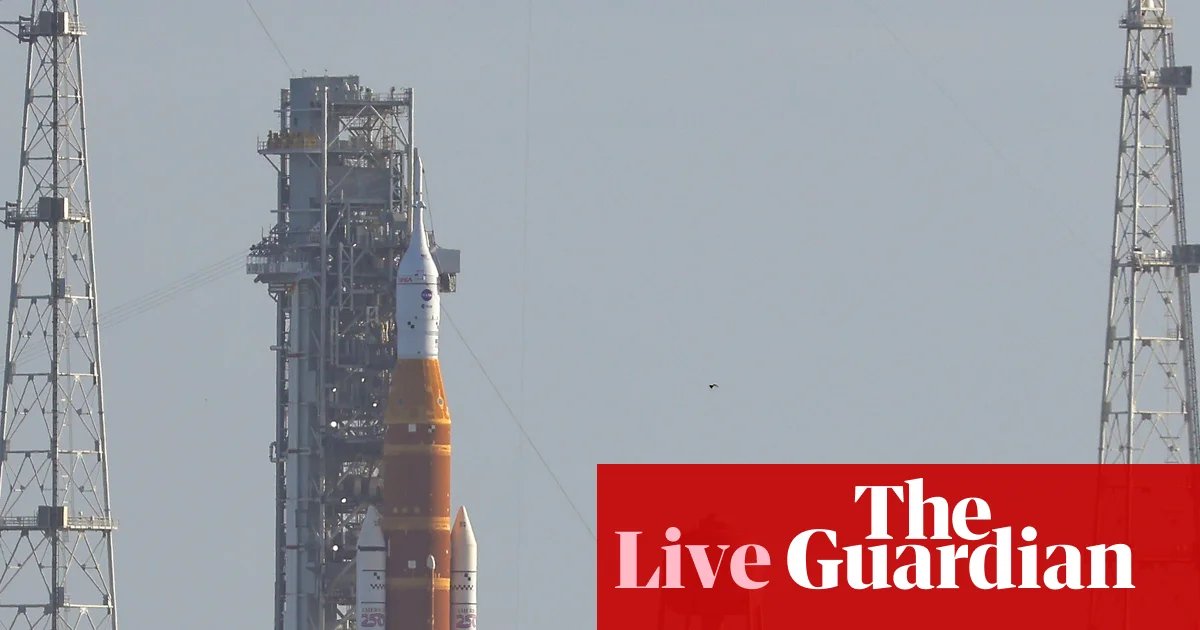
The Artemis II launchpad stack comprises Nasa’s Space Launch System (SLS) rocket, and the Orion crew capsule, a five-meter diameter craft with the interior volume similar to that of a small camper van.
The height of the rocket assembly is 322ft (98m), slightly higher than the Statue of Liberty (305ft), and London’s Elizabeth Tower, commonly known as Big Ben, at 316ft.
Four RS-25 engines, remnants from Nasa’s space shuttle program that ended in 2011, will provide almost nine million pounds of thrust at lift-off, making SLS the most powerful fully operational space rocket in history.
Two solid rocket boosters and the main tank fuel fall away after main engine cut-off and stage separation early in flight, and Orion will be powered to the moon by the European Service Module (ESM), built by Airbus for the European Space Agency.
The ESM will separate from Orion about 45 minutes before the crew’s splashdown in the Pacific ocean at the end of the 10-day mission. Unlike the solid rocket boosters at the start of the mission, which will be recovered, the ESM is designed to burn up on re-entry to Earth’s atmosphere.
The Artemis II crew will be arriving at the launchpad shortly after an emotional farewell with their families at the Neil A Armstrong operations and checkout building at Kennedy Space Center.
They posed for photographs and waved their goodbyes with heart signs and air kisses, not being allowed to hug their loved ones because of quarantine protocols.
Commander Reid Wiseman thanked the throngs who gathered to see them off. “It’s a great day for us. It’s a great day for this team,” Wiseman called out.
The astronauts boarded a silver astrovan for the journey to launchpad 39B, with military helicopters overhead and several security vehicles following at a close distance.
The next launch milestone will be the crew walking around and checking out their 322ft (98m) rocket ship from the ground before ascending in the elevator to the Orion crew capsule.
The Artemis II mission
Artemis II is the second flight, and first crewed mission, of the core component of Nasa’s Moon to Mars initiative, which aims to build a permanent, habitable lunar base as a prelude to eventual human flights to the red planet.
Assuming a successful launch on Wednesday, it will be a 10-day fly past of the moon, with no landing, in which the four astronauts will travel farther into space, just short of 253,000 miles, than any human beings before them.
The objectives are to test crucial spacecraft and life support systems, monitor extensively the astronauts’ health during a long-duration spaceflight, specifically the enhanced effects of radiation and microgravity, and confirm the ability of the Orion capsule to withstand temperatures up to 3,000F (1650C) at re-entry.
The highlight for the crew will be on flight day six, when Orion will slingshot around the moon and pass between 4,000 and 6,000 miles from the lunar surface, providing opportunities to photograph the moon’s south pole where the next human landing will take place as early as 2028.
Nasa has published a comprehensive, day-by-day schedule of the Artemis II mission timeline here.
First photos of Artemis II crew in their space suits
The first photos of the Artemis II crew on launch day are appearing on the news wires now. Canadian astronaut Jeremy Hansen and Nasa astronauts Victor Glover, Reid Wiseman and Christina Koch were posing for pictures with their families before they’re expected to set off on a 10-day journey around the moon.
They were seen smiling and waving to the crowd ahead of the launch later expected later today:
Who is on the Artemis II crew
Three of Artemis II’s four crew members are Nasa astronauts and spaceflight veterans extended stays on the international space station (ISS).
Commander Reid Wiseman, 50, is a retired US Navy captain from Baltimore, Maryland. He was selected as an astronaut in 2009, spent six months on the ISS from May to November 2014, and is a former chief of Nasa’s astronaut office.
He has two daughters with his wife Carroll, who died in 2020 from cancer. He has said he is taking a notepad and pencil with him to space to record his thoughts during the mission.
Pilot Victor Glover, 49, will become the first astronaut of color to fly beyond lower Earth orbit. From Pomona, California, he joined the astronaut corps in 2013, and flew to the ISS on the maiden operational flight of SpaceX’s Dragon capsule in 2020.
He is married with four children. His callsign, Ike, is an acronym bestowed lovingly by colleagues for “I know everything”. Glover said he will carry his Bible, wedding ring, and book of quotations from Apollo 8 astronaut Rusty Schweickart.
Mission specialist Christina Koch (pronounced Cook), 47, is already a record holder for the longest single spaceflight by an American woman, 328 days on the ISS from March 2019 to February 2020.
Koch, from Grand Rapids, Michigan, is a married engineer who became an astronaut in 2013. She will become the first woman to travel to the moon. Her personal items in space will be handwritten notes from loved ones.
Mission specialist Jeremy Hansen, 50, is the only non-American crew member, and has no previous spaceflight experience. A fighter pilot in the Royal Canadian air force, Hansen was recruited to the country’s astronaut training program in 2009.
Hansen is married with three children. Born in London, Ontario, he plans to take with him four moon-shaped pendants for his family, and maple syrup and cookies.
How to watch the Artemis II mission
Unlike the Apollo moon landings from 1969 to 1972, when millions of people had to gather around small TV sets to watch missions unfold in often grainy and ghosting black and white video, every moment of Artemis II will be a fully online, high-resolution multimedia experience.
The Guardian has a live feed at the top of this blog you can follow.
Nasa has countless webpages dedicated to every aspect of the flight from its homepage at nasa.gov, and the space agency has a significant presence on numerous social media platforms including X, YouTube, Instagram and Twitch.
Additionally, it runs a free, on-demand streaming channel, Nasa+, which will provide live coverage from before launch to after splashdown, including all press briefings. It also has a dedicated app for smart devices.
The Artemis II commander Reid Wiseman maintains a prominent social media presence, and has been posting prolifically ahead of the flight, although it remains to be seen how often he is able to update during the mission itself.
Also worth keeping an eye on is the X account of the new Nasa administrator Jared Isaacman.
How the launch is expected to unfold
A two-hour launch window for Artemis II opens at 6.24pm EST (11.24pm BST) after an almost four-hour fueling process. Nasa’s final weather briefing on Tuesday reported an 80% chance of favorable conditions for launch.
Mission managers will be watching closely data from launchpad 39B at the Kennedy Space Center, as well as real-time and forecast weather information. Any last-minute technical issue or weather violation can cause a scrubbed launch attempt, or a delay, right up to T-0 (the moment the countdown clock reaches zero).
After lift-off, the 322ft (98m) rocket will take about 6.5 seconds to clear its tower, and accelerate quickly to 17,500mph and an altitude of about 531,000ft. Once there, main engine cut-off and core stage separation take place a little more than eight minutes into flight.
The real journey to the moon begins on flight day two, after several revolutions in Earth’s orbit, with the so-called translunar injection burn, the final major engine firing of the mission.
Welcome to our launch blog for Wednesday’s scheduled launch of Artemis II, Nasa’s first crewed lunar rocket in more than half a century that is set to lift-off from Florida’s Kennedy Space Center at 6.24pm ET (11.24 BST).
I’m Richard Luscombe at the press site in Cape Canaveral with a close-up view of launchpad 39B, where the Space Launch System (SLS) rocket and Orion crew capsule will depart on their 10-day, 685,000-mile journey to the moon and back.
Hundreds of thousands of spectators will pack the beaches and causeways of Florida’s space coast to watch humans travel beyond lower Earth orbit for the first time since the final Apollo mission in December 1972.
Three Nasa astronauts, Americans Reid Wiseman, Victor Glover and Christina Koch, join Jeremy Hansen of the Canadian Space Agency on a mission that will slingshot around, but not land on the moon, before returning to a Pacific ocean splashdown.
Follow our coverage as we bring you the latest from the space center leading up to the opening of tonight’s two-hour launch window.
Read our preview of the mission here:
UK News
FA Cup buildup, Championship action and latest on Italian turmoil: football news – live | Championship

Key events
FA Cup: Southampton v Arsenal (Saturday, 8pm)
Eleven Arsenal players withdrew from their respective international squads. How many will be in action at St Mary’s tomorrow?
Women’s Champions League
Arsenal will face OL Lyonnes in the semi-finals for the second season in a row. OL Lyonnes overcame a 1-0 first-leg deficit to beat Wolfsburg 4-0 after extra-time in France.
Last season, OL were strong favourites to go through after winning 2-1 at the Emirates, only for Arsenal to run riot in France.
There’s a full EFL programme today, starting with Middlesbrough v Millwall and Doncaster v Walsall at 12.30pm. I won’t type all the fixtures because that would be an arthritic mistake when I can just direct you to our live scores page. But there are some big games, with Boro v Millwall probably the pick.
The race for the second automatic promotion spot in the Championship is spandex-tight. Fifth-placed Hull go to Oxford, while third-placed Ipswich have the day off. They were due to meet Southampton, who are otherwise engaged in the FA Cup.
In other Championship news, Roy Hodgson, 78, begins his second spell as Bristol City manager with a trip to Charlton.
The FA Cup quarter-finals
-
Manchester City v Liverpool (Saturday, 12.45pm)
-
Chelsea v Port Vale (Saturday, 5.15pm)
-
Southampton v Arsenal (Saturday, 8pm)
-
West Ham v Leeds (Sunday, 4.30pm)
Phil Foden made two starts for England over the international break as Thomas Tuchel experimented with how the Manchester City attacking midfielder could be used at the World Cup. He played in a couple of positions but was ineffective in two collectively subpar performances from the Three Lions. It means he has one assist and no goals in his past 22 appearances for club and country in what has been an underwhelming campaign for the 25-year-old. He has dropped below Rayan Cherki in Pep Guardiola’s pecking order and has not completed a full 90 minutes since January. In the Carabao Cup final, Foden was permitted a late cameo, and it feels like this is the time when he should be making a difference in the final stages of the season.
There are still trophies to be played for, even if winning the Premier League title would involve a huge turnaround against Arsenal. This means the FA Cup is the most promising prospect and Foden should be desperate to start and remind everyone of the world-class player he could be, especially against a Liverpool side who often struggle against smart No 10s. The next six weeks could be make or break for Foden’s City and international career, so he must seize every opportunity.
Preamble
Hello, good morning, good Good Friday and welcome to our rolling football news blog. Our attention will soon turn to the weekend’s action, including the FA Cup quarter-finals and a full EFL programme today, but first let’s have a recap of the week in international football.
-
Bosnia and Herzegovina, Sweden, Turkey, Czech Republic, DR Congo and Iraq completed the 48-team line-up for this summer’s World Cup.
-
Italy failed to qualify for the third World Cup in a row, an “unacceptable disgrace” that prompted recriminations and resignations.
-
A largely second-string England team lost at home to Japan.
-
Ghana, who are in England’s group, sacked their manager Otto Addo.
-
Scotland followed a 1-0 defeat to Japan with a 1-0 defeat to Cote d’Ivoire.
-
Fifa raised the highest ticket price for the World Cup final from $1,600 in 2022 to $10,990 in 2026.
-
And most importantly of all, France moved to the top of our World Cup power rankings.

The cost of fixing the most serious repairs at major hospitals alone is more than £600m, figures show.
Source link

The four Artemis astronauts have fired up their spacecraft’s engine to break away from Earth’s orbit and zoomed towards the moon, a milestone that commits Nasa to the first crewed lunar flyby in more than half a century.
With enough thrust to accelerate a stationary car to highway-driving speed in less than three seconds, the Orion capsule engine blasted on Thursday the astronauts on their trajectory towards the moon, which they now will loop as part of the 10-day Artemis 2 mission.
The burn lasting just under six minutes propelled them on their three-day voyage towards Earth’s natural satellite, the first since 1972.
“Looks like a good burn, we’re confirming,” mission control in Houston said.
“The crew is feeling pretty good up here on our way to the moon,” said astronaut Jeremy Hansen. “Humanity has once again shown what we are capable of.”
The burn came one day after the enormous orange and white Space Launch System (SLS) rocket carrying the Orion capsule blasted off flawlessly from Kennedy Space Center in Florida for the long-anticipated journey around the moon.
Now the astronauts are moonbound, there’s no turning back: they are on a “free return” trajectory, which uses the moon’s gravity to slingshot around it before heading back towards Earth without propulsion.
In the event something goes wrong, the astronauts wear suits that also serve as “survival systems” – in the unlikely case of a cabin depressurisation or leak, they’ll maintain oxygen, temperature controls and the correct pressure for up to six days.
The astronauts – Americans Reid Wiseman, Victor Glover and Christina Koch, and Hansen, a Canadian – spent their first hours in space performing checks and troubleshooting minor problems on the spacecraft that has never carried humans before, including a communications issue and a malfunctioning toilet.
They began the second day of their mission by playing Green Light by John Legend and Andre 3000, Nasa said – a reference to the go signal they would soon get to fire up the engine and move towards the moon.
They also had their first workouts on the spacecraft’s “flywheel exercise device” – each astronaut will carve out 30 minutes a day for fitness to minimise the muscle and bone loss that happens without gravity.
The 10-day Artemis 2 mission is aimed at paving the way for a moon landing in 2028.
The mission marks a series of historic accomplishments: sending the first person of colour, the first woman and the first non-American on a lunar mission. If all proceeds smoothly, the astronauts will set a record by venturing further from Earth than any human before – more than 250,000 miles (402,336km).
It is also the inaugural crewed flight of SLS, Nasa’s new lunar rocket.
SLS is designed to allow the US to repeatedly return to the moon with the goal of establishing a permanent base that will offer a platform for further exploration. It was meant to take off in February after years of delays and massive cost overruns. But repeated setbacks stalled it and even necessitated rolling the rocket back to its hangar for repairs.
The current era of US lunar investment has frequently been portrayed as an effort to compete with China, which aims to land humans on the moon by 2030.
During a post-launch briefing, Jared Isaacman, the Nasa administrator, said competition was “a great way to mobilise the resources of a nation”.
“Competition can be a good thing,” he said. “And we certainly have competition now.”
The Artemis program has come under pressure from Trump, who has pushed its pace with the hope that boots will hit the lunar surface before his second term ends in early 2029. But the projected date of 2028 for a landing has raised eyebrows among some experts, in part because Washington is relying heavily on the private sector’s technological headway.
The crew wrapped up their press conference, in which they spoke about the significance of the mission, adapting to life in space, and the “spectacular” view of Earth.
The Artemis II commander, Reid Wiseman, describing the moment the crew saw Earth as a whole, said: “You can see the entire globe from pole to pole, you can see Africa, Europe, and if you look closely, the northern lights. It was the most spectacular moment and it paused all four of us in our tracks.”



-

 Crime & Safety2 weeks ago
Oxford: ‘Next generation’ LimeBikes in city from today
-

 Jobs & Careers2 weeks ago
Why Join Oxford | Oxford University Jobs
-

 Jobs & Careers2 weeks ago
Explore our Careers
-

 Oxford Events2 weeks ago
Oxford News and Events, What’s on in Oxford, Exhibitions
-

 Jobs & Careers2 weeks ago
Internal Job Board for University vacancies
-

 Student Life2 weeks ago
The independent cinema battling Oriel College to stay open
-

 Oxford Events3 weeks ago
Michelin Guide Oxfordshire Restaurants – The Oxford Magazine
-

 Crime & Safety2 weeks ago
Crash partially blocks A40 and causes severe Oxfordshire traffic