
UK News
‘A tsunami of harm’: views on tackling online safety for under-16s in the UK | Social media ban

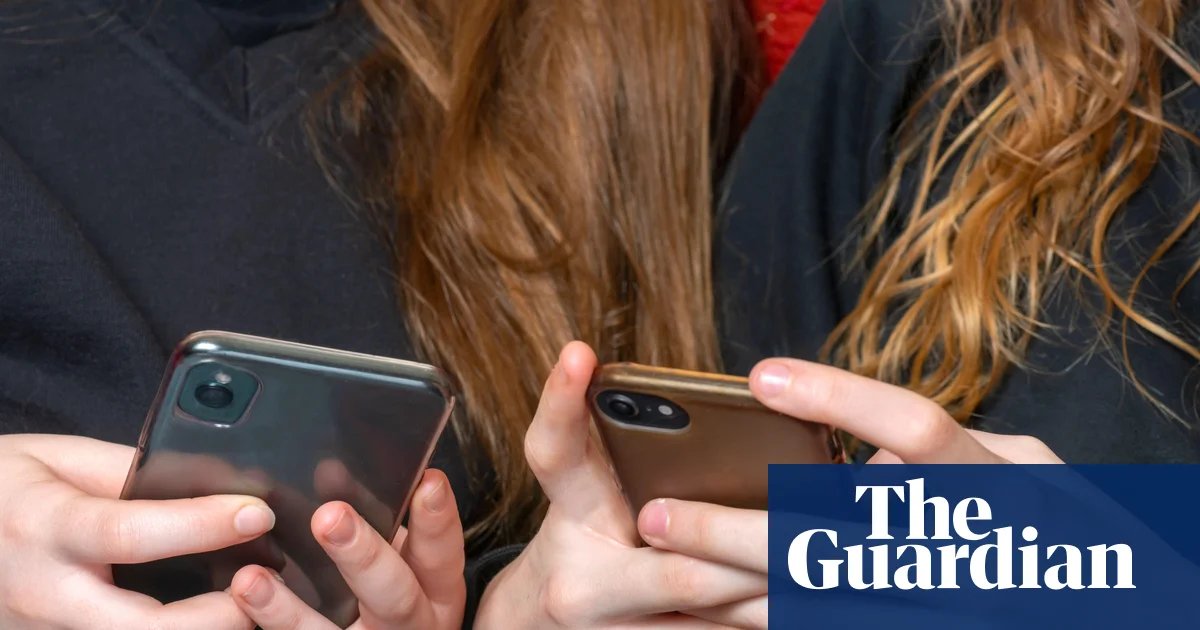
Change is coming for social media platforms. The UK government’s consultation on improving online safety for children will result in some form of action being taken against big tech. Even before the deadline for submissions has passed, ministers have pledged to introduce an Australia-style social media ban for under-16s or restrictions on “addictive” features such as infinite scrolling.
There is overwhelming pressure from safety campaigners and MPs for a further crackdown on social media platforms, despite the introduction of the Online Safety Act, which requires tech firms to shield children from harmful content. The deadline for contributions is Tuesday night and the government has promised to act swiftly.
Here is what some key contributors to the debate think should happen.
Ian Russell, 62, father of Molly Russell
Russell, a prominent online safety campaigner, wants action that “turns the tide on the tsunami of unacceptable and avoidable harm”. Russell’s 14-year-old daughter Molly took her own life after watching harmful content on Instagram and Pinterest.
He is not in favour of a blanket under-16s ban for major platforms, as in Australia, believing it would form a “cliff edge” that would expose teenagers to harmful content on unreformed platforms as soon as they are old enough. Last week he came out in support of a more nuanced approach where platforms that do not meet strict safety standards would be blocked to under-16s, with teenagers allowed to access “safe” apps.
Currently, most major platforms have a minimum age of 13 in the UK, a limit set, in effect, by the General Data Protection Regulation. There is no formal limit for social media.
Russell, the chair of the Molly Rose Foundation charity, has been critical of the pace of implementation of the Online Safety Act and wants it to be rebooted. On top of that, he wants a ban on aggressive algorithms that serve harmful content to teens, and targeting of app features such as infinite scrolling, push notifications and autoplay.
“This is an opportunity to go much further than a blanket ban, which would offer a false sense of safety to parents and quickly unravel,” he says.
Esther Ghey, 39, mother of Brianna Ghey
Ghey is in favour of a ban. Her daughter, Brianna, was murdered in 2023 and she believes social media addiction contributed to her daughter’s mental health issues, leading to her taking risks with her personal safety. Brianna, who was transgender, became isolated through heavy use of social media, and suffered from anxiety and body dysmorphia.
“I support raising the age of social media. At the moment, as it stands, social media represents a serious risk to under-16s,” she says.
Ghey, the founder of the Brianna Ghey Legacy Project, which promotes online safety education, also wants curbs on addictive features and more help for teens in navigating an online world.
“We cannot just take something away. So we need to make sure that we educate children in digital literacy so that when they enter the world of social media they have the emotional maturity to deal with it,” she says.
Fin, 17, sixth-form student
Fin finds the government’s proposals to restrict social media for under-16s “incredibly harsh”, particularly for young people who use those platforms to follow the news and stay connected with friends. “There’s a lot of ways they could have gone around it instead of just a complete blanket ban. There should be different levels of restrictions, but maybe that’s too complicated,” he says.
However, he believes the government should step in to regulate addictive designs such as infinite scrolling or autoplay. “People should be free to do what they want, but it also comes down to safety. You can’t just let someone drink themselves to death.”
While the government has “good intentions”, Fin feels many measures have not been properly considered. For example, he says the announcement of a statutory smartphone ban in schools in England does not consider how integrated phones and technology are into classrooms. “Nowadays, teachers are setting work to do online: Google Classroom, Microsoft Teams. I just feel there’s so much more nuance to the debate than what’s currently being put in.”
The consultation includes a survey for 10- to 21-year-olds. However, Fin says the online safety debate as a whole has been skewed towards adults’ desires. “I don’t blame them. It’s hard to interview kids. But I wish there was more of an acknowledgment that ‘we’ve only really spoken to adults’.”
British teenagers interviewed by NSPCC, 11-18
The NSPCC has run a series of focus groups about the consultation around the UK. One widely held view was that adults do not grasp the complexities and nuances of social media and smartphone use. One girl said: “I use my phone mainly for research and revision.”
Some focus group members felt that a ban would be punishing them instead of the social media companies that fail to enforce their own safety measures. Against that background, some called for a more “layered approach” to online safety where apps adopt safety measures that reflected users’ ages. As one said, they wanted gradual exposure to social media so that they can “have freedom and make mistakes”.
There was a lot of discussion about the behaviour of others, with some saying the blame should lie with users, not with platforms. Cyberbullying, catfishing, trolling and grooming were topics that appeared regularly in the groups. “Being chronically online can affect your mental and physical wellbeing,” said one.
There was also support for being able to control your own online experience, such as selecting the sort of content you want and who you interact with. “I quite like the environment I have on social media because I’ve made it safe for me and also my algorithm does feed me things that I really engage with,” said one girl.
Chi Onwurah, 61, MP
Onwurah is chair of the science, innovation and technology committee, which said last week that the “status quo is not acceptable” for online safety. Onwurah says the committee was not convinced by an Australia-style ban. Her own concerns about a ban, she says, were how to define what gets blocked and the “cliff edge” situation.
In Australia, where access to apps including Instagram and TikTok is restricted for under-16s, the criteria for age limitation of a service include if a service enables social interaction between two or more users and if it allows users to post material.
“I am not advocating for a ban personally but the committee is strongly of the view that the status quo is unacceptable,” Onwurah says. She would like to see restrictions on addictive features, tougher enforcement of the OSA and better provision of tech platform data to researchers so that the level of harm to teenagers can be gauged properly.
The committee is also calling for stricter age verification, so that fewer under-13s slip through the net, and regulation of digital advertising to prevent platforms from encouraging addictive behaviour.
Colm Gannon, 48, chief executive of the International Centre for Missing and Exploited Children Australia (ICMEC)
Gannon was on the advisory board for the trial of age assurance technology that was completed prior to Australia introducing the social media ban at the end of last year. He has more than 20 years of expertise in digital safety and child protection, and says the UK had started on a good footing with age checks on iPhones.
He says the UK government should not impose an outright ban on social media for under-16s as Australia has done. He says teens under 16 have been able to circumvent the ban in Australia and it has pushed them into an unmoderated environment without the parental controls and other limits on teen accounts that the platforms have put in place.
“Young people in this generation, the persons under the age of 16, have this ambition and the right to connect,” he says. “We need to set up safety parameters around that, so that we actually bring in a high level of trust and safety and to treat vulnerability as a high priority, create environments where they can safely engage in community practices that are moderated.”
As it stands with the ban, he says, Australia has created an environment where young people are still engaged on social media but they’re not talking to their parents about it, owing to fears that they are not supposed to be on those platforms.
“I don’t think it’s working in Australia and I’m continuing to talk to other governments and say to them: ‘This is not the golden recipe, this is not the template you should follow,’” he says.
Doniya Soni-Clark, 33, TechUK
Soni-Clark, an associate director at the UK tech industry trade group, which represents the major social media firms, says there is a “broad consensus” against a ban within TechUK’s membership, which includes platforms such as Spotify and Google. A key reason is defining what should be banned, with members concerned that just banning platforms because they operate in social media would be too punitive. Instead, the government should focus on features that are deemed unsafe.
“We are calling for universal standards for all platforms accessed by children, so if a particular feature is found to cause alarm, that is regulated across all platforms,” she says.
Meta, a big player in the sector as the owner of Facebook and Instagram, would like users’ ages to be confirmed when they set up their smartphone or buy an app, with Mark Zuckerberg’s company providing further age assurance once users open an account. Social media platforms can provide an age-appropriate experience, Meta argues.
Béjar, a former senior engineer and consultant at the Instagram and Facebook owner, was a witness at recent trials in the US that ruled Meta was liable for deliberately designing addictive products and had misled consumers about the safety of its platforms.
He argues that social media companies have “squandered all the trust we have given them”. He supports an under-16s ban for platforms that are unsafe and, similar to other campaigners, wants a set of standards introduced that apps must meet.
“My dream would be to say: ‘This is what safety means and if you don’t comply by this date, teens will not have access until you do,’” he says.
The family of Shaun Burton, say they are “devastated” by the loss.
Source link
Key events
In the opening half an hour against Cape Verde, Mikel Oyarzabal, the centre-forward, did not get a single touch.
Kyle Green gets in touch: “Your highlighting of Lalas and his absurdity is something that has prevented me from wanting to watch the coverage on Fox. While every channel has its pros and cons I just can’t.
“I’m 45 and probably the youngest of anyone who remembers him as a player instead of an opinionated insert insult here. As for the match this could be more competitive than it looks on paper Spain need a win the pressure is on them. Saudi Arabia could hold out for a draw and see what happens in their last match. “
News from the England camp, and it seems to be good news on Declan Rice.
“I’m ready and fit, raring to go. I was feeling a little bit of neural pain in my hamstring, which I was managing from after Christmas with Arsenal for a very long time. Obviously, not a lot of people would have known that. It was all behind-the-scenes stuff but it was a smart decision.
“In the end, that last 20 minutes is probably where you pick up the most, and it’s where you play a 70-minute match. But that last 20 is where you really feel your body going for it. And I think it was a smart decision because the last few days I felt really, really good.”
Alex Reid has penned today’s weekend special Football Daily.
Portugal v Uzbekistan on Tuesday enticingly pits the incredibly nice, incredibly 41-year-old-superstar-tolerant Roberto Martínez against Fabio Cannavaro, who’s won a Ballon d’Or as a player and the Chinese Super League as a coach. While the fixture following that game really does see the dream of Thomas Tuchel – in his first international job with England – taking on Queiroz, who is in charge of his ninth national side with Ghana.
The expected formations are 4-2-3-1 for Spain, and 5-3-2 for the Saudi Arabians.
The Saudi team features two Donis changes: Ali Lajami, a defender, and Nasser Al Dawsari, a midfielder, are preferred to Mohammed Abu Al Shamat and Mohamed Kanno. You may recall Salem Al Dawsari, the Saudi captain, as the man who scored the winner against Argentina.
An entertaining read, even for those of us who have just seen the clips.
In a conversation where his co-panelist is casually reminiscing about his days playing alongside Messi or exchanging shirts with Ronaldo Nazário at the World Cup, what exactly is Lalas going to talk about – coming on as a second-half substitute for Earnie Stewart in a friendly against Scotland in 1998? Helping the Kansas City Wizards finish last in the 1999 MLS Western Conference? Did Lalas enjoy an elite playing career? No. But does he do the background reading that could compensate for his relative lack of standing in a conversation with titans like Henry and Zlatan? Also no. But is he charming or funny or charismatic or otherwise magnetic on screen? Eh, no.
For the record, I once interviewed Alexi Lalas on the challenge of playing against Romario in the 1994 World Cup. He had this to say:
“He could kill you in so many different ways. If you remember from that World Cup, he scored so many types of goals. That ranged from solo adventures to an outside-of-the-right-foot half-volley off a corner kick. Romario was both the most difficult to play against and the best that I have faced.
“Roberto Baggio was doing his thing, but in terms of consistency and living up to the hype, he [Romario] was the best. As with all stars, there was a moment when the fans sit up in their seats, and that was a feeling I got with Romario. When it got close to him and the potential for his involvement in a play was there, everybody sat up in their seat. They knew that something spectacular would be happening.”
Saturday’s match reports here.
The Saudi Arabia coach, and Blackburn legend, Georgios Donis, spoke about the challenges facing his team: “Spain is not the same team when Yamal or Williams are on the bench.
“While they still have plenty of possession, they lack the individual one-on-one penetration when these two are missing. I’m not saying it’s a problem for Spain, but when those players are missing, they play in a different way. We saw this very clearly against Cape Verde.
“We are playing against one of the best teams in the world, and it’s very important that when you play against these kinds of teams, you should enjoy the experience and respect the opponent, but not too much.
“It is very hard for any team playing against Spain to have any time in possession. So what we must do is to be more in control of our movement and compact, and when the ball goes through the lines, be able to defend dynamically.
“It’s nice to see miracles in football, and we’ve seen favourites losing against underdogs. Of course, it’s great for Saudi football to have a great memory of the result against Argentina, but we aren’t drawing anything from that.
“I think we’ll feel more pressure in that [Cape Verde] game than we will against Spain.”
The Spain coach, Luis De La Fuente had this to say in his Saturday press conference: “This generation of footballers is highly competitive and really fired up… It’s going to be a completely different story,” he said at his pre-match press conference on Saturday. There is no drama or crisis. The bottom line is simply that we need to win tomorrow.”
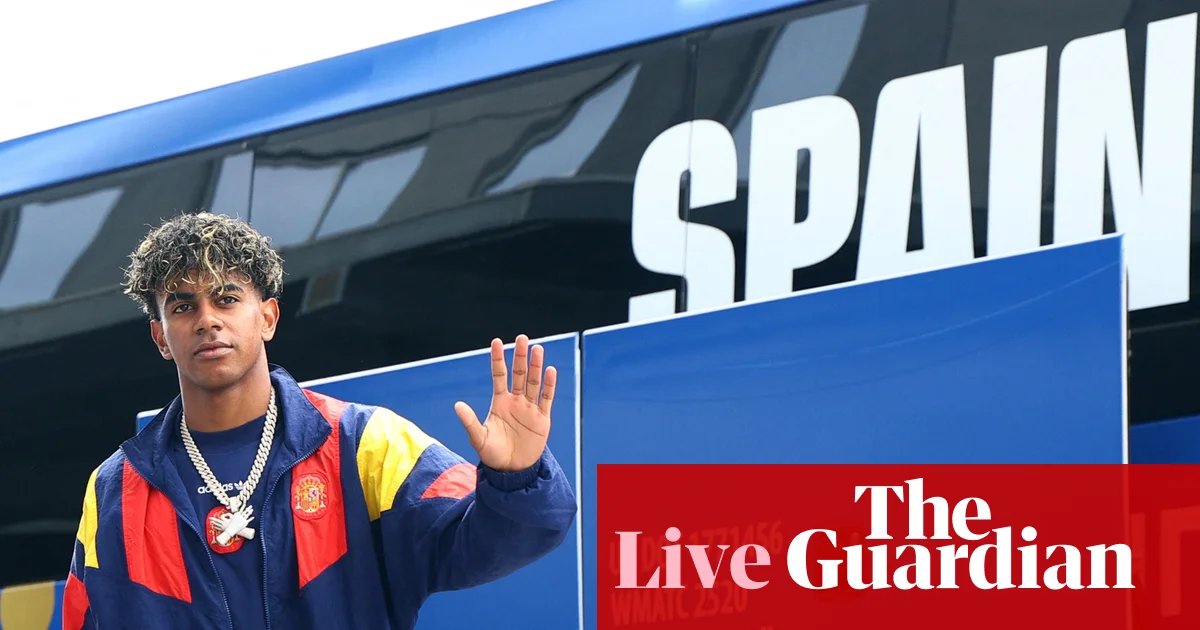
Four changes for Spain: Lamine Yamal, Pedro Porro, Dani Olmo and Alex Baena also come into the side with Marcos Llorente, Fabian Ruiz, Ferran Torres and Gavi dropping out.
The teams – Lamine Yamal starts
Spain: Simon, Porro, Cubarsi, Laporte, Cucurella, Gonzalez, Rodri, Yamal, Olmo, Baena, Oyarzabal. Subs: Raya, Joan Garcia, Pubill, Grimaldo, Eric Garcia, Llorente, Merino, Torres, Fabian, Gavi, Pino, Williams, Zubimendi, Munoz, Iglesias.
Saudi Arabia: Al Owais, Abdulhamid, Tambakti, Lajami, Al Amri, Al Harbi, Nasser Al Dawsari, Al Khaibari, Al Juwayr, Al Buraikan, Salem Al Dawsari. Subs: Al Aqidi, Al Kassar, Majrashi, Yahya, Al Shehri, Al Boushal, Kadesh, Al Johani, Al Ghannam, Al Hajji, Al Hamdan, Mandash, Kanno, Thakri, Abu Al Shamat.
Referee: Raphael Claus (Brazil)
Perhaps one of the Saudi -players can write themselves into this high-grade selection?
Perhaps it can be their goalkeeper.
Madrid screening of Spain v Saudi Arabia cancelled due to heat
The public screening of Spain’s World Cup match against Saudi Arabia in Madrid on Sunday has been cancelled because of extreme heat forecast for the Spanish capital, officials said.
The match, due to kick off at 6pm local time on Sunday, had been scheduled to be shown on a giant screen installed by the Spanish football federation (RFEF) at a fan zone in Plaza de Colón in central Madrid.
Madrid city council and the federation decided to cancel the screening after national weather agency AEMET issued an orange heat warning – the second-highest level – for the Madrid region, with temperatures forecast to reach 40C.
“The decision has been taken with the aim of protecting the health of attendees, event staff and support services involved in the event,” Madrid city hall said in a statement, apologising for any inconvenience.
Officials urged supporters to watch the match indoors in air-conditioned spaces and avoid prolonged exposure to the heat.
Large parts of Spain are experiencing unusually high temperatures for June as a mass of hot air from North Africa moves across the Iberian Peninsula.
A total of 13 of Spain’s 17 regions are on orange alert for heat on Sunday, while the northern Basque Country bordering France is on red alert, the highest level.
Authorities advised residents and visitors to take precautions during the heatwave, including drinking water regularly, staying in cool environments, limiting outdoor physical activity during the hottest hours of the day and taking extra care of vulnerable people. AFP
Can Saudi Arabia repeat the magic of 2022?
Argentina arrived in Qatar on a 36-game unbeaten run. When Lionel Messi opened the scoring from the penalty spot after 10 minutes, a comfortable afternoon seemed in the offing. Saleh al-Shehri and Salem al-Dawsari had other ideas, Argentina had three goals disallowed for offside in the space of 13 minutes and the greatest comeback in Saudi Arabia football history was made. Argentina went on to lift the trophy, while defeats to Poland and Mexico meant the Saudis did not reach the knock-out stage.
Unai Simon over David Raya is a controversial choice for De la Fuentes. The Arsenal keeper could lay claim to being Europe’s best this season.
“Those at the Champions League final had a few more days, so I got there on the Wednesday night,” Raya says. “I arrived a bit before Fabián [Ruiz]. I was saying hello to some of the others in reception when he arrived. I went to say congratulations; that was almost the first thing I did. I couldn’t really talk [to him] after the final; I just didn’t have it in me. The next day we talked about the game properly. Just two mates chatting … I was happy for him that he could lift the trophy for a second time.”
A high pressure game for the European champions, as Sid Lowe reports.
“If we had scored one, the game would have changed,” Martín Zubimendi said. Immediately after the game, De la Fuente had offered a simple analysis: when the ball doesn’t want to go in it doesn’t want to go in, he insisted. Spain had racked up 27 shots, after all. Ferran Torres had hit the bar and seen another clear opportunity saved. Vozinha, the 40-year-old goalkeeper who stopped that, saved six more and was named the man of the match. “There’s nothing to reproach the team for,” Rodri said. “We generated chances but couldn’t put it away; the good thing is they created almost nothing.”
We wait to see what role Lamine Yamal will play today. His coach would surely like to be able to use him.
The worst mistake we could make would be to compare him to anyone. He is the midst of a process. He has exceptional footballing maturity and lives it all with total naturalness. He has great serenity and strength. We have to let him follow his path but those players who have something different are ready for that. They’re geniuses, like Dalí [who] can paint a picture, or Michelangelo. They’re different. What is exceptional to us, isn’t to them. In those extremes, they feel comfortable. Why? Because they are different. What we think is exceptional, they consider normal.
Preamble
Spain’s campaign did not get off to a flying start, and Luis de la Fuentes may wake up in the night to visions of Cape Verde’s Vozinha. He will have Georgia on his mind ever since Monday. Saudi Arabia are no pushovers and gave Uruguay a scare in their opening match. Memories of downing Argentina four years ago still abound, and so Spain might beware. They can ill afford to go into the final game with Uruguay at a disadvantage. All eyes on Lamine Yamal, whose fitness situation remains opaque, though Spain need their other forwards to come to the party.
Kick-off 5pm UK, 1pm ET, 2am AEST. Join me.

A topless man can be seen driving erratically in Edinburgh before abandoning his car and attacking a black man and a delivery rider.
Source link



-

 Business & Technology3 weeks ago
HSBC UK & Visa test AI shopping with live payments
-

 Business & Technology3 weeks ago
Valarian lands USD $50 million backing for sovereign AI
-

 Oxford Events4 weeks ago
Henley Festival 2026 highlights: Five nights of unforgettable performances and festival moments
-

 Oxford united FC3 weeks ago
Oxford United three players who be kept after transfer ban
-

 Business & Technology4 weeks ago
ZYMIX uses Henley event to pitch social app to Gen Z
-

 Business & Technology2 weeks ago
Slice golf bar swings to new heights after successful launch
-

 Business & Technology3 weeks ago
UK AI firms raise record GBP £4.56bn in Q2 funding
-

 Oxford News3 weeks ago
Man jailed for ‘sickening’ sexual assault of three girls in Cotswolds