
UK News
Contingency plans in place for possible food shortages if Iran war continues, minister confirms – UK politics live | Politics

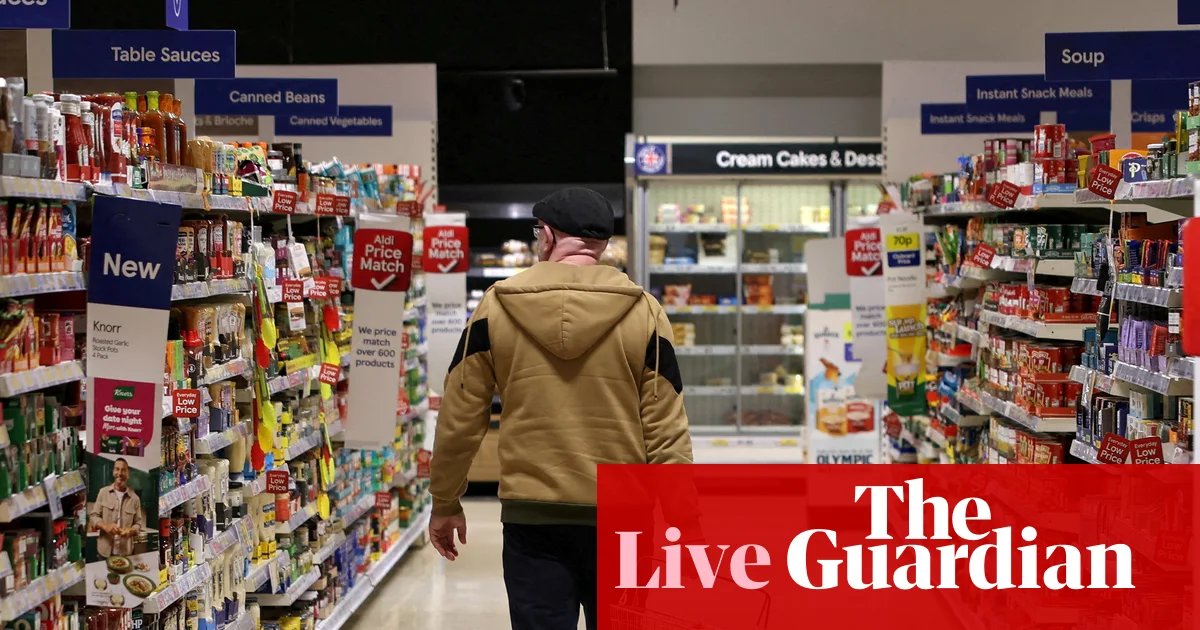
Contingency plans in place for possible food shortages if Iran war continues, Peter Kyle confirms
Good morning. ‘We don’t comment on leaks,’ is the usual government response to an unsanctioned lobby scoop. But this morning Peter Kyle, the business secretary, took a different response. Asked about a Times splash saying the government is making plans to deal with possible food shortages in the summer, caused by the Iran war, he told Sky News:
It is difficult for me, because, of course, these leaks are very unhelpful. But when people do read it, they need to be reassured that we are doing this kind of planning, and we are doing this kind of scenario planning.
Kyle contrasted his stance with Boris Johnson’s conduct in the early days of Covid, when the Tory PM “missed five Cobra meetings in the lead-up to it”.
The Times story, by Aubrey Allegretti, is not saying that the country is going to run out of food. But it does say that serious contingency planning is taking place, with an assumption that under a “reasonable worst-case scenario”, supermarkets might start running out of some items. Allegretti says:
Britain could face shortages of chicken, pork and other supermarket goods this summer if the war in Iran continues, a secret government analysis has found.
Officials have drawn up contingency plans for a “reasonable worst-case scenario” amid fears that the closure of the Strait of Hormuz will lead to shortages of carbon dioxide (CO2) which is critical to the food industry …
Farming and hospitality would likely be hit earliest and hardest, given CO2 is used to help increase the shelf life of food such as salad, packaged meats and baked goods.
CO2 is used in the process of slaughtering nearly all pigs and more than two thirds of chickens and the sector is not thought to have much by way of surplus supplies. While the government does have stockpiles, this was said to not be a long-term solution …
While there are not expected to be critical food supply shortages, officials expect there could be a lack of product variety in shops.
The “reasonable worst-case scenario” assumes that by June the strait of Hormuz is still closed, and there is no permanent peace deal. According to Allegretti’s story, officials are working on the basis that, in these circumstances, supplies of CO2 could fall to just 18 per cent of present levels. This could have consequences for healthcare and the energy sector, as well as the food industry. Allegretti says one plan involves possible emergency legislation being passed to require factorsies to maximise CO2 production.
In interviews this morning, Kyle did not dispute the story; instead he presented it as evidence of the government taking emergency planning seriously.
He told Times Radio:
I can tell you, because I’m in these meetings, the prime minister has been there since the very start, and he is going through personally and driving deep dives into lots of areas of resilience throughout our economy.
He said that at the start of the conflict he reversed the mothballing of the Ensus bio-ethanol plant in Teesside to secure supplies of carbon dioxide.
People should be reassured that we are doing this kind of action behind the scenes to keep resilience in our economy, so that when the full extent of what may or may not emerge, because this situation is still unfolding in the Middle East, you have a government that is acting with creativity and boldness.
Kyle told Sky News that supplies of CO2 were “not a concern” now.
He went on:
If any of these things change, I will be up front with the public about it in advance so that we can prepare. But right now, people should go on as they are, enjoying beer, enjoying their meats, enjoying all the salads.
But also there are critical uses for CO2 – MRI scanning, for example, water purification; it’s involved in our nuclear industry, our civil nuclear power industry, some defensive uses for it as well.
There’s lots of needs for CO2, so these are the reasons why I took it so seriously way back to six months ago, not just in the last few weeks.
Here is the agenda for the day.
Morning: Keir Starmer meets executives from tech companies including TikTok, X and Meta in Downing Street to discuss restricting social media for teenagers. Last night, for the second time, MPs rejected a proposal to ban under-16s from using social media.
9.30am: NHS England publishes its monthly performance figures.
10am: John Swinney, the SNP leader and Scotland’s first minister, launches the SNP manifesto for the Holyrood election.
Morning: Nigel Farage, the Reform UK leader, does a walkabout in South Wales Valleys town with the party’s Welsh leader, Dan Thomas.
11.30am: Downing Street holds a lobby briefing.
Noon: The Covid inquiry publishes its report on vaccines and therapeutics.
Afternoon (UK time): Rachel Reeves attends IMF meeting in Washington. She is also doing a huddle with reporters.
4pm: Kemi Badenoch, the Conservative leader, and Russell Findlay, the party’s leader in Scotland, attend a rally in Edinburgh.
I am afraid we are not able to open comments on the blog today because we do not moderators available; I am sorry about that.
If you want to to contact me, you can use social media. You can reach me on Bluesky at @andrewsparrowgdn.bsky.social. The Guardian has given up posting from its official accounts on X, but individual Guardian journalists are there, I still have my account, and if you message me there at @AndrewSparrow, I will see it and respond if necessary.
I find it very helpful when readers point out mistakes, even minor typos. No error is too small to correct. And I find your questions very interesting too. I can’t promise to reply to them all, but I will try to reply to as many as I can, either BTL or sometimes in the blog.
Key events
Swinney says SNP would set maximum prices for essential food items, using public health powers, on nutrition grounds
Swinney says people are struggling to afford food. That is an “outrage”, he says.
He cannot set prices at the till, he says.
But he says the Scottish government does have powers over public health. He goes on:
It is now impacting on our nation’s nutrition. That is a public health issue and I have public health powers, so I can answer today that, if re-elected, your SNP government will use our public health powers to set a maximum price for essential food items, reducing the price of the weekly shop, putting more money in people’s pockets.
Bread. Milk. Cheese. Eggs. Rice. Chicken. Everyday items that make up a decent diet. Necessities that no one should ever have beyond their means. That’s what you get with a government on Scotland side.
Swinney says SNP will cap all bus fares in Scotland at £2 if it wins
Swinney sums up some manifesto proposals already announced.
A re-elected SNP government will, for people trying to buy their first home, help you onto the property ladder with £10,000 towards your deposit.
For private renters, the right of first refusal to buy your home if it goes on sale for parents will intensify.
Scotland’s childcare revolution. Extending support over the next parliament to every child in the country from nine months old to the end of primary school all year round, and we will build on the success of the baby box with a new welcome to school bag.
Swinney says the Scottish government has already done a lot of concessionary travel, but it wants to go further, he says.
People need to be able to afford to get to the work, to go out and to see friends, to get out and about.
The cost of travelling from Hamilton, for example, to get here today by bus would cost more than £7. From Paisley it would cost £6. From Dumbarton it would cost £9.30. These costs are too high.
So I can announce today that if re-elected, an SNP government will cap bus fares at £2 in every part of Scotland.
Swinney says this is a manifesto for the whole of Scotland.
He confirms that the SNP would argue for the Scottish power to have more control over energy policy (still largely reserved to Westminter). He says:
The problem is not that we do not have the energy. The problem is that Westminster has the power. This election is our opportunity to take those powers and put them into Scotland’s hands.
Swinney confirms that he views a vote for the SNP as a vote to hold a referendum on independence.
That would be “a referendum that will allow Scotland to reclaim our place at the heart of Europe, and a referendum that I intend to win”, he says.
Swinney highlights his record as first minister, and says he’s ‘only just getting started’
John Swinney, the SNP leader and first minister, is speaking now.
He starts saying:
In the two years since becoming first minister, I’ve dedicated every single day to improving the lives of the people of Scotland.
When I took office, I promised I would deliver for Scotland falling waiting times, more operations, GP walk-in clinics, frozen rail fares, peak rail fares abolished, child poverty down and winter fuel payments restored. Friends, I keep my promises. That is my record. It’s a record I’m proud to take to the people of Scotland.
He goes on:
But make no mistake about it, I am only just getting started.
This is a reference to how Swinney was originally seen as a stopgap FM when he was chosen after the surprise resignation of Humza Yousaf.
SNP launches election manifesto
The SNP is launching its manifesto.
Jenny Gilruth, the Scottish government’s education secretary, is doing the warm-up speech for John Swinney. She says the party is fighting for a fifth successive election win.
She says Swinney stands “head and shoulders” above other candidates for first minnister.
Hospital waiting lists in England fall for fourth month in row, reaching lowest level since February 2023
The waiting list for routine hospital treatment in England has fallen for the fourth month in a row, the Press Association reports. PA says:
An estimated 7.22 million treatments were waiting to be carried out at the end of February, relating to 6.11 million patients.
This is down from 7.25 million treatments and 6.13 million patients at the end of January.
The number of treatments waiting to be carried out is at its lowest level since February 2023, when it stood at 7.22 million.
The list hit a record high in September 2023, with 7.77 million treatments and 6.50 million patients.
Government extends scheme to help firms in energy-intensive industries with fuel bills
Peter Kyle, the business secretary, was giving interviews this morning to promote a government announcement that will help companies in energy-intensive industries with fuel bills.
As the Department for Business and Trade says in a news release, the existing scheme – the British Industrial Competitiveness Scheme, or BICS – is being expanded. It says:
Automotive and aerospace, steel, and pharmaceuticals are among the sectors where eligible businesses are to benefit from a one-off additional payment in 2027. This will cover the support firms would have received if BICS had been in place from April 2026.
Eligibility has also been expanded by 40%, from 7,000 to over 10,000 businesses. This targets support at energy-intensive firms on the number one issue they face – high electricity costs.
From April 2027, eligible firms will see electricity bills cut by up to 25 percent. Households will see no increase in their bills as a result.
BICS will exempt eligible businesses from the indirect costs of three electricity schemes: the Renewables Obligation, Feed-in Tariffs, and the Capacity Market. This is worth around £35–£40 per MWh.
It is expected to be worth up to £600m per year from April 2027. Households and other businesses not benefiting will see no increase in their energy bills.
The government says sectors that could benefit “include automotive and aerospace, steel producers, metal fabricators, pharmaceutical and medical supplies companies, recycling businesses, plastic producers, nuclear fuel processors, and cooling and ventilation equipment manufacturers.”
Heather Stewart and Richard Partington have more on this announcement here.
Reform UK says it would tighten law to make prosecuting lawyers who help with bogus asylum claims easier
Reform UK has said that it would tighten the law to make it easier to prosecute lawyers and advisers who help people make bogus asylum claims.
Zia Yusuf, the party’s home affairs spokesperson, announced the proposals in response to a major BBC investigation illustrating the extent of fraud in the asylum advice industry.
A report yesterday, by Billy Kenber and Phil Kemp, said “migrants are falsely claiming to be victims of domestic abuse in order to stay in the country”. Today they have followed it up with a second report about how “migrants are falsely claiming to be victims of domestic abuse in order to stay in the country”.
In a response to the initial investigation, Shabana Mahmood, the home secretary, said:
Anyone abusing protections for people fleeing persecution over gender or sexual orientation is beyond contempt.
Let me be clear: try to defraud the British people to enter or remain in the UK and your asylum claim will be refused, your support cut off, and you will find yourself on a one-way flight out of Britain.
Sham lawyers facilitating this abuse will face the full force of the law.
Today Reform UK went further. Yusuf said:
A Reform UK government will put a stop to the legal-industrial complex exploiting the generosity of the British taxpayer. We will criminally prosecute unscrupulous immigration lawyers by creating a new strict liability offence. We will also end legal aid for illegal arrivals and visa overstayers. Those who break into our country will no longer get taxpayer funds to fight their removal.
Reform will ensure our borders are secured, illegal migrants deported and British taxpayers are no longer defrauded in this manner.
Explaining the proposed change, Reform UK said:
A Reform government will make facilitating a false asylum claim a ‘strict liability’ criminal offence. There will be no requirement to prove intent in prosecutions, and this serious crime will be punishable by up to 2 years in jail. Lawyers defrauding the British people in this way will not be tolerated. Similar duties already apply to law firms and lawyers to prevent bribery and tax evasion and it’s reasonable to also apply this to immigration law firms.
Swinney says it will legislate for smartphone ban in Scottish schools if it wins Holyrood election
The SNP is to bring in a national ban on smartphones in classes if it wins May’s Holyrood election, John Swinney has pledged. As the Press Association reports, the first minister and SNP leader insisted the devices were “a distraction from learning” pledging legislation after the election to ban them across Scotland. PA says:
Currently head teachers have the power to ban smartphones in their schools, with a number of councils in Scotland having acted.
However Swinney said that the SNP will now seek to “ensure a full national ban in Scotland’s classrooms”.
He told the Daily Record newspaper: “We have already taken action to empower headteachers to act but if re-elected we will legislate to deliver a full ban across Scotland.
“The SNP is on the side of schools and we will take every step necessary to ensure teaching in our classrooms is done without distraction.
“We have record levels of literacy and numeracy in our schools and this national ban will support pupils and teachers to build on that progress.”
UK economy showed surprise 0.5% growth before Iran war
UK GDP expanded by a stronger than expected 0.5% in February, official figures show, suggesting the economy was gaining momentum before the onset of war in the Middle East dashed hopes of recovery, Heather Stewart reports.
Contingency plans in place for possible food shortages if Iran war continues, Peter Kyle confirms
Good morning. ‘We don’t comment on leaks,’ is the usual government response to an unsanctioned lobby scoop. But this morning Peter Kyle, the business secretary, took a different response. Asked about a Times splash saying the government is making plans to deal with possible food shortages in the summer, caused by the Iran war, he told Sky News:
It is difficult for me, because, of course, these leaks are very unhelpful. But when people do read it, they need to be reassured that we are doing this kind of planning, and we are doing this kind of scenario planning.
Kyle contrasted his stance with Boris Johnson’s conduct in the early days of Covid, when the Tory PM “missed five Cobra meetings in the lead-up to it”.
The Times story, by Aubrey Allegretti, is not saying that the country is going to run out of food. But it does say that serious contingency planning is taking place, with an assumption that under a “reasonable worst-case scenario”, supermarkets might start running out of some items. Allegretti says:
Britain could face shortages of chicken, pork and other supermarket goods this summer if the war in Iran continues, a secret government analysis has found.
Officials have drawn up contingency plans for a “reasonable worst-case scenario” amid fears that the closure of the Strait of Hormuz will lead to shortages of carbon dioxide (CO2) which is critical to the food industry …
Farming and hospitality would likely be hit earliest and hardest, given CO2 is used to help increase the shelf life of food such as salad, packaged meats and baked goods.
CO2 is used in the process of slaughtering nearly all pigs and more than two thirds of chickens and the sector is not thought to have much by way of surplus supplies. While the government does have stockpiles, this was said to not be a long-term solution …
While there are not expected to be critical food supply shortages, officials expect there could be a lack of product variety in shops.
The “reasonable worst-case scenario” assumes that by June the strait of Hormuz is still closed, and there is no permanent peace deal. According to Allegretti’s story, officials are working on the basis that, in these circumstances, supplies of CO2 could fall to just 18 per cent of present levels. This could have consequences for healthcare and the energy sector, as well as the food industry. Allegretti says one plan involves possible emergency legislation being passed to require factorsies to maximise CO2 production.
In interviews this morning, Kyle did not dispute the story; instead he presented it as evidence of the government taking emergency planning seriously.
He told Times Radio:
I can tell you, because I’m in these meetings, the prime minister has been there since the very start, and he is going through personally and driving deep dives into lots of areas of resilience throughout our economy.
He said that at the start of the conflict he reversed the mothballing of the Ensus bio-ethanol plant in Teesside to secure supplies of carbon dioxide.
People should be reassured that we are doing this kind of action behind the scenes to keep resilience in our economy, so that when the full extent of what may or may not emerge, because this situation is still unfolding in the Middle East, you have a government that is acting with creativity and boldness.
Kyle told Sky News that supplies of CO2 were “not a concern” now.
He went on:
If any of these things change, I will be up front with the public about it in advance so that we can prepare. But right now, people should go on as they are, enjoying beer, enjoying their meats, enjoying all the salads.
But also there are critical uses for CO2 – MRI scanning, for example, water purification; it’s involved in our nuclear industry, our civil nuclear power industry, some defensive uses for it as well.
There’s lots of needs for CO2, so these are the reasons why I took it so seriously way back to six months ago, not just in the last few weeks.
Here is the agenda for the day.
Morning: Keir Starmer meets executives from tech companies including TikTok, X and Meta in Downing Street to discuss restricting social media for teenagers. Last night, for the second time, MPs rejected a proposal to ban under-16s from using social media.
9.30am: NHS England publishes its monthly performance figures.
10am: John Swinney, the SNP leader and Scotland’s first minister, launches the SNP manifesto for the Holyrood election.
Morning: Nigel Farage, the Reform UK leader, does a walkabout in South Wales Valleys town with the party’s Welsh leader, Dan Thomas.
11.30am: Downing Street holds a lobby briefing.
Noon: The Covid inquiry publishes its report on vaccines and therapeutics.
Afternoon (UK time): Rachel Reeves attends IMF meeting in Washington. She is also doing a huddle with reporters.
4pm: Kemi Badenoch, the Conservative leader, and Russell Findlay, the party’s leader in Scotland, attend a rally in Edinburgh.
I am afraid we are not able to open comments on the blog today because we do not moderators available; I am sorry about that.
If you want to to contact me, you can use social media. You can reach me on Bluesky at @andrewsparrowgdn.bsky.social. The Guardian has given up posting from its official accounts on X, but individual Guardian journalists are there, I still have my account, and if you message me there at @AndrewSparrow, I will see it and respond if necessary.
I find it very helpful when readers point out mistakes, even minor typos. No error is too small to correct. And I find your questions very interesting too. I can’t promise to reply to them all, but I will try to reply to as many as I can, either BTL or sometimes in the blog.
The family of Shaun Burton, say they are “devastated” by the loss.
Source link

Key events
In the opening half an hour against Cape Verde, Mikel Oyarzabal, the centre-forward, did not get a single touch.
Kyle Green gets in touch: “Your highlighting of Lalas and his absurdity is something that has prevented me from wanting to watch the coverage on Fox. While every channel has its pros and cons I just can’t.
“I’m 45 and probably the youngest of anyone who remembers him as a player instead of an opinionated insert insult here. As for the match this could be more competitive than it looks on paper Spain need a win the pressure is on them. Saudi Arabia could hold out for a draw and see what happens in their last match. “
News from the England camp, and it seems to be good news on Declan Rice.
“I’m ready and fit, raring to go. I was feeling a little bit of neural pain in my hamstring, which I was managing from after Christmas with Arsenal for a very long time. Obviously, not a lot of people would have known that. It was all behind-the-scenes stuff but it was a smart decision.
“In the end, that last 20 minutes is probably where you pick up the most, and it’s where you play a 70-minute match. But that last 20 is where you really feel your body going for it. And I think it was a smart decision because the last few days I felt really, really good.”
Alex Reid has penned today’s weekend special Football Daily.
Portugal v Uzbekistan on Tuesday enticingly pits the incredibly nice, incredibly 41-year-old-superstar-tolerant Roberto Martínez against Fabio Cannavaro, who’s won a Ballon d’Or as a player and the Chinese Super League as a coach. While the fixture following that game really does see the dream of Thomas Tuchel – in his first international job with England – taking on Queiroz, who is in charge of his ninth national side with Ghana.
The expected formations are 4-2-3-1 for Spain, and 5-3-2 for the Saudi Arabians.
The Saudi team features two Donis changes: Ali Lajami, a defender, and Nasser Al Dawsari, a midfielder, are preferred to Mohammed Abu Al Shamat and Mohamed Kanno. You may recall Salem Al Dawsari, the Saudi captain, as the man who scored the winner against Argentina.
An entertaining read, even for those of us who have just seen the clips.
In a conversation where his co-panelist is casually reminiscing about his days playing alongside Messi or exchanging shirts with Ronaldo Nazário at the World Cup, what exactly is Lalas going to talk about – coming on as a second-half substitute for Earnie Stewart in a friendly against Scotland in 1998? Helping the Kansas City Wizards finish last in the 1999 MLS Western Conference? Did Lalas enjoy an elite playing career? No. But does he do the background reading that could compensate for his relative lack of standing in a conversation with titans like Henry and Zlatan? Also no. But is he charming or funny or charismatic or otherwise magnetic on screen? Eh, no.
For the record, I once interviewed Alexi Lalas on the challenge of playing against Romario in the 1994 World Cup. He had this to say:
“He could kill you in so many different ways. If you remember from that World Cup, he scored so many types of goals. That ranged from solo adventures to an outside-of-the-right-foot half-volley off a corner kick. Romario was both the most difficult to play against and the best that I have faced.
“Roberto Baggio was doing his thing, but in terms of consistency and living up to the hype, he [Romario] was the best. As with all stars, there was a moment when the fans sit up in their seats, and that was a feeling I got with Romario. When it got close to him and the potential for his involvement in a play was there, everybody sat up in their seat. They knew that something spectacular would be happening.”
Saturday’s match reports here.
The Saudi Arabia coach, and Blackburn legend, Georgios Donis, spoke about the challenges facing his team: “Spain is not the same team when Yamal or Williams are on the bench.
“While they still have plenty of possession, they lack the individual one-on-one penetration when these two are missing. I’m not saying it’s a problem for Spain, but when those players are missing, they play in a different way. We saw this very clearly against Cape Verde.
“We are playing against one of the best teams in the world, and it’s very important that when you play against these kinds of teams, you should enjoy the experience and respect the opponent, but not too much.
“It is very hard for any team playing against Spain to have any time in possession. So what we must do is to be more in control of our movement and compact, and when the ball goes through the lines, be able to defend dynamically.
“It’s nice to see miracles in football, and we’ve seen favourites losing against underdogs. Of course, it’s great for Saudi football to have a great memory of the result against Argentina, but we aren’t drawing anything from that.
“I think we’ll feel more pressure in that [Cape Verde] game than we will against Spain.”
The Spain coach, Luis De La Fuente had this to say in his Saturday press conference: “This generation of footballers is highly competitive and really fired up… It’s going to be a completely different story,” he said at his pre-match press conference on Saturday. There is no drama or crisis. The bottom line is simply that we need to win tomorrow.”
Four changes for Spain: Lamine Yamal, Pedro Porro, Dani Olmo and Alex Baena also come into the side with Marcos Llorente, Fabian Ruiz, Ferran Torres and Gavi dropping out.
The teams – Lamine Yamal starts
Spain: Simon, Porro, Cubarsi, Laporte, Cucurella, Gonzalez, Rodri, Yamal, Olmo, Baena, Oyarzabal. Subs: Raya, Joan Garcia, Pubill, Grimaldo, Eric Garcia, Llorente, Merino, Torres, Fabian, Gavi, Pino, Williams, Zubimendi, Munoz, Iglesias.
Saudi Arabia: Al Owais, Abdulhamid, Tambakti, Lajami, Al Amri, Al Harbi, Nasser Al Dawsari, Al Khaibari, Al Juwayr, Al Buraikan, Salem Al Dawsari. Subs: Al Aqidi, Al Kassar, Majrashi, Yahya, Al Shehri, Al Boushal, Kadesh, Al Johani, Al Ghannam, Al Hajji, Al Hamdan, Mandash, Kanno, Thakri, Abu Al Shamat.
Referee: Raphael Claus (Brazil)
Perhaps one of the Saudi -players can write themselves into this high-grade selection?
Perhaps it can be their goalkeeper.
Madrid screening of Spain v Saudi Arabia cancelled due to heat
The public screening of Spain’s World Cup match against Saudi Arabia in Madrid on Sunday has been cancelled because of extreme heat forecast for the Spanish capital, officials said.
The match, due to kick off at 6pm local time on Sunday, had been scheduled to be shown on a giant screen installed by the Spanish football federation (RFEF) at a fan zone in Plaza de Colón in central Madrid.
Madrid city council and the federation decided to cancel the screening after national weather agency AEMET issued an orange heat warning – the second-highest level – for the Madrid region, with temperatures forecast to reach 40C.
“The decision has been taken with the aim of protecting the health of attendees, event staff and support services involved in the event,” Madrid city hall said in a statement, apologising for any inconvenience.
Officials urged supporters to watch the match indoors in air-conditioned spaces and avoid prolonged exposure to the heat.
Large parts of Spain are experiencing unusually high temperatures for June as a mass of hot air from North Africa moves across the Iberian Peninsula.
A total of 13 of Spain’s 17 regions are on orange alert for heat on Sunday, while the northern Basque Country bordering France is on red alert, the highest level.
Authorities advised residents and visitors to take precautions during the heatwave, including drinking water regularly, staying in cool environments, limiting outdoor physical activity during the hottest hours of the day and taking extra care of vulnerable people. AFP
Can Saudi Arabia repeat the magic of 2022?
Argentina arrived in Qatar on a 36-game unbeaten run. When Lionel Messi opened the scoring from the penalty spot after 10 minutes, a comfortable afternoon seemed in the offing. Saleh al-Shehri and Salem al-Dawsari had other ideas, Argentina had three goals disallowed for offside in the space of 13 minutes and the greatest comeback in Saudi Arabia football history was made. Argentina went on to lift the trophy, while defeats to Poland and Mexico meant the Saudis did not reach the knock-out stage.
Unai Simon over David Raya is a controversial choice for De la Fuentes. The Arsenal keeper could lay claim to being Europe’s best this season.
“Those at the Champions League final had a few more days, so I got there on the Wednesday night,” Raya says. “I arrived a bit before Fabián [Ruiz]. I was saying hello to some of the others in reception when he arrived. I went to say congratulations; that was almost the first thing I did. I couldn’t really talk [to him] after the final; I just didn’t have it in me. The next day we talked about the game properly. Just two mates chatting … I was happy for him that he could lift the trophy for a second time.”
A high pressure game for the European champions, as Sid Lowe reports.
“If we had scored one, the game would have changed,” Martín Zubimendi said. Immediately after the game, De la Fuente had offered a simple analysis: when the ball doesn’t want to go in it doesn’t want to go in, he insisted. Spain had racked up 27 shots, after all. Ferran Torres had hit the bar and seen another clear opportunity saved. Vozinha, the 40-year-old goalkeeper who stopped that, saved six more and was named the man of the match. “There’s nothing to reproach the team for,” Rodri said. “We generated chances but couldn’t put it away; the good thing is they created almost nothing.”
We wait to see what role Lamine Yamal will play today. His coach would surely like to be able to use him.
The worst mistake we could make would be to compare him to anyone. He is the midst of a process. He has exceptional footballing maturity and lives it all with total naturalness. He has great serenity and strength. We have to let him follow his path but those players who have something different are ready for that. They’re geniuses, like Dalí [who] can paint a picture, or Michelangelo. They’re different. What is exceptional to us, isn’t to them. In those extremes, they feel comfortable. Why? Because they are different. What we think is exceptional, they consider normal.
Preamble
Spain’s campaign did not get off to a flying start, and Luis de la Fuentes may wake up in the night to visions of Cape Verde’s Vozinha. He will have Georgia on his mind ever since Monday. Saudi Arabia are no pushovers and gave Uruguay a scare in their opening match. Memories of downing Argentina four years ago still abound, and so Spain might beware. They can ill afford to go into the final game with Uruguay at a disadvantage. All eyes on Lamine Yamal, whose fitness situation remains opaque, though Spain need their other forwards to come to the party.
Kick-off 5pm UK, 1pm ET, 2am AEST. Join me.

A topless man can be seen driving erratically in Edinburgh before abandoning his car and attacking a black man and a delivery rider.
Source link



-

 Oxford University4 weeks ago
New to the Oxford English Dictionary this September
-

 Oxford united FC4 weeks ago
Chris Gunter steps away Wales role to focus on Oxford United
-

 Oxford united FC2 weeks ago
LIVE: Exeter City vs Oxford United – Jersey Mike's Trophy group stage
-

 Traffic & Transport2 weeks ago
Why should I have to pay more for buses if I don’t use a smartphone? | Bus fares
-
 Traffic & Transport3 weeks ago
How poor public transport policy is putting the brake on cities | Road transport
-
 Student Life3 weeks ago
Oxford partnership allows OpenAI to use rare Bodleian texts to train ChatGPT
-

 Oxford united FC2 weeks ago
Oxford United lose to Exeter City on penalties in Jersey Mike’s Trophy
-

 Oxford united FC3 weeks ago
Northern Ireland fans laud Oxford United defender Ciaron Brown